
The coolant system in heavy truck engines is a pressurized thermal management circuit that absorbs combustion heat, dissipates it through the radiator, lubricates internal components, and prevents corrosion across the engine block and cylinder heads. Without a functioning cooling circuit, a Class 8 diesel engine generating temperatures that exceed 2,000°C at combustion would destroy itself within minutes. The role of coolant system heavy truck engines play goes far beyond simply keeping temperatures down. It is an active, interdependent partner to every major engine system, from the turbocharger to the EGR cooler. Understanding how it works, where it fails, and how to maintain it is the difference between a truck that runs 800,000 miles and one that grenades a block at 300,000.
How does the coolant system work in heavy truck engines?
Heavy truck cooling systems operate as closed-loop circuits driven by a belt-driven or gear-driven water pump. Coolant flows from the pump through the engine block and cylinder heads, absorbing heat generated by combustion. It then travels to the radiator, where airflow strips that heat away before the cooled fluid cycles back to the pump and starts again.
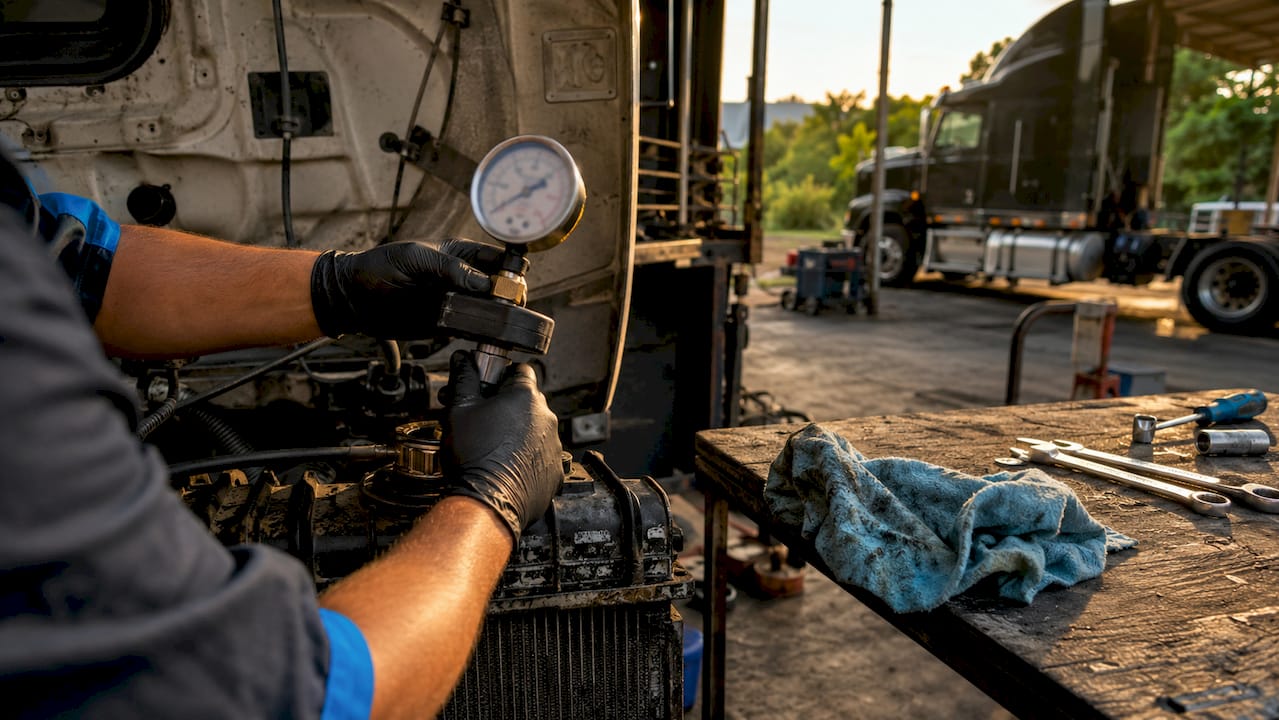
The system runs under 15 to 20 PSI of pressure, which raises the boiling point of the coolant and keeps operating temperatures stable between 180°F and 220°F. Coolant circulates at 30 to 60 gallons per minute depending on engine displacement. That flow rate matters because insufficient circulation, even briefly, allows hot spots to form around cylinder walls and valve seats.
The thermostat controls when coolant enters the radiator. At cold start, it stays closed to help the engine reach operating temperature faster. Once the engine hits its target range, the thermostat opens and full circulation begins. A stuck-closed thermostat causes rapid overheating. A stuck-open thermostat prevents the engine from reaching efficient operating temperature, increasing fuel consumption and wear.
Heavy-duty coolant formulations do something automotive coolants cannot. They lubricate the water pump and prevent cavitation damage inside wet cylinder liners. Cavitation occurs when vapor bubbles form and collapse against metal surfaces, pitting the liner walls from the inside. Standard green antifreeze lacks the anti-cavitation additives required to stop this process in diesel engines.
Pro Tip: Always verify that your coolant meets the OEM specification for your engine platform. Cummins, Detroit Diesel, and Mack each publish approved coolant lists. Using a mismatched formulation voids the protection the system was designed to provide.
- The water pump drives circulation and must maintain consistent pressure and flow
- The thermostat regulates temperature by controlling radiator bypass
- The radiator dissipates heat through airflow across the core
- Coolant additives protect metal surfaces, prevent scale, and stop cavitation
- Hoses and clamps maintain system pressure integrity under thermal cycling
What are the common failure modes in heavy truck cooling systems?
Heavy truck cooling systems fail in predictable patterns. Knowing the five most common failure modes lets you catch problems during a scheduled inspection rather than on the side of a highway.
-
Water pump failure. Water pump failure is the most common cooling system failure in Class 8 trucks. Replacement costs $600 to $1,200. Ignoring the warning signs leads to emergency repairs that routinely exceed $7,000.
-
Coolant additive depletion. As inhibitors deplete, corrosion and scale build up inside the block and radiator passages. Restricted flow raises operating temperatures and accelerates wear on every component downstream.
-
Radiator core clogging. Road debris, insects, and scale deposits reduce airflow through the radiator core. A partially blocked core can drop heat rejection capacity by 20 to 30 percent before any warning light triggers.
-
Hose collapse. Lower radiator hoses soften with age and can collapse under the suction created by the water pump at high RPM. Squeezing hoses to detect softness or cracking is a two-second check that prevents intermittent overheating on long grades.
-
Pressure cap failure. A cap that no longer holds rated pressure allows the coolant to boil at lower temperatures, creating vapor pockets that interrupt flow and cause localized overheating.
Pro Tip: Pressure test the cooling system to its rated PSI every time you do a coolant flush. A system that cannot hold pressure has a leak, a bad cap, or a compromised head gasket. Finding that during a scheduled service costs far less than finding it on a mountain pass.
| Failure Mode | Symptom | Diagnostic Method |
|---|---|---|
| Water pump failure | Coolant leak at pump weep hole, overheating | Visual inspection, flow test |
| Additive depletion | Corrosion, scale deposits, rising temps | Coolant chemistry test strip or lab analysis |
| Radiator clogging | Elevated coolant temperature at highway speed | Infrared scan, airflow check |
| Hose collapse | Intermittent overheating under load | Squeeze test, visual inspection |
| Pressure cap failure | Coolant loss, boilover | Pressure cap tester |
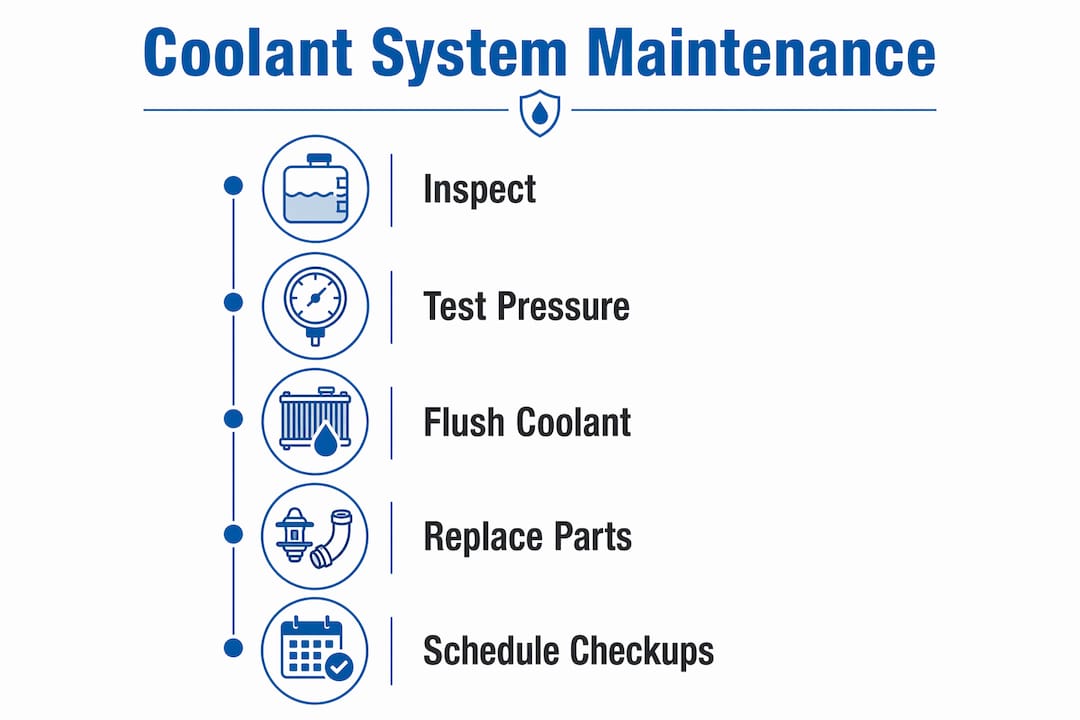
Coolant chemistry and system pressure directly determine fuel efficiency and engine health. Neglecting either accelerates every failure mode on this list simultaneously.
How do severe vocational conditions accelerate cooling system failures?
Vocational trucks operating in construction, refuse, logging, and municipal service face cooling demands that long-haul trucks rarely encounter. The combination of low road speed, heavy payload, and continuous PTO use creates conditions where the cooling system operates near its thermal limit for hours at a time.
Severe vocational conditions create a perfect storm for coolant system failures. Low airflow at slow speeds reduces the radiator's ability to shed heat. High idle and PTO operation add thermal load without the ram air benefit of highway driving. Heavy payloads increase combustion temperatures and extend the time the engine spends at peak output.
The consequences of cooling failure in these environments cascade quickly. An overheated engine damages the turbocharger oil seals, warps cylinder heads, and can crack the EGR cooler. Each of those repairs runs into thousands of dollars and takes the truck out of service for days.
- Dust and debris from job sites pack into radiator fins, cutting airflow by 30 percent or more within a single shift
- High idle periods at construction sites keep coolant temperatures elevated without the airflow that highway speed provides
- PTO-driven equipment like concrete mixers and dump bodies add consistent thermal load that standard cooling systems were not sized to handle indefinitely
- Frequent stop-and-go cycles prevent the thermostat from stabilizing, causing temperature swings that fatigue hoses and clamps faster than steady-state operation
Operators running vocational cycles should inspect radiator fins weekly during summer months and consider upgrading to a heavy-duty radiator with higher core density if the truck runs more than 60 percent of its hours in low-speed, high-load conditions.
What are the recommended maintenance intervals for heavy truck coolant systems?
Structured maintenance is the only reliable defense against cooling system failure. The intervals below reflect current best practices for Class 8 diesel engines running extended-life coolant formulations.
Extended-life coolant should be flushed every 250,000 to 500,000 miles or every two to four years, whichever comes first. Coolant chemistry testing should occur every 25,000 miles to confirm that corrosion inhibitors remain within specification. A full cooling system service, including flush and pressure test, takes about two hours and costs $250 to $450. That is a straightforward investment against engine damage.
| Service Task | Interval | Estimated Cost |
|---|---|---|
| Coolant chemistry test | Every 25,000 miles | $20 to $50 |
| Full coolant flush and refill | Every 250,000 to 500,000 miles or 2 to 4 years | $250 to $450 |
| Water pump replacement | Every 60,000 to 90,000 miles | $600 to $1,200 |
| Hose and clamp inspection | Every 50,000 miles or annually | Minimal labor |
| Pressure test | With every flush | Included in flush service |
| Radiator fin cleaning | Every 25,000 miles or seasonally | $50 to $150 |
A pre-summer coolant audit under $400 can prevent catastrophic repairs costing $4,000 to $14,000. That math is not complicated. Two hours of scheduled service versus a week of downtime and a five-figure repair bill.
- Use a 50/50 mix of approved extended-life coolant and distilled water. Tap water introduces minerals that accelerate scale buildup inside the block
- Never mix coolant types. Green conventional, orange OAT, and pink NOAT formulations have incompatible inhibitor chemistries that react and form gel deposits
- Replace the water pump at the lower end of the recommended interval if the truck runs vocational cycles. The 60,000-mile mark is the right target for severe-duty applications
- Log every coolant service with date, mileage, and chemistry test results. That record is your early warning system for a system trending toward failure
Pro Tip: Schedule your coolant system audit in April or May, before summer heat loads arrive. Catching a marginal water pump or a partially clogged radiator in spring costs a fraction of what it costs when the truck overheats in July with a full load.
Key takeaways
The coolant system is the primary defense against catastrophic engine failure in heavy trucks, and structured maintenance at defined intervals is the only reliable way to keep it functioning.
| Point | Details |
|---|---|
| Active thermal management | The cooling circuit manages combustion heat exceeding 2,000°C, not just ambient temperature. |
| Specialized coolant required | Heavy-duty formulations prevent cavitation in wet cylinder liners; automotive coolants cannot. |
| Water pump is the weak link | Replace every 60,000 to 90,000 miles to avoid failures that cost over $7,000 to repair. |
| Vocational conditions accelerate failure | Low speed, PTO use, and heavy loads push cooling systems to their thermal limits daily. |
| Pre-season audits pay for themselves | A $400 spring service prevents $4,000 to $14,000 in summer breakdown repairs. |
Why most fleets underestimate their cooling system until it's too late
I have seen fleet managers invest heavily in engine rebuilds, transmission overhauls, and tire programs, then lose a perfectly good motor because nobody checked the coolant chemistry in three years. The cooling system does not announce its decline loudly. It degrades quietly, through additive depletion, slow scale buildup, and a water pump impeller that is eroding from the inside out due to cavitation. By the time the temperature gauge climbs, the damage is already done.
The insight that changed how I think about this is the distinction between cooling and thermal management. A cooling system does not just remove heat. It holds the engine in a precise temperature window where combustion efficiency, oil viscosity, and metal expansion tolerances all align. Run too cold and fuel economy drops. Run too hot and you are trading cylinder head gaskets and turbo seals for the privilege.
What I recommend to every fleet maintenance professional is a simple rule: treat the coolant system audit as a pre-season event, not a reactive one. Run your chemistry test in April. Squeeze every lower radiator hose. Pressure test the system to its rated PSI. If the water pump is within 10,000 miles of its replacement window and summer is coming, replace it now. The cost difference between a planned replacement and an emergency roadside failure is not just dollars. It is driver safety, customer commitments, and the kind of downtime that damages relationships.
The Nationwideheavytruckparts blog covers these maintenance topics in depth if you want to go further on specific engine platforms and their cooling system quirks.
— Carl
Find quality heavy truck engine and cooling system parts
When a cooling system failure does take out an engine, the priority is getting back on the road with a reliable replacement at a price that makes sense for the operation.
Nationwideheavytruckparts stocks a daily-changing inventory of tested and inspected commercial truck engines from platforms including Cummins, Mack, Detroit Diesel, and Caterpillar. Every engine ships with a standard warranty and same-day shipping is available on most units. Whether you need a Detroit Diesel engine for a vocational fleet or a Cummins replacement for a long-haul operation, Nationwideheavytruckparts has the inventory and the technical knowledge to match you with the right unit fast. Contact the team directly to check current stock and get a quote.
FAQ
What does the coolant system do in a heavy truck engine?
The coolant system circulates pressurized fluid through the engine block and radiator to absorb combustion heat, maintain operating temperatures between 180°F and 220°F, lubricate the water pump, and prevent corrosion inside the engine.
How often should coolant be flushed in a Class 8 truck?
Extended-life coolant should be flushed every 250,000 to 500,000 miles or every two to four years, with chemistry testing every 25,000 miles to confirm inhibitor levels remain effective.
What happens when the coolant system fails in a heavy truck?
Coolant system failure causes rapid overheating that warps cylinder heads, damages turbocharger seals, cracks EGR coolers, and can destroy the engine block, with repair costs ranging from $4,000 to over $14,000.
Can I use regular automotive coolant in a heavy truck diesel engine?
Standard automotive coolants lack the anti-cavitation additives required to protect wet cylinder liners in diesel engines. Using the wrong formulation causes hidden pitting damage that leads to engine failure over time.
How do I know if my water pump needs replacement?
Replace the water pump every 60,000 to 90,000 miles as a scheduled service. Signs of imminent failure include coolant leaking from the weep hole, bearing noise, and rising coolant temperatures during normal operation.