
Diesel engine oil consumption is defined as the measurable rate at which a diesel engine uses oil through combustion, evaporation, and leakage during normal operation. Every diesel engine consumes some oil by design, because a thin film of oil must coat cylinder walls, piston rings, and valve stems to prevent metal-on-metal contact. The question is never whether your engine uses oil. The question is how much. Normal consumption ranges from 1 quart per 1,000 to 3,000 miles, and anything beyond that threshold points to a mechanical problem that will cost you more to ignore than to fix.
How diesel engine oil consumption works: rates and mechanisms
Oil consumption in diesel engines follows three distinct pathways: combustion burn-off, evaporation, and external leakage. Burn-off is the most common. A thin oil film on cylinder walls enters the combustion chamber with each power stroke and burns along with the fuel charge. This is not a defect. It is how diesel engine lubrication functions by design.
Diesel engines consume oil naturally as a thin film for lubrication, heat dissipation, and contaminant suspension. The key distinction is stability. A steady, low consumption rate is normal. A rising rate signals mechanical integrity issues that require immediate attention.
| Engine type | Normal consumption rate | Warning threshold |
|---|---|---|
| Light-duty diesel under 100,000 miles | 1 quart per 2,500 to 3,000 miles | Over 1 quart per 750 miles |
| Heavy-duty diesel under severe load | 1 quart per 1,000 to 1,500 miles | Over 1 quart per 750 miles |
| Any diesel (fuel-based measure) | 300 to 500 ml per 1,000 km | Over 2 liters per 100 liters of fuel burned |
The critical warning threshold is 2 liters per 100 liters of diesel fuel burned, which indicates urgent repair is required. That benchmark gives fleet managers and mechanics a fuel-normalized way to track consumption across different duty cycles and engine sizes.
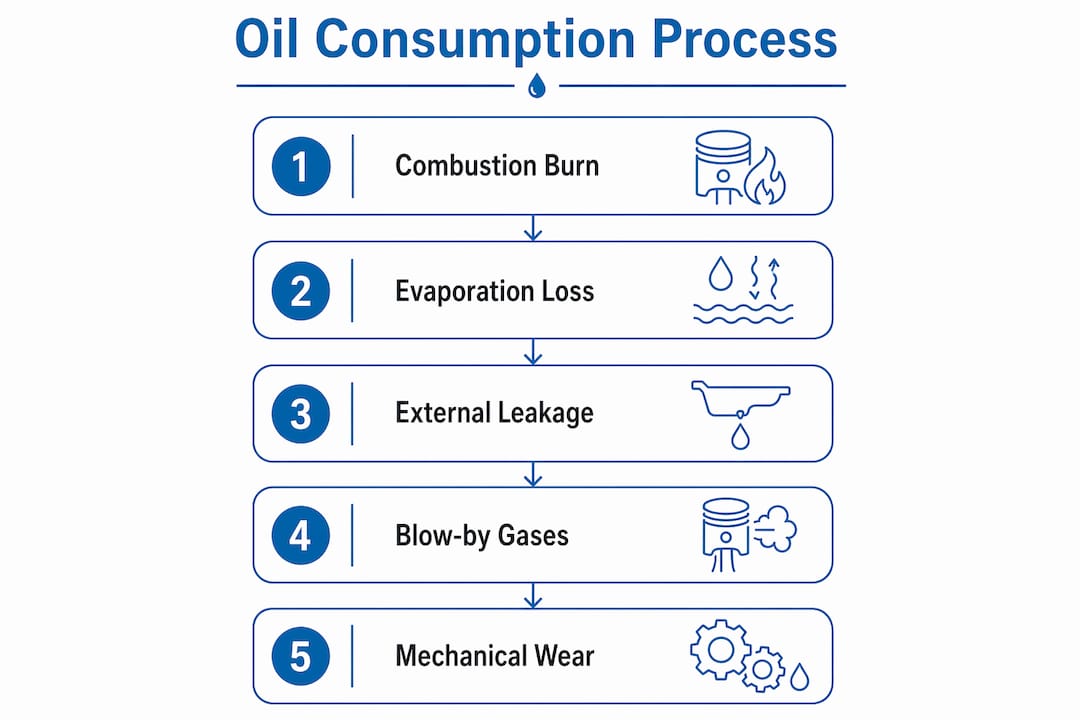
Blow-by gases also contribute to oil usage. When combustion gases slip past piston rings and enter the crankcase, they carry oil mist with them. That mist gets routed back through the intake via the crankcase ventilation system and burned in the next combustion cycle. On a healthy engine, this amount is negligible. On a worn engine, it becomes a significant source of oil loss.
Pro Tip: Track your oil consumption in quarts per 1,000 miles, not just "how often you add oil." Consistent measurement over five or six fill intervals gives you a trend line, and that trend line tells you far more than any single reading.
What causes increased oil consumption in diesel engines?
Most abnormal oil consumption in diesel engines traces back to one of six mechanical failures. Understanding each one helps you diagnose the problem before it cascades into a full engine rebuild.
-
Worn or stuck piston rings. Piston rings and valve stem seal wear cause oil to enter the combustion chamber, producing blue smoke and leaving oil residue in the intake. Rings lose their spring tension over time or get stuck in their grooves from carbon buildup, allowing oil to bypass the sealing surface on every stroke.
-
Valve stem seal deterioration. Rubber valve stem seals harden and crack with heat cycles. Once they fail, oil from the cylinder head drains past the valve guides and into the combustion chamber, especially during cold starts when oil pressure is highest and the seals are most brittle.
-
Turbocharger seal and bearing wear. A worn turbo shaft seal allows oil from the bearing housing to enter the intake tract. On a Detroit DD15 or Cummins ISX, this shows up as a persistent blue haze at idle and an oily film inside the intercooler piping.
-
Blocked crankcase ventilation (PCV) system. A blocked PCV valve increases internal crankcase pressure, forcing oil past seals and into the intake manifold. The engine burns this oil without producing obvious external leaks, which makes it one of the most commonly missed causes of high consumption.
-
External gasket and seal leaks. Oil leaks from gaskets and seals cause oil loss without smoke. Common failure points include the valve cover gasket, oil pan gasket, and crankshaft seals. These leaks are diagnosable by visible oil drips or residue around engine surfaces.
-
Incorrect oil viscosity. Using the wrong oil viscosity increases consumption because thick oil prevents rings from scraping cylinder walls cleanly, while thin oil seeps through worn clearances. Always match the viscosity to the manufacturer specification for the operating temperature range.
Pro Tip: If you replace valve stem seals and consumption does not drop within 1,000 miles, move directly to a compression and leak-down test. Valve seals and piston rings often fail together in high-mileage engines.
How to diagnose oil consumption issues using symptoms
Diagnosing oil consumption causes in diesel engines requires reading multiple symptoms together, not reacting to any single sign in isolation.
-
Check for blue or gray smoke. Blue smoke at startup that clears after a few minutes points to valve stem seals. Blue smoke that persists under acceleration points to piston rings or a turbocharger seal. Gray smoke with an oily smell at idle points to a blocked PCV system routing crankcase vapors into the intake.
-
Read the dipstick correctly. Oil must settle for several minutes on level ground before you check the dipstick for an accurate reading. Checking immediately after shutdown on a slope gives you a false reading that can mask a quart or more of actual loss.
-
Inspect the intake piping. Pull the intake hose between the air filter and the turbocharger. An oily film inside that pipe confirms oil is entering the intake, either from a turbo seal or from the crankcase ventilation system.
-
Look for external leaks. Park on clean concrete overnight and inspect the ground in the morning. Trace any drips upward to their source. A valve cover gasket leak looks different from an oil pan leak, and both look different from a rear main seal weep.
-
Track consumption over consistent intervals. Measure oil level at every fuel fill-up under the same conditions. Record the result. Changing trends in oil usage over time are more critical than a single consumption figure. A sudden increase between two consecutive intervals often indicates ring or seal failure starting.
-
Smell the exhaust. A sweet or acrid burning smell from the exhaust stack, even without visible smoke, indicates oil combustion. This is particularly useful on turbocharged engines where the turbo can atomize oil finely enough that it burns without producing visible blue smoke.
"One quart low on the dipstick is not a crisis. One quart low every 500 miles for three consecutive fill-ups is a diagnosis."
What maintenance actions reduce diesel engine oil consumption?
Reducing oil consumption in diesel engines starts with prevention and escalates to mechanical repair when prevention is no longer enough.
-
Change oil on schedule using the correct specification. Degraded oil loses viscosity and film strength, which accelerates ring and seal wear. Use the viscosity grade specified in the engine manual. For a Mack MP8 or Cummins ISM, that specification exists for a reason tied to bearing clearances and operating temperatures.
-
Clean or replace the PCV valve regularly. The crankcase ventilation system on most heavy-duty diesels uses a coalescing filter or separator that clogs with oil mist over time. Cleaning or replacing this component every 50,000 miles prevents the pressure buildup that forces oil past seals.
-
Replace valve stem seals at the first sign of startup smoke. Valve stem seals are a low-cost repair relative to the damage caused by extended oil burning. On most inline-six diesel engines, replacing all eight or twelve seals at once costs far less than a cylinder head rebuild from prolonged oil contamination.
-
Inspect and service the turbocharger at each major service interval. Check the turbo shaft for radial and axial play. Any detectable movement beyond manufacturer tolerance means the bearings are worn and the oil seal will fail soon. Catching this early on a Detroit DD15 engine prevents oil from flooding the intake and fouling the intercooler.
-
Maintain correct oil level and never overfill. Overfilling by even half a quart increases crankcase pressure and forces oil into the ring belt area, which increases consumption rather than reducing it. The full mark on the dipstick is the target, not a minimum.
-
Reduce extended idling and avoid cold-throttle acceleration. Extended idling and harsh driving raise oil consumption by increasing operating temperature and degrading the oil film faster. Allow the engine to reach operating temperature before loading it, and avoid sustained idle periods longer than ten minutes.
Pro Tip: After any repair targeting oil consumption, run the engine for exactly 1,000 miles before evaluating results. Some consumption improvements take time to show up as the new seals seat and residual oil burns off.
How does excessive oil consumption damage engine performance long-term?
Excessive oil consumption does not just cost you money on oil. It triggers a chain of secondary failures that can total an engine.
Excessive oil use severely damages emission control systems like catalytic converters and diesel particulate filters (DPFs). Oil ash does not burn cleanly. It coats the DPF substrate and accelerates plugging, which forces more frequent regeneration cycles and eventually requires a DPF replacement that can cost $2,000 to $5,000 on a Class 8 truck.
| Consequence | Short-term effect | Long-term effect |
|---|---|---|
| DPF contamination | More frequent regeneration cycles | Premature DPF failure and replacement |
| Cylinder wall scoring | Reduced compression | Power loss and increased fuel consumption |
| Bearing contamination | Increased wear rate | Shortened engine lifespan |
| Catalytic converter fouling | Increased exhaust backpressure | Catalyst failure and emissions violations |
Beyond the emission system, oil burning deposits carbon on piston crowns and in ring grooves. Carbon-packed ring grooves prevent rings from sealing, which increases blow-by, which increases crankcase pressure, which forces more oil into the intake. The cycle feeds itself until you have a full engine overhaul on your hands.
Unchecked excessive oil consumption results in costly damage to emission control systems requiring expensive repairs. The math is straightforward. A $150 valve stem seal job done at 300,000 miles costs far less than a $12,000 engine rebuild at 350,000 miles.
Key takeaways
Diesel engine oil consumption is normal at low, stable rates, but a rising trend always signals a mechanical problem that gets more expensive the longer it goes unaddressed.
| Point | Details |
|---|---|
| Normal consumption range | Expect 1 quart per 1,000 to 3,000 miles depending on engine age and duty cycle. |
| Warning threshold | Consumption over 1 quart per 750 miles, or 2 liters per 100 liters of fuel, requires immediate diagnosis. |
| Top internal causes | Worn piston rings, failed valve stem seals, turbocharger seal wear, and blocked PCV valves drive most abnormal consumption. |
| Diagnostic priority | Track trends over multiple intervals on level ground. A single dipstick reading proves nothing. |
| Long-term risk | Ignored oil consumption destroys DPFs, scores cylinder walls, and shortens engine lifespan significantly. |
What I've learned tracking diesel oil consumption over the years
I have seen mechanics replace turbochargers on engines that only needed a $12 PCV separator cleaned out. I have seen fleet owners buy replacement engines when a set of valve stem seals would have solved the problem at 50,000 miles. The pattern is almost always the same. Someone noticed the oil level dropping, added oil, and kept driving without writing anything down.
The single most underused tool in diesel maintenance is a notebook. Not a telematics system. Not a diagnostic scanner. A notebook where you write the date, mileage, and quarts added at every service. That record turns a vague complaint of "it seems to use a lot of oil" into a precise consumption rate that tells you exactly which failure mode you are dealing with.
I also want to push back on the idea that any oil consumption is a red flag. Diesel engines burn some oil naturally, and a healthy engine that consumes a quart every 2,500 miles is not a problem. The problem is the engine that consumed a quart every 2,500 miles last year and now consumes one every 800 miles. That change is the diagnosis. Chasing a stable, low consumption rate with unnecessary repairs wastes money and introduces new failure points.
If you are a fleet manager running Cummins diesel engines or a shop mechanic working on a mixed fleet, build oil consumption tracking into your standard service workflow. The data you collect over six months will tell you more about engine health than any single inspection.
— Carl
Find the diesel engine parts you need at Nationwideheavytruckparts
When oil consumption points to worn piston rings, failed valve stem seals, or a turbocharger that needs replacement, the repair is only as good as the parts you use. Nationwideheavytruckparts carries a daily-changing inventory of tested and inspected diesel engine components, including complete engines for Detroit, Cummins, Mack, International, and Caterpillar applications. Every part ships with a standard warranty and same-day shipping is available to get your truck back on the road fast.

Whether you need a replacement engine because consumption damage has gone too far, or you are sourcing specific components to address a seal or ring failure, browse the full inventory of diesel engines and truck parts at Nationwideheavytruckparts. You can also explore used truck engines for sale to find a tested replacement that fits your application and budget.
FAQ
What is a normal oil consumption rate for a diesel engine?
Normal diesel oil consumption ranges from 1 quart per 1,000 to 3,000 miles depending on engine age and duty cycle. Light-duty diesels under 100,000 miles typically fall at the lower end of that range.
What does blue smoke from a diesel exhaust mean?
Blue smoke indicates oil is burning in the combustion chamber. Smoke that appears at startup and clears points to valve stem seals, while persistent blue smoke under load points to piston rings or a turbocharger seal failure.
How do I check diesel engine oil level accurately?
Oil must settle for several minutes on level ground before you pull the dipstick. Checking immediately after shutdown or on a slope produces inaccurate readings that can mask significant oil loss.
Can a blocked PCV valve cause oil consumption without visible leaks?
Yes. A blocked PCV valve increases crankcase pressure and forces oil past seals and into the intake manifold, where it burns without producing external drips or obvious smoke. Cleaning or replacing the PCV valve is one of the most cost-effective fixes for unexplained oil consumption.
How does excessive oil consumption damage a diesel particulate filter?
Oil ash does not combust cleanly and coats the DPF substrate, accelerating plugging and forcing more frequent regeneration cycles. Left unaddressed, excessive oil use severely damages emission control systems and leads to premature DPF failure requiring expensive replacement.