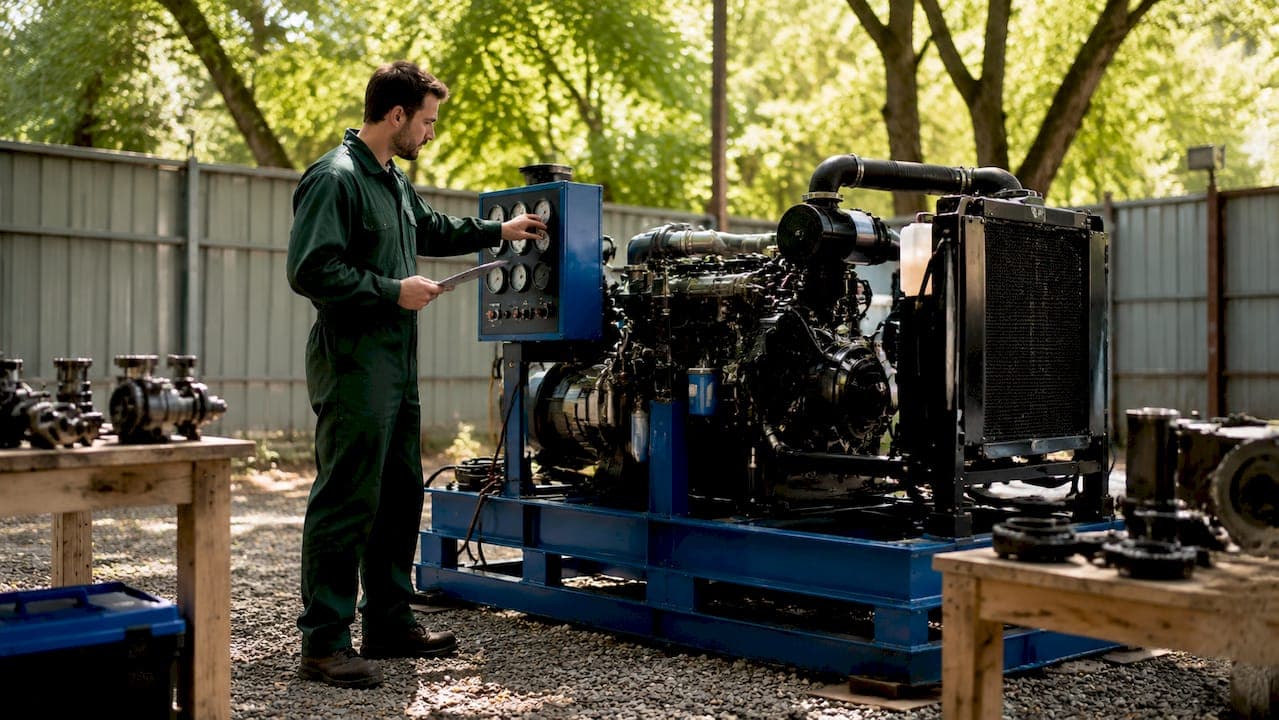
Diesel engine testing is the systematic process of evaluating engine performance, emissions, and component function through controlled mechanical and emissions analyses. Engineers and technicians use dynamometers, injector bench test equipment, Portable Emission Measurement Systems (PEMS), and standards like ISO 8178 to measure power output, fuel consumption, NOx, and particulate matter. Understanding how diesel engine testing is done separates a reliable engine from one that fails under load, and the difference matters whether you are certifying a new Cummins ISM for fleet service or diagnosing a Detroit DD15 after a rebuild.
How is diesel engine testing done on a dynamometer?
Dynamometer testing is the foundation of diesel engine performance evaluation. The dynamometer controls engine speed and load while sensors record power, torque, fuel consumption, and emissions simultaneously. Yanmar's Dyno 6 measures emissions at two separate points during the same test run, capturing both engine-out gases and tailpipe output after the after-treatment system. That dual-point capability gives engineers a direct view of how well a diesel particulate filter or SCR catalyst is actually working.
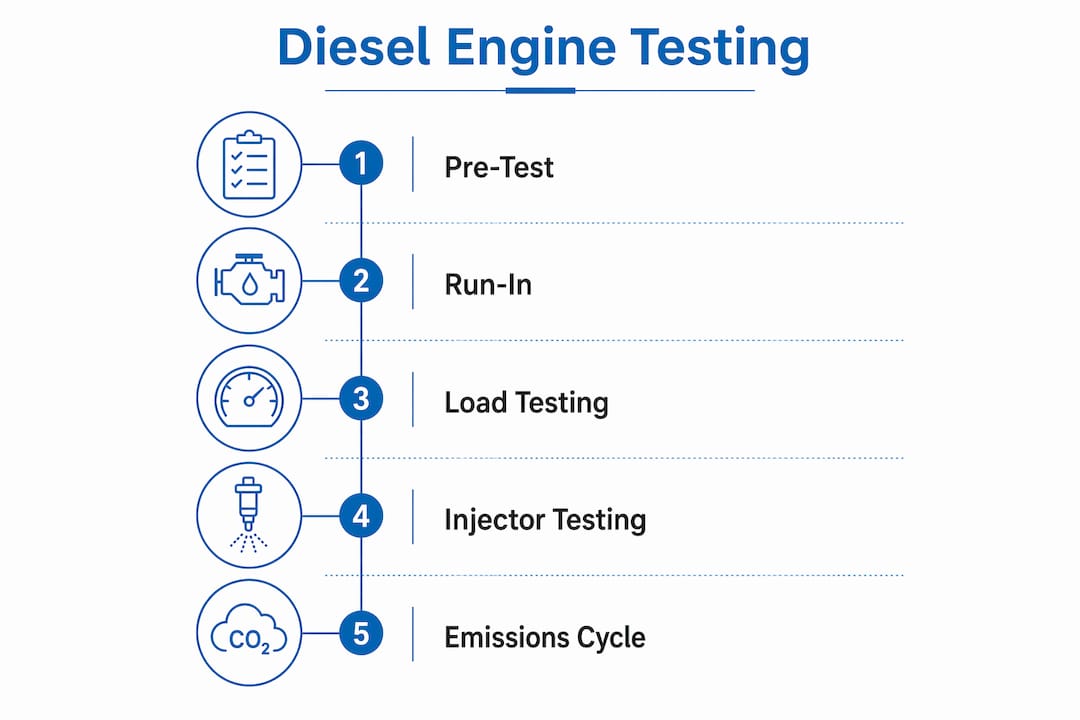
Pre-test inspection and sensor calibration
Before any load is applied, the engine goes through a structured pre-test checklist. Technicians verify oil pressure, coolant levels, belt tension, and fuel supply integrity. Sensor calibration and continuity checks come next, because without zero-point verification, combustion and emissions data can reflect instrumentation drift rather than actual engine behavior. Skipping this step is the most common source of biased data in field testing environments.

Stepwise loading and run-in procedure
The engine does not go straight to full load. A structured run-in procedure applies stepwise loading at 20%, 50%, and 80% RPM with defined dwell periods at each stage. This process seats piston rings and confirms lubrication integrity before full performance testing begins. Oil pressure must rise within 2–4 seconds at idle. If it does not, the test stops.
The full load cycle follows once the engine passes run-in. Technicians record power curves, fuel consumption rates, and emissions at each load point. Data from each stage feeds into the final performance report.
Pro Tip: Always log coolant and oil temperatures at each load step. Thermal stabilization at each dwell point is what separates clean data from noise.
- Perform visual inspection and fluid checks
- Calibrate all sensors and verify zero-point readings
- Start engine and confirm oil pressure rise within 2–4 seconds
- Run cold and hot run-in at 20%, 50%, and 80% RPM with dwell periods
- Apply full load cycle and record power, torque, fuel consumption, and emissions
- Measure emissions at engine-out and tailpipe positions
- Post-process data and compare against manufacturer specifications
What are the procedures for bench testing diesel fuel injectors?
Common-rail diesel injectors require bench testing at multiple operating points to measure fuel delivery volume, return volume, spray pattern, and electrical response against manufacturer specifications. A Bosch injector test bench cycles each injector through idle, cruise, and full-load scenarios while recording detailed metrics. This process catches faults that a simple continuity check or visual inspection will never find.
The bench test procedure follows a defined sequence:
- Intake and visual inspection: Check for external damage, corrosion, and connector condition before the injector is mounted
- Cleaning cycle: Run a flushing sequence to clear carbon deposits that could skew delivery measurements
- Idle point test: Measure fuel delivery volume and return volume at low pulse width to simulate light engine load
- Cruise point test: Increase pulse width to mid-range and record delivery accuracy against Bosch specification tables
- Full-load test: Run maximum pulse width and confirm delivery volume, spray pattern symmetry, and return flow
- Electrical response check: Measure solenoid or piezo actuator response time and confirm signal timing matches the ECU command
Return volume anomalies indicate internal leakage and control faults that delivery volume alone will not reveal. An injector can pass a delivery test and still fail in service because of a worn control valve leaking fuel back to the tank. Multi-point bench testing catches that failure mode before the injector goes back into the engine.
Pro Tip: Compare return volume at idle versus full load. A large spread between those two readings points to a worn needle seat or control valve, not just a dirty tip.
How do standardized test cycles and regulations guide diesel engine testing?
ISO 8178 is the primary international standard for non-road diesel engine emissions testing. It defines both steady-state and transient test cycles, specifying measurement conditions, sampling methods, and acceptable pollutant limits. ISO 8178 Parts 4 and 9 cover steady-state and transient cycles respectively, including smoke measurement and gaseous pollutant sampling under controlled ambient conditions. Adherence to ISO 8178 makes emissions results comparable across labs and regulatory contexts worldwide.
Certification testing adds another layer of control. The SC03 test cycle, used in emissions compliance work, requires a 10-minute soak with the engine off followed by a 600-second test run under defined ambient conditions. Continuous proportional gaseous sampling runs throughout the cycle. That level of environmental control eliminates the variables that cause one lab's results to differ from another's.
| Standard / Cycle | Application | Key Measurement |
|---|---|---|
| ISO 8178 Part 4 | Non-road steady-state | NOx, PM, CO, HC |
| ISO 8178 Part 9 | Non-road transient | NOx, PM, smoke |
| SC03 Cycle | On-road certification | CO, NOx, HC |
| Euro VI / EPA 2013 | Heavy-duty on-road | NOx, PM, CO2 |
Test cell conditions matter as much as the cycle itself. Ambient temperature, humidity, and barometric pressure all affect combustion and emissions output. Certified test facilities control these variables within tight tolerances. An engine tested outside those tolerances produces data that cannot be used for regulatory submission.
How are real-world emissions tested using PEMS?
Portable Emission Measurement Systems (PEMS) measure pollutants including CO, CO2, and NOx directly on a vehicle during real-world operation. PEMS setups use strategically placed gas analyzers and sensors with continuous data acquisition to capture emissions across the full range of operating conditions a vehicle actually encounters. Lab dynamometer testing cannot replicate every load transient a truck experiences on a highway grade or in stop-and-go traffic.
The PEMS test procedure includes several defined steps:
- Preconditioning: The vehicle runs a defined warm-up cycle to bring the engine and after-treatment system to operating temperature
- Sensor mounting: Gas analyzers, flow meters, and GPS units are installed without altering normal vehicle operation
- Operational window: The test covers a defined mix of urban, rural, and highway driving to capture varied load conditions
- Continuous sampling: Emissions concentrations are logged at high frequency throughout the entire run
- Post-processing: Raw concentration data is filtered and converted into mass emission rates per kilometer or per kilowatt-hour
Advanced post-processing is not optional. Raw PEMS data contains noise from sensor lag, exhaust flow estimation errors, and GPS signal gaps. Filtering algorithms clean the dataset before regulatory mass emission rates are calculated. PEMS results then validate or challenge the lab dyno data, giving regulators and engineers a complete picture of real-world diesel engine performance evaluation.
Key Takeaways
Diesel engine testing requires dynamometer load cycles, injector bench testing, standardized emissions protocols, and real-world PEMS validation to produce reliable, regulatory-compliant performance data.
| Point | Details |
|---|---|
| Dynamometer testing is the core method | Controlled speed and load profiles measure power, torque, and emissions at engine-out and tailpipe positions. |
| Pre-test calibration is non-negotiable | Sensor zero-point verification prevents instrumentation drift from corrupting combustion and emissions data. |
| Injector bench tests catch hidden faults | Multi-point testing at idle, cruise, and full load reveals return volume anomalies that delivery tests alone miss. |
| ISO 8178 standardizes comparability | Steady-state and transient cycles under ISO 8178 make emissions results consistent across labs and regulators. |
| PEMS validates lab results in the field | Real-world emissions data from PEMS post-processing confirms whether dyno results reflect actual operating behavior. |
What I've learned from years of watching diesel tests go wrong
The most expensive mistake I see technicians make is treating sensor calibration as a formality. They run the zero-point check, see a number close enough to zero, and move on. Three hours later, the NOx data shows a spike that does not match any combustion event, and the entire test run is invalid. Calibration is not a checkbox. It is the foundation every other data point rests on.
The second pattern I keep seeing is over-reliance on lab dyno results for emissions compliance. A Cummins ISM can pass every ISO 8178 steady-state cycle in a climate-controlled cell and still produce elevated NOx on a cold morning in Minnesota because the after-treatment system never fully activates at low ambient temperatures. PEMS testing exists precisely to catch that gap. Engineers who treat lab and field testing as interchangeable are setting themselves up for a compliance failure at the worst possible time.
The injector testing piece is where I think the industry still cuts corners most aggressively. A quick delivery volume check at one operating point tells you almost nothing. The failure modes that cause real-world driveability complaints, rough idle, smoke at cruise, poor fuel economy, almost always show up in return volume data at partial load. Bosch's multi-point bench protocol exists for a reason. Running the full cycle takes more time, but it eliminates the misdiagnosis that sends a rebuilt engine back to the shop two weeks later.
The trend worth watching in 2026 is the integration of real-time data analytics into dynamometer post-processing. Test cells that used to produce a PDF report now feed live data into diagnostic platforms that flag anomalies during the test run, not after. That shift is compressing the time between testing and actionable diagnosis, which matters enormously for fleet operators running tight maintenance windows.
— Carl
Tested engines from Detroit, Cummins, Mack, and Caterpillar
Nationwideheavytruckparts stocks commercial diesel engines from Detroit Diesel, Cummins, Mack, and Caterpillar, each inspected and tested before it ships. Every engine in the inventory goes through a structured evaluation process covering compression, oil pressure, and operational checks so you know what you are getting before it arrives at your shop.
Whether you need a Detroit Diesel engine for a Class 8 rebuild or a Cummins diesel engine to replace a failed unit in a fleet truck, Nationwideheavytruckparts carries tested, warranted options with same-day shipping available. The inventory changes daily, so technicians and fleet managers can find the specific engine they need without waiting weeks for a new unit to arrive. Browse the full selection of commercial truck engines to find the right fit for your application.
FAQ
What equipment is used to test a diesel engine?
Diesel engine testing uses dynamometers to control speed and load, emissions analyzers to measure NOx and PM, and injector bench test equipment such as Bosch test benches to evaluate fuel delivery and spray pattern. PEMS units are used for on-road real-world emissions measurement.
What does ISO 8178 cover in diesel engine testing?
ISO 8178 defines steady-state and transient emissions test cycles for non-road diesel engines, specifying measurement conditions, sampling methods, and pollutant limits for NOx, PM, CO, and smoke. Parts 4 and 9 cover the most widely applied cycles in commercial engine certification.
Why is injector return volume measured during bench testing?
Return volume anomalies reveal internal leakage and control valve wear that delivery volume tests alone cannot detect. An injector can pass a delivery check and still fail in service due to a worn needle seat leaking fuel back to the tank.
How does PEMS testing differ from dynamometer testing?
Dynamometer testing runs the engine under controlled lab conditions using standardized load cycles, while PEMS testing captures emissions during actual vehicle operation across real driving conditions. PEMS results validate whether lab data reflects true on-road engine behavior.
What is the purpose of the run-in procedure before full load testing?
The run-in procedure applies stepwise loading at 20%, 50%, and 80% RPM with dwell periods to seat piston rings and confirm lubrication integrity. Oil pressure must rise within 2–4 seconds at idle before any load is applied.