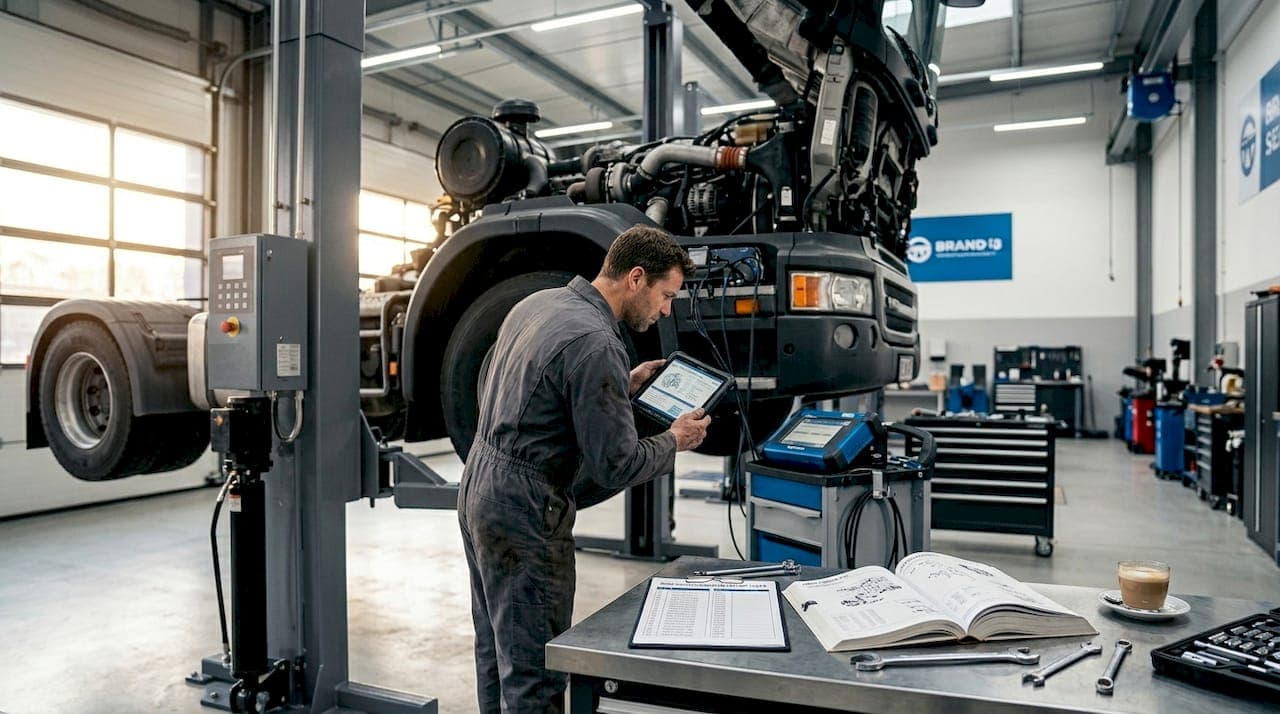
Confirming engine compatibility for a heavy truck is defined as the process of matching a replacement engine to a vehicle's original factory specifications across physical, electronic, and emissions dimensions. Fleet managers who skip this process risk installing an engine that starts, runs poorly, triggers fault codes, or fails a DOT inspection. The verification process relies on three primary data sources: the Vehicle Identification Number (VIN), the stamped engine code on the block, and the under-hood emissions label. Getting all three to align is the only reliable way to confirm a heavy truck engine match before money changes hands.
What are the essential identifiers for confirming engine compatibility?
The VIN is the starting point for any heavy-duty engine compatibility check. A VIN-based engine lookup reveals the exact engine family and configuration your truck left the factory with, which is critical when a vehicle has had prior service, undocumented swaps, or mid-year production changes. Relying on model year alone is a documented source of error because manufacturers like Cummins, Detroit Diesel, and Mack frequently released multiple engine options within the same calendar year.
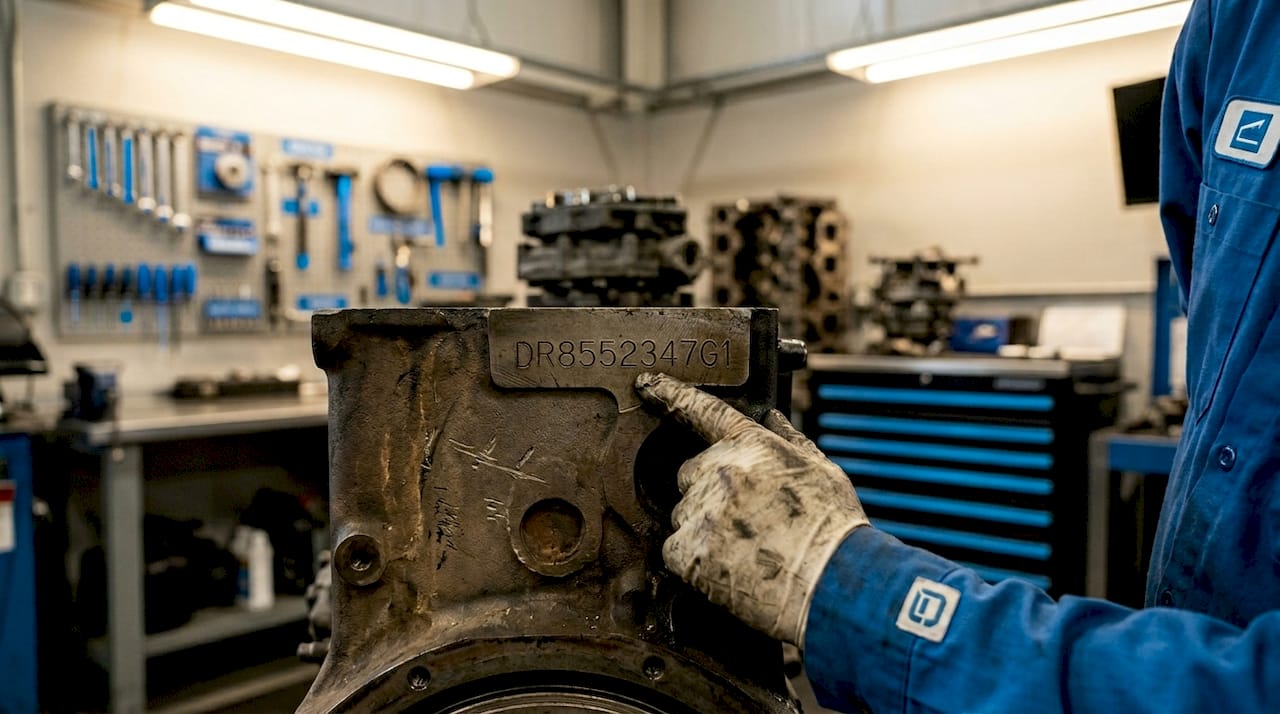
The stamped engine code on the block is your second confirmation layer. This code is physically cast or stamped into the engine block itself and identifies the specific variant, displacement, and build configuration. A stamped code verification catches incorrect vendor listings and confirms the certified engine family. If the stamped code does not match what the VIN decoding tool returns, you are likely looking at a prior swap or a non-factory replacement.
The under-hood emissions label is the third required identifier. This label shows the EPA or CARB certified engine family, displacement, and applicable emissions tier. For trucks operating in California or states that follow CARB standards, this label is a compliance document, not just a reference sticker.
Here is what each identifier tells you and why all three must align:
- VIN (digits 4 through 8): Reveals original engine family, configuration, and plant of manufacture. Use a VIN decoder or OEM catalog to extract this data.
- Stamped engine code: Found on the block near the front or side of the engine. Confirms the actual installed engine variant, not just what paperwork says.
- Under-hood emissions label: Shows certified EPA/CARB engine family and displacement. Any mismatch with the VIN data signals a non-compliant or undocumented swap.
- OEM build sheets or dealer records: Secondary sources that can confirm factory-installed options, especially useful for trucks with fleet spec packages.
Pro Tip: Photograph all three identifiers before contacting any vendor. Vendors who ask only for the model year and horsepower rating are not doing a thorough engine compatibility check. Stamped codes and emissions labels are the only documents that hold up under scrutiny.
How to check system-level compatibility for ECU and emissions controls
Physical fitment is the easier half of the problem. The harder half is system-level compatibility, and it is where most modern heavy truck engine swaps fail. ECU compatibility is critical because a mismatched Engine Control Unit causes no-start conditions, persistent fault codes, and derate events that ground a truck even when the engine physically bolts in correctly.
The ECU manages fuel injection timing, turbo boost control, idle speed, and emissions system operation. When you swap in an engine with a different ECU calibration or a different communication protocol, the truck's body control modules and instrument cluster may not recognize the new unit. This is especially common when crossing model years on platforms like the International MaxxForce or the Detroit Series 60, where DDEC software versions changed significantly between production runs.
Aftertreatment system integration is the second system-level factor that stops swaps cold. EGR and DPF sensor wiring must match the ECU's expected input signals. If the replacement engine's aftertreatment hardware uses different sensor types or connector pinouts, the ECU will log faults and may derate the engine to protect itself. This happens even when the base engine appears identical.
Follow this sequence to verify system-level compatibility before committing to a purchase:
- Identify the ECU part number on both the donor engine and the receiving truck. Cross-reference these numbers against OEM technical data or a compatibility checker tool.
- Confirm the software calibration version matches the truck's existing wiring harness and body control modules. Calibration mismatches are common across model year transitions.
- Verify EGR and DPF sensor connector types match between the replacement engine and the truck's existing aftertreatment wiring harness.
- Check wiring harness routing and connector count. Mounting geometry and harness layout must align; a harness that is six inches short or missing a connector block will require custom fabrication.
- Consult OEM technical service bulletins for the specific engine family. Manufacturers publish mid-year change notices that affect electronics compatibility and are not reflected in general catalog data.
Pro Tip: If you are sourcing a used engine, ask the seller for the ECU part number before shipping. A Detroit Diesel Series 60 14.0 with a DDEC V calibration will not communicate correctly in a truck wired for DDEC VI without reprogramming. That reprogramming cost can exceed the savings on the engine itself.
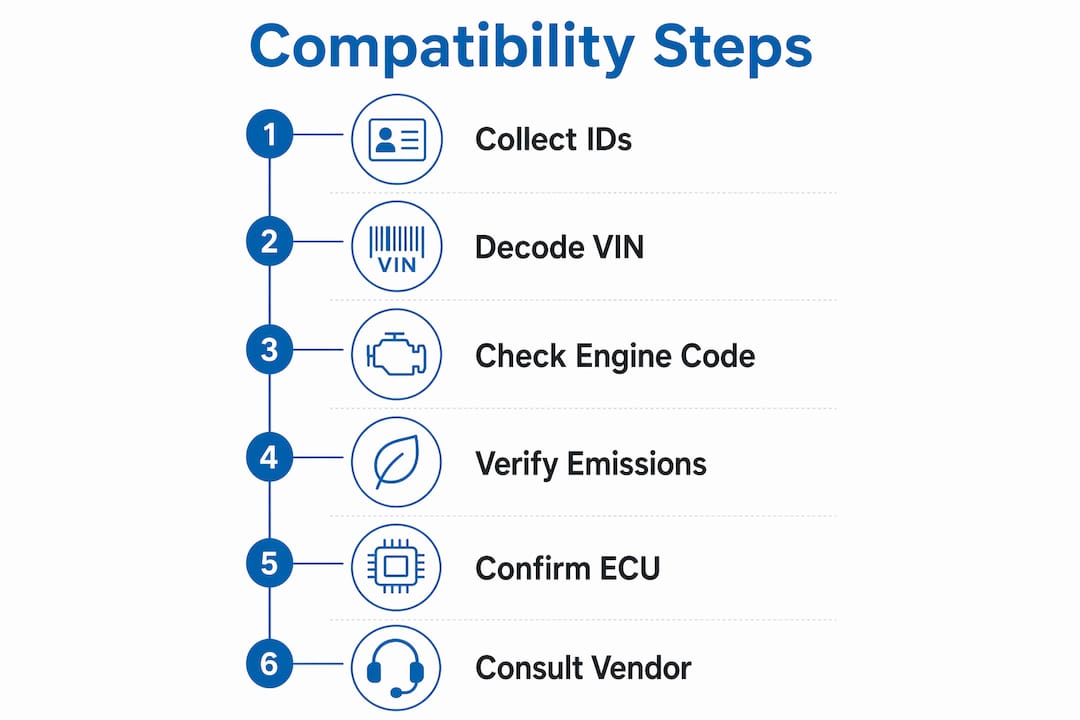
What step-by-step process should fleet managers follow to confirm engine compatibility?
A structured workflow prevents the most expensive mistakes in engine replacement for trucks. The goal is to collect, verify, and cross-check every identifier before a purchase order is issued.
| Step | Action | Purpose |
|---|---|---|
| 1. Collect identifiers | Pull VIN, stamped engine code, and emissions label data | Establishes the baseline factory specification |
| 2. Decode the VIN | Use OEM catalogs or a VIN lookup tool | Confirms original engine family and configuration |
| 3. Match stamped code | Compare block code to OEM data | Detects prior swaps or incorrect vendor listings |
| 4. Verify emissions label | Confirm EPA/CARB family matches VIN data | Validates compliance tier for the jurisdiction |
| 5. Check ECU and harness | Cross-reference ECU part numbers and calibration versions | Prevents no-start and fault code failures |
| 6. Cross-check all findings | Look for any discrepancy across all five data points | Identifies undocumented changes or non-factory parts |
| 7. Document and file | Save photos and records of all identifiers | Supports vendor communication and regulatory audits |
Step 6 is where experienced fleet managers catch problems that paperwork misses. A truck that shows a Cummins ISX15 on the VIN but has a stamped code for an ISX12 has had an undocumented swap. That discrepancy affects warranty eligibility, emissions compliance, and resale value. Documenting stamped codes before ordering protects you from receiving an engine that matches the paperwork but not the truck.
The Cummins X10, launched in 2025, meets EPA 2027 emissions standards and replaces older ISX platforms in many fleet applications. This matters because a fleet manager ordering a replacement for a 2022 truck may encounter a newer engine generation with different ECU architecture and aftertreatment hardware. Verifying the compliance tier and engine generation before purchase prevents a mismatch that looks correct on paper but fails in the field.
What common mistakes to avoid when verifying heavy truck engine compatibility?
The most expensive mistakes in heavy-duty engine compatibility share a common cause: skipping steps because the engine "looks right" or the part number "seems close enough." Here are the errors that generate the most costly comebacks:
- Relying on model year and displacement alone. A 2019 Peterbilt 579 could have left the factory with a Cummins X15, a Paccar MX-13, or a Detroit DD15. Model year tells you nothing about which one is installed without VIN decoding.
- Ignoring ECU and emissions system differences. Overlooking emissions integration including EGR and DPF wiring leads to fault codes and derate events even when the engine physically fits. This is the leading cause of failed engine swaps in post-2010 heavy trucks.
- Missing mid-year production changes. Manufacturers like International and Mack made mid-cycle changes to engine families that affected sensor types, harness connectors, and ECU calibrations. These changes are not always reflected in general interchange guides.
- Overlooking transmission and drivetrain configuration. An engine swap that changes the flywheel housing pattern or PTO configuration will create a drivetrain mismatch. Always cross-check transmission compatibility alongside the engine.
- Skipping the physical stamped code check. Vendor databases and interchange tools contain errors. The stamped code on the block is the only document that cannot be falsified after the fact.
- Ignoring mounting bracket and exhaust clearance differences. Two engines from the same family can have different front accessory drive configurations or exhaust outlet positions that require custom fabrication to resolve.
"Aftertreatment compatibility is often where replacements fail. The ECU expects specific sensor inputs and control strategies, and a mismatch triggers derates that are difficult to diagnose without knowing the root cause from the start." (Engine Compatibility Checker)
The EPA compliance tier of the replacement engine must also match the jurisdiction where the truck operates. Installing a pre-2010 engine in a truck registered in California, for example, creates a compliance failure regardless of physical fitment.
Key takeaways
Confirming heavy truck engine compatibility requires verifying the VIN, stamped engine code, emissions label, ECU calibration, and aftertreatment wiring before any purchase is finalized.
| Point | Details |
|---|---|
| VIN is the baseline | Decode the VIN first to establish the factory engine family and configuration. |
| Stamped code is the proof | The block's stamped code catches vendor errors and confirms the actual installed variant. |
| ECU mismatches cause derates | Verify ECU part numbers and calibration versions to prevent no-start and fault code failures. |
| Aftertreatment wiring matters | EGR and DPF sensor connectors must match the replacement engine's harness exactly. |
| Document everything | Photographs of all identifiers protect you during vendor communication and compliance audits. |
Why I think most fleet managers underestimate the electronics side of this
I have watched fleet managers spend hours on the phone confirming horsepower ratings and displacement, then lose two weeks of downtime because the replacement engine's ECU calibration was one software version off from what the truck expected. The physical fitment conversation is familiar territory. The electronics conversation is where most people's eyes glaze over, and that is exactly where the risk lives.
The shift to post-2010 emissions hardware changed everything about engine swaps. Before EGR and DPF systems became standard, a Detroit Series 60 swap was mostly a mechanical exercise. Now, the ECU and sensor integration is so tightly coupled to the aftertreatment hardware that you cannot treat them as separate systems. I have seen trucks with perfectly good replacement engines sit in the shop for three weeks because nobody verified the DPF sensor connector pinout before the engine shipped.
My practical advice: build a one-page identifier sheet for every truck in your fleet. VIN, stamped code, emissions label data, ECU part number. Update it every time a major component is replaced. That document cuts the verification time for any future replacement from days to hours, and it gives vendors the exact data they need to pull the right part the first time.
Find verified compatible engines at Nationwideheavytruckparts
Nationwideheavytruckparts carries a daily-changing inventory of tested and inspected heavy truck engines from Detroit Diesel, Cummins, Mack, Caterpillar, and International. Every engine in the catalog is backed by a standard warranty, and the team can assist you in matching identifiers to confirm fitment before you order. Whether you need a Detroit Diesel engine for a Series 60 application or a Cummins replacement for a post-2010 platform, Nationwideheavytruckparts provides the technical support to get the right engine to your dock with same-day shipping on qualifying orders. Contact the team directly with your VIN, stamped code, and emissions label data for the fastest and most accurate fitment confirmation available.
FAQ
What is the fastest way to confirm engine compatibility for a heavy truck?
Pull the VIN, stamped engine code, and under-hood emissions label, then cross-reference all three against OEM catalog data or a VIN decoding tool. Any mismatch across these three identifiers signals a prior swap or a non-factory configuration that requires further investigation.
Why does the ECU matter when replacing a heavy truck engine?
A mismatched ECU causes no-start conditions, persistent fault codes, and derate events even when the engine physically fits the truck. ECU calibration versions and communication protocols must match the truck's existing wiring harness and body control modules.
Can I use model year alone to verify truck engine fit?
No. Manufacturers like Cummins, Detroit Diesel, and Mack offered multiple engine options within the same model year, and mid-cycle production changes further complicate year-based matching. VIN decoding is the only reliable method for confirming the original factory engine configuration.
What happens if the emissions label does not match the VIN data?
A mismatch between the emissions label and VIN data indicates an undocumented engine swap or a non-compliant replacement. This creates regulatory exposure, particularly in states that follow CARB standards, and may affect the truck's ability to pass inspection.
Do I need to verify transmission compatibility when replacing a heavy truck engine?
Yes. An engine swap that changes the flywheel housing pattern or PTO configuration creates a drivetrain mismatch that prevents proper installation. Always confirm transmission and drivetrain compatibility alongside the engine before finalizing any replacement purchase.