
Extending truck engine life as an owner-operator is defined by one discipline: consistent, data-driven preventive maintenance applied before problems develop. Every mile you put on a Cummins, Detroit Diesel, or Mack engine either builds toward longevity or chips away at it, depending on how you manage oil, cooling, filtration, and inspections. Owner-operator engine longevity is not a matter of luck. It is the direct result of scheduled habits, condition monitoring through oil analysis, and compliance with FMCSA inspection protocols like 49 CFR §396.13. The operators who keep engines running past 1,000,000 miles do not have better trucks. They have better routines.
What are the most critical maintenance tasks to extend a truck engine's lifespan?
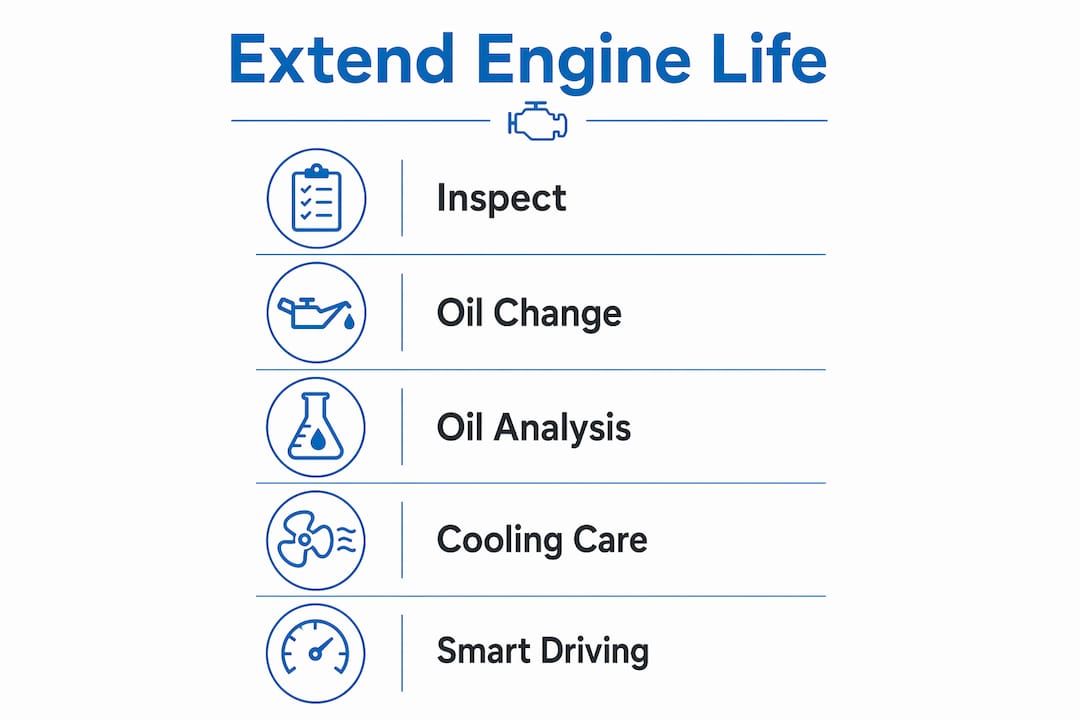
Lubrication, filtration, and cooling systems form the foundation of diesel engine durability, and maintaining these correctly is the single most impactful thing you can do for owner-operator engine longevity. Every other maintenance task builds on top of these three. Here are the core tasks ranked by their impact on engine life:
- Oil and filter changes on condition, not just mileage. Dirty or degraded oil causes internal damage and contamination that compounds over time. Use the manufacturer's interval as a floor, not a ceiling, and verify oil condition with analysis before extending.
- Cooling system inspections every 50,000 miles. Coolant degrades and loses its corrosion inhibitors. A failed cooling system is one of the fastest ways to destroy a diesel engine. Check coolant concentration, pH, and inhibitor levels at every major service.
- Fuel and air filter replacements on schedule. Contaminated fuel introduces abrasive particles directly into injection components. A clogged air filter starves the engine of clean air, raising combustion temperatures and accelerating wear on rings and cylinder walls.
- Greasing all chassis and driveline fittings. Neglected grease points create metal-on-metal contact that transfers vibration and stress back through the drivetrain to the engine mounts and block.
- Belt and hose inspections at every oil change. A cracked serpentine belt or a swollen coolant hose costs under $50 to replace. The engine damage from a failure on the road costs thousands.
Pro Tip: Keep a maintenance log in a simple spreadsheet or an app like Fleetio. When you have a paper trail of every oil change, filter swap, and inspection, you can spot patterns, like a coolant top-off happening more frequently, before they become failures.
Proactive oil, filtration, and cooling maintenance protects engine longevity and reduces costly downtime. The cost of prevention is always lower than the cost of repair, and simple habits prevent catastrophic failures that pull you off the road for days.

How can oil analysis improve oil change intervals and engine health?
Oil analysis is the practice of sending a small sample of used engine oil to a laboratory for chemical and physical testing. Labs like Blackstone Laboratories and Oil Analyzers Inc. measure wear metals such as iron, copper, and aluminum, along with viscosity, total base number (TBN), soot levels, fuel dilution, and coolant contamination. Each of these markers tells a specific story about what is happening inside your engine.
The process for using oil analysis to extend drain intervals safely follows a clear sequence:
- Pull 2 to 3 baseline samples at your current standard interval to establish your engine's normal wear profile.
- Extend the interval by 5,000 to 10,000 miles and resample at the new endpoint.
- Compare the new results against your baseline trends, not against generic industry averages.
- Continue extending only if wear metals and contamination markers remain stable.
- Stop extending immediately if any single marker spikes, particularly fuel dilution or coolant presence.
This approach matters because mileage-based oil changes without condition monitoring can lead to unsafe longer intervals. A truck running short hauls with frequent cold starts accumulates soot and fuel dilution far faster than a long-haul truck running steady highway miles. The same 25,000-mile interval that is safe for one operation is dangerous for another.
| Oil Analysis Marker | What It Detects | Action Threshold |
|---|---|---|
| Iron (Fe) | Cylinder and ring wear | Rising trend over baseline |
| Copper (Cu) | Bearing and bushing wear | Spike above baseline |
| Fuel dilution | Injector or ring seal failure | Above 2% by volume |
| Coolant contamination | Head gasket or liner leak | Any detectable presence |
| TBN (Total Base Number) | Remaining acid-neutralizing capacity | Below 2.0 triggers change |
Pro Tip: Never make an oil drain decision based on a single oil analysis reading. Trends across three or more samples are what reveal real wear patterns. One elevated iron reading could be a sampling error. Three consecutive elevated readings are a warning you cannot ignore.
The financial case is straightforward. Unnecessary oil changes on a Cummins ISX15 or a Detroit DD15 engine cost $300 to $600 each when you factor in oil, filters, and labor. Oil analysis at $25 to $40 per sample pays for itself the first time it lets you safely skip a premature change or catches a coolant leak before it destroys a head gasket.
Why are pre-trip inspections and FMCSA rules essential for engine life?
FMCSA regulation 49 CFR §396.13 requires drivers to be satisfied that the vehicle is in safe operating condition before each trip, review the last driver vehicle inspection report (DVIR), and sign to acknowledge that required repairs were completed. Most owner-operators treat this as a compliance checkbox. The operators who get the most miles out of their engines treat it as a diagnostic tool.
The inspection cycle creates a continuous feedback loop between what you observe on the road and what your mechanic addresses in the shop. Defects caught during a pre-trip inspection that directly affect engine life include:
- Oil leaks at the pan gasket, valve cover, or turbo oil lines
- Coolant seepage at hose connections or the radiator core
- Unusual belt wear or glazing that signals misalignment
- Exhaust leaks that indicate manifold or gasket deterioration
- Low fluid levels that suggest consumption or leakage between services
Maintenance records and inspection defect history guide when to change oil or investigate leaks promptly. When you cross-reference your DVIR log with your oil analysis results, patterns emerge that neither document reveals alone. A recurring oil consumption note in your DVIR combined with rising iron levels in your oil analysis points directly to ring wear, giving you time to plan a repair before it becomes an in-frame overhaul.
"Inspection compliance is not just regulatory. It is the earliest warning system available to an owner-operator, and it costs nothing beyond the time to do it right."
Legal compliance and engine longevity are the same goal when you approach inspections with discipline. A truck that passes every pre-trip inspection is a truck that is not accumulating hidden damage between service intervals.
What driving habits contribute to longer engine life?
Mechanical maintenance keeps the engine healthy between services. Driving behavior determines how fast it degrades during operation. Excessive idle time produces harmful combustion byproducts without adequate heat to burn them off, accelerating wear on rings, liners, and valve stems. Controlling idle time is one of the most overlooked truck engine efficiency improvements available to owner-operators.
Here are the operational habits that directly reduce engine wear:
- Limit idle time to under 10 minutes when stationary. Use an auxiliary power unit (APU) like those made by Thermo King or Carrier for cab comfort instead of idling the main engine. Every hour of unnecessary idle adds roughly the equivalent of 25 to 30 miles of wear without moving the truck.
- Accelerate gradually from stops. Hard acceleration from a cold or warm idle forces the engine to build cylinder pressure rapidly, stressing rings, pistons, and connecting rod bearings simultaneously.
- Distribute load weight evenly. Uneven loading creates torque imbalance that transfers stress through the drivetrain back to the engine mounts and crankshaft. Check axle weights at a scale before every loaded run.
- Respond to warning signs immediately. Blue smoke signals oil burning. White smoke indicates coolant entering the combustion chamber. Black smoke points to fuel system or air restriction problems. Each of these is a symptom of a condition that worsens with every mile you ignore it.
- Check fluid levels every morning before departure. Consistent fluid checks and addressing warning signs get longer engine life and reduce major repair costs. A two-minute check of oil, coolant, and DEF levels before startup costs nothing and catches drops that signal developing leaks.
Pro Tip: Install a real-time engine monitoring app connected to your truck's ECM via a Bluetooth OBD adapter. Tools like Samsara or KeepTruckin give you live data on coolant temperature, oil pressure, and idle time, so you catch deviations before they trigger a warning light.
Smooth, loaded highway driving at governed speeds is genuinely the lowest-wear operating condition for a diesel engine. The operators who treat their trucks like precision instruments rather than workhorses get the miles to prove it.
Key takeaways
Owner-operators who extend truck engine life combine disciplined preventive maintenance with oil analysis, inspection compliance, and controlled driving habits rather than relying on mileage intervals alone.
| Point | Details |
|---|---|
| Oil and filtration first | Change oil based on condition data, not just mileage, using lab analysis from services like Blackstone Laboratories. |
| Use oil analysis trends | Pull 2 to 3 baseline samples before extending drain intervals; decisions require trend data, not single readings. |
| FMCSA inspections protect engines | Reviewing DVIRs under 49 CFR §396.13 catches oil leaks, coolant seepage, and belt wear before they cause failures. |
| Idle time accelerates wear | Keep idle time under 10 minutes and use an APU for cab comfort to reduce unnecessary combustion byproduct buildup. |
| Warning signs demand action | Blue, white, or black exhaust smoke are symptoms of active damage. Address them at the next stop, not the next service. |
What most owner-operators get wrong about engine care
I have talked with hundreds of owner-operators over the years, and the pattern I see most often is not neglect. It is misplaced confidence. An operator runs a Cummins ISX to 600,000 miles without a major issue and concludes that his routine is working. What he does not realize is that his engine survived despite some of his habits, not because of them.
The biggest mistake I see is extending oil drain intervals based on the fact that the last extension went fine. That logic works until it does not. One batch of fuel with higher sulfur content, one cold snap that causes extended idling, one small injector weep that nobody noticed, and that extended interval becomes the reason for a $15,000 engine repair. Oil analysis from a lab removes the guesswork entirely. It is the only way to know what is actually happening inside the engine rather than what you assume is happening.
The second thing I would push back on is the idea that inspections are a burden. Every DVIR you fill out carefully is a data point. When you look back at six months of DVIRs alongside your oil analysis results, you have a picture of your engine's health that no single mechanic visit can replicate. Build that habit early, and it pays you back for the life of the truck.
Finally, find a diesel shop you trust and stick with them. A mechanic who knows your truck's history catches anomalies that a new shop would miss. That relationship is worth more than any discount you might find shopping around.
— Carl
Quality parts that support every mile you put in
When maintenance and smart driving are not enough and a component needs replacing, the quality of the part you install determines how long your next interval lasts.
Nationwideheavytruckparts stocks tested and inspected used diesel engines and truck transmissions for the brands owner-operators actually run: Cummins, Detroit Diesel, Mack, CAT, and International. Every part ships with a standard warranty and same-day shipping on in-stock inventory, so a breakdown does not have to mean a week off the road. Browse the full inventory at Nationwideheavytruckparts.com and find the specific engine or drivetrain component your truck needs today.
FAQ
How often should an owner-operator change engine oil?
The correct interval depends on your operation and oil condition, not a fixed mileage number. Use oil analysis to establish a baseline and extend intervals only when wear metal trends and contamination markers confirm it is safe to do so.
What does oil analysis actually test for in a diesel engine?
Oil analysis measures wear metals like iron and copper, viscosity, total base number, soot levels, fuel dilution, and coolant contamination. Each marker identifies a specific failure mode, giving you early warning before damage becomes visible or costly.
What is FMCSA §396.13 and why does it matter for engine longevity?
FMCSA 49 CFR §396.13 requires drivers to review the prior inspection report, confirm repairs were made, and certify the vehicle is safe before each trip. Following this rule consistently catches oil leaks, coolant issues, and belt wear that would otherwise go unnoticed between scheduled services.
How much does excessive idling actually damage a truck engine?
Excessive idle time produces incomplete combustion byproducts that contaminate oil and coat cylinder walls without generating enough heat to burn them off. Keeping idle time below 10 minutes per stop and using an APU for cab comfort significantly reduces this wear.
When should an owner-operator consider replacing rather than repairing an engine?
Replacement becomes the better financial decision when repair costs exceed 60 to 70 percent of the value of a quality used engine. Nationwideheavytruckparts offers tested replacement diesel engines for major brands, making it practical to swap rather than rebuild when the numbers favor it.