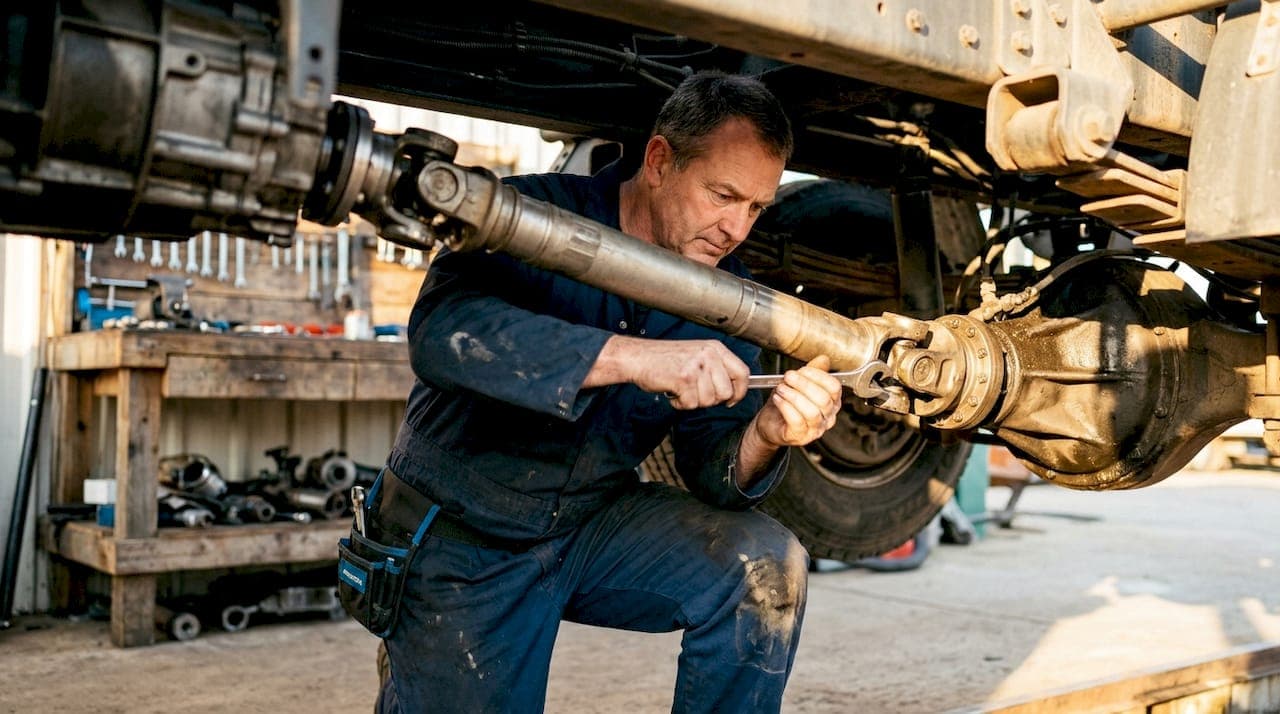
The drive shaft is defined as the rotating assembly that transmits torque from a truck's transmission to its rear drive axles, making vehicle movement under load possible. Understanding the role of drive shaft heavy trucks rely on goes well beyond basic mechanical knowledge. It shapes maintenance schedules, fleet uptime, and total operating costs. For truck mechanics, fleet managers, and truck owners, this guide covers how drive shafts work, what makes them fail, and how to keep them running past 500,000 km.
How does a heavy truck drive shaft transmit power and handle torque demands?
The drive shaft carries engine torque through the driveline, from the transmission output shaft, through one or more shaft sections, to the differential and rear axles. Without it, none of the power generated by a diesel engine reaches the ground. The shaft must do this while the suspension moves, the chassis flexes, and the load shifts constantly.
Heavy truck drive shafts face torque demands that passenger vehicle components cannot approach. Driveline assemblies like the Meritor RPL35+ handle torque loads up to 21,600 lb-ft, which reflects the real demands of Class 8 powertrains running fast axle ratios. That figure sets the engineering baseline for material selection, joint design, and shaft diameter.
Several design features make this torque transmission possible:
- Reinforced steel tubing provides the torsional strength to handle peak torque without twisting or fracturing
- Universal joints (U-joints) allow the shaft to transmit rotation at an angle, accommodating suspension travel and chassis flex
- Slip yokes let the shaft change length as the drivetrain moves, preventing binding
- Constant velocity (CV) joints are used in some configurations to reduce speed fluctuations at higher operating angles
U-joints are the most critical link in this chain. They allow the shaft to operate at an angle while still spinning, but they introduce a cyclic speed variation at every rotation. Two U-joints phased correctly cancel each other out. Get the phasing wrong, and that variation becomes a vibration the entire drivetrain feels.
What are the key design considerations and components of heavy truck drive shafts?
Drive shaft design in heavy trucks balances torque capacity, length, operating angle, and vibration control. Each variable affects the others, and getting one wrong shortens the life of every component downstream.
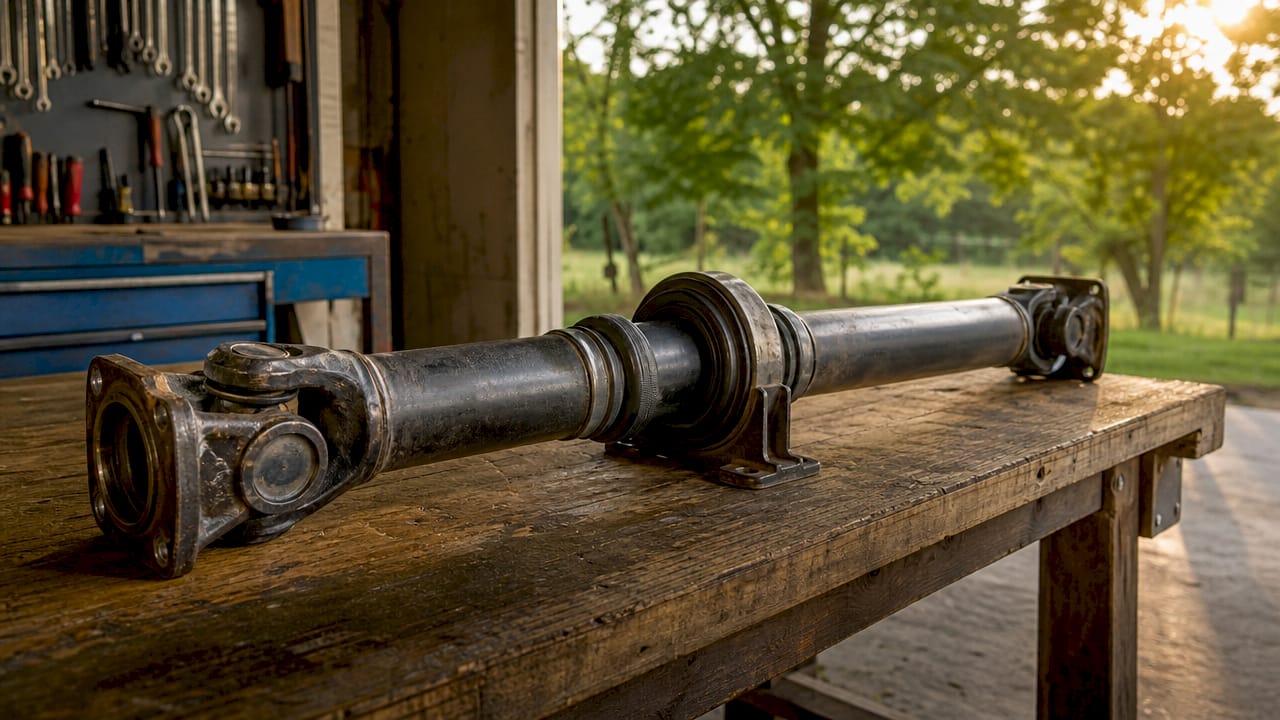
Single-piece vs. two-piece shafts
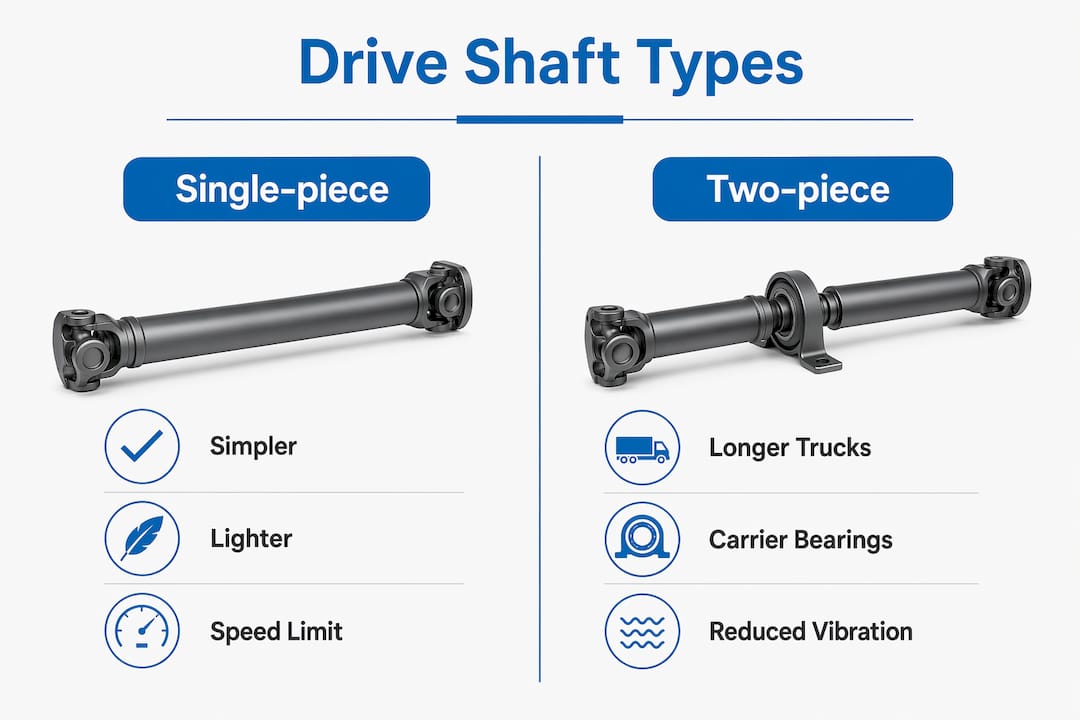
Single-piece shafts are simpler and lighter, but they have a critical speed limit. Longer trucks require two-piece shafts with a center carrier bearing to prevent the shaft from whipping at highway speeds. Two-piece designs add complexity but solve the critical speed problem for longer wheelbases.
Operating angles and phasing
Operating angles above 3 degrees reduce U-joint lifespan significantly. Service standards require working angles matched within approximately 1 degree between the front and rear U-joints on each shaft section. That tight tolerance prevents the cyclic speed variation that causes vibration and premature wear. Shaft phasing misalignment causes cyclic speed fluctuations and severe vibrations that lead to early failure of carrier bearings and transmission seals. Phasing is not a comfort issue. It is a structural one.
Balancing to G16 grade
Driveline reliability depends on balance to G16 grade, which is the industry standard for heavy truck driveline components. An out-of-balance shaft sends a repeating force into the transmission and differential at every revolution. At highway speeds, that force cycles hundreds of times per minute.
Sealed joints and contamination protection
Quad-lip sealed U-joints block dust, water, and abrasive particles from reaching the bearing cups. This matters most in off-road, mining, and construction environments where contamination is constant. Sealed joints extend service intervals and protect the bearing surfaces that carry the full torque load.
Pro Tip: When replacing U-joints, always verify the operating angles with an inclinometer before and after installation. A joint that looks correctly installed can still be out of spec by more than 1 degree if the mounting flange has any wear or distortion.
| Feature | Single-piece shaft | Two-piece shaft |
|---|---|---|
| Best application | Short to medium wheelbase | Long wheelbase trucks |
| Critical speed risk | Higher on long spans | Managed by center bearing |
| Complexity | Lower | Higher, requires carrier bearing |
| Maintenance points | U-joints only | U-joints plus carrier bearing |
| Vibration sensitivity | Moderate | Higher if carrier bearing fails |
Why is regular maintenance critical for heavy truck drive shafts?
Inspections every 50,000 km identify wear before it becomes failure, and with consistent maintenance, drive shafts can exceed 500,000 km of service life. That is a tenfold return on a disciplined inspection schedule. Skipping inspections does not save time. It converts a $200 U-joint replacement into a $5,000 differential repair.
A structured maintenance routine covers these steps:
- Check U-joint play. Grip the shaft near each joint and try to rotate it without moving the yoke. Any detectable play means the bearing cups are worn and the joint needs replacement.
- Inspect the carrier bearing. On two-piece shafts, press on the center bearing housing and listen for roughness or feel for looseness. A worn carrier bearing vibrates at specific road speeds and worsens progressively.
- Measure operating angles. Use an inclinometer at each U-joint. Confirm angles are within spec and matched within 1 degree front to rear on each section.
- Check shaft balance. If vibration appears after a repair or part replacement, have the shaft dynamically balanced to G16 grade before returning the truck to service.
- Grease all fittings. Greaseable U-joints require regular lubrication. Dry joints fail fast, especially under high torque loads.
- Inspect for physical damage. Look for dents, cracks, or corrosion on the shaft tube. Even minor dents change the balance and can create stress fractures under load.
Operating environments like mining with abrasive dust demand more frequent inspections than the standard 50,000 km interval. Contaminants accelerate joint wear at a rate that standard intervals do not account for. Fleet managers running trucks on dusty or unpaved routes should cut the inspection interval in half.
Pro Tip: Keep a simple vibration log for each truck. Note the speed at which vibration appears and whether it changes with load. A vibration that shows up at 55 mph but disappears at 65 mph points to an imbalance issue. One that stays constant across speeds points to a worn U-joint or carrier bearing.
Fleet managers using GPS fleet tracking can correlate vibration complaints from drivers with specific routes and loads, making it easier to prioritize which trucks need driveline inspection first.
What are common failure modes and operational risks in truck drive shafts?
Drive shaft failures follow predictable patterns. Most start small and become catastrophic because the early warning signs get ignored.
- U-joint wear is the most common failure. Worn bearing cups allow the joint to wobble, creating a vibration that increases with speed and load. Left unaddressed, the joint seizes or fractures.
- Carrier bearing failure in two-piece shafts causes dynamic instability. Failed carrier bearings risk driveline separation, which is a serious safety hazard at highway speeds.
- Shaft imbalance after a repair or impact sends repeating vibration forces into the transmission and differential. Unbalanced shafts transmit vibration into the differential and transmission, causing cascading damage and costly repairs.
- Phasing errors after reassembly create cyclic speed variations that destroy carrier bearings and transmission seals within thousands of kilometers.
- Contamination ingress through worn seals accelerates bearing cup wear, especially in dusty or wet environments.
Ignoring minor U-joint vibration symptoms leads to progressive driveline damage, converting inexpensive repairs into catastrophic axle or transmission failures. A $150 U-joint that gets skipped becomes a $6,000 axle shaft replacement three months later.
The cascade effect is what makes driveline neglect so expensive. Vibrations from worn U-joints cause downstream damage to differentials and axle shafts, escalating repair costs well beyond the original fault. The drivetrain does not absorb vibration. It passes it along.
How do drive shaft design and maintenance improve fleet uptime?
Fleet uptime depends directly on driveline reliability. A truck that loses a drive shaft on the highway costs far more than the part itself. Towing, lost loads, driver time, and emergency repairs add up fast.
| Maintenance practice | Impact on uptime | Cost implication |
|---|---|---|
| 50,000 km U-joint inspection | Catches wear before failure | Low cost, prevents major repairs |
| G16 balance after any repair | Eliminates vibration-induced wear | Minimal shop time, major savings |
| Carrier bearing replacement at first sign | Prevents driveline separation | Moderate cost, avoids catastrophic failure |
| Angle verification after suspension work | Prevents premature joint wear | One-time check, long-term protection |
| Sealed joint use in harsh environments | Extends service life significantly | Higher part cost, lower total spend |
Driveline engineers at Cummins emphasize that smooth operation and balance alongside torque capacity are the real drivers of uptime. A shaft that handles 21,600 lb-ft but vibrates at 60 mph will still destroy a transmission in 100,000 km. Torque capacity and balance are both non-negotiable.
Fleet operators who treat driveline maintenance with the same priority as engine oil changes consistently report fewer unplanned breakdowns. The Cummins ISC 8.3 and similar high-torque engines place significant demands on driveline components. Pairing a well-maintained engine with a neglected drive shaft is a common and expensive mistake.
Key Takeaways
The drive shaft is the single most load-bearing rotating component between the engine and the road, and its condition directly determines drivetrain longevity, safety, and fleet uptime.
| Point | Details |
|---|---|
| Torque capacity defines design | Heavy truck shafts must handle up to 21,600 lb-ft, requiring reinforced steel and precision joints. |
| Angles must stay within 1 degree | Operating angles above 3 degrees reduce U-joint life; matching angles within 1 degree prevents vibration. |
| Inspect every 50,000 km | Regular inspections extend service life beyond 500,000 km and prevent costly downstream failures. |
| Balance to G16 grade after every repair | An out-of-balance shaft transmits destructive forces into the transmission and differential at every revolution. |
| Harsh environments need shorter intervals | Dusty or abrasive routes accelerate joint wear and require more frequent inspections than standard schedules. |
What fleet managers often get wrong about driveline care
Most fleet managers I talk to treat the drive shaft as a set-and-forget component. They schedule oil changes, track tire wear, and monitor engine codes, but the driveline gets attention only after a driver calls in a vibration complaint. By then, the U-joint has been worn for 30,000 km and the differential has already absorbed thousands of hours of abnormal load.
The part that surprises most people is phasing. You can replace every U-joint on a two-piece shaft correctly and still destroy the carrier bearing in 50,000 km if the shaft sections are not phased properly during reassembly. This is not a rare edge case. It happens regularly when shafts are rebuilt without a phasing reference mark.
The other thing I see consistently is fleets running higher-torque engine upgrades without reassessing their driveline specs. A Detroit DD15 or DD13 pushing more torque than the original spec requires a driveline that can handle it. The shaft that was adequate for the original engine may not be adequate for the upgraded one. That mismatch shows up as accelerated U-joint wear and unexplained vibrations that no one connects to the engine change.
My recommendation is simple. Add driveline angle verification to every suspension repair. Add a vibration check to every 50,000 km service. And when you replace a shaft section, mark the phasing before disassembly so you can restore it exactly. These three habits eliminate the majority of premature driveline failures I have seen in fleet environments.
— Carl
Nationwideheavytruckparts has the driveline parts your fleet needs
When a U-joint fails or a carrier bearing gives out, getting the right replacement part fast is what keeps your truck on the road. Nationwideheavytruckparts carries a wide selection of tested and inspected heavy truck drivetrain components, including transmissions and driveline parts compatible with the most common Class 8 powertrains.
Every part ships same day and comes backed by a standard warranty, so you are not gambling on quality when you are under pressure to get a truck back in service. The inventory changes daily, which means parts that were unavailable last week may be in stock today. Check the current selection of truck transmissions and drivetrain components to find what your fleet needs right now.
FAQ
What is the main function of a drive shaft in a heavy truck?
The drive shaft transmits torque from the transmission to the rear drive axles, enabling the truck to move under load. It also accommodates suspension movement and chassis flex through U-joints and slip yokes.
How often should a heavy truck drive shaft be inspected?
Inspections every 50,000 km are the standard interval, but trucks operating in dusty, abrasive, or off-road environments need more frequent checks. Consistent inspection can extend drive shaft service life beyond 500,000 km.
What causes drive shaft vibration in heavy trucks?
Vibration most commonly comes from worn U-joints, an out-of-balance shaft, a failed carrier bearing, or operating angles that exceed 3 degrees. Each cause produces a distinct vibration pattern that changes with speed and load.
What happens if a carrier bearing fails on a two-piece drive shaft?
A failed carrier bearing causes dynamic instability in the shaft, which can lead to driveline separation at highway speeds. This is a serious safety hazard and requires immediate repair, not just monitoring.
Can a drive shaft problem damage other drivetrain components?
Yes. Vibrations from a worn or imbalanced shaft transmit directly into the differential and transmission, accelerating wear on gears, seals, and axle shafts. Addressing a drive shaft fault early prevents far more expensive repairs downstream.