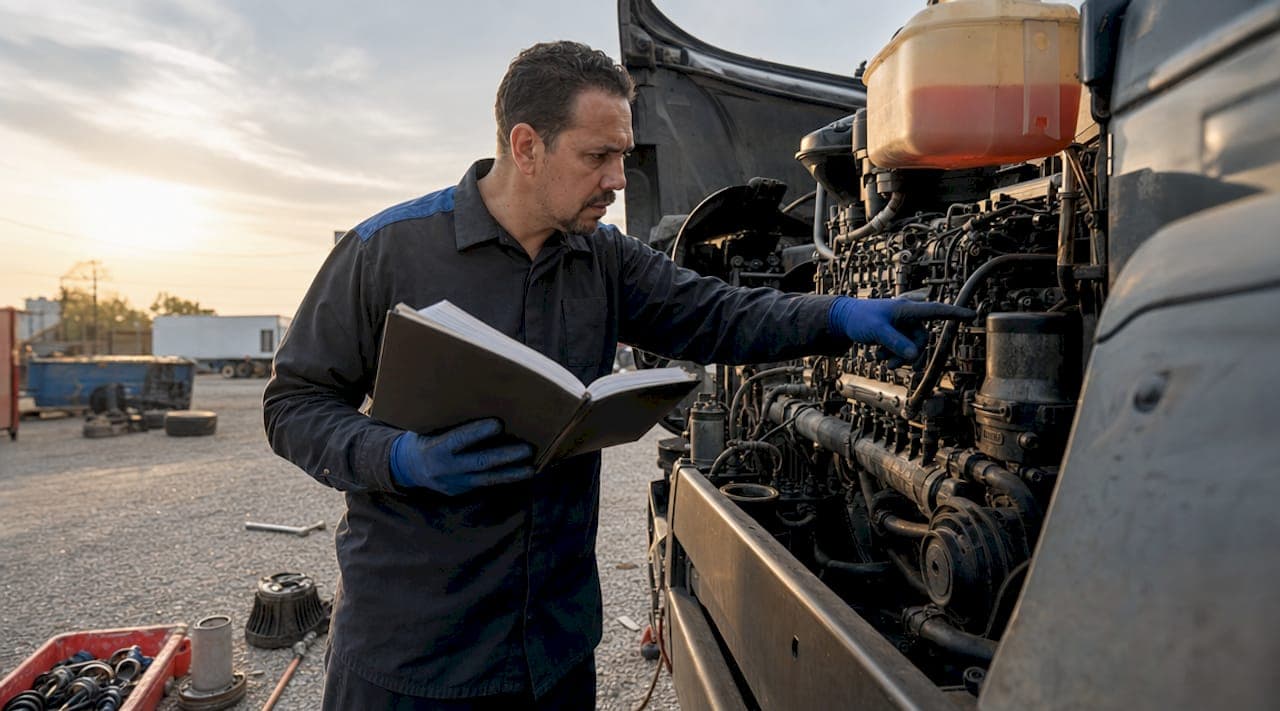
Types of commercial truck engine failures refer to specific mechanical, electrical, and system breakdowns that disable heavy-duty trucks, requiring prompt diagnosis to prevent compounding damage and revenue loss. For fleet maintenance professionals, understanding these failure categories is the difference between a scheduled repair and a catastrophic roadside breakdown. Repair costs range from $5,000 to $25,000 for catastrophic failures, with idle trucks losing $500 to $1,500 per day in revenue. The major component groups affected span the fuel system, cooling system, turbocharger assembly, electrical sensors, and emission controls. Knowing which failure type you are dealing with, and when in the engine's lifecycle it typically strikes, is the foundation of every effective fleet maintenance program.
1. The most common types of commercial truck engine failures
Engine overheating is the single most frequent cause of unplanned downtime in Class 8 trucks. It originates from coolant leaks, failed water pumps, clogged radiators, or a malfunctioning thermostat. Symptoms include rising coolant temperature gauges, steam from the hood, and sudden power loss. Left unaddressed, overheating warps cylinder heads and destroys head gaskets within minutes of onset.
Fuel injector failure ranks second in frequency among common engine problems in trucks. Worn or contaminated injectors produce rough idle, black or white exhaust smoke, and measurable fuel economy drops. Ultra-Low Sulfur Diesel reduces lubricity, accelerating wear on high-pressure pumps and injectors faster than older diesel formulations did. Fleets running high annual mileage on ULSD need to treat injector replacement as a scheduled item, not a reactive one.

Turbocharger failure is the third major category, and it is one of the most misdiagnosed. Oil starvation, contaminated oil, and heat soak after engine shutdown are the primary causes. Blue or gray smoke at startup, a high-pitched whine, and sluggish throttle response are the defining truck engine failure symptoms. Turbo failures in Detroit DD15 and Cummins ISX engines are particularly common in high-idle vocational applications.
Oil leaks, electrical and sensor faults, and emission system malfunctions round out the top six. Oil leaks accelerate bearing wear and can contaminate the aftertreatment system. Sensor failures generate false fault codes that mislead technicians. Emission system faults, including EGR valve sticking and DPF clogging, are the fastest-growing category in post-2010 trucks.
Pro Tip: When a truck presents with multiple fault codes simultaneously, start with the oldest active code in the ECM log. Newer codes are often downstream effects of the original fault, and chasing them first wastes diagnostic time.
2. How mileage and usage patterns shape failure timing
Engine component failures concentrate in three mileage windows: early service wear from 80,000 to 150,000 km, mid-life failures from 150,000 to 400,000 km, and major overhaul risk beyond 400,000 km. This lifecycle framework gives fleet managers a predictive lens for scheduling preventive work rather than reacting to breakdowns.
| Mileage window | Typical failure types | Primary cause |
|---|---|---|
| 80,000–150,000 km | Filters, belts, sensors, minor leaks | Normal wear, contamination |
| 150,000–400,000 km | Injectors, turbochargers, EGR valves | Accumulated wear, heat cycles |
| 400,000+ km | Pistons, bearings, cylinder liners | Fatigue, long-term wear |
Route type and idle hours compound these windows significantly. A truck running urban stop-and-go routes accumulates heat cycles and idle hours at twice the rate of a long-haul highway unit covering the same odometer distance. High idle hours accelerate EGR valve carbon buildup and DPF loading without the regeneration benefit of sustained highway speeds. Fuel quality at regional terminals also varies enough to shift injector wear into earlier mileage windows in some markets.
Pro Tip: Track engine hours alongside odometer miles in your fleet management system. A truck with 300,000 miles but 8,000 idle hours is mechanically closer to an overhaul candidate than its odometer suggests.
3. Causes and cascading effects of major engine failures
The most dangerous aspect of troubleshooting commercial truck engines is that a single failing component rarely fails in isolation. A single injector failure cascades into higher fuel consumption, soot buildup, rising piston temperatures, oil dilution, and accelerated bearing wear across the entire lower end. Technicians who replace only the injector without auditing connected systems often see the same truck back within weeks.
Overheating follows a similar cascade pattern. A failed water pump raises coolant temperature, which warps the head gasket, which allows combustion gases into the coolant circuit, which causes further overheating. The original $400 water pump repair becomes a $6,000 head gasket job if the driver continues operating after the first temperature warning.
Turbocharger failures carry the highest immediate safety risk. Sudden turbocharger shaft failure can occur without gradual decline, creating an abrupt loss of power at highway speed. The subtle early signs, including slight changes in fuel economy, a faint whine at high RPM, or oil consumption creeping upward, are the only reliable warning window. Fleets that log and trend these metrics catch turbo failures before they become roadside events.
Engines fail in cascades. Targeting only one component without auditing connected systems causes recurrent breakdowns that cost more than the original repair.
Fuel system contamination deserves specific attention. Water intrusion or microbial growth in fuel tanks degrades injector tips and high-pressure pump components simultaneously. The result is a truck that presents with multiple injector codes across all cylinders, which technicians sometimes misread as an ECM fault rather than a fuel quality problem.
4. Preventive maintenance and diagnostic practices that reduce failures
Routine oil analysis is the most cost-effective tool available for how to prevent engine failures in commercial trucks. Sending oil samples to a lab like Blackstone Laboratories or Polaris Laboratories every 25,000 miles reveals wear metals, fuel dilution, and coolant contamination weeks before symptoms appear. A single abnormal sample costs less than $30 to analyze and can prevent a bearing failure that costs $15,000 to repair.
Coolant analysis runs a close second. Silicate depletion and pH changes in coolant indicate imminent water pump seal failure and early corrosion inside the cooling circuit. Fleets running Cummins ISX or Detroit Series 60 engines should test coolant at every oil change interval given the thermal loads these platforms generate.
For electrical and sensor faults, platform-specific diagnostic software is not optional on post-2010 Class 8 trucks. Generic OBD readers misinterpret multiplexed fault codes on Paccar MX engines, Detroit DD15s, and International MaxxForce platforms, leading to unnecessary part replacements. Misdiagnosis of electrical faults costs an average of $1,200 per incident, excluding downtime. Investing in Cummins INSITE, Detroit Diesel Diagnostic Link, or JPRO Fleet Diagnostics pays for itself after the first avoided misdiagnosis.
Scheduled replacement of wear items is the third pillar of prevention:
- Replace fuel filters at manufacturer-specified intervals, not when pressure drop is noticed.
- Inspect and replace serpentine and accessory belts at 150,000 miles regardless of visual condition.
- Test NOx sensors and EGR valve function at every major service interval on 2010-and-newer trucks.
- Perform DPF cleaning on a mileage schedule rather than waiting for regeneration failures.
- Audit turbocharger oil supply lines for restriction or carbon buildup at each oil change.
Pro Tip: Blue smoke at cold startup is not always piston rings. Test valve stem seals and turbo oil seals first before authorizing an engine teardown. Misidentifying blue smoke as a ring failure leads to unnecessary overhauls when a $200 seal replacement would have resolved the issue.
5. How modern emission systems complicate engine failure diagnosis
Emission control components, specifically the DPF, SCR catalyst, EGR valve, and NOx sensors, are now the most frequently misdiagnosed systems in engine repair for commercial trucks. The core problem is that these components sit downstream of the engine and absorb the consequences of upstream failures. An oil leak past a turbo seal contaminates the DPF. A coolant leak into the combustion chamber loads the SCR catalyst with ash it cannot process. Aftertreatment misdiagnoses waste thousands replacing emissions parts when the actual fault is an upstream engine leak.
| Scenario | Wrong diagnosis | Correct diagnosis |
|---|---|---|
| DPF clogging at low mileage | DPF replacement | Oil leak past turbo seal |
| SCR catalyst failure | NOx sensor replacement | Coolant intrusion in combustion |
| EGR valve sticking | EGR replacement | Carbon buildup from short-trip idling |
| Repeated DPF regens | Fuel quality issue | Injector over-fueling |
The financial gap between preventive maintenance and failure remediation is stark. A scheduled DPF cleaning costs $300 to $500. A replacement DPF on a Cummins ISX15 or Detroit DD15 costs $2,500 to $4,000. Verifying engine health before replacing any emission component is not optional. It is the diagnostic step that separates a $300 repair from a $4,000 one.
Multiplexed control systems on post-2010 trucks add another layer of complexity. The aftertreatment control module communicates with the ECM, the transmission control module, and the body controller simultaneously. A fault in one module can generate phantom codes in another, sending technicians down the wrong diagnostic path entirely.
Key takeaways
Preventing commercial truck engine failures requires matching maintenance intervals to mileage windows, using platform-specific diagnostics, and auditing connected systems before replacing any single component.
| Point | Details |
|---|---|
| Failure cascades are the real cost driver | One injector or turbo failure triggers multiple system failures if connected components are not audited. |
| Mileage windows predict failure type | Early, mid-life, and late-stage failures follow predictable patterns that allow proactive scheduling. |
| Platform-specific tools prevent misdiagnosis | Generic scanners misread post-2010 emissions codes, costing an average of $1,200 per incident. |
| Emission parts fail last, not first | DPF and SCR failures are usually symptoms of upstream engine leaks, not primary faults. |
| Oil and coolant analysis catch failures early | Lab analysis at regular intervals detects wear and contamination weeks before mechanical symptoms appear. |
What I've learned about diagnosing modern truck engine failures
Post-2010 trucks have fundamentally changed what competent fleet maintenance looks like. The mechanical intuition that served technicians well on pre-emissions engines, listening for knock, watching for smoke, feeling for vibration, is still necessary but no longer sufficient. I have watched experienced mechanics replace three DPFs on the same truck in 18 months because nobody stopped to ask why the DPF kept failing. The answer, every time, was a turbo oil seal weeping into the exhaust stream.
The most underused tool in fleet maintenance is trending. Not just reading fault codes, but tracking how values change over time. A NOx sensor reading that drifts 8% over three months tells you far more than a snapshot reading that looks acceptable today. Fleets that invest in telematics platforms capable of logging engine parameters continuously catch failures in the early-warning window that manual inspections miss entirely.
My honest recommendation is to treat electrical and aftertreatment diagnostics as a separate skill set from mechanical repair. The technicians who are best at rebuilding engines are not always the best at reading multiplexed control systems, and vice versa. Structuring your shop to match the diagnostic task to the right technician cuts repeat repairs significantly. The fleet maintenance resources available today make this specialization more accessible than it has ever been.
The other shift I would push every fleet manager to make is moving from time-based to condition-based maintenance wherever oil and coolant analysis supports it. The data is cheap. The insight it provides is not available any other way.
— Carl
Where to source replacement engines when failures occur
When a commercial truck engine failure crosses the threshold from repair to replacement, sourcing a quality used engine quickly is what keeps your fleet moving.
Nationwideheavytruckparts stocks a daily-changing inventory of tested and inspected commercial truck engines from the platforms most likely to need replacement: CAT C15 and C13, Detroit DD15 and Series 60, Cummins ISX and ISM, and Mack MP7 and MP8 engines. Every unit ships with a standard warranty and same-day shipping is available on in-stock engines. For fleet managers who cannot afford extended downtime, Nationwideheavytruckparts provides the combination of verified part quality and fast fulfillment that keeps repair timelines tight. Browse the current inventory at Nationwideheavytruckparts.com to find the specific engine your truck needs.
FAQ
What are the most common types of commercial truck engine failures?
The six most common types are overheating, fuel injector failure, turbocharger failure, oil leaks, electrical and sensor faults, and emission system malfunctions including DPF and EGR failures. Each type produces distinct symptoms and follows predictable mileage windows.
What are the early warning signs of truck engine failure?
Key truck engine failure symptoms include unexplained fuel economy drops, rough idle, blue or white exhaust smoke, rising coolant temperatures, and unusual noises at startup or under load. Catching these signs early prevents single-component failures from cascading into full engine damage.
How much does a commercial truck engine failure cost to repair?
Catastrophic engine failures cost between $5,000 and $25,000 in parts and labor, with additional daily revenue losses of $500 to $1,500 per idle truck. Preventive maintenance and early detection reduce total repair costs significantly.
Why do emission system parts keep failing on the same truck?
Repeated DPF, EGR, or SCR failures almost always indicate an unresolved upstream engine problem such as a turbo oil seal leak or injector over-fueling. Replacing emissions parts without verifying engine health first produces the same failure within months.
What diagnostic tools work best for post-2010 Class 8 trucks?
Platform-specific software such as Cummins INSITE, Detroit Diesel Diagnostic Link, and JPRO Fleet Diagnostics are the standard for accurate fault code interpretation on modern trucks. Generic OBD scanners misread multiplexed emissions codes and lead to costly unnecessary repairs.