
Heavy truck diesel engines are classified into four primary categories: size and output, combustion cycle, engine platform family, and emissions generation. Understanding these types of heavy truck diesel engines directly affects which parts fit your truck, how you diagnose faults, and which engine you should buy. Manufacturers like Cummins, Detroit Diesel, and Volvo each organize their lineups around these same distinctions. Whether you are a fleet manager sourcing a replacement or a technician planning a service schedule, knowing the classification system saves time and prevents costly mistakes.
1. types of heavy truck diesel engines by size and output
Diesel engines are classified into three size segments: small (up to 288 hp), medium (up to 1,000 hp), and large (over 1,000 hp). Each segment maps directly to a different application, and that mapping determines part compatibility and repair complexity.
Small diesel engines (up to 288 hp) power lighter commercial trucks, delivery vans, and some pickup-class work vehicles. These engines use smaller injectors, lighter block castings, and simpler aftertreatment systems. Repair work on this class is generally faster and less specialized.
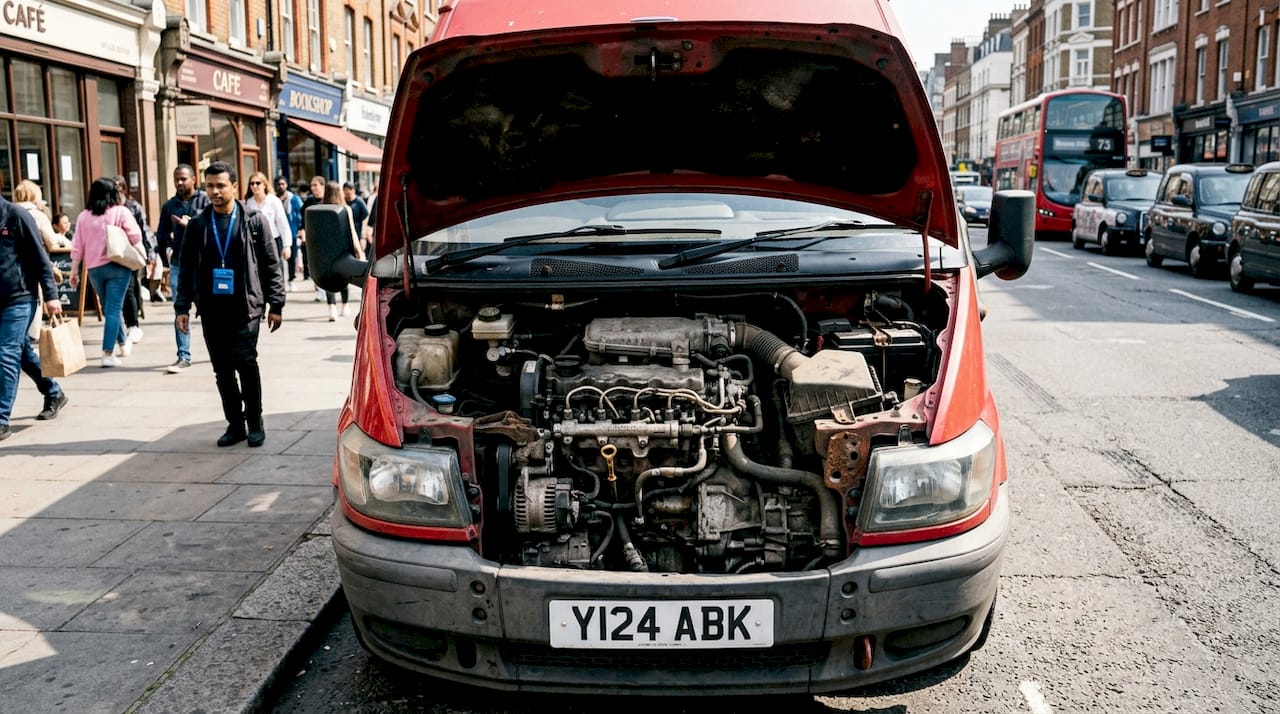
Medium diesel engines (up to 1,000 hp) cover the majority of Class 7 and Class 8 long-haul and regional trucks. This is where the Cummins X15, Detroit DD15, and Volvo Aero platform live. Most heavy-duty diesel service work in North America falls in this segment.
Large diesel engines (over 1,000 hp) power trains, marine vessels, and specialized mining or construction equipment. These engines share design principles with truck engines but require entirely different tooling, facilities, and parts sourcing.
Pro Tip: Before ordering any replacement part, confirm your engine's output rating from the dataplate, not just the model name. A "DD15" can carry different ratings depending on the truck spec, and the wrong part will not interchange.
2. two-stroke vs. four-stroke: combustion cycle types
The combustion cycle is the second major way to classify heavy truck diesel engines. Four-stroke diesel engines have largely replaced two-stroke designs across the entire commercial trucking industry. Two-stroke engines were phased out because of higher emissions output and more frequent mechanical failures. That matters to you if you are working on older trucks or sourcing used engines from the secondary market.
Here is how the two cycles compare in practice:
- Four-stroke cycle: Intake, compression, power, and exhaust each occupy a separate piston stroke. This design produces cleaner combustion and longer service intervals.
- Two-stroke cycle: Power fires on every revolution, which sounds efficient but creates more heat, more wear, and far more unburned fuel in the exhaust stream.
- Modern relevance: Every current production heavy truck diesel from Cummins, Detroit Diesel, and Volvo uses a four-stroke design. Two-stroke truck engines are a legacy concern, not a current purchase option.
- Service implication: If you encounter a two-stroke diesel in a fleet, assume it predates modern emissions hardware. Scan tools and aftertreatment service procedures for four-stroke engines will not apply.
Understanding the combustion cycle tells you immediately whether modern diagnostic equipment and current parts catalogs will cover the engine in front of you.
3. engine platform families: cummins, detroit diesel, and volvo
Engine platform families are the most practical classification for repair professionals and buyers. Distinct series within a platform are treated as separate engine types because their ratings and service profiles differ significantly.
| Engine Family | Model | Power Range | Key Feature |
|---|---|---|---|
| Cummins | X15 Efficiency | 400–500 hp | Fuel economy focus |
| Cummins | X15 Productivity | 500–605 hp | High-torque applications |
| Cummins | X12 | 350–500 hp | Lightweight, max payload |
| Detroit Diesel | DD13 Gen 6 | 425–505 hp | Regional haul |
| Detroit Diesel | DD15 Gen 6 | 455–560 hp | Long-haul standard |
| Detroit Diesel | DD16 Gen 6 | 475–605 hp | Heavy-haul, vocational |
| Volvo | Aero Platform | Varies | Fuel efficiency, alt-fuel ready |
The Cummins X12 is lighter and optimized for maximum payload, with output ranging 350–500 hp and torque from 1,250–1,700 lb-ft. That weight advantage directly increases legal payload capacity on weight-sensitive routes.
Detroit Diesel Gen 6 engines cover 425–605 hp across the DD13, DD15, and DD16 models. The DD13 and DD15 Gen 6 launch in january 2027, while the DD16 follows in january 2028. These staggered dates reflect the complexity of meeting new emissions targets at different displacement levels.
The Volvo Aero platform cuts fuel consumption by up to 5% compared to its predecessor. It also accepts biodiesel and hydrogen blends, which positions it for fleets planning ahead for fuel diversification.
Pro Tip: When sourcing a used engine from the Cummins X15 family, confirm whether it is the Efficiency or Productivity variant. The calibration files, injector specs, and turbocharger configurations differ between them, and mixing components causes performance and warranty issues.
4. how emissions regulations create new engine types
Emissions standards are now a primary classification axis for heavy duty diesel engines. The EPA 2027 low-NOx rule sets a maximum of 35 mg/hp-hr for NOx output. That limit is a sharp reduction from current standards and forces fundamental changes in engine hardware.
These changes create a hard line between pre-2027 and 2027-compliant engines:
- Larger SCR catalysts: 2027-spec engines carry bigger selective catalytic reduction systems to process more exhaust at lower temperatures.
- Altered DEF dosing: Diesel exhaust fluid injection strategies change to meet tighter NOx thresholds, affecting fluid consumption rates and injector service intervals.
- Increased DPF maintenance: Aftertreatment changes for 2027-compliant engines increase DPF cleaning frequency and add sensor monitoring complexity.
- Diagnostic tool requirements: Different scan tools and service routines are required for pre-2027 and 2027-compliant engines, even within the same engine family name.
The 2027 NOx standard is the biggest single driver of new diesel engine types entering the market. Fleets buying engines now need to decide whether to stock pre-2027 inventory or prepare their shops for the new service demands of compliant hardware.
5. diesel vs. petrol: why diesel dominates heavy trucks
Diesel engines produce more torque at lower RPM than petrol engines of equivalent displacement. That characteristic makes them the only practical choice for Class 7 and Class 8 trucks carrying heavy loads over long distances. Petrol engines burn fuel faster under sustained load, which raises operating costs to a level that makes them uncompetitive in commercial trucking.
Diesel fuel also contains more energy per gallon than petrol. That energy density advantage compounds over hundreds of thousands of miles in a fleet operation. Maintenance intervals for diesel engines are longer under normal operating conditions, which reduces downtime in high-utilization fleets.
The comparison is not close for heavy-duty applications. Diesel's torque curve, fuel economy, and durability under sustained load have no current petrol equivalent at Class 8 gross vehicle weights.
6. how to choose the best heavy truck diesel engine type
Matching the right engine type to your application requires four decisions. Work through them in order.
| Decision | What to Evaluate | Why It Matters |
|---|---|---|
| Engine size | Truck class and payload requirements | Oversized engines waste fuel; undersized engines fail early |
| Platform family | Brand support, parts availability, shop familiarity | Affects repair speed and parts cost |
| Emissions generation | Pre-2027 vs. 2027-compliant | Determines aftertreatment complexity and diagnostic tooling |
| Fuel compatibility | Biodiesel, ULSD, or alternative fuel blends | Affects injector and seal material selection |
For long-haul Class 8 operations, the Cummins X15 Productivity or Detroit DD15 Gen 6 cover most duty cycles. For weight-sensitive regional routes, the Cummins X12 offers a payload advantage that directly affects revenue per load. For fleets with vocational or heavy-haul requirements, the DD16 or X15 Performance series handle sustained high-torque demands better than mid-range options.
Pro Tip: Always check the engine's emissions generation before purchasing used. A pre-2027 engine bought in late 2026 may require aftertreatment upgrades to remain compliant in certain states, adding cost that erases the purchase price advantage.
Key takeaways
Heavy truck diesel engines are best understood by classifying them first by size, then by combustion cycle, platform family, and emissions generation, in that order.
| Point | Details |
|---|---|
| Size classification comes first | Small, medium, and large output bands determine application fit and parts compatibility. |
| Four-stroke dominates modern trucks | Two-stroke designs are legacy equipment; all current production trucks use four-stroke engines. |
| Platform families differ within brands | Cummins X15 Efficiency and Productivity are separate engine types with different service profiles. |
| 2027 NOx rules create a new engine class | Pre-2027 and 2027-compliant engines require different scan tools, DEF strategies, and DPF service intervals. |
| Emissions generation affects purchase value | Buying without confirming emissions compliance can add unexpected aftertreatment upgrade costs. |
What 15 years around diesel engines taught me
The most common mistake I see from buyers and technicians alike is treating the model name as the full story. A "DD15" bought in 2024 and a DD15 Gen 6 launching in 2027 share a name and almost nothing else in terms of calibration, aftertreatment hardware, or diagnostic requirements. Generation changes within engine families bring updates that affect warranty, parts, and service in ways that catch people off guard.
My advice is to start every engine evaluation with two questions: What is the output rating, and what emissions generation is it? Those two data points tell you more than the model name ever will. From there, the combustion cycle question answers itself, since everything current is four-stroke.
The 2027 NOx transition is the most significant shift I have seen since the 2010 EPA standards. Shops that have not started planning for the new aftertreatment complexity will face a steep learning curve when Gen 6 Detroit and next-generation Cummins engines start arriving for service. Read the manufacturer tech guides now, not after the first one rolls into your bay.
One more thing: categorize by size and combustion type before you go to brand. It sounds basic, but it prevents the part compatibility errors that cost shops real money.
— Carl
Find the right diesel engine at Nationwideheavytruckparts
Nationwideheavytruckparts carries a daily-changing inventory of tested and inspected heavy truck diesel engines from Cummins, Detroit Diesel, Caterpillar, Mack, and more. Every engine ships with a standard warranty, and same-day shipping gets your truck back on the road fast.
Whether you need a Cummins diesel engine for a long-haul fleet rebuild or a Detroit Diesel engine to replace a Gen 5 unit before the 2027 transition, Nationwideheavytruckparts has the inventory and the expertise to match you with the right engine. Browse the full selection of commercial truck engines online or call to confirm compatibility before you order.
FAQ
What are the main types of heavy truck diesel engines?
Heavy truck diesel engines are classified by size (small, medium, large), combustion cycle (four-stroke), engine platform family (such as Cummins X15 or Detroit DD15), and emissions generation. Each classification affects part compatibility, service requirements, and purchase decisions.
What is the difference between the cummins x15 efficiency and productivity?
The X15 Efficiency is tuned for fuel economy at lower power outputs, while the X15 Productivity targets higher torque and horsepower for demanding duty cycles. They carry different calibration files, injector specs, and turbocharger configurations, so parts do not interchange between them.
Why are two-stroke diesel engines no longer used in heavy trucks?
Two-stroke diesel engines were phased out because they produce higher emissions and experience more frequent mechanical failures than four-stroke designs. Every current production heavy truck from major manufacturers uses a four-stroke engine.
How do 2027 EPA nox rules affect engine types?
The 2027 EPA rule limits NOx to 35 mg/hp-hr, which requires larger SCR systems, revised DEF dosing, and more frequent DPF maintenance. These changes make 2027-compliant engines a distinct type requiring different diagnostic tools and service procedures than pre-2027 engines.
How do i identify which engine type is in my truck?
Read the engine dataplate for the model name, output rating, and serial number, then cross-reference with the manufacturer's emissions certification label. The serial number prefix identifies the engine family and emissions generation, which determines the correct parts catalog and scan tool protocol.