
Engine replacement is the most financially and operationally sound choice for fleet managers and truck owners who need to extend vehicle life without absorbing the full cost of a new truck. A new Class 8 truck averages $180,000, while a comprehensive engine overhaul runs about $30,000, preserving $150,000 in capital per unit. That gap compounds further when you factor in immediate depreciation, multi-year loan interest, and the operational disruption of integrating new equipment into an existing fleet. Understanding why engine replacement beats full truck purchase requires looking at the full financial picture, not just the sticker price.
Why engine replacement beats full truck purchase on cost
The financial case for engine replacement over a new truck purchase is not close. Avoiding a $150,000 loan saves roughly $42,000 in interest over five years at an 8.5% commercial rate. That $42,000 alone would cover a second engine overhaul with money left over. Fleet managers who finance new trucks are not just paying for the truck. They are paying for the privilege of borrowing the money to buy it.
Depreciation makes the math worse. New trucks lose 20% of their value immediately after purchase, while a quality engine overhaul can increase resale value by up to 30%. That is a 50-percentage-point swing in asset value from a single decision. A truck that was worth $80,000 before an engine replacement can command significantly more on resale than a new truck that has already shed $36,000 in value the moment it left the lot.
The 15% to 20% maintenance cost rule is a useful threshold for this decision. When annual repair bills exceed 20% of a truck's market value, you have hit what fleet analysts call the "maintenance cliff," the point where continued repairs cost more than financing a replacement. Below that threshold, engine replacement is almost always the better financial move.
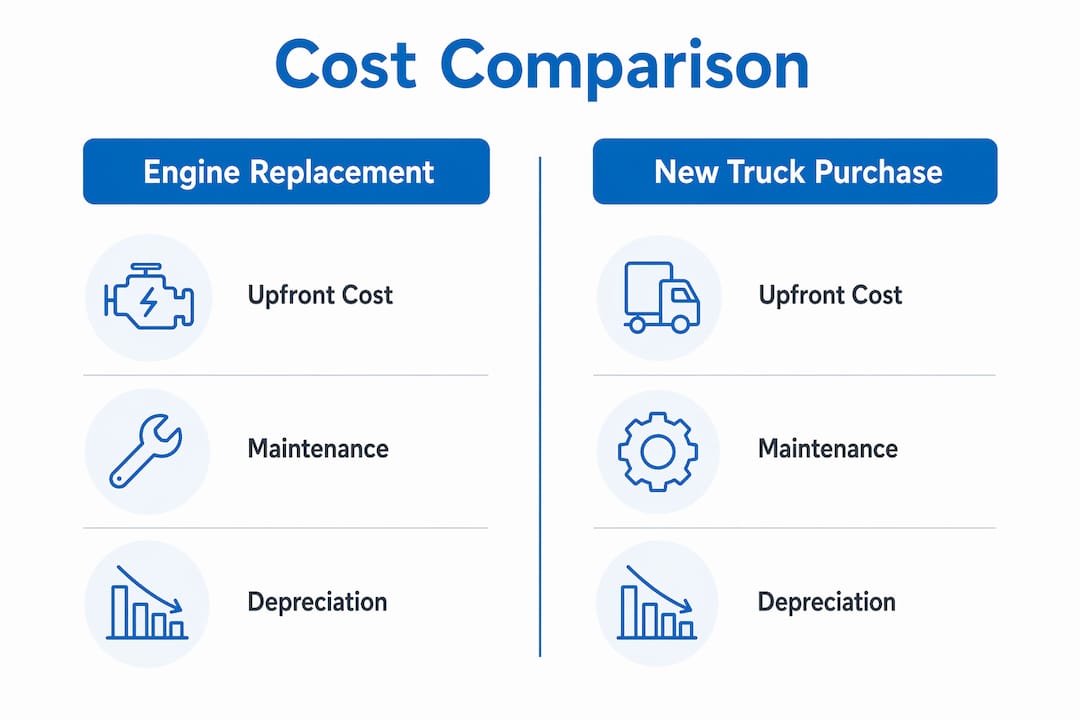
| Cost Factor | Engine Replacement | New Truck Purchase |
|---|---|---|
| Upfront cost | ~$30,000 | ~$180,000 |
| 5-year interest (8.5%) | Minimal or none | ~$42,000 |
| First-year depreciation | None | ~$36,000 |
| Resale value impact | +30% increase | -20% immediate loss |
| Tax treatment | Full deduction, 1 year | 5-year depreciation |
Pro Tip: Before approving any new truck purchase, calculate the total cost of ownership over five years including interest, insurance, and registration fees. In most cases, that number will exceed $250,000 for a single Class 8 unit, making the $30,000 engine overhaul look even more compelling.
What operational advantages does engine replacement offer?
The financial comparison is only part of the story. Operational continuity is where engine replacement delivers advantages that rarely appear in a spreadsheet. Scheduled engine replacements reduce unscheduled downtime by 65%, and downtime costs average $760 per hour across the industry. A single unexpected breakdown can wipe out days of margin.

Emergency breakdowns carry costs beyond the lost revenue. Roadside failures generate an average $1,200 in daily revenue loss plus $800 or more in towing fees. A planned engine replacement, scheduled during a low-demand period, eliminates that risk entirely. You control the timing. An unplanned breakdown controls you.
Fleet consistency is another advantage that gets underestimated. When drivers, mechanics, and dispatch teams work with familiar vehicles, productivity stays high. Introducing new truck models creates training requirements, parts stocking changes, and diagnostic tool updates. A fleet of ten identical trucks with replaced engines is operationally simpler than a mixed fleet of five old and five new units.
Here is what operational disruption actually looks like in practice:
- A new truck requires 30 to 60 days for delivery, upfitting, and driver orientation before it generates revenue.
- Mechanics must learn new diagnostic systems, which increases repair time and labor cost during the transition period.
- Parts inventory built around existing truck models becomes partially obsolete, creating waste and procurement gaps.
- Warranty claims on new trucks often require dealer service, pulling vehicles out of your control and into a service queue.
Professionally remanufactured engines can extend truck life by 400,000 to 600,000 miles, which directly contradicts the assumption that high mileage means end of life. A well-maintained Cummins ISX or Detroit DD15 with a remanufactured engine can run reliably for another decade. That is a decade of avoided truck payments.
When should you replace the engine vs. buy a new truck?
Engine replacement is not the right answer in every situation. The condition of the chassis and transmission determines whether an engine investment pays off or triggers a cascade of follow-on repairs. A sound engine in a failing chassis is money wasted.
Use this decision framework before committing to either path:
- Assess transmission condition first. Transmission rebuilds cost between $3,000 and $8,000. If the transmission is also near failure, combined repair costs approaching 50% to 60% of the truck's market value signal that full replacement may be more practical.
- Count the repair clusters. One major repair is manageable. Two or three major repairs in the same 12-month window, covering the engine, transmission, and suspension, indicate systemic aging across multiple systems simultaneously.
- Check the chassis and frame. Rust, frame cracks, or bent rails cannot be fixed by a new engine. If the structure is compromised, the truck is not worth the investment regardless of engine condition.
- Review mileage in context. Mileage alone is a poor indicator. A 700,000-mile truck with a documented maintenance history and sound chassis is a better candidate for engine replacement than a 400,000-mile truck with deferred maintenance and unknown service records.
- Factor in the truck's market value. A truck worth $40,000 can justify a $20,000 engine replacement. A truck worth $15,000 cannot justify the same investment unless the chassis and drivetrain are in exceptional condition.
Pro Tip: Request a full pre-replacement inspection from a certified diesel mechanic before approving any engine overhaul. A $300 inspection that reveals a failing transmission saves you from a $15,000 mistake.
The risk of buying used trucks as an alternative deserves attention here. 45% of used trucks purchased at auction require major repairs within 90 days, which negates the upfront savings almost immediately. A remanufactured engine with a warranty is a known quantity. An auctioned used truck is not.
How do tax implications affect the engine vs. new truck decision?
Tax treatment creates a meaningful financial advantage for engine replacement that most fleet managers do not fully account for when running their numbers. Section 179 allows businesses to deduct 100% of engine overhaul costs in a single tax year, rather than spreading the deduction across five years as required for new truck depreciation.
Here is what that difference means in practice:
- A $30,000 engine overhaul deducted in full in year one reduces taxable income by $30,000 immediately, improving cash flow in the same fiscal year the expense occurs.
- A $180,000 truck depreciated over five years generates roughly $36,000 in annual deductions, meaning you wait five years to recover the full tax benefit while carrying the full debt load from day one.
- The cash flow difference in year one alone can fund additional maintenance, driver wages, or a second engine replacement elsewhere in the fleet.
The Section 179 depreciation advantage in 2026 makes engine overhauls particularly attractive for fleet operators managing tight annual budgets. The deduction timing aligns with the expense, rather than trailing it by years. Consult a tax professional familiar with trucking operations to confirm eligibility and optimize the deduction structure for your specific fleet size and entity type.
Key takeaways
Engine replacement beats full truck purchase because it preserves $150,000 in capital, avoids immediate depreciation, reduces unscheduled downtime by 65%, and delivers a full tax deduction in a single year.
| Point | Details |
|---|---|
| Capital preservation | Engine overhauls cost ~$30,000 versus ~$180,000 for a new Class 8 truck. |
| Depreciation advantage | New trucks lose 20% value immediately; engine replacement can increase resale value by 30%. |
| Downtime control | Scheduled replacements reduce unscheduled downtime by 65%, avoiding $760/hour losses. |
| Tax efficiency | Section 179 allows full overhaul cost deduction in one year versus a 5-year depreciation schedule for new trucks. |
| Decision threshold | When combined repairs exceed 50% to 60% of truck market value, full replacement becomes justified. |
What I've learned from watching fleets make this decision wrong
The most common mistake I see fleet managers make is treating engine replacement as a last resort rather than a planned capital event. They run a truck until it fails catastrophically, then face the decision under pressure with no time to source the right engine, negotiate pricing, or schedule the work during a low-demand window. That reactive posture turns a $30,000 planned expense into a $50,000 emergency.
The second mistake is ignoring the transmission when evaluating engine replacement. I have watched operators invest in a quality Cummins ISX replacement only to have the transmission fail four months later, triggering another $6,000 repair and a second round of downtime. The engine and transmission age together. You cannot assess one without assessing the other.
What actually works is treating engine replacement as a scheduled capital event, the same way you treat tire rotations or DOT inspections. When you know a truck is approaching 400,000 miles with a solid chassis, you budget for the engine replacement 12 months out, source a certified remanufactured unit from a supplier like Nationwideheavytruckparts, and schedule the swap during your slowest operational week. That approach converts a potential crisis into a controlled cost.
The fleets I have seen run the most efficiently are not the ones with the newest trucks. They are the ones with the most disciplined asset management. A 2018 Freightliner with a remanufactured Detroit DD15 and a documented service history is a more reliable revenue generator than a 2024 truck financed at 8.5% with a $3,200 monthly payment eating into every load's margin.
— Carl
Get the right engine from Nationwideheavytruckparts
When the numbers point to engine replacement, the next decision is sourcing a unit you can trust. Nationwideheavytruckparts carries a wide selection of commercial truck engines from the brands your fleet already runs, including CAT C15 and C13 units, Cummins ISX engines, Detroit DD15 and Series 60 engines, and Mack MP7 and MP8 powerplants.
Every engine is inspected and tested before it ships, and each unit comes backed by a standard warranty so you are not trading one risk for another. Inventory changes daily, and same-day shipping means your truck gets back on the road without a week-long wait. If you are evaluating engine replacement vs. new truck purchase and need a reliable source for the replacement unit, Nationwideheavytruckparts is the place to start.
FAQ
How much does a truck engine replacement cost?
A comprehensive engine overhaul for a Class 8 truck costs approximately $30,000, compared to $180,000 for a new truck purchase. The exact cost varies by engine brand, such as Cummins, CAT, or Detroit Diesel, and whether you choose a remanufactured or used unit.
Is it worth replacing the engine in a high-mileage truck?
Yes, if the chassis and transmission are in sound condition. Professionally remanufactured engines can extend a truck's reliable service life by 400,000 to 600,000 additional miles, making high mileage alone a poor reason to retire an otherwise solid vehicle.
When do repair costs justify buying a new truck instead?
When combined repair costs approach 50% to 60% of the truck's current market value, full replacement becomes more practical than continued investment in the existing unit. Multiple simultaneous system failures, covering the engine, transmission, and chassis, are the clearest signal to consider replacement.
What is the Section 179 advantage for engine replacement?
Section 179 allows businesses to deduct 100% of engine overhaul costs in the year the expense occurs, versus a five-year depreciation schedule required for new truck purchases. This creates an immediate cash flow benefit that makes engine replacement even more attractive from a tax planning perspective.
Are used auction trucks a reliable alternative to engine replacement?
No. Approximately 45% of used trucks purchased at auction require major repairs within 90 days, which eliminates the upfront cost savings quickly. A remanufactured engine with a warranty from a vetted supplier carries significantly less risk than an auctioned truck with an unknown service history.