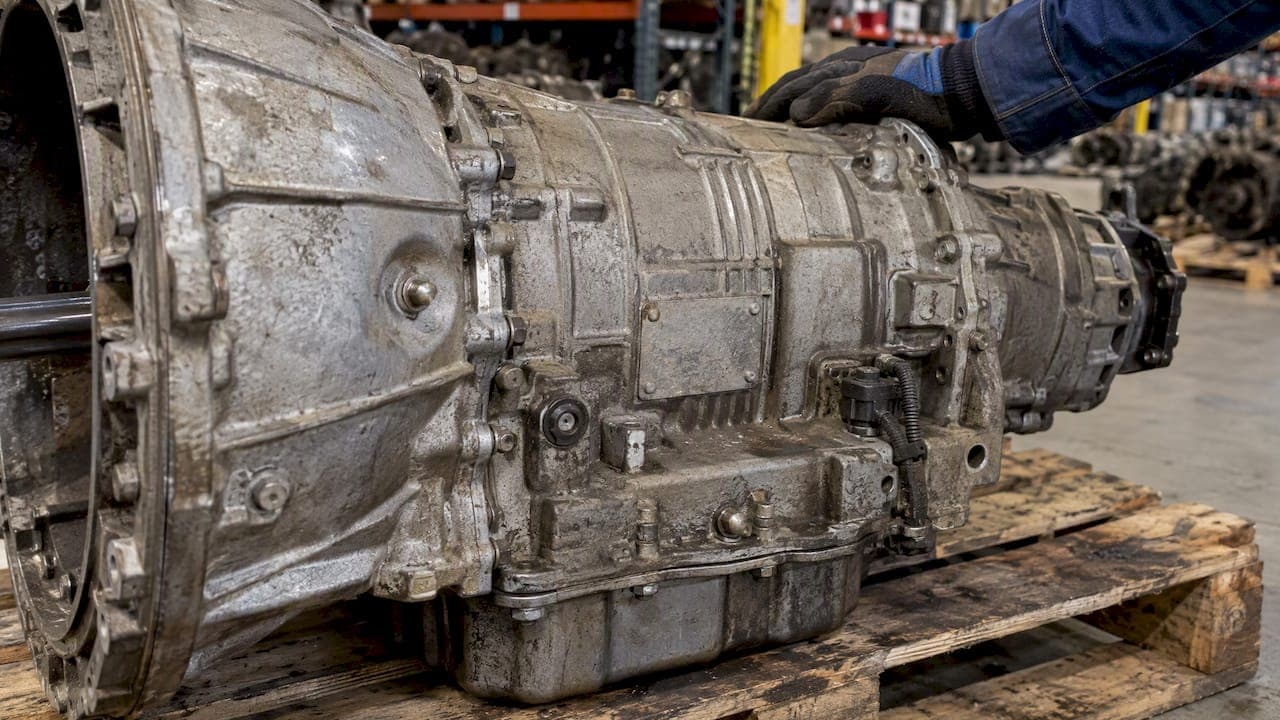
The serial number on an Allison transmission sits on a tag on the outside of the case. On most units you will find it on the passenger side, toward the rear. On the 5000, 6000, 8000 and 9000 series, look at the lower rear face of the rear housing. The tag also carries the model designation, which is what a parts counter needs along with the serial number.
This guide shows where to look on each family of Allison, what the tag tells you, what to do when it is painted over or missing, and how to confirm that a used transmission is the right one before you pay for it.
TL;DR
- Start on the passenger side of the case, near the rear. Larger Allisons carry the tag on the lower rear face of the rear housing.
- The tag lists the serial number and the model. Older tags also show an assembly (part) number. Newer tags may show less.
- Tags can be wrong on used units. Always check the serial number against the truck's VIN and build data.
- If the tag is gone, gather horsepower, shift selector description and vehicle age, then call an Allison distributor or dealer.
- Give the serial number and model to your parts supplier before you order a used transmission.
Table of Contents
- Where the Allison tag is located
- What is on the tag
- Look the serial number up in Allison HUB
- When the tag is painted over, worn or missing
- Why the tag alone is not enough on a used unit
- Reading electronic data: why Allison DOC matters
- Buying a used Allison: what to send your supplier
- Our perspective: identification before inventory
- Need a replacement transmission?
- Common mistakes when reading Allison serial numbers
- A short background on Allison
- FAQ
- Sources
Where the Allison tag is located
Allison identification tags are riveted or stuck to the housing, and the usual spot is the right rear, passenger side of the case. That holds for the 1000 and 2000 series that sit behind a lot of medium-duty trucks, school buses and motorhomes. Position still varies by series and by build year, so use the table below as a starting map.
| Series | Where to look first | What you may find |
|---|---|---|
| 1000 / 2000 (including 2100, 2200, 2400, 2500 variants) | Passenger side of the case, toward the rear | A metal tag on older units, or a white label near the oil pan split line on newer ones |
| 3000 / 4000 | Side of the case, rear section | Metal data plate with model and serial number |
| 5000, 6000, 8000, 9000 (including motorhome M-series units) | Lower rear face of the rear housing | Aluminum nameplate with model and serial number |
The 1000 series detail comes from a forum thread where owners describe a metal tag on the passenger side of older units and a white label near the pan split line on recent ones. The larger-series location is confirmed by an owner on an RV forum describing the aluminum nameplate on the lower rear face of the rear housing. Treat forum posts as a pointer, not as the final word. If the tag is not where you expect, check the whole rear half of the case before assuming it is gone.
Getting a clear view of the tag
On a truck in service, the tag is often hidden behind a crossmember, a driveshaft, a heat shield or a layer of road grime and undercoating. A few habits save time:
- Let the transmission cool, chock the wheels and set the parking brake before you crawl under.
- Wipe the area with a rag and a degreaser. Do not scrape the tag with a screwdriver, because scratches can destroy the stamped digits.
- Use a bright flashlight held at a low angle. Raised or stamped characters read better with side light than with direct light.
- Take a photo of the tag with your phone. It is easier to zoom in on a photo than to squint upside down under a truck.
- Write down the model and the full serial number twice, then compare what you wrote to the photo.
If you are standing at a truck stop with a stranded rig, the photo alone is usually enough for a parts supplier to start working on your problem.
What is on the tag
Older Allison tags usually display three things: the assembly (part) number, the model number and the serial number. On many newer units the assembly number has been replaced by product group codes. If you are comparing a used unit to an older catalog, do not be alarmed when a newer tag looks different. It carries enough information, the serial number and the model, for Allison's online systems to identify the exact build.
Each item does a different job:
- Model number. This tells you the family and the capability, for example whether you have a 1000, a 2500 or a 4000 series. A supplier needs it to know the physical envelope, mounting and gear ratios you are dealing with.
- Assembly (part) number. On older tags, the part number of the unit helps you work out the model if the model is unknown. The catalog gives examples where one assembly number maps to one model.
- Serial number. It denotes the date the unit was produced and matters when a design change occurred. Allison catalogs often list a serial number to separate parts that changed during a production run.
That last point is why a serial number beats a guess based on model year. Two transmissions of the same model can use different internal parts depending on when they were built. A serial number settles the question.
One format note: a supplier of Allison units describes the serial number as typically ten digits, shown under the model number at the bottom left of the data plate. Serial formats have changed over the years and remanufactured units can carry their own numbering, so a number that does not fit this pattern is a reason to ask questions, not proof of a problem.
Look the serial number up in Allison HUB
Once you have the number, put it to work. Allison runs Allison HUB, a central place for technical information. You can enter a serial number to check warranty status, search the parts catalog by serial, assembly or detail part number, and pull build history and field action data. Access is open to everyone, including independent owners and fleet managers.
Two practical uses:
- Before you repair. Confirm the exact model and build so you order the right seal kit, filter kit or valve body parts.
- Before you buy used. Check that the serial number on a used unit resolves to the model the seller says it is. If the lookup returns something different, stop and ask why.
Allison's own service pages also say that your product can be identified through the serial number, and that warranty and maintenance information is tied to it as well.
When the tag is painted over, worn or missing
Tags do not last forever on trucks that run in salt, sand and diesel spray. Some data on the plate can wear off with time. If you cannot read it, you still have options.
Clean and re-read first
Most unreadable tags are just dirty. Degrease, wipe, and try the low-angle flashlight trick before you give up. A pencil rubbing on a sheet of paper can bring out stamped characters that your eyes miss.

Check the paperwork
Allison's service FAQ says that to find your transmission model you should check your vehicle or order paperwork. The original build sheet, a past repair invoice or a fleet maintenance record often lists both model and serial number. Fleet managers who keep these records in a spec database have a big advantage here.
Call a distributor with vehicle details
If the tag is truly gone, the same Allison FAQ says to call an Allison distributor or dealer. Before you call, have ready the vehicle's engine horsepower, the shift selector description and the vehicle's age. Allison transmissions are built into specific vehicle configurations, so authorized distributors can often use those details to narrow down the model and serial number range. For technical questions, the Allison Technical Assistance Center is available around the clock at 1-800-252-5283, though support for legacy models can be limited.
Do not rely on a guess
Ordering a transmission by looking at it and saying "that looks like a 3000" is how people end up with a unit that bolts up wrong or has the wrong gear ratio. If you cannot identify it, say so to your supplier. A good one would rather spend ten minutes on identification than process a return.
Why the tag alone is not enough on a used unit
This is the part many guides skip. A serial number tag tells you what the tag says, not necessarily what is inside the case.
Experienced mechanics warn that it is common to find the wrong tag on a transmission. That can come from an improper earlier repair, a transplant from another vehicle or a mistake during remanufacturing. If you order parts or a replacement unit based on a wrong tag, you pay for the mistake in freight, downtime and labor.
The same source recommends cross-checking the Allison serial number against the vehicle's VIN or the chassis manufacturer's build data whenever possible. In practice, that dual check looks like this:
- Read the tag on the transmission currently in the truck and record the model and serial number.
- Pull the truck's VIN and decode the build data from the chassis manufacturer or your dealer.
- Compare the transmission model on the build data with the tag. If they match, you have strong confirmation.
- If they disagree, treat the unit as a possible swap. Check for evidence: different bolt colors, non-original wiring, mismatched shift selector.
- Run the serial number through Allison HUB and see what build it resolves to.
We cover the same kind of cross-checking for other components in our heavy truck parts compatibility checklist for fleet managers and in how to confirm engine compatibility for heavy trucks. The logic carries over to transmissions.
Reading electronic data: why Allison DOC matters
Modern Allisons are electronically controlled. The serial number tells you what the hardware is, but fault codes, calibrations and TCM programming live in software. Allison names Allison DOC as the tool for diagnosing and servicing its electronic systems, and generic scanners may read basic codes without covering everything a repair needs. Allison DOC requires a valid subscription license, and the capability depends on the version (Premium, Fleets or Classic).
Why mention this in a serial number article? Because when you swap in a used transmission, the TCM often needs to be compatible with the unit and sometimes reprogrammed. Knowing the exact model and serial number before you buy tells your shop what to expect.
Buying a used Allison: what to send your supplier
When you contact a parts seller about a used transmission, a complete request gets you a faster and more accurate answer. Send:
- Photo of the tag on your current transmission, plus the typed model and serial number
- Truck make, model, model year and VIN
- Engine make and horsepower
- Shift selector type (push-button or lever) and PTO needs, if any
- Whether the truck is a motorhome, bus, vocational or on-highway application
- Any special notes: a past swap, a remanufactured unit, a missing tag
With that, the supplier can match model and build rather than guess. It also protects you if a mismatch turns up later, because there is a record of what you asked for.
Our perspective: identification before inventory
We sell used heavy truck parts, and we see the same pattern again and again. A buyer has a truck down, a deadline and a transmission they think they know. The fastest orders are not the ones with the shortest conversation. They are the ones where the buyer has the model and serial number in hand, a photo of the tag and the VIN next to it.
Here is how we think about it:
- Match the numbers, then verify them. A matching tag is the gold standard, but tags move between units. We always want the VIN-to-build-data check as well.
- Identification is cheaper than a return. Ten minutes with a flashlight and a rag costs nothing next to a wrong unit on a lowboy.
- Ask what the tag cannot tell you. Mileage history, prior repairs and whether the unit was tested are separate questions. Every part we sell is tested and inspected and comes with a standard warranty, and we would rather you ask about that than assume.
- Inventory changes daily. If one unit does not fit, another may. Check back rather than settling for something close.
If you are not sure of your model, tell us what you do know and we will help you work through it.
— John
Need a replacement transmission?
Once you know your model and serial number, you can browse our transmissions for sale. Our parts are tested and inspected before sale, come with a standard warranty and ship nationwide with same-day shipping. If your truck needs more than a transmission, we also stock truck engines, differentials and exhausts.
Have the tag photo, VIN and a description of your application ready, and the match goes quicker.

Common mistakes when reading Allison serial numbers
- Reading the wrong plate. Engines, axles and other components carry their own tags. Make sure you are on the transmission case, not the bellhousing or an adjacent component.
- Misreading characters. Zeros and the letter O, ones and the letter I, and eights and Bs get confused on worn tags. When a lookup fails, try the alternatives.
- Trusting a mismatched tag. As covered above, a swapped tag will send you toward the wrong parts.
- Assuming the model from the vehicle. The same truck model can be sold with different Allison models depending on engine, axle ratio and application.
- Comparing a new tag to an old catalog. Tag layouts changed over time. A missing assembly number is not a red flag by itself.
A short background on Allison
It helps to know who stands behind the tag. Allison Transmission was founded in 1915 by James A. Allison and is headquartered in Indianapolis, Indiana. It has been an independent company since being separated from General Motors, and it trades on the NYSE as ALSN. That history explains why older forum posts and manuals sometimes refer to GM Powertrain on the tag or in the paperwork: units built under GM ownership carry that labeling, and it does not mean the unit is unusual.
FAQ
Where is the serial number on an Allison 1000 transmission?
Check the passenger side of the case toward the rear. Older units have a metal tag there, while newer ones can have a white label near the oil pan split line. Clean the area first, since road grime often covers it.
How many digits is an Allison serial number?
Many Allison serial numbers are ten digits, listed under the model number on the data plate. Formats differ between eras and remanufactured units, so do not reject a number only because its length looks different. Run it through Allison HUB to confirm what it resolves to.
What if the Allison tag is missing or unreadable?
Check your vehicle or order paperwork for the model first. If that fails, call an Allison distributor or dealer with the engine horsepower, shift selector description and vehicle age. They can often narrow down the right model and serial range from those details.
Can I trust the tag on a used transmission?
Not on its own. Tags can end up on the wrong unit through transplants, earlier repairs or remanufacturing mistakes. Verify the serial number against the truck's VIN and the chassis build data before you order parts or a replacement.
Does the VIN tell me which transmission is in the truck?
Not directly. The VIN identifies the chassis, and the build data tied to it can show the factory-installed transmission model. That is why we suggest checking the tag against build data, and not decoding the VIN alone.
Sources
- Allison 1000/2000 transmission tech tips
- Allison HUB
- FAQs and service tips, Allison Transmission
- Service tools and information, Allison Transmission
- Electronic diagnostics and essential tools, Allison Transmission
- History and heritage, Allison Transmission
- Allison catalog (2011)
- Allison catalog, serial number explanation
- Location Allison 1000 Serial # (forum thread)
- Allison series identification (RV forum thread)
- Locate your Allison transmission serial number