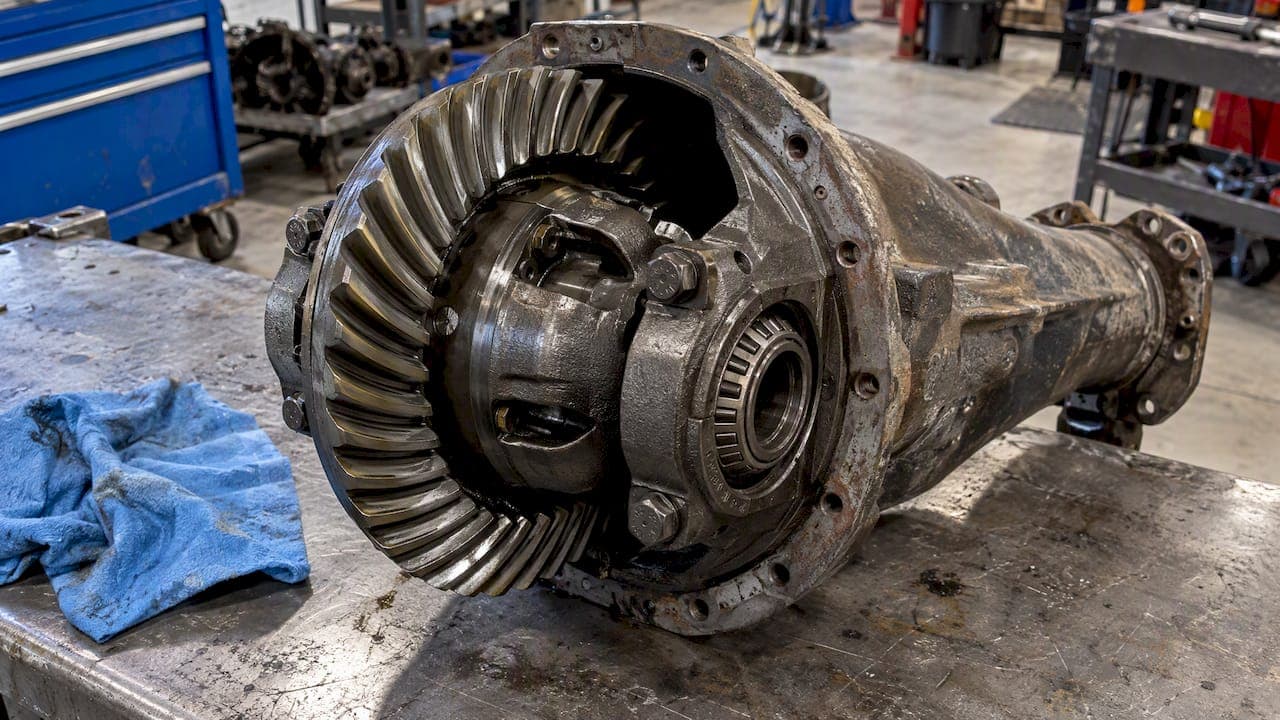
Your semi truck gear ratio is the axle ratio multiplied by the transmission's final gear ratio, and it decides how fast the engine spins at highway speed. A higher numeric axle ratio gives more low-speed torque but raises cruising RPM. A lower one cuts RPM and saves fuel if your engine and transmission suit it, which is the logic behind downspeeding. Match the ratio to your transmission, load and route.
TL;DR:
- Multiply the axle ratio by the transmission’s top gear ratio; a 3.42 axle with 0.73 overdrive yields a 2.50 overall ratio.
- With tires at 500 revolutions per mile and 0.73 overdrive, a 2.64 axle runs about 960 RPM at 60 mph, versus 1,300 with 3.55.
- Highway routes favor lower ratios when torque supports low RPM; mixed routes suit middle ratios, while steep grades or frequent stops favor 3.5 to 3.9.
- A 1.00 direct drive leaves the axle ratio unchanged, while 0.73 overdrive reduces it; automated shifting can keep low axle ratios within the engine’s torque band.
- Before ordering, verify the axle tag and model, calculate cruise RPM using tire revolutions per mile, and confirm fit and torque rating with the installer.
Table of Contents
- What is a semi truck gear ratio and how do you calculate it?
- How do gear ratios affect speed, RPM, torque and fuel economy?
- Which axle ratios fit which jobs?
- How do transmission type and electronics change the best axle ratio?
- How do you choose the right ratio for your truck?
- Which differentials do we recommend for common ratios?
- Why spec sheets are only half the answer
- FAQ
- Sources
What is a semi truck gear ratio and how do you calculate it?
The axle ratio is how many times the driveshaft turns for one turn of the wheels. The transmission's final gear ratio is the multiplier in top gear. Multiply them and you get the overall ratio, which is the correct comparator for drivetrain setups because axle ratio alone hides what the transmission is doing.
A Freightliner example: a 0.73 overdrive top gear times a 3.42 axle gives about 2.50 overall.
- Axle ratio: stamped on the axle tag, and often listed on the build sheet or in the door jamb paperwork.
- Transmission ratios: published in the maker's spec tables, such as Eaton's transmission ratios listing.
- Worked RPM example: say your tires turn 500 revolutions per mile (illustrative). At 60 mph that is 30,000 tire revolutions per hour, or 500 per minute. Multiply by a 2.50 overall ratio and the engine turns about 1,250 RPM.
For axle identification tips, our drive shaft guide covers the driveline components you will be checking.
How do gear ratios affect speed, RPM, torque and fuel economy?
At any given road speed, a numerically higher overall ratio makes the engine spin faster. That multiplies more torque at the wheels, which helps on grades and with heavy loads, but burns more fuel cruising. A lower numeric ratio does the opposite: calmer RPM, less low-speed grunt.

Published gear tables make this concrete. An NTSB docket lists a Meritor RT-40-145A axle with a 3.9 ratio behind a Fuller 10-speed, and its table shows each gear producing a different road speed and RPM.
Downspeeding is the modern answer to the trade-off. According to Kenworth and Eaton experts, downspeeding means matching engine, transmission and axle so the truck holds the lowest fuel-efficient RPM.
- Torque: lower RPM only works if the engine makes enough torque there. Our diesel torque explainer shows why the torque curve matters.
- Tires: revs per mile change everything above, so keep tire size and inflation consistent.
- Mismatch risk: a taller gear without enough engine torque leads to lugging, higher maintenance costs and poor driveability.
Which axle ratios fit which jobs?
Axle ratios vary, and the right choice follows your duty cycle.
- Long-haul downspeeding (lower numeric ratio): steady highway miles and lower cruising RPM, best when paired with an automated or direct-drive transmission and a torque-rich engine.
- Regional and mixed (middle-range ratio): a balance of highway speed and hill work, common with overdrive manual transmissions.
- Heavy-grade or short-haul (around 3.5 to 3.9): more multiplication for steep grades, heavy loads and frequent stops, at the cost of higher cruise RPM.
A quick comparison at the same speed, using the illustrative 500 revs-per-mile tire and a 0.73 overdrive: a 2.64 axle gives an overall ratio of about 1.93, or roughly 960 RPM at 60 mph. A 3.55 axle gives about 2.59, or roughly 1,300 RPM. That gap of roughly 340 RPM is why ratio choice shows up in fuel bills.
How do transmission type and electronics change the best axle ratio?
Transmission top gear sets the starting point. A 0.73 overdrive multiplies the axle ratio down, so a 3.42 axle yields about 2.50 overall. A 1.00 direct drive leaves the axle ratio unchanged, so a 3.42 axle stays 3.42 overall. Direct drive transmissions let operators use lower axle ratios while retaining grade capability, because the gears below top are closer together.
Automated transmissions go further. Kenworth explains that the Eaton Fuller Advantage tunes shift logic to the engine's fuel map to keep RPM low, using short step ratios to hold torque on grades. PACCAR documentation adds that integrated systems offer predictive cruise, grade downshifting and neutral coast modes.
- Direct drive: pairs with lower numeric axles for the same cruising RPM.
- Overdrive: traditionally pairs with higher numeric axles.
- Automated: software keeps the engine in its best torque band, so a lower axle ratio often works.
Pro Tip: Never pick an axle ratio from the axle ratio alone. Compute the overall ratio with your transmission's top gear first.
How do you choose the right ratio for your truck?
Weigh gross combination weight, typical payload, route profile, target cruise speed, the engine torque curve, transmission type and tire revs per mile. Then work through these steps:
- Record your current axle ratio, transmission top-gear ratio and tire revs per mile.
- Compute your overall ratio and cruising RPM at your target speed.
- Model candidate ratios the same way.
- Check each candidate against your engine's torque at that RPM.
- Confirm fit and torque rating with your supplier or installer.
Ask any supplier about axle model compatibility, torque rating, inspection details, warranty and shipping time. Our testing standards overview explains what inspection should cover.
| Situation | Direction to consider | Watch for |
|---|---|---|
| Long highway runs, automated transmission | Lower numeric ratio | Enough engine torque at low RPM |
| Mixed regional routes | Middle ratio | Hill pulls at cruise speed |
| Heavy grades, frequent stops | Higher numeric ratio | Higher cruise RPM |
Remember the two failure modes: lugging from a ratio too tall for the engine, and overspin from one too short.
Which differentials do we recommend for common ratios?

Check each differential’s listing for inspection details, warranty terms and shipping information. Three options cover different ratio needs:
- Detroit Alliance RT40-4N differential assembly: a low numeric ratio for downspeeding setups.
- Meritor-Rockwell MT40-14X rear differential: a middle ratio for regional work.
- Meritor-Rockwell MT40-14X differential: a higher numeric ratio for heavier or hillier duty.
Send us your VIN or axle model before you order. Browse our full differentials category, or pair a new ratio with the right transmission, engine or exhaust.
Why spec sheets are only half the answer
Specs tell you what should work. The shop floor tells you what does. Before you commit to a ratio, read the axle tag yourself instead of trusting a listing, and ask for the unit's inspection details. Then test the numbers against your real route: engine torque, transmission and terrain have to agree. A ratio that wins on paper but makes the engine lug on your hills is the wrong ratio.
— John
FAQ
Is a 3.31 or 3.73 axle ratio better?
Neither is better everywhere. A higher numeric ratio gives more low-speed torque for heavy loads and grades but raises cruising RPM, while a lower ratio runs lower RPM on the highway. Choose by load, route and transmission.
Where can I find the gear ratio on a truck?
Check the axle tag on the differential housing first. Build sheets and door jamb paperwork often list it too, and the transmission's ratio comes from its spec sheet, such as the Eaton Fuller driver instructions.
How many gears can a semi-truck have?
Common heavy-duty transmissions have 10 or 12 forward speeds, and some models have more. The Fuller FRO-16210C in the NTSB table is a 10-speed.
Does tire choice change the effective gear ratio?
Yes. Tire size changes revs per mile, which shifts cruising RPM, and inflation matters for fuel economy: every 10 psi of underinflation can cost about 1%.
Sources
- Fleetmaintenance
- Data
- Eaton Fuller Advantage Offers Added Fuel Savings For Kenworth T680 | Kenworth
- Accu-components