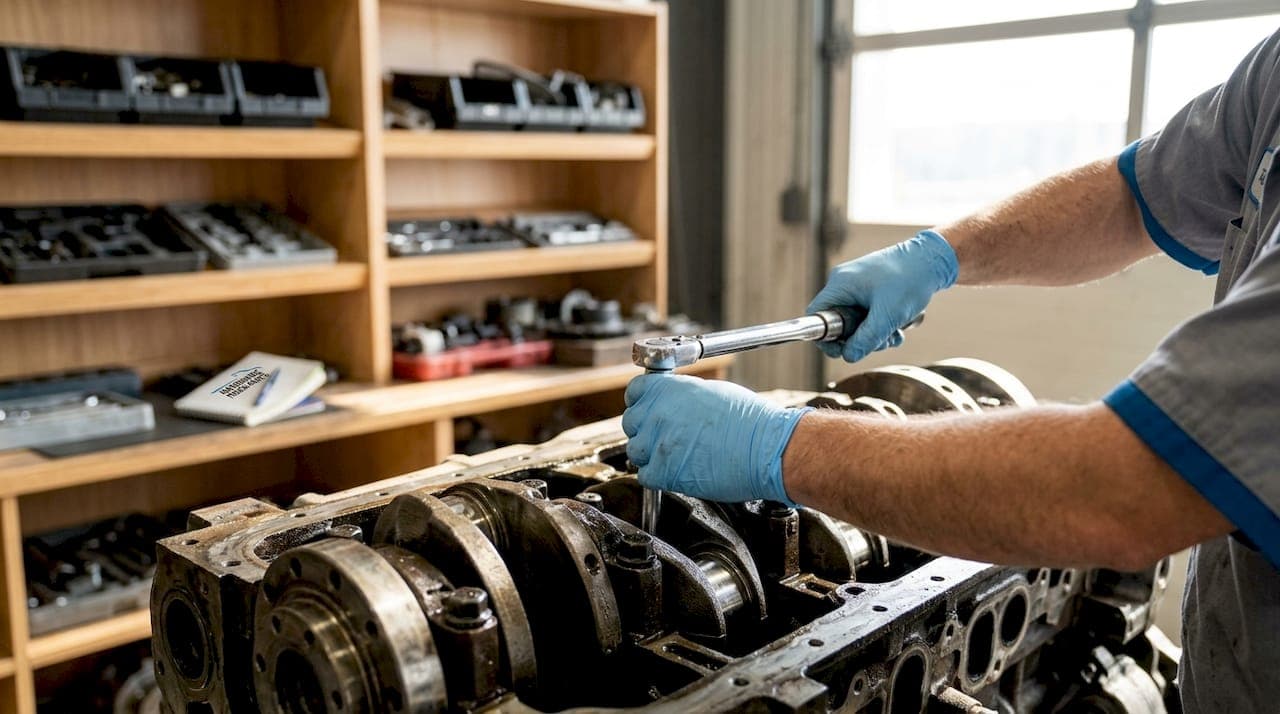
Diesel engine torque is defined as the rotational twisting force produced at the crankshaft, measured in pound-feet (lb-ft) or newton-meters (Nm), that gives a diesel engine its ability to move heavy loads from a standstill. Understanding what is diesel engine torque explained correctly means separating it from horsepower: torque measures the pulling strength, while horsepower measures how fast that work gets done. The standard formula connecting both is Horsepower = (Torque × RPM) / 5,252. For anyone who tows, hauls, or runs a heavy truck, torque is the number that actually matters at the moment the load starts moving.
Why do diesel engines produce more torque than gasoline engines?
Diesel engines generate higher torque than gasoline engines because of three core design factors: compression ratios, fuel energy density, and engine architecture. Each factor stacks on the others to produce a force advantage that gasoline engines simply cannot match at low speeds.
High compression ratios and combustion force
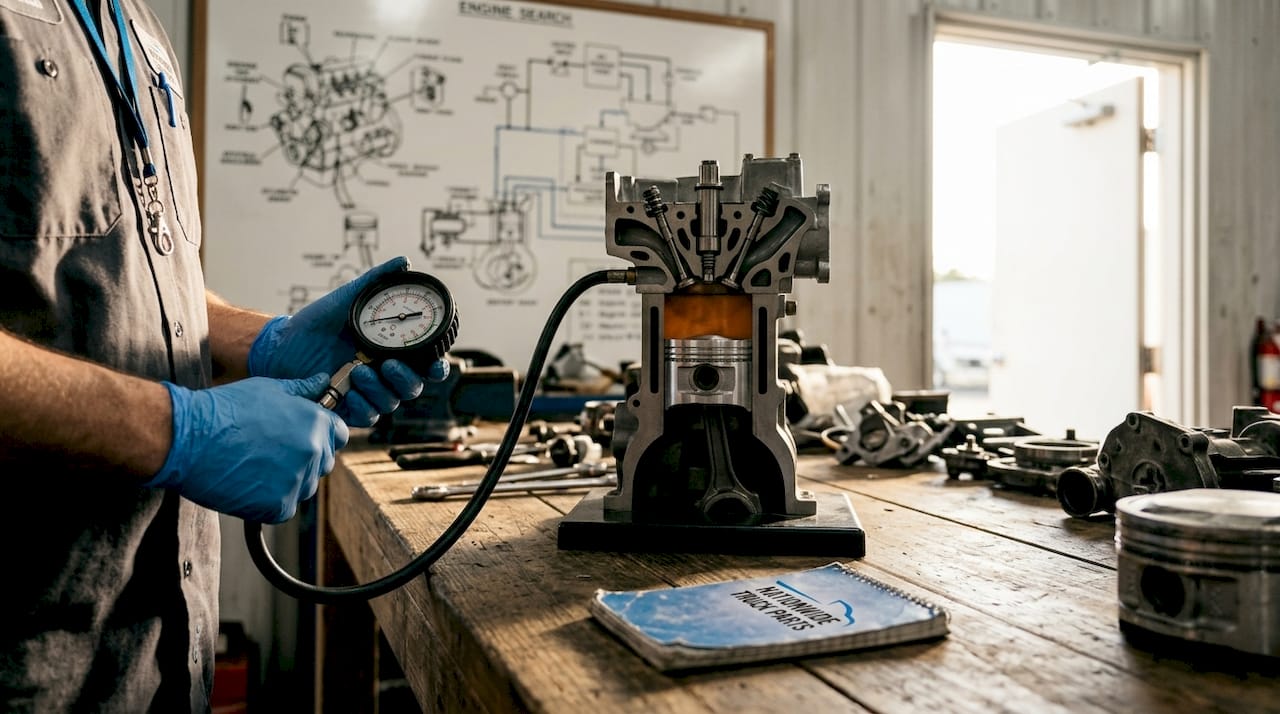
Diesel engines operate at compression ratios of 14:1 to 25:1, far above the 8:1 to 12:1 typical of gasoline engines. That extreme compression heats the air inside the cylinder until the diesel fuel ignites on its own, a process called compression ignition. The resulting combustion pressure is dramatically higher than what a spark plug can produce, and that pressure pushes down on the piston with far greater force. Greater force on the piston means greater torque at the crankshaft.
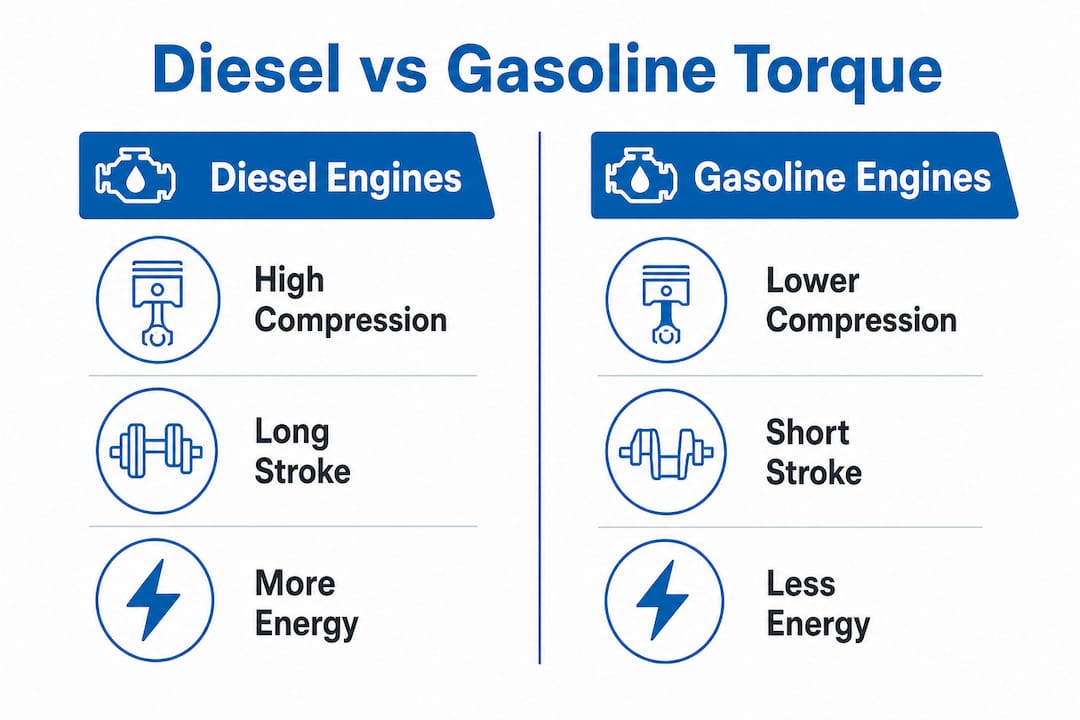
Diesel fuel also carries more energy per gallon than gasoline. Diesel engines convert that energy at 40–55% brake thermal efficiency, which means less energy is wasted as heat and more goes directly into mechanical work. That efficiency gap is a direct contributor to the torque advantage you feel when a diesel truck pulls away from a stop.
Long-stroke architecture
Diesel engines use a long-stroke design where the piston travels a greater distance inside the cylinder compared to short-stroke gasoline engines. A longer stroke gives the combustion gases more time to push the piston down, and a longer piston arm creates greater leverage on the crankshaft. Think of it like using a longer wrench: the same force applied at a greater distance produces more turning power.
Turbocharging multiplies the effect
Most modern diesel engines add a turbocharger to force more air into the cylinder before combustion. More air means more oxygen, which allows more fuel to burn, which raises cylinder pressure further. The result is a torque output that would be impossible from a naturally aspirated engine of the same displacement.
- Compression ignition produces higher peak cylinder pressure than spark ignition
- Long-stroke design increases crankshaft leverage
- High energy density in diesel fuel raises combustion output
- Turbocharging forces additional air into the cylinder, amplifying pressure
- Combined, these factors produce torque at low RPM where gasoline engines are weakest
Pro Tip: When comparing diesel specs, check the RPM at which peak torque is reached. A lower RPM number means the engine delivers its full pulling power sooner, which matters most for towing and hauling.
How does diesel torque influence performance and drivability?
The most important practical fact about diesel torque is where it shows up on the RPM range. Diesel engines deliver peak torque between 1,200 and 1,800 RPM, which is barely above idle. That means full pulling power is available the moment you press the accelerator, without needing to rev the engine.
Gasoline engines typically need 4,000 RPM or higher to reach peak torque. A diesel driver moving a loaded trailer feels the difference immediately: the truck pulls hard from the first foot of movement, with no waiting for the engine to build speed.
Here is how that low-RPM torque advantage plays out in real driving situations:
- Towing from a stop. The engine delivers maximum twisting force before the vehicle has moved 10 feet, preventing the stall or hesitation common in underpowered gasoline setups.
- Sustained highway grades. A diesel holds its torque across a wide RPM band, so the driver rarely needs to downshift on a long climb.
- Stop-and-go fleet work. Diesel engines produce a flat wall of force nearly instantly, making them far more efficient in repeated start-stop cycles than engines that depend on high RPM.
- Heavy equipment operation. Industrial engines like the Caterpillar 3512C deliver peak torque below 1,500 RPM, which is why they power cranes, generators, and mining equipment without complaint.
- Fuel economy under load. Because the engine does not need to rev high to produce force, it burns less fuel per unit of work. That efficiency matters enormously in fleet fuel costs over thousands of miles.
"Torque is the 'feel' of the engine at low speed. It is the force that responds immediately when a load is applied, without requiring the driver to build RPM first. For anyone moving weight for a living, that instant response is not a luxury. It is the difference between a productive day and a frustrating one."
The Ram 2500 with the Cummins turbo-diesel produces 1,075 lb-ft of torque at approximately 1,800 RPM, with peak power arriving at around 2,800 RPM. That gap between peak torque and peak power is the sweet spot where diesel engines live and where their drivability advantage is most obvious.
How is diesel torque measured, and how does it relate to horsepower?
The formula Horsepower = (Torque × RPM) / 5,252 is the standard relationship between the two metrics. One consequence of that formula is that torque and horsepower curves always cross at 5,252 RPM, regardless of the engine. Below that point, torque is numerically higher than horsepower. Above it, horsepower is higher. Diesel engines spend almost all their working life well below 5,252 RPM, which is why their torque numbers dominate their spec sheets.
Peak torque alone does not tell the full story. The torque curve, which shows how torque changes across the entire RPM range, matters more for real-world use. A diesel engine with a broad, flat torque curve delivers consistent pulling power across a wide band of engine speeds. An engine with a narrow torque peak requires careful gear selection to stay in the power band.
Pro Tip: Ask for a torque curve chart, not just a peak number, when evaluating a used diesel engine. A flat curve from 1,200 to 2,200 RPM is more useful for heavy hauling than a sharp spike at one RPM point.
Wheel torque adds another layer to the measurement. Wheel torque equals engine torque multiplied by the transmission and final drive gear ratios. A lower-torque engine with a well-matched gearbox can outperform a higher-torque engine with poor gearing in real-world acceleration. This is why drivetrain components, including differentials and transmissions, are as important as the engine itself when building for torque-dependent work. You can learn more about how different diesel engine types interact with drivetrain components in heavy-duty applications.
| Metric | What it measures | Why it matters |
|---|---|---|
| Engine torque (lb-ft or Nm) | Twisting force at the crankshaft | Sets the baseline pulling strength |
| Peak torque RPM | Engine speed at maximum torque | Lower is better for towing and hauling |
| Torque curve width | Usable RPM band at near-peak torque | Wider band means less downshifting |
| Wheel torque | Engine torque × gear ratios | Actual force moving the vehicle |
| Horsepower | Rate of work (torque × RPM / 5,252) | Determines top-end speed and sustained power |
Practical considerations for tuning, durability, and real-world use
Torque is not only a performance metric. It is also a durability factor. Higher torque at lower speeds reduces mechanical stress and heat buildup inside a diesel engine, which directly extends service life. A diesel doing heavy work at 1,600 RPM experiences far less wear than a gasoline engine doing the same work at 4,500 RPM.
For enthusiasts who want to increase torque through tuning, the critical variable is Exhaust Gas Temperature (EGT). Increasing fuel delivery raises torque, but it also raises EGT. Safe EGT limits typically fall between 1,300°F and 1,400°F to protect the turbocharger and pistons. Exceeding those limits risks catastrophic component failure, even on engines with strong baseline torque. Monitoring EGT with a dedicated gauge is not optional when tuning for more torque.
Key practical points for diesel owners and enthusiasts:
- Monitor EGT during any tune. Fuel delivery increases raise torque but push EGT toward dangerous levels quickly.
- Match the transmission to the torque output. A gearbox rated below the engine's torque capacity will fail under sustained load.
- Use torque characteristics to extend engine life. Running a diesel in its torque band, rather than pushing high RPM, reduces heat and wear. Proper habits also support longer engine life in owner-operator settings.
- Do not confuse peak torque with usable torque. A broad torque band beats a sharp peak for fleet and industrial use every time.
- Avoid common misconceptions. More torque does not always mean more fuel consumption. At moderate speeds, diesel engines use torque efficiently, which is why they dominate long-haul and heavy-duty applications.
Pro Tip: If you are sourcing a used diesel engine for a torque-heavy application, verify the engine's service history at the RPM ranges you plan to use. An engine that spent its life at highway cruise RPM is in better condition for towing work than one that was repeatedly pushed to redline.
Key Takeaways
Diesel engine torque is the single most important performance metric for any application involving heavy loads, towing, or sustained pulling force at low engine speeds.
| Point | Details |
|---|---|
| Torque definition | Torque is the rotational twisting force at the crankshaft, measured in lb-ft or Nm. |
| Diesel torque advantage | High compression ratios, long-stroke design, and turbocharging give diesels superior low-RPM torque. |
| Peak torque RPM | Diesel engines reach peak torque between 1,200 and 1,800 RPM, delivering full force almost instantly. |
| Wheel torque matters | Engine torque multiplied by gear ratios determines actual pulling force at the wheels. |
| Tuning and durability | Monitoring EGT between 1,300°F and 1,400°F is required when tuning for higher torque output. |
Why torque is the spec I always check first
After years of working with diesel engines across heavy trucks, fleet vehicles, and industrial equipment, I have come to one firm conclusion: peak horsepower is a marketing number, and peak torque is an engineering number. Horsepower tells you how fast a vehicle can go. Torque tells you whether it can actually do the job.
The enthusiasts I see get burned are the ones who buy an engine based on horsepower ratings without checking the torque curve. A broad, flat torque band from 1,200 to 2,000 RPM is worth more in a work truck than a sharp horsepower peak at 3,500 RPM that disappears the moment you put a load on the hitch.
My advice for anyone evaluating a diesel engine: look at the RPM where peak torque arrives, look at how wide that torque band is, and then look at the drivetrain components that will multiply or limit that torque at the wheels. The engine is only part of the equation. The transmission and differential ratios determine what actually reaches the ground. Get those three numbers right, and the horsepower figure becomes almost irrelevant for real-world heavy-duty work.
— John
Diesel engine and drivetrain parts built for torque-heavy work
Nationwide Truck Parts stocks tested and inspected heavy truck diesel engines and drivetrain components for owners who need reliable torque-focused builds and replacements.
If you are replacing a worn engine or upgrading a drivetrain for higher torque capacity, the inventory includes proven options like the 2015 Paccar MX13 engine and the 2013 Mack MP8 445 engine assembly, both known for strong low-RPM torque output. For drivetrain components that multiply engine torque at the wheels, the Meritor-Rockwell MT40-14X differential assembly and Eaton-Fuller FRO-14210B transmission are available with same-day shipping. Nationwide Truck Parts backs every part with a standard warranty and daily-updated inventory, so you find what you need without waiting.
FAQ
What is the diesel engine torque definition?
Diesel engine torque is the rotational twisting force produced at the crankshaft, measured in pound-feet (lb-ft) or newton-meters (Nm). It represents the engine's pulling strength, particularly at low RPM.
Why do diesel engines produce more torque than gasoline engines?
Diesel engines use compression ratios of 14:1 to 25:1, long-stroke architecture, and turbocharging to generate far higher cylinder pressures than gasoline engines. Those higher pressures translate directly into greater crankshaft torque.
At what RPM do diesel engines reach peak torque?
Most diesel engines reach peak torque between 1,200 and 1,800 RPM. That low-RPM delivery is why diesels feel so responsive under load without needing to rev high.
What is the difference between engine torque and wheel torque?
Engine torque is the force produced at the crankshaft, while wheel torque is engine torque multiplied by the transmission and final drive gear ratios. A well-geared drivetrain can deliver more effective pulling force than raw engine torque numbers suggest.
How does torque affect diesel engine lifespan?
Higher torque at lower speeds means the engine does heavy work without running at high RPM, which reduces heat buildup and mechanical wear. Diesel engines that operate consistently in their torque band tend to last longer than gasoline engines doing equivalent work at high RPM.