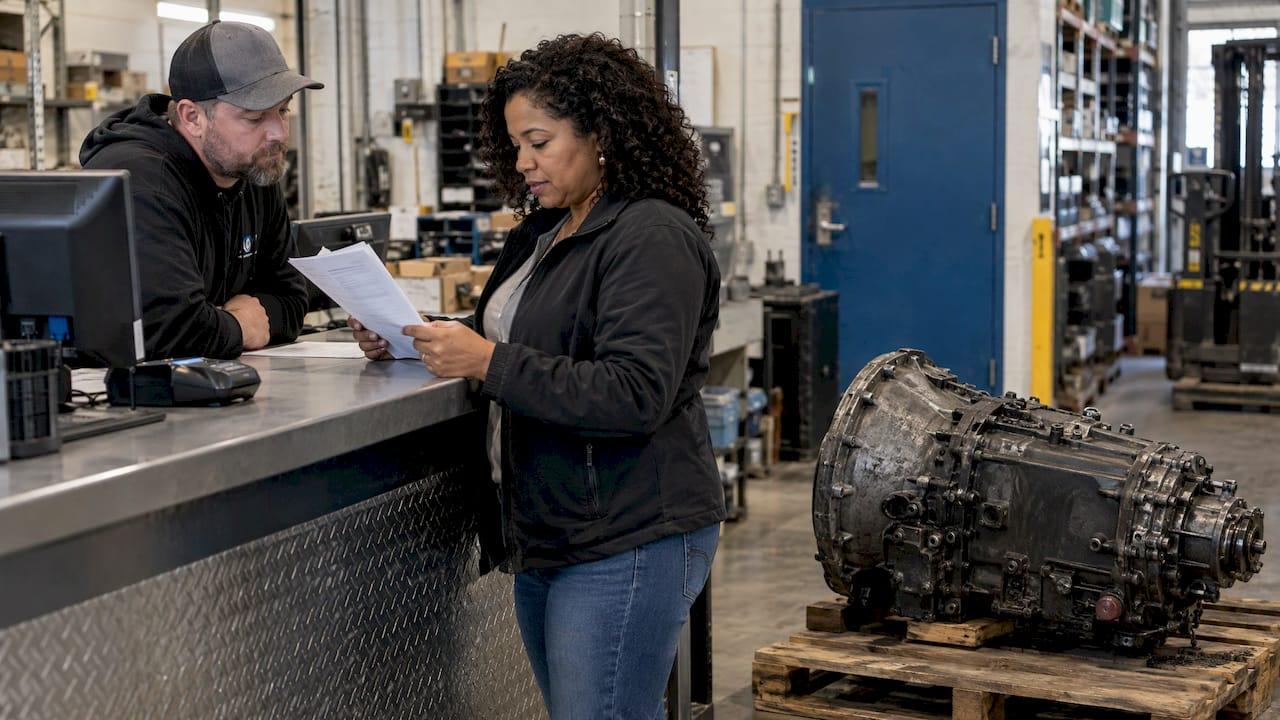
A truck parts warranty is the seller's written promise that a part will work as sold for a set time, and the paper behind that promise matters more than the headline. The best coverage for an owner-operator or fleet is a warranty on a part that was tested and inspected before it shipped, with terms you can read, a claim process you can follow and a seller that ships fast when you need a replacement. That is how we build every sale at Nationwide Truck Parts: each part is tested and inspected, carries our standard warranty and ships the same day.
Below you will find what a warranty covers, how manufacturer terms read in practice, the exclusions that sink claims, how a claim works and a checklist for comparing terms on engines, transmissions and differentials.
TL;DR
- A warranty is a promise on specific parts for a defined time. An "extended warranty" is usually a separate service contract, and the federal consumer agency says it covers only certain components.
- Manufacturer terms vary widely by part: Ford's new-parts warranty runs 24 months, while Mercedes-Benz lists 48 months/50,000 miles on remanufactured engines.
- Claims fail on paperwork and installation conditions more often than on the part itself: receipts, dates, fault codes and approved labor.
- Compare coverage period, what is excluded, who pays labor, how fast you can file and how fast a replacement reaches you.
- Every part we sell is tested, inspected and covered by our standard warranty, with same-day shipping.
Table of Contents
- What a truck parts warranty actually covers
- Warranty versus extended warranty versus service contract
- How manufacturer terms look in practice
- Exclusions and conditions that decide a claim
- How a warranty claim works
- What to compare before you buy
- Which buyer needs what
- The warranty on a used part, done right
- Perspective
- Find your part
- FAQ
- Sources
What a truck parts warranty actually covers
The Consumer Financial Protection Bureau explains that a manufacturer's warranty generally covers defects or failures for a period after purchase and comes with the vehicle automatically. Optional extended warranties cover certain mechanical or electrical components the manufacturer's warranty does not, and service contracts or prepaid maintenance plans are separate products again.
For a part you buy to replace a failed one, you are dealing with the part's own warranty, the seller's promise on that specific engine, transmission or differential. It does not depend on your truck's original factory coverage, which is useful when the truck is well past its first warranty period, as most working trucks are.
In plain terms, a parts warranty usually answers four questions:
- What is covered? Usually defects in materials or workmanship of the part itself.
- For how long? A number of months, sometimes with a mileage cap, sometimes unlimited miles.
- What does it pay? A replacement part, a repair, or parts plus labor.
- What voids it? Misuse, accidents, wrong application, missing records.
The rest of this article is about reading those four answers on any warranty you are handed.
Warranty versus extended warranty versus service contract
This is where truckers lose money. The Michigan Department of Licensing and Regulatory Affairs points out that legally, "extended warranties" are service contracts: they cost extra and pay only for designated repairs. Its alert repeats the FTC's rule of thumb that if an item isn't listed, you should assume it isn't covered.
Cost is the other difference. One trucking-focused guide reports that extended truck warranties typically run $8,000 to $15,000 depending on the truck, and a separate explainer puts service contract costs for light and medium-duty trucks at $1,500 to $5,000 or more with deductibles often $0 to $200 per visit. Those are contracts that wrap an entire truck over years. A warranty on a single tested engine or transmission is a different, narrower promise: it attaches to the part you just bought and is included in the sale.
When you are choosing a replacement part, the question is not which contract to buy. It is whether the part itself comes with a clear written warranty and a seller who stands behind it.

How manufacturer terms look in practice
Manufacturer warranties are a useful yardstick for reading any warranty, because they spell out structure: duration, mileage, receipts and exclusions.
Ford and Motorcraft
Ford's limited warranty on new Ford and Motorcraft parts sold through authorized dealers covers 24 months with unlimited miles. It starts on the purchase date for retail customers, or the installation date for fleets and installers, and claims need the original dated receipt or repair order. The same sell sheet lists 3 years/unlimited miles including labor for new and remanufactured transmission and gas engine assemblies, and 2 years/unlimited miles including labor for light-truck diesel engines.
If you run Ford trucks and also work on engine calibration, the Ford truck ECU files catalog helps you match software to the engine variant you are repairing, which keeps a replacement part within the application the warranty expects.

Mercedes-Benz
Mercedes-Benz USA says its remanufactured parts carry the same warranty coverage as new genuine parts. Per its remanufactured parts page, that is 12 months/unlimited miles generally, 24 months/24,000 miles for transmissions and 48 months/50,000 miles for engines and long blocks, validated by the original sales receipt or repair order.
Eaton transmissions
Eaton lists 12 months/unlimited mileage for new or remanufactured medium-duty transmissions and 24 months/unlimited mileage for remanufactured heavy-duty transmissions, with exceptions such as output shaft seals and conditions on parts and labor.
What the numbers tell you
Three makers, three structures. Some count from purchase, some from installation. Some cap miles, some do not. Some include labor, some do not. So "24 months" on its own tells you very little. Read the start date, the mileage cap and the labor line every time.
Exclusions and conditions that decide a claim
Most denied claims come from conditions, not from a part that was fine. The Ford sell sheet is typical: it excludes failures from abuse, misuse, neglect, alteration, impact, accident, racing, non-Ford parts, unauthorized applications and normal-maintenance replacements. Mercedes-Benz's wholesale warranty page adds environmental damage, labor at non-authorized facilities, transferred parts and consequential expenses.
Translate that into shop habits:
- Keep the dated invoice. Without the original receipt or repair order, many warranties stop at the door.
- Record the install date and mileage. Fleets in particular need this, since some terms start at installation.
- Match the application. Confirm engine model, serial range and transmission ratio before ordering, so a fitment mismatch never becomes an exclusion.
- Replace what belongs with the job. Seals, gaskets, filters, coolant and oil are routine parts of an engine or transmission swap. Doing the job to spec protects you from "neglect" findings.
- Mind consequential costs. Towing, downtime and lost loads are typically excluded. That is why speed of replacement matters as much as the warranty text.
How a warranty claim works
A claim is a documentation exercise. Eaton's process is a good model of what any serious claim needs. Claims for verifiable material or workmanship defects must be submitted within 90 days of failure, and they ask for:
- VIN and in-service date
- Component model and serial number
- Itemized part numbers and prices
- Failure details and fault codes
- Failure date and mileage
- Labor rate and hours
A general explainer on truck warranties describes the same flow: identify the failure at a facility, document diagnostic codes (J1939 on heavy-duty trucks), get authorization where required, repair, then settle by direct payment or reimbursement.
A practical routine for any part you buy:
- At delivery, photograph the part and tag, and save the invoice and the engine or transmission serial number.
- At installation, log the date, odometer reading and who did the work.
- If something goes wrong, stop running the truck, pull fault codes and write down the failure date and mileage.
- Contact the seller promptly, with the documents above in one file.
- Keep every repair order, because they back up the story the seller needs to approve the claim.
Speed counts at step 4. Documentation windows, like Eaton's 90 days, are short, and a truck sitting idle is losing money every day.
What to compare before you buy
The CFPB's advice for comparing coverage is to look at cost and length, covered and excluded problems, how you plan to use the vehicle and whether it overlaps with manufacturer coverage. Applied to a replacement engine, transmission or differential, that becomes a short checklist:
| What to compare | Why it matters |
|---|---|
| Coverage period and start date | Purchase date and install date can differ by weeks |
| Mileage cap | Over-the-road trucks can use up a capped term quickly |
| Parts only or parts and labor | Labor on a heavy engine swap is a major cost |
| Exclusions | Misuse, wrong application and missing records are common |
| Paperwork needed | Receipt, serial number, install records |
| Testing before sale | A tested part is less likely to need the warranty at all |
| Shipping speed | Downtime costs more than most parts |
| Commercial use | Confirm the terms fit a working truck |
One industry piece makes the point that aftermarket parts warranties function as a signal of product vetting. Eaton's aftermarket vice president is quoted in Trucks, Parts, Service saying you have to have a warranty to show confidence in your own product. A warranty is only as meaningful as the testing and inspection that stand behind it.
Which buyer needs what
Owner-operators carry the whole cost of downtime. For you, a standard warranty on a tested part plus same-day shipping is the practical package: the part moves while you are still arranging the install.
Fleet managers should standardize. Pick a supplier whose warranty terms you can read once and apply across engines, transmissions and differentials, then keep install records for every unit so claims are quick.
Shop mechanics and truck stop techs care about fitment and clean claims. Verify serial numbers and application before ordering and log install data on the repair order.
Logistics companies with urgent engine needs should weigh time to delivery against everything else. A warranty cannot recover a missed week of loads, but a tested engine that ships the same day shortens it.
If you want more background on why used engines carry warranties at all, our buyer's guide to used engine warranties goes deeper, and our piece on finding a reputable used truck parts supplier covers the supplier side.
The warranty on a used part, done right
A used engine or transmission is a smart buy when the seller does the work that gives a warranty meaning. For us that means each part is thoroughly tested and inspected before sale, then covered by a standard warranty. Our inventory changes daily and spans Caterpillar, Cummins, Detroit, Volvo, International, Isuzu, Mack, Mercedes, Hino, Mitsubishi and Paccar, in both complete assemblies and components, so you can match the part to your truck instead of settling.
The cost advantage is straightforward: you pay a used-part price for a part that has been checked and is backed in writing. And because the part ships the same day, the warranty is paired with the thing a driver values most, a truck back on the road.
Perspective
We hear the same question from every kind of buyer: how do I know this part will last? Our answer is that a warranty should be the second line of defense, not the first. The first is testing and inspection, which is why every part we sell goes through both before it ships.
Then comes the paper. Our standard warranty comes with each part, so you are not shopping for add-on contracts or deciding what to bolt onto a purchase after the fact. Whether you run one truck or a hundred, you get the same approach on engines, transmissions and differentials.
And because downtime is the real cost, we ship the same day. A good warranty and a part that arrives quickly work together: one protects the purchase, the other protects your schedule. That is the combination we built our business around.
John
Find your part
If you already know the engine, transmission or differential you need, start with the category that fits. Browse our used truck engines, transmissions or differentials. Each part is tested, inspected, covered by our standard warranty and ready for same-day nationwide shipping.

Keep your engine model, serial number and truck VIN handy when you order, and save the invoice with your install records. That one folder is what makes any warranty easy to use later.
FAQ
Is a parts warranty the same as an extended warranty?
No. A parts warranty is the seller's promise on a specific part and comes with the sale. An extended warranty is legally a service contract that costs extra and pays only for the repairs it lists, according to Michigan's consumer protection office. Read the list of covered items before relying on one.
What paperwork do I need for a warranty claim?
Start with the dated invoice, the part's serial number and your VIN. Manufacturer claims like Eaton's also ask for in-service date, fault codes, failure date and mileage, and labor hours, so log those at install and at failure.
What usually voids a truck part warranty?
Misuse, abuse, accident damage, alteration, wrong application and normal-maintenance items are common exclusions, as seen in Ford's parts warranty. Install the part to spec, keep service records and match the part to your engine's application.
What should I compare when choosing the best truck parts warranty?
Compare coverage period and start date, mileage cap, whether labor is included, the exclusions list, the paperwork required and how the part was tested. Then weigh how quickly the part ships, since downtime usually costs more than the part. Our parts are tested, inspected and covered by our standard warranty with same-day shipping.
Sources
- Consumer Financial Protection Bureau: manufacturer's warranty vs. extended warranty or service contract
- Michigan LARA: Auto Extended Warranties consumer alert
- National Truck Authority: Truck Warranty and Service Agreements Explained
- Ford/Motorcraft parts warranty sell sheet
- Mercedes-Benz USA: Remanufactured Parts
- Mercedes-Benz wholesale parts warranty
- Eaton: commercial vehicle aftermarket parts warranty coverage
- Eaton: how to file a warranty claim
- Trucks, Parts, Service: Aftermarket parts warranties and what they actually mean
- Ford truck ECU files