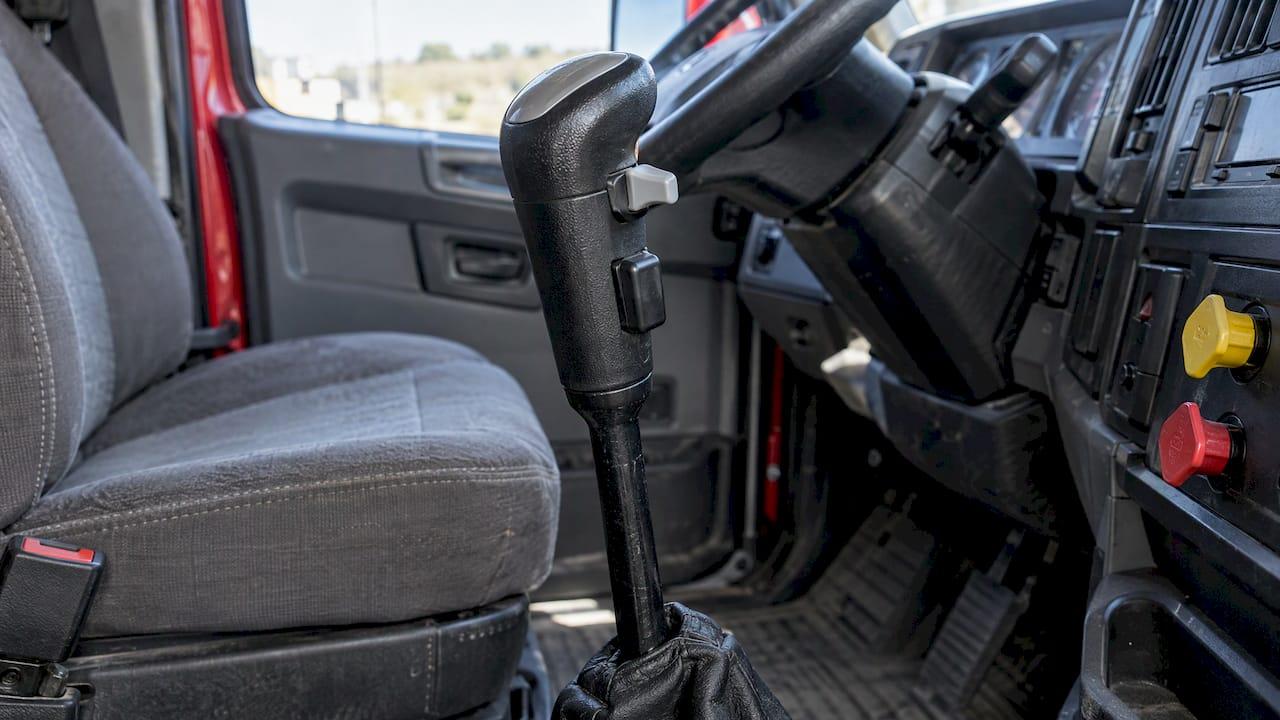
An Eaton Fuller 13-speed is a manual transmission with a five-speed front section and a three-speed auxiliary section. It gives you 13 forward speeds and 2 reverse speeds, all controlled with one shift knob. You work through the main gears with a repeating H pattern, preselect the range with a lever, and use a splitter button in high range. This guide covers how that works, how to shift it, the mistakes that cost you parts, how it compares with an 18-speed, and how it differs from automated Eaton transmissions.
TL;DR
- The 13-speed is a 5-speed front section plus a 3-speed auxiliary section, with 13 forward and 2 reverse speeds.
- Always preselect the range lever before you start the shift. The transmission completes the range change as the shift lever passes through neutral.
- Only the high-range positions can be split on a 13-speed. An 18-speed lets you split more positions, in both ranges.
- Never move the range lever or splitter button with the shift lever in neutral while the truck is moving, and never make a range shift in reverse.
- Automated Eaton transmissions such as UltraShift PLUS take over clutch and shift decisions. A Fuller manual leaves both to you.
Table of Contents
- How the Eaton Fuller 13-speed is built
- The shift pattern: the repeating H
- Range and splitter controls
- How to shift a 13-speed, step by step
- Mistakes that cost you synchronizers and time
- 13-speed vs 18-speed: what actually differs
- Eaton Endurant vs UltraShift vs a Fuller manual
- Before you drive a new or swapped 13-speed
- Perspective: why tested used transmissions make sense
- Find a transmission for your truck
- FAQ
- Sources
How the Eaton Fuller 13-speed is built
The Roadranger 13-speed is a heavy-duty, constant-mesh manual with air-operated range and splitter controls. Eaton's driver instructions describe 13 forward speeds and 2 reverse speeds, built from a five-speed front section and a three-speed auxiliary section.
The front section is the part you move with the shift knob. The auxiliary section multiplies those gears. Eaton's instructions explain that it holds LO and HI range ratios plus an overdrive splitter gear. The "1st" position in the front section is used only as a starting gear.

That is why the 13-speed feels simple once you see it. You are driving a five-speed gearbox twice, once in low range and once in high range, with one extra split on top.
Daimler Truck North America describes the same layout for 13-speed models. It adds that all thirteen speeds are controlled with one shift knob. You do not need a second hand-operated gear lever. The range lever and splitter button just set up what the main lever does next.
The shift pattern: the repeating H
After you shift out of LO, you use the Roadranger repeat "H" shift pattern. You start in the low-range gears, then preselect high range and run the same H pattern again.
The pattern printed on the cab decal matters more than any diagram in a blog. Patterns vary by transmission and truck, and not every ratio is used in each range. DTNA's guidance is to read the shift-pattern decal for the specific transmission you are driving. That applies doubly if you just bought a used truck or swapped in a different gearbox.
If you are not sure which exact model you have, the tag on the case tells you. Our guide to Eaton transmission identification by tag, model and serial number shows where to look.

Range and splitter controls
The range lever
The range lever selects LO or HI range. It is a preselect control: you move it before the shift, not during it. Eaton's instructions say the synchronizer range shift completes as the shift lever passes through neutral into the next gear.
The range lever is used once during an upshift and once during a downshift. DTNA notes that preselecting the range prevents damage and smooths shifts.
The splitter button
While you are in HI range, the splitter control button picks "L" (rearward) or "H" (forward) to split the high-range ratios, per Eaton's driver instructions. Like the range lever, it is preselected. DTNA says splitter preselection allows smoother, faster shifts and should be completed right away to avoid wear.
There is also an interlock. According to DTNA, the splitter control cannot be activated when the range preselection lever is down. If the button seems dead, check the range lever position first.
How to shift a 13-speed, step by step
This is the sequence for a normal upshift from low range into high range. Treat Eaton's driver instructions and your cab decal as the final word for your truck.
- Start in the starting gear. Use the "1st" position only to get moving, as Eaton's instructions describe it as a starting gear.
- Run the low-range gears. Shift up through the H pattern using the double-clutch procedure below.
- Preselect HI range before the shift. Move the range lever to HI first. Do this before you move the shift lever.
- Shift through neutral. As the lever passes through neutral into the next gear, the transmission completes the range shift for you.
- Repeat the H pattern. Now you are shifting the same pattern in high range.
- Split with the button. In HI range, preselect the splitter with the button to move between "L" and "H" positions.
The double-clutch procedure
Eaton's instructions define the lever-shift procedure this way. Press the clutch pedal, move the shift lever to neutral, release the pedal, then quickly press it again and move to the next gear, releasing the pedal to engage.
Downshifting
The same rules run in reverse. Preselect the range you want before the shift, then move the lever through neutral so the range change completes. The range lever gets one use per downshift, just as it does per upshift.
Mistakes that cost you synchronizers and time
Most 13-speed damage comes from a short list of habits. Eaton's driver instructions warn against these:
- Moving the range lever or splitter button with the shift lever in neutral while the vehicle is moving. The range and splitter controls are not meant to be moved that way.
- Making a range shift while moving in reverse. DTNA says to never make a range or splitter shift while moving in reverse.
- Moving the range lever into LO after HI-range preselection, or at any time while in HI range.
- Skipping the double-clutch procedure on lever shifts.
- Preselecting late. Preselect early and finish the move. Half-done preselects wear parts.
New drivers often fight the transmission instead of setting it up. If you preselect the range and splitter ahead of the shift, the box does most of the work.
Shifting a manual all day is skilled work, and logged hours decide how you pace it. If you run long hauls, here is an electronic logging device explained for drivers and fleets.
13-speed vs 18-speed: what actually differs
Both boxes use a five-speed front section and an auxiliary section. The difference is how many positions you can split.
| 13-speed | 18-speed | |
|---|---|---|
| Forward speeds | 13 | 18 |
| Reverse speeds | 2 | 4 |
| Splittable positions | HI range only | 5 ratios in low range, 4 in high range |
| Low range splittable | No | Yes |
Per DTNA's manual transmission reference, 13-speed RTLO models split only the HI-range positions, and low range cannot be split. In the same reference, 18-speed splitter/range-shift models have 18 forward and four reverse speeds. The splitter gear covers LO-1-2-3-4 in low range and 5-6-7-8 in high range.
Which one fits your work
The 13-speed has fewer shift decisions, so it is quicker to learn and easier to drive when you hop between trucks. The 18-speed gives finer steps, which matters when you spend hours in the same narrow rpm band with a heavy load or a lot of grade.
What the gearbox does is tied to your axle ratio and engine rpm. For the bigger picture, see our piece on semi truck gear ratios and downspeeding.
Eaton Endurant vs UltraShift vs a Fuller manual
The Fuller 13-speed is a manual. Endurant and UltraShift are automated transmissions from the same maker. The difference is who does the clutching and the shifting.
Endurant. Eaton describes it as an automated transmission family whose controls let the engine and transmission work together seamlessly.
UltraShift PLUS. Eaton's guide says it has Automatic, Manual and Low modes for control across weight and road conditions. In the driver instructions:
- MANUAL mode is for when you want to pick shifts yourself. The system holds the current gear unless you prompt it with the up or down buttons.
- LOW mode selects the lowest available gear for start. It is meant to maximize engine braking and reduce brake pedal use on long grades or when coming to a stop.
The UltraShift PLUS LSE version uses an electronic clutch actuator for faster shifting and smoother engagement.
If you drive a Fuller manual, you control the clutch, the lever, the range and the splitter. With an automated unit, those jobs move to the controller. Match the transmission to the spec of the truck and the driver. Your driver's experience with a manual is a real advantage on a Fuller.
If you are replacing a unit, clutch matching matters too. See how to match the right Eaton clutch.
Before you drive a new or swapped 13-speed
A short check saves a lot of grief:
- Read the shift-pattern decal in the cab. Make sure it matches the transmission.
- Confirm the model from the case tag, not from memory or the listing.
- Check the air system. The range and splitter controls are air-operated, so low or leaking air shows up as odd shifts.
- Walk through the pattern with the engine off. Check lever travel, the range lever and the splitter button. Remember the interlock: no splitter action with the range preselect lever down.
- Review Eaton's driver instructions for your exact model, which cover the cautions above.
Perspective: why tested used transmissions make sense
We talk with owner-operators, fleet managers and shop mechanics every day, and the pattern is consistent. When a transmission goes down, the truck is not earning. The question is how fast you can get a reliable replacement without paying for new.
That is why we put each part through testing and inspection before it is sold, and why every part carries a standard warranty. A used transmission that has been tested and is backed by a warranty is a practical answer for a truck that has to get back on the road. Our inventory changes daily, and we ship the same day.
If you are matching a 13-speed or moving to a different ratio spread, get the model and serial right first. That one step prevents most wrong-part orders. Our team works with fleets and independents on exactly that.
John
Find a transmission for your truck
If your 13-speed needs replacing, or you are changing the setup, browse our used heavy truck transmissions. Each unit is tested and inspected, comes with our standard warranty and ships same day anywhere in the U.S.

Need the engine, the differential or the exhaust too? We carry truck engines, differentials and exhausts for major brands including Cummins, Detroit, Caterpillar, Volvo, International, Mack and Paccar.
FAQ
Is a 13-speed hard to drive?
It takes practice, but the logic is simple. You shift a repeating H pattern, preselect the range lever before the shift, and use the splitter button in high range. Eaton's instructions describe the double-clutch procedure for lever shifts, and most drivers settle in quickly once they preselect early.
What is the difference between a 13-speed and an 18-speed?
The 13-speed has 13 forward and 2 reverse speeds and splits only high-range positions. The 18-speed has 18 forward and four reverse speeds and splits positions in both low and high range. That gives you finer steps in the 18-speed.
Can I move the range lever while the truck is moving?
Yes, but only as part of the preselect procedure, before the shift. Do not move the range lever or splitter button with the shift lever in neutral while the vehicle is moving, and never make a range shift in reverse. Follow Eaton's driver instructions for your model.
Is Endurant the same as UltraShift?
No. Both are automated Eaton transmissions, but they are separate product lines. UltraShift PLUS offers Automatic, Manual and Low modes. Check Eaton's current literature and your truck's spec for the exact model you drive.
Sources
- Eaton Fuller heavy-duty transmission driver instructions, TRDR0670
- Eaton Fuller heavy-duty transmissions driver instructions, TRDR0630
- DTNA: General Information, Eaton Fuller Splitter and Range-Shift Transmissions
- DTNA: Manual Transmissions and Hydraulic Clutch
- Eaton transmission guide brochure
- Eaton Transmission Guide
- Eaton UltraShift PLUS driver instructions, TRDR1110
- Eaton UltraShift PLUS LSE brochure