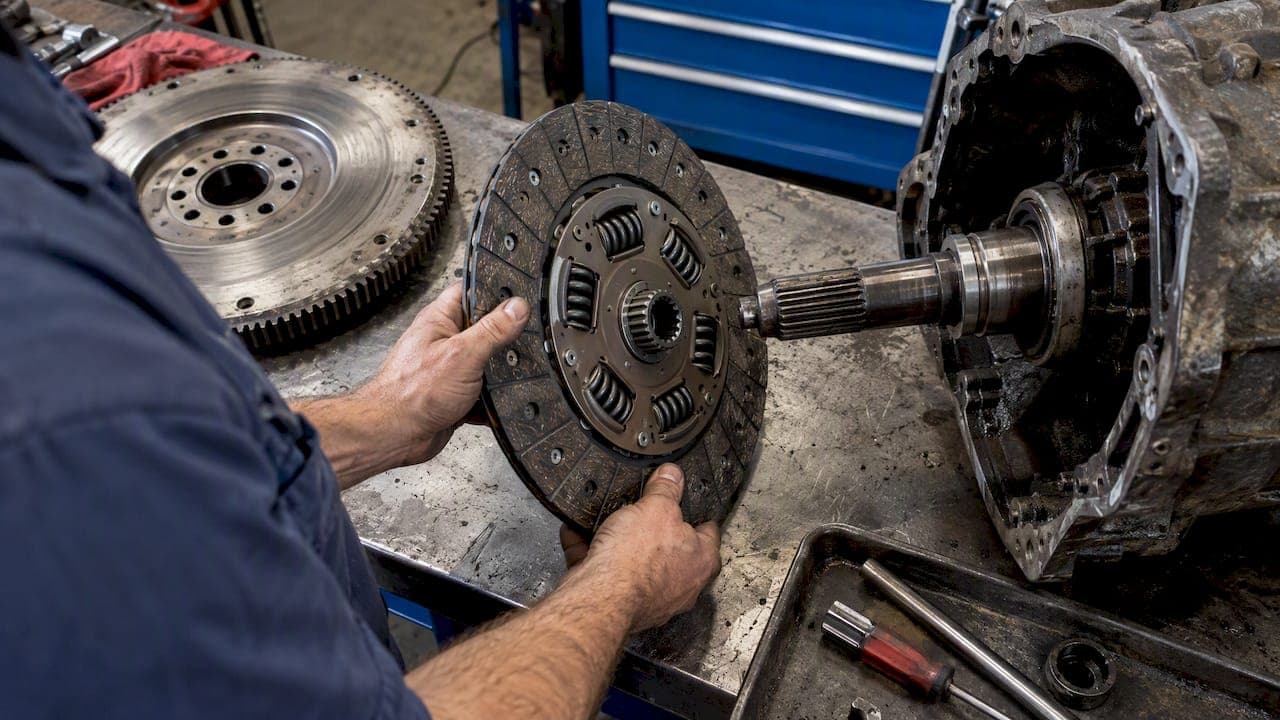
An Eaton clutch fits your truck when four things agree: its torque rating meets or beats your engine's torque, its spline diameter and count match the transmission input shaft, its type suits your clutch linkage, and the flywheel and housing are in spec. Get one of those wrong and you get a clutch that slips, drags, chatters or wears out early. This guide walks through each check in the order we would do it on the shop floor, and shows where an engine or transmission swap changes the answer.
TL;DR
- Clutch torque rating must equal or exceed the engine's torque rating. Eaton's selector says so directly.
- Match the spline diameter and spline count to the transmission input shaft (for example 1.75 inch or 2 inch, 10 spline) before you look at anything else.
- Eaton recommends self-adjusting clutches on trucks with hydraulic linkage. Manual-adjust clutches suit mechanical linkage that you can service on schedule.
- Measure flywheel face, flywheel housing and pilot bore runout before installing. A good clutch on a bad flywheel wears out early.
- Swapping in a used engine or transmission? Re-verify the whole chain, not just the clutch part number.
Table of Contents
- What "compatible" means for an Eaton clutch
- Step 1: Start with the transmission input shaft
- Step 2: Match torque to your engine, not to your hopes
- Step 3: Check clutch size and the flywheel it mounts to
- Step 4: Match the clutch type to your linkage
- Step 5: Inspect the flywheel and housing before you install
- Common compatibility traps
- When you are replacing the engine or transmission too
- Our perspective: verify the chain, then buy the part
- Need a transmission to go with the clutch?
- A short pre-order checklist
- FAQ
- Sources
What "compatible" means for an Eaton clutch
The word gets used loosely in parts listings. A clutch can bolt to a flywheel and still be the wrong clutch. Real compatibility is a chain of four links:
- Engine side: clutch diameter, flywheel type and bolt pattern, flywheel housing, and engine torque.
- Transmission side: input shaft spline diameter and spline count, and the bell housing it must sit inside.
- Control side: hydraulic or mechanical linkage, release bearing travel, and whether the clutch adjusts itself.
- Duty side: how the truck is used, from steady linehaul to heavy vocational work, and how much torque the engine is tuned to make.
A part number lookup on a retail site usually covers only the first link. The rest is on you or your mechanic, and it is where most wrong-part returns start.
Step 1: Start with the transmission input shaft
Eaton's heavy-duty clutch selector is built around spline diameter and spline count. It lists combinations such as 1.75 inch with 10 splines and 2 inch with 10 splines, and each one points to different clutch options. If the spline count on your input shaft does not match the clutch disc hub, nothing else matters, because the disc will not slide on the shaft.
How to find your numbers:
- Read the transmission tag. The model code tells you the family (for example a Fuller FRO or RTLO series) and gear count. Our guide to Eaton transmission identification shows where the tag sits and how to read the model and serial.
- Confirm the spline specs with the transmission's parts documentation, or measure the input shaft if the transmission is out.
- Write down diameter and spline count. Use them to filter the selector chart.
If the transmission was swapped at some point, do not trust the old clutch part number. The clutch in the truck may have been fitted to a different transmission before.
Step 2: Match torque to your engine, not to your hopes
The selector tells you to choose a clutch whose torque rating in the chart is equal to or higher than the engine torque rating. That is the single most common mistake we see described: a buyer picks a clutch by size alone, and the engine's tune puts out more than the clutch can hold.
The selector lists clutch torque capacities in pound-feet, with ratings such as 1650 and 1850 lb-ft for certain heavy-duty automated-transmission clutches. Use those as an illustration of the scale, then read the row for your own configuration.
A worked example of the logic:
- Your engine's rated peak torque is on the engine data plate or in its spec sheet. Say it is 1,650 lb-ft.
- You can only consider clutches in your size and spline family whose listed torque capacity is 1,650 lb-ft or higher.
- If the chart offers a 1,650 and a 1,850, the 1,650 meets the rule, and the 1,850 gives headroom if the engine has been tuned up or the truck runs heavy.
If an engine has been reprogrammed, use the actual output, not the original rating. Buying a clutch to the factory number and then running more torque through it is a classic early failure.
Step 3: Check clutch size and the flywheel it mounts to
Heavy-duty Eaton clutches come in sizes such as 14 inch and 15.5 inch. The selector groups them by diameter, then by spline, then by torque. The clutch diameter must suit your flywheel, and the flywheel must suit the engine's housing.
That last link is where SAE standards come in. SAE J1857 covers flywheel dimensions and, per its scope, the flywheels it describes are normally used on Class 6 and 7 medium-duty and Class 8 heavy-duty trucks. Housing sizes follow the SAE numbering system. If you are not sure which one your engine has, read our SAE flywheel housing size chart and identification guide before you order anything.
A quick sanity checklist for this step:
- Clutch diameter matches the flywheel's clutch surface and bolt circle.
- Flywheel housing size matches the transmission's bell housing.
- Pilot bearing or bushing style matches the flywheel pilot bore and the input shaft tip. Eaton's selector lists separate kits for FR Series and RT Series applications, including a Mack-style pilot bearing variant, which shows how much this detail varies.
Step 4: Match the clutch type to your linkage
Eaton's own guidance is plain: self-adjusting clutches are recommended for trucks with hydraulic linkage, to reduce the risk of drivetrain damage. The reason is practical. A hydraulic system has no easy way to compensate for facing wear, so a clutch that adjusts itself keeps release geometry in range.
| Linkage | Better fit | Why it matters |
|---|---|---|
| Hydraulic | Self-adjusting clutch | Per Eaton, lowers the risk of drivetrain damage |
| Mechanical, with a regular service schedule | Manual-adjust or self-adjust | Manual types need periodic adjustment to stay in range |
| Short-stroke linkage | Check the selector's stroke column | The selector asks you to choose linkage stroke before clutch type |
The selector's flow has you pick the linkage stroke and clutch type first, then spline diameter, then clutch size and number of discs, then torque, then damper type. Following that order saves you from backing out of a wrong choice late.
One disc or two
The selector notes that a two-disc clutch can fit in place of a single plate pull-type unit, but that this increases inertia to the transmission and may affect shiftability and longevity. So a two-disc upgrade is not a free torque bump. Treat it as a deliberate change and check the rest of the driveline.
Step 5: Inspect the flywheel and housing before you install
Compatibility on paper does not survive a warped flywheel. Eaton's installation instructions tell the installer to measure runout with a dial indicator. In the 15.5 inch self-adjusting clutch guide, the checks include pilot bearing bore runout, flywheel housing face runout, flywheel face runout and flywheel housing inside diameter runout. The manual-adjust guide gives a maximum pilot bearing bore runout of 0.005 inch.
The angle-spring ECA clutch guide states that the flywheel and housing must meet its specifications or the clutch will wear prematurely. It also says to replace the LCIB when replacing that clutch.
In practice that means:
- Resurface or replace a scored, heat-checked or out-of-flat flywheel.
- Replace the pilot bearing every time.
- Clean all gauge contact surfaces before measuring.
- Use the torque values and lubrication specs in the guide for your exact clutch, not generic numbers.
The rest of the install sequence differs between models, so keep the correct Eaton instruction sheet for your part number open at the bench.
Common compatibility traps
Swapped transmission, old clutch. Someone replaced a transmission with a different model, but the clutch stayed. The splines may still match, but release bearing travel or housing depth may not.
Cross-brand parts. Owners sometimes pair an Eaton clutch with a transmission or flywheel from another maker's setup, particularly on trucks where engines and gearboxes from different suppliers are mixed. Check bolt pattern and pilot style, not just diameter.
Tuned engine, stock clutch. Covered above: the torque rule applies to what the engine actually makes.
Automated transmission confusion. Automated manual transmissions use their own clutch family. The selector has a separate section for clutches for automated transmissions. A manual-pedal clutch is not a substitute.
Mixing up a kit and a clutch. Release bearings, input shaft kits and pilot bearings are sold separately in some catalogs. Make sure the order includes everything the job needs.

When you are replacing the engine or transmission too
A clutch job often rides along with a bigger repair. When a failed engine or transmission is being replaced, compatibility becomes a set of decisions across parts, not one part. The same rules apply in both directions:
- A replacement engine must carry the same flywheel housing size and flywheel arrangement as the one it replaces, or you need matching adapters and parts. Our walkthrough on confirming engine compatibility for heavy trucks covers the engine side of the chain, and why engine compatibility matters explains what goes wrong when it is skipped.
- A replacement transmission must have the input shaft spline spec your clutch disc expects. If it does not, the clutch changes too.
- A different engine torque rating can push you into a different clutch row on the selector.
The cheapest time to replace a clutch is while the transmission is already out. If you are already in there, measure the flywheel, replace the pilot bearing and check the clutch brake.
Our perspective: verify the chain, then buy the part
We sell used heavy-duty diesel engines, transmissions and differentials, and every part we sell is tested and inspected and comes with a standard warranty. Our inventory changes daily, and orders ship the same day. What that gives us is a close view of how compatibility problems start.

Most of them are not defective parts. They are good parts that do not fit what they were paired with. A buyer matches a transmission by model name and forgets the input shaft spec. A shop orders a clutch by size and skips the torque rating. A fleet swaps an engine and assumes the old clutch stays valid.
Our advice is boring and it works. Pull the tag or data plate numbers first. Write down engine torque, spline spec, housing size and linkage type. Then compare them to the manufacturer's selector, not to a listing title. If you are buying a used transmission from us, tell us the engine, the clutch size and the linkage, and we will help you check it against the unit before it ships. A five-minute check is cheaper than a second teardown.
— John
Need a transmission to go with the clutch?
If the clutch job is part of a bigger repair, our transmissions for sale are tested, inspected and warrantied, and we ship them nationwide. Eaton-Fuller units we list include the FRO15210B 10-speed manual, the FRO16210C 10-speed with overdrive and the FO-18E313A-MHP UltraShift PLUS. Need an engine instead? Browse our truck engines, or start from our home page.

A short pre-order checklist
Before you pay for a clutch or a replacement drivetrain part, have these written down:
- Engine make, model and rated torque (and any tune)
- Flywheel housing size
- Flywheel type and clutch diameter
- Transmission model and input shaft spline diameter and count
- Linkage type: hydraulic or mechanical, and stroke
- Whether the transmission is manual or automated
- Condition of the flywheel, pilot bearing and release components
If you cannot fill in all seven, find the missing ones before ordering. Do not guess on splines or torque.
FAQ
How do I know which Eaton clutch fits my truck?
Start with the transmission input shaft spline diameter and count, then use Eaton's selector to choose clutch size, discs and torque. The torque rating on the chart must equal or exceed your engine's torque. Finish by confirming linkage type and flywheel condition.
Should I use a self-adjusting or manual-adjust Eaton clutch?
Eaton recommends self-adjusting clutches for trucks with hydraulic linkage. Manual-adjust clutches are used on mechanical linkage, but they need regular adjustment to stay in range. If you are unsure of your linkage, check the pedal system before ordering.
Can I put a stronger clutch behind a higher-torque engine?
Yes, if the clutch's spline, size and flywheel fit still match. The torque rating must be at least the engine's rating. Remember that a two-disc clutch in place of a single plate adds inertia, which can affect shiftability and longevity, so check the rest of the setup.
Do I need to replace the flywheel and pilot bearing with the clutch?
You must at least measure the flywheel and housing runout, since Eaton specifies maximum limits and warns of premature wear if the specs are not met. Replace the pilot bearing every time. Resurface or replace the flywheel if it is scored, warped or out of tolerance.
Does a swapped transmission change which clutch I need?
It can. A different transmission may have a different input shaft spline spec or bell housing, which changes the clutch you can use. Verify the new transmission's specs against the clutch before installing.
Sources
- Eaton Heavy-Duty Clutch Selector
- SAE J1857: Flywheel Dimensions for Truck and Bus Applications
- Eaton 15.5 inch Heavy-Duty Self-Adjusting Clutch installation guide
- Eaton 14 and 15.5 inch Heavy-Duty Manual Adjust Clutch installation guide
- Eaton 15.5 inch Heavy-Duty ECA Clutch installation instructions