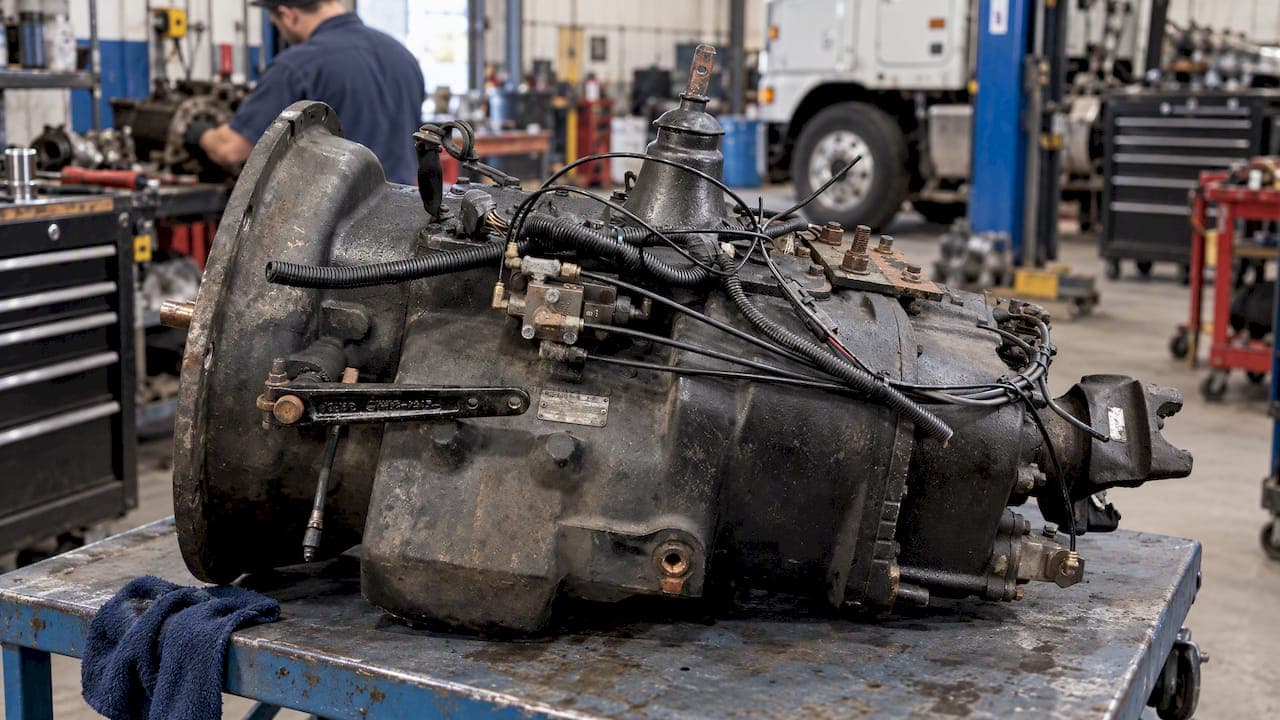
To identify an Eaton transmission, find the metal tag on the side of the housing and read the model designation stamped on it. The tag also carries the serial number and often a customer-specific Bill of Material (BOM) number. That tag, per Eaton, is the source of truth for ordering parts and checking service history. If the tag is gone, you can still get to an answer through casting numbers, shift pattern and the truck's VIN. This guide covers both routes.
TL;DR
- Look for the tag on the side of the transmission case. Write down the model, serial and BOM numbers exactly as stamped, and take a photo.
- The model number (for example RT-12609A) carries the engineering data. The serial number only identifies one unit. Do not mix them up.
- Ordering from the base model alone can get you the wrong rebuild kit or gear set. Use the full designation and the BOM number.
- Never sandblast, grind or remove the tag. Without it, identification is slow.
- Before you pay for a replacement unit or core, confirm the model. It can decide core credit and warranty eligibility.
Table of Contents
- Where the transmission tag is and what it shows
- How to read an Eaton model number
- Model number vs. serial number vs. BOM number
- If the tag is missing, painted over or unreadable
- Quick physical clues before you read the tag
- Why identification affects money: cores, warranty and claims
- A worked example: from tag to order
- Our perspective: what we see when identification goes wrong
- Replacing the unit: used Eaton transmissions from us
- Mistakes that cost fleets time
- FAQ
- Sources
Where the transmission tag is and what it shows
Eaton's identification guide starts the same way every time: locate the tag, then locate the model designation on it. Eaton's Fuller service literature says the model designation and other identification details are stamped on the serial tag.
On a truck that has been working for years, the tag is often covered in road film, grease and paint overspray. Clean it with a rag and degreaser, not a wire wheel. A flashlight held at a low angle makes stamped characters readable when they are worn.
What you are looking for on the tag:
| Item | What it tells you | Why it matters |
|---|---|---|
| Model designation | Series, torque rating, speeds, ratios, configuration | Selects the correct parts and replacement unit |
| Serial number | One specific unit | Warranty and service history lookups |
| BOM number | The customer-specific build | Replacement parts often require it |
Photograph the tag before you do anything else. A phone picture saves a second trip under the truck when the parts counter asks a question you did not expect.
How to read an Eaton model number
Eaton model numbers are not random. Each character group gives you something. Eaton's Fuller Advantage service manual uses FAOF11810B as its example:
- FA: Fuller Advantage, the series
- O: overdrive
- 11: the torque capacity group
- 10: ten forward speeds
- B: a design level letter at the end
Older Roadranger models follow a similar logic with different prefixes. In a model like RT-12609A or RTLO-16913A, the prefix points to the family, the digits give torque class, speeds and ratio configuration, and the final letter marks the design level. Eaton's unit exchange guide includes full nomenclature tables for both manual and automated units, and that is the reference to check when a suffix looks unfamiliar.
Two habits prevent most mistakes:
- Copy the entire designation, including the hyphen pattern and trailing letters. A trailing "A" versus "B" is not a typo.
- If the model ends with an automation suffix such as AS, you are looking at an automated unit. Those have separate parts and service procedures from the manual version, and Eaton's AutoShift driver instructions list models such as RTAO-14710B-AS and RTLO-16918B-AS that way.
Model number vs. serial number vs. BOM number
This is the most common slip. People read the longest string of digits and call it the model. It is usually the serial number.
The serial number is a sequential identifier for one unit. The model number holds the engineering specifics: torque capacity, speeds and shift configuration. The BOM number sits below them on the tag and ties the transmission to a particular build. Replacement parts often require it, according to Eaton's identification page.

Why the difference matters in practice: Eaton transmissions are modular. Two units that look the same on the bench can have different internal parts depending on the full configuration code. If you order with only a base model, you risk the wrong rebuild kit or an incompatible gear set. That is an expensive mistake: a shop loses a bay day, a driver loses a load.
If the tag is missing, painted over or unreadable
Do not guess. Work through these in order.
- Clean and re-inspect. Paint and grime hide more tags than damage does.
- Check for a second record. Fleet shops often log transmission data in work orders or the truck's spec sheet. A previous repair invoice may have the model and serial.
- Use the VIN. The 17-digit VIN lets the truck manufacturer check the original build record. Eaton notes that the VIN is also what its support team uses to verify the original in-service date and configuration. Be aware this path is slower than reading a tag.
- Use casting numbers, input shaft and shift pattern. Eaton's unit exchange guide has an identification chart for units that have no tag. Count the forward speeds from the shift pattern, check whether it has an overdrive, and compare case features against the chart.
- Call Roadranger support. The Roadranger Call Center is at 1-800-826-HELP (4357), and representatives will want the full model and serial numbers. Without a tag you will be giving them what you have worked out, so say how you got it.
One rule from Eaton's service literature: never remove or sandblast the tag. It is often the only way to verify warranty eligibility and the specific build configuration. If you are sending a case out for paint or blasting, mask the tag or note its data first.
Quick physical clues before you read the tag
Sometimes you are looking at a unit on a pallet or under a truck and want a rough sense of what it is before you get the tag clean. Use these as a screen, never as a final answer:
- Shift pattern on the lever or the cover. It narrows the speed count. A 10-speed and an 18-speed do not shift alike.
- Overdrive or direct. The "O" in a model name signals overdrive, so a model without it is a direct-drive unit.
- Manual or automated. An automated unit has an electronic control and a shift motor instead of a conventional lever setup.
- Mounting and PTO openings. These vary by build, so match them to the truck's spec rather than assuming.
Then go to the tag and confirm. A visual match tells you which family to look in. The tag tells you which unit it is.
Why identification affects money: cores, warranty and claims
Three places where a wrong or incomplete ID costs real money.
Unit exchange and core credit. Under Eaton's Unit Exchange program, the core value is tied to the model number. A unit that has been modified or fitted with a non-matching configuration may carry no core value, which leaves you with the full cost. Verify the nomenclature before you pull a unit for exchange.
Warranty claims. Claims move faster when the file is complete. In Eaton's dealer claim instructions, the failed unit's model and serial number are among the required details, along with the in-service date and mileage at failure. Add the VIN, because a claim without it cannot be checked against the original configuration.
Wrong parts. A rebuild kit for the wrong configuration is a restocking fee at best and a second teardown at worst.

A worked example: from tag to order
Say you pull a tag that reads RTLO-16913A. Here is how to turn it into an order without a second call.
- Record the full designation, the serial number and the BOM number. Photograph the tag.
- Note the truck's make, model year and VIN, and the engine it is paired with.
- Confirm whether the unit is manual or automated, and whether it has any PTO provision on the case.
- Check the designation against Eaton's nomenclature tables so you understand what you have: the family, the speed count, the design level.
- Ask any seller to quote against the full designation, not "a 13-speed Eaton".
If you are replacing the unit, matching it to the drivetrain matters too. Final drive ratio, engine torque and tire size all interact with the transmission. Our piece on semi truck gear ratios explains why a transmission swap is not just a model-number exercise. And if the engine is also in question, how to confirm engine compatibility and finding an engine by VIN and the VECI label walk through the same discipline for the other half of the powertrain.
Our perspective: what we see when identification goes wrong
We sell used heavy truck parts, and every part we ship is tested and inspected and backed by a standard warranty. That makes us care about identification before the order, not after.
The pattern is simple. A buyer who sends the full tag data, the VIN and the truck's spec gets a match the first time. A buyer who sends "Eaton 10 speed" starts a back-and-forth that costs a day, and a day is what the truck cannot spare. Our advice to owner-operators and shop mechanics is the same: before you call anyone, photograph the tag, copy the whole designation and note the VIN. It takes two minutes under the truck and spares you from guessing between units that look alike.
The other thing we tell fleet managers: log the tag data for every unit in your yard now, while the trucks are in the shop. When a transmission fails on the road, the person on the phone has the information in front of them instead of a driver reading it off a dirty tag in the rain.
— John
Replacing the unit: used Eaton transmissions from us
Once you know what you have, you can look for a matching replacement. Our transmissions inventory changes daily, every unit is tested and inspected before sale with a standard warranty, and we offer same-day shipping. Examples of Eaton-Fuller units we list include the RTLO16913A and the FRO15210B 10-speed manual. If you are also looking at the driveline, we carry differentials as well. Have your full model designation and VIN ready when you contact us.

Mistakes that cost fleets time
- Reading the serial as the model. Check that what you wrote down contains letters and a pattern like RT-12609A, not just digits.
- Dropping the suffix. The last letter is part of the identity.
- Removing or blasting the tag. It is hard to replace the information afterwards.
- Pulling a unit for exchange without verifying it. A mismatched configuration can cost you the core credit.
- Filing a claim without the VIN. It slows the check of the original in-service date.
- Trusting memory. A transmission swapped in a previous repair may not match the truck's original spec.
FAQ
How do I read an Eaton serial number?
The serial number on the tag identifies one specific unit, and it is not a code you decode for specifications. Use it for warranty and service history lookups, along with the model number. If you need the specifications, read the model designation instead.
What is the difference between the model number and the BOM number?
The model number gives the family, torque capacity, speeds and configuration. The BOM number is the customer-specific build reference printed below them on the tag. Replacement parts often require it, so record all three.
Can I identify an Eaton transmission without the tag?
Yes, but it takes more work. Use the unit exchange guide's identification chart, which relies on case features and shift pattern, and use the truck's VIN to check build records with the truck manufacturer. Then confirm with Roadranger support before ordering anything.
Who do I call for Eaton technical help?
The Roadranger Call Center takes technical and warranty calls at 1-800-826-HELP (4357). Have the full model and serial numbers ready, and the VIN if you are asking about a claim.
Sources
- How to identify an Eaton transmission
- Fuller Advantage manual transmission service manual (TRSM0970)
- Fuller heavy-duty transmission service manual (TRSM0580)
- Eaton AutoShift Gen 1 driver instructions (TRDR0060)
- Unit exchange program guide (APSL0419)
- Unit exchange guide (TRMT0951)
- Roadranger support FAQs
- Kenworth warranty claims
- Hino warranty claims