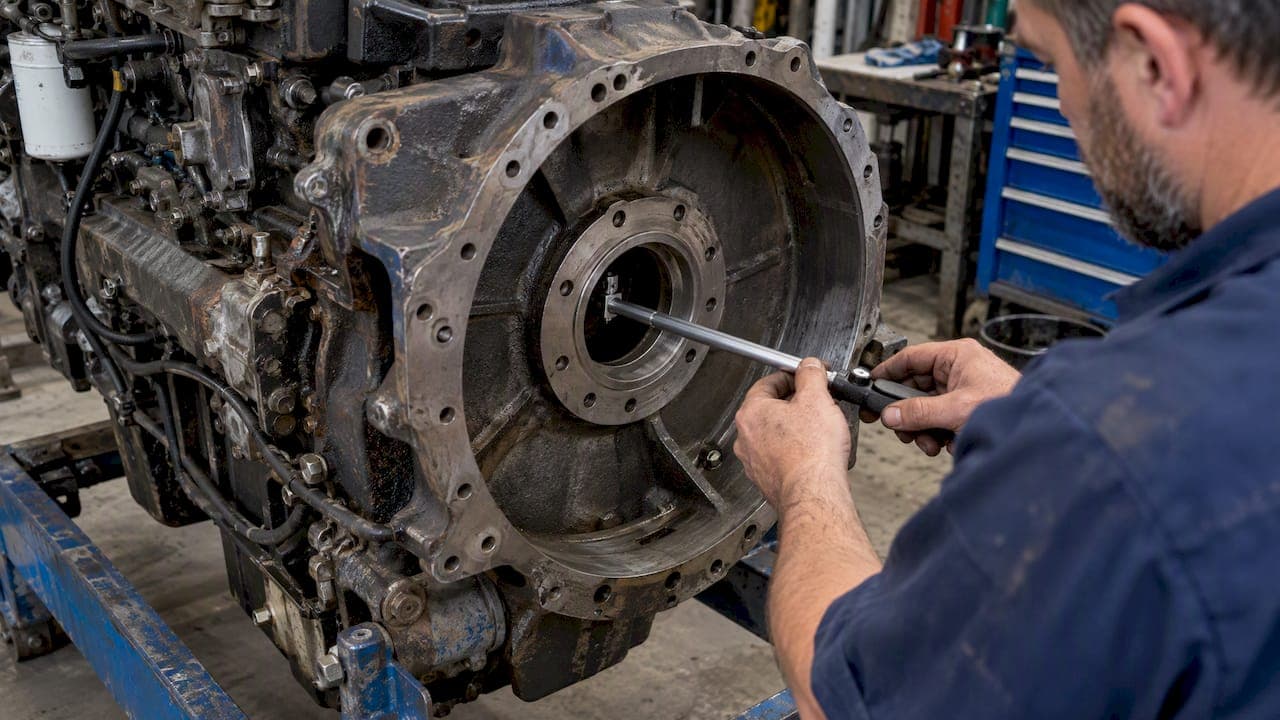
SAE flywheel housing sizes run from No. 00 (the largest) down to No. 6 (the smallest), and each size is defined by two numbers: the pilot bore diameter and the bolt circle diameter. Add the bolt count and you can pin down any housing with a tape measure. The chart below gives every size in inches and millimeters, then shows you how to measure your own housing and avoid ordering an engine or transmission that won't bolt together.
TL;DR
- SAE J617 sets the housing sizes: No. 00, 0, 1/2, 1, 2, 3, 4, 5 and 6. Bigger number means smaller housing, except for the fractional and double-zero sizes at the large end.
- Measure the pilot bore (XD), the bolt circle (XB) and count the bolt holes. Those three readings match one row of the chart.
- The housing is not the flywheel. Flywheels use a separate numbering system (SAE 14, 11-1/2, 10 and so on) and must match the clutch too.
- On-highway (commercial) and industrial SAE engines can differ, so confirm the application before you buy.
- Housing bolt holes are tapped in inch threads, so a metric bolt will not fit.
Table of Contents
- What an SAE flywheel housing size actually tells you
- SAE flywheel housing size chart
- SAE 1 vs SAE 2 bellhousing: how to tell them apart
- How to measure your flywheel housing
- SAE flywheel sizes are a separate number
- Commercial vs. industrial SAE: the trap on used engines
- Our perspective: housing size is one line on the compatibility checklist
- Buying an engine or transmission that bolts together
- Common mistakes with SAE housing sizes
- SAE housing size quick reference by use
- FAQ
- Sources
What an SAE flywheel housing size actually tells you
The flywheel housing is the big casting bolted to the back of the engine block. The transmission (or an adapter plate, or a bellhousing) bolts to its rear flange. For the two to mate, the pilot bore that centers the transmission has to match, the bolt circle has to match, and the number of bolts has to match.
SAE publishes the dimensions in standard J617, which covers housings from SAE No. 6 through SAE No. 00 and defines each by its pilot bore diameter (A) and bolt circle diameter (C). An SAE No. 1 housing, for example, has a 20.125 in. (511.18 mm) pilot and a 20.875 in. (530.22 mm) bolt circle.
People use "bellhousing" and "flywheel housing" interchangeably in conversation. Strictly, the flywheel housing belongs to the engine, and the bellhousing (or mating transmission housing flange) belongs to the transmission side. The SAE number is what lets the two line up.
SAE flywheel housing size chart
The table below combines the J617 housing dimensions as published by a driveline supplier's SAE reference and Palmer Johnson's SAE specification sheet, which lists the metric conversions. XD is the pilot bore inside diameter. XB is the bolt circle.
| SAE No. | Pilot bore (XD) | Bolt circle (XB) | Tapped holes | Thread |
|---|---|---|---|---|
| 00 | 31.000 in. (787 mm) | 33.50 in. (851 mm) | 16 | 1/2-13 |
| 0 | 25.500 in. (648 mm) | 26.75 in. (679 mm) | 16 | 1/2-13 |
| 1/2 | 23.000 in. (584 mm) | 24.38 in. (619 mm) | 12 | 1/2-13 |
| 1 | 20.125 in. (511 mm) | 20.88 in. (530 mm) | 12 | 7/16-14 |
| 2 | 17.625 in. (448 mm) | 18.38 in. (467 mm) | 12 | 3/8-16 |
| 3 | 16.125 in. (410 mm) | 16.88 in. (429 mm) | 12 | 3/8-16 |
| 4 | 14.250 in. (362 mm) | 15.00 in. (381 mm) | 12 | 3/8-16 |
| 5 | 12.375 in. (314 mm) | 13.12 in. (333 mm) | 8 | 3/8-16 |
| 6 | 10.500 in. (267 mm) | 11.25 in. (286 mm) | 8 | 3/8-16 |
Published charts differ slightly in the last decimal or in rounding (you will see 17.625 and 17.652 for SAE 2 on different sites). The 17.625 in. figure, matching the 447.69 mm in the SAE-based sheet, is the one to trust. When a number matters to a machining job, check it against J617 itself.
The sizes you will meet most
For diesel work, the middle of the chart does most of the work. SAE 1, 2 and 3 all use a 12-bolt pattern, so you cannot tell them apart by counting bolts. The pilot bore is what separates them: roughly 20 in., 17.6 in. and 16 in. SAE 4 is also 12 bolts but noticeably smaller at 14.25 in. Once you drop to SAE 5 and 6, the pattern changes to 8 bolts.

That is why a tape measure beats a guess. A 12-bolt housing could be any of four sizes, and a few inches decide whether a transmission fits.
SAE 1 vs SAE 2 bellhousing: how to tell them apart
Both are 12-bolt patterns, and both show up on diesel engines, so they get confused. The differences:
| SAE 1 | SAE 2 | |
|---|---|---|
| Pilot bore | 20.125 in. (511 mm) | 17.625 in. (448 mm) |
| Bolt circle | 20.88 in. (530 mm) | 18.38 in. (467 mm) |
| Bolt holes | 12 | 12 |
| Thread | 7/16-14 | 3/8-16 |
The bore differs by 2.5 inches, which you can see with a tape. The bolt thread differs too, so a bolt that threads into one will be the wrong size for the other. An SAE 1 transmission flange will not seat on an SAE 2 engine. If you want to run a transmission with a different SAE flange than the engine, you need an adapter plate, and that is an engineering decision, not a bolt-on swap.
How to measure your flywheel housing
You need a tape measure or caliper, a clean housing face, and the engine out of the truck or the transmission removed so you can see the flange.
- Clean the face. Remove old gasket material, sealant and grime so you are measuring the casting, not the buildup.
- Measure the pilot bore (XD). Measure the inside diameter of the bore, across the machined register at the rear of the housing. Measure in two directions and average if it is slightly out of round from wear.
- Measure the bolt circle (XB). This is the diameter of the circle running through the centers of the bolt holes. With an even number of holes, measure center to center across opposite holes. For a more reliable result on 12-hole patterns, use opposite pairs.
- Count the tapped holes. Twelve, eight or sixteen narrows the list fast.
- Check the thread. Use a thread gauge or a known bolt. The thread (7/16-14, 3/8-16, 1/2-13) confirms your row in the chart.
- Match the row. Find the chart row that fits all four readings. If one reading doesn't agree, remeasure before ordering anything.
The same dimensional keys appear in Choate's Cummins SAE identification guide: XD for housing bore, XB for housing bolt circle, XE for flywheel outside diameter, XF for flywheel bolt circle and XG for the total offset.
Watch the threads
Industrial engines often mix metric and inch fasteners. The flywheel-to-crankshaft connection may use metric bolts, while the housing-to-transmission flange frequently uses UNC (Unified National Coarse) threads. Check the thread pitch before you run a bolt in. Forcing the wrong bolt into a tapped hole can strip the threads in the housing, and repairing a cast housing costs far more than the bolt.
SAE flywheel sizes are a separate number
The flywheel has its own SAE size, and the numbers do not line up with the housing numbers. A flywheel size describes the outside diameter, bolt circle, offset (the "G" dimension) and bolt pattern of the flywheel itself. The common ones:
| SAE flywheel | Outside diameter (XE) | Bolt circle (XF) | Offset (XG) | Bolts |
|---|---|---|---|---|
| 21 | 26.500 in. (673 mm) | 25.25 in. (641 mm) | 0 | 12 |
| 18 | 22.500 in. (572 mm) | 21.38 in. (543 mm) | 0.62 in. (16 mm) | 6 |
| 14 | 18.375 in. (467 mm) | 17.25 in. (438 mm) | 1.00 in. (25 mm) | 8 |
| 11-1/2 | 13.875 in. (352 mm) | 13.12 in. (333 mm) | 1.56 in. (40 mm) | 8 |
| 10 | 12.375 in. (314 mm) | 11.62 in. (295 mm) | 2.12 in. (54 mm) | 8 |
| 8 | 10.375 in. (264 mm) | 9.62 in. (244 mm) | 2.44 in. (62 mm) | 6 |
These figures come from a published SAE housing and flywheel reference. A housing and flywheel usually come as a pair, so if you know one you can often infer the other, but never assume. As one example from the same sources, an SAE No. 1 housing is commonly paired with an SAE 14 flywheel. Measure both when you are replacing either.
The flywheel also has to match the clutch or torque converter you are running. That is a separate check from the housing flange, and it is where many mismatched swaps go wrong.
Commercial vs. industrial SAE: the trap on used engines
An engine can carry an SAE housing size and still not fit the way you expect. Palmer Johnson's guide separates commercial SAE (on-highway) from industrial SAE (off-highway and marine) and notes that components such as flywheel housings can differ significantly between the two. The same engine family may be built in both versions.
For a truck buyer, that matters in two ways:
- An industrial engine listed as the same model as your on-highway engine may have a different housing, flywheel and PTO arrangement.
- A generator-set or marine engine will not necessarily accept the transmission your truck uses without changes.
The fix is simple: confirm the engine's intended application, the engine serial number and the housing before you commit. Our guides on how to confirm engine compatibility for heavy trucks and finding an engine by VIN and checking the VECI label walk through the paperwork side.
Our perspective: housing size is one line on the compatibility checklist
We sell tested used diesel engines, transmissions and differentials, and the mismatch we hear about most is not a bad part. It is a good part that does not fit the truck it was ordered for. The SAE housing size is one of the easiest places to catch that before a part ships.
Here is how we would approach it as a buyer:
- Start with the donor truck's paperwork, not a measurement. The engine serial number and the VECI label identify the engine and its configuration. Measure the housing only to confirm what the paperwork says, or when the paperwork is missing.
- Match the pair, not the part. An engine and a transmission both have to agree on the SAE flange. If you are replacing only one, find out what the other one is first.
- Check what bolts on around the housing. Starter position, PTO opening and clutch or torque converter fit are separate from the SAE size, and a wrong answer on any of them stops the install.
- Ask before you assume on industrial engines. If a listing is not clearly an on-highway truck engine, ask for the housing size.
Our heavy truck parts compatibility checklist for fleet managers puts these checks in order for shops buying more than one engine.
— John
Buying an engine or transmission that bolts together
If you have your housing size and need a replacement, we carry used heavy-duty truck engines and transmissions covering Caterpillar, Cummins, Detroit, Volvo, International, Mack, Paccar and other major brands. Each part is tested and inspected before sale, comes with a standard warranty, and ships same-day nationwide. Our inventory changes daily, so when you have the engine model, serial number and housing size in hand, you can check what is in stock now.
For example, a transmission listing such as the Eaton Fuller FRO15210B 10-speed manual shows the kind of detail to compare against your engine before you order.

Common mistakes with SAE housing sizes
Trusting the bolt count alone. Twelve bolts covers SAE 1, 2, 3 and 4. Always add the pilot bore.
Confusing the housing number with the flywheel number. SAE 1 housing and SAE 1 flywheel is not a thing. The flywheel numbers (14, 11-1/2, 10) are a different scale.
Measuring the outside of the housing. The outside diameter of the casting is not the pilot bore. The bore is the inside diameter of the register.
Using metric bolts in inch-tapped holes. The housing flange is tapped in inch sizes. A near-fit bolt can cross-thread and ruin the hole.
Ignoring tolerance. SAE sets tight tolerances on bore eccentricity and face deviation. The SAE-based specification sheet from Palmer Johnson lists limits as small as 0.15 mm to 0.20 mm for the bore, depending on the size. A worn or damaged housing can fail to center the transmission even if the size is right, so inspect it for cracks and wear.
Skipping the second check. If a shop is replacing several engines, one wrong assumption gets repeated. Our guide to coordinating multi-truck engine replacements covers that situation.

SAE housing size quick reference by use
Sizes are a standard, not a guarantee of what a given engine uses, but this grouping helps you place yourself on the chart:
- SAE 00, 0 and 1/2: the largest housings, with 16 or 12 half-inch bolts. These are for large industrial and power-generation engines.
- SAE 1, 2, 3: the middle of the chart, with 12-bolt patterns and the bulk of diesel engine work.
- SAE 4: a smaller 12-bolt housing at 14.25 in.
- SAE 5 and 6: the smallest, with an 8-bolt pattern, for compact engines.
For a specific truck, the engine and transmission model is a better guide than size class. Our overview of types of heavy truck diesel engines and the article on finding compatible used diesel engines for trucks help you narrow from there.
FAQ
What are the SAE flywheel housing sizes?
The standard housing sizes are SAE No. 00, 0, 1/2, 1, 2, 3, 4, 5 and 6, defined in SAE J617. SAE 00 is the largest, at a 31 in. pilot bore. SAE 6 is the smallest, at 10.5 in. Each is identified by pilot bore, bolt circle and bolt count.
How do I find my SAE bellhousing size?
Measure the inside diameter of the pilot bore, measure the bolt circle through the hole centers, and count the tapped holes. Match those to the chart above. If your engine has a serial number, the engine's spec sheet or the VECI label will also give you the housing, which is the quicker check.
Is an SAE 1 bellhousing the same as an SAE 2?
No. Both have 12 bolts, but SAE 1 has a 20.125 in. pilot bore and 7/16-14 bolts, while SAE 2 has a 17.625 in. bore and 3/8-16 bolts. They do not interchange without an adapter plate.
Is the SAE flywheel size the same as the housing size?
No. Flywheels use a separate scale, such as SAE 14, 11-1/2 or 10, based on outside diameter, bolt circle and offset. A housing and flywheel are usually paired, but you should measure and confirm both.
Can I use metric bolts on an SAE flywheel housing?
Not safely. The housing flange is tapped in inch threads, such as 3/8-16 or 7/16-14, so metric bolts can cross-thread and damage the casting. Check the thread pitch with a gauge before installing.
Sources
- SAE J617 (1992): Engine Flywheel Housing and Mating Transmission Housing Flanges
- SAE Flywheel Housing Dimensions, drive-lines.com
- SAE Housing & Flywheel Specifications (PDF), Palmer Johnson
- Industrial SAE Housing & Flywheel Specifications, Palmer Johnson
- Cummins Industrial SAE Flywheel & Housing Identification Guide, Choate
- Bell Housing and SAE Flywheel Sizes, Depco Power Systems