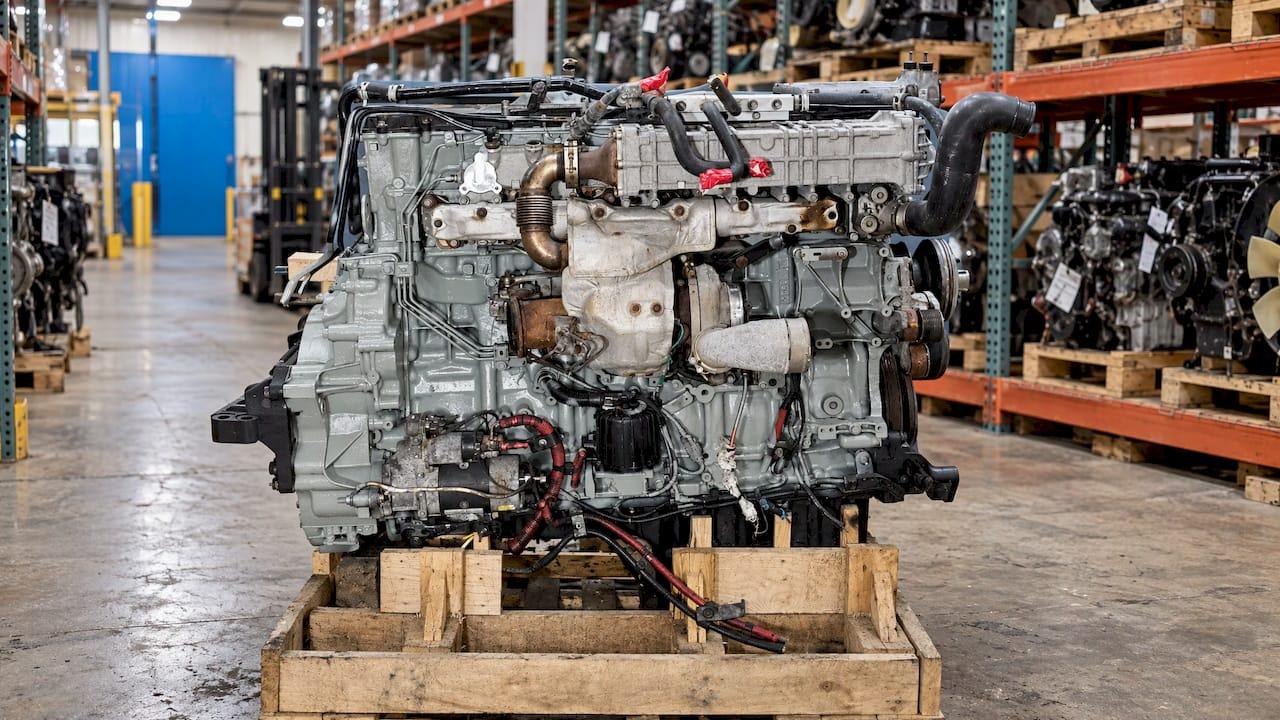
A hard-to-find truck part is rarely missing from the country. It is usually missing from the three suppliers you called, or listed under a number you did not search. The fastest route is to identify the part exactly, search stock that is tested and updated daily, and confirm fitment before it ships. At Nationwide Truck Parts, we sell tested, inspected used diesel engines, transmissions, differentials and exhausts with a standard warranty and same-day shipping, and our inventory changes daily. This guide gives you the routine we would hand a fellow mechanic.
TL;DR
- Identify the part by engine serial number (ESN), CPL or option list and VIN before you search. Year, make and model alone are not enough on heavy trucks.
- Search in tiers: stock suppliers with daily-changing inventory first, then dealer locators, then salvage networks, then rebuilders or brokers for true obsolete parts.
- Ask for tested, inspected parts with a written warranty, real photos and the actual test figures, not "it passed."
- If the exact part is gone, an interchange match or a rebuilt or used complete assembly often solves the problem faster than waiting.
- Tell your customer or dispatcher the lead time up front, and track the part, install date, supplier and warranty terms.
Table of Contents
- Why heavy truck parts are hard to find
- Step 1: Identify the exact part before you search
- Step 2: Search in tiers, not at random
- Step 3: Source a compatible used engine nationwide
- Step 4: Verify condition, testing and history before you buy
- Step 5: Compare the offers that matter
- When the part is discontinued or sold only as part of an assembly
- Worked example: a 2014 Detroit DD13 that will not run
- Our view on hard-to-find parts
- Check our current stock
- FAQ
- Sources
Why heavy truck parts are hard to find
Heavy-duty trucks are built to order. Two trucks of the same model year can carry different engine ratings, emissions hardware, axle ratios and sensors. Cummins explains the root of it in its own engine guide: part numbers vary, no matter how similar engines might seem, because a control parts list (CPL) records which combinations of parts can be built into an engine without affecting performance or certification.
That is why a search for "2014 Detroit DD13 part" returns a pile of near matches. The part you need is not scarce so much as buried under variants. Search by the right identifiers and the pile shrinks fast.

Step 1: Identify the exact part before you search
Most failed searches fail here. Gather this before you pick up the phone:
- VIN. The 17-character number on the door jamb or dash plate. Many suppliers decode it to the original build.
- Engine serial number (ESN) and data plate. Cummins states that the ESN identifies the correct part, and that the CPL number stamped on the engine data plate cross-references parts and fuel pump calibration values.
- Engine, transmission and axle details. For example Cummins ISX15 or Detroit DD15, the transmission model, and the axle configuration such as 6x4 or 4x2.
- OEM part number and a photo. Take a clear picture of the part, the tag and the mounting points. Also note the symptoms that led you to replace it.
- Emissions label. The VECI label under the hood tells you the engine family and emissions configuration, which matters when you swap an engine.
If you are starting from only a VIN, our guide on finding a heavy-duty truck engine by VIN and checking the VECI label walks through where to look. For Cummins engines, what CPL numbers mean and how to use them explains why two engines with the same displacement can take different parts.
Where it goes wrong
The common mistakes are ordering from a year/make/model match, trusting a part number that was superseded, and reading the ESN off a replacement engine that was swapped in years ago. If the engine in the truck is not the original, the VIN will point you to the wrong build. Read the data plate on the engine itself.
Step 2: Search in tiers, not at random
A tiered search saves the most time because each tier is harder to verify than the last. Start where the stock is tested and the seller can confirm fit, and move down only if you come up empty.
Tier 1: Tested used stock with daily inventory
For engines, transmissions, differentials and exhaust components, start with a supplier whose inventory is current. Our stock changes daily, and each part is tested and inspected before sale. We carry Caterpillar, Cummins, Detroit, Volvo, International, Isuzu, Mack, Mercedes, Hino, Mitsubishi and Paccar, both complete and component parts. Browse the categories directly: truck engines, transmissions, differentials and exhausts.
Because listings change every day, a part that was absent last week may be there now. Check again before you conclude it does not exist.
Tier 2: Dealer locators and legacy OEM inventory
For older or lower-volume components, call several OEM dealers across different states. Dealer inventory is local, so one "no" tells you only about that lot. A sourcing guide for heavy-duty shops recommends calling multiple dealers nationwide and using exact part numbers.
Tier 3: Salvage networks and marketplaces
Salvage yards that share inventory, and online marketplaces that aggregate used, new-old-stock and remanufactured listings, widen the net. They also add risk. The same guide advises using exact part numbers, checking seller reviews, requesting real photos and confirming availability by phone rather than trusting a listing. Ask about donor-truck mileage and whether the part was tested before removal.
Tier 4: Rebuilders, brokers and obsolete-part specialists
When the part is truly obsolete, the realistic paths are a rebuilder, a specialist in discontinued parts, or a broker who charges a markup to hunt through salvage contacts and international suppliers. Use these after the first three tiers, not before.
Step 3: Source a compatible used engine nationwide
Engines are where "hard to find" costs the most, because every day the truck sits is lost revenue. Sourcing across the country works when you give the supplier what they need to match the build:
- Send the ESN and CPL (or option list). The Cummins guide describes matching a customer's ESN option list against the replacement's option list line by line, down to details like oil pan sump location. Expect a good supplier to ask for the same data.
- Add the last eight digits of the VIN and the year, make and model. This confirms the chassis side of the match.
- List the accessories you need to carry over. Turbo, ECM, fuel system, EGR and aftertreatment hardware often come from the old engine, so know what the replacement includes.
- Confirm interchange. Some engines from different model years or ratings swap cleanly, others need ECM or harness changes. Our walkthrough on diesel engine interchange and how to confirm a replacement fits covers the checks.
- Plan freight. Ask for the ship date and the delivery method before you commit. We ship same day.
For fleets facing downtime, this is where nationwide reach matters. A supplier that lists inventory from the whole country, updates it daily and ships the same day cuts days off the wait that a local-only search adds.
Step 4: Verify condition, testing and history before you buy
Used does not have to mean unknown. Before any engine or drivetrain part ships, confirm:
- Fitment by VIN and engine code, not just year, make and model.
- Testing. Ask what was tested and get the result. For engines, request the actual numbers rather than a pass/fail.
- Photos. Request clear images of every side of the block or housing, tags and mounting surfaces.
- Donor mileage and history, where available.
- Warranty. Read the terms: what is covered, for how long, and what you must do to keep the coverage valid.
- Return and core terms. Know the core return policy, if any, before the part arrives.
Our parts are tested and inspected before sale and come with a standard warranty, so the first questions on this list are answered before you ask. Keep the paperwork anyway. Record the part, the install date, the supplier and the warranty terms for every installation. That record speeds any later claim and helps your next search.
Step 5: Compare the offers that matter
When two suppliers both have the part, compare these:
| What to compare | What to look for |
|---|---|
| Identification | Do they ask for ESN, CPL or VIN, or just the year and model? |
| Testing | Is the part tested and inspected, and can they tell you what was checked? |
| Warranty | Standard warranty in writing, with clear terms |
| Shipping | Same-day shipping or a stated ship date, and the freight method |
| Inventory | Current stock, updated daily, rather than a stale listing |
| Counterfeit risk | OEM numbers verified, item inspected |
Be honest about timing too. Telling a customer about a three-week wait up front beats breaking a promise, as the shop-sourcing guide notes.
When the part is discontinued or sold only as part of an assembly
Some components are no longer sold on their own. You have three practical routes:
- Buy the assembly. A complete used engine, transmission or differential often contains the component and is a tested unit. This is frequently the fastest fix when the standalone part is gone.
- Rebuild or refurbish. Many older turbochargers, pumps and electronic modules can be rebuilt by a qualified rebuilder, and OEM remanufacturing programs cover many parts.
- Fabricate. Machine shops can sometimes reproduce brackets, bushings and low-volume mechanical parts. These options are described in the same heavy-duty sourcing guide.
For a driver or owner-operator, the assembly route has an extra advantage: one tested unit with one warranty, instead of chasing three separate parts.
Worked example: a 2014 Detroit DD13 that will not run
Say a fleet truck has a failed DD13 and the shop wants a replacement fast. The shop pulls the ESN from the engine data plate, writes down the last eight VIN digits and notes the transmission and axle setup. It photographs the engine and the VECI label. It then checks daily stock for a matching DD13 assembly, confirms with the supplier that the ECM and accessories line up, asks for test results and the warranty terms, and books same-day shipping. Total time on the phone is short because every question was answered with data, not guesses. We list engines like the 2014 Detroit DD13 assembly and the PACCAR MX13 ECM among current examples.
Our view on hard-to-find parts
Most of the calls we would call "hard to find" are really "hard to identify." The mechanic has a dead engine and a rough idea of what it was. Once the ESN, the CPL and the VIN are on the table, the search gets short.
That is why we put so much weight on testing and inspection. A used engine or transmission is only worth the money if you know it was checked before it left, and that is how we handle every part. It is also why the standard warranty matters: it turns a used part into a repair you can plan around.
Our inventory changes daily and we ship the same day. For an owner-operator losing miles or a fleet manager with a truck on the lot, that combination of current stock and fast shipping is the difference between a day of downtime and a week.
Start with the identification, then start with us.
John
Check our current stock
If you have the ESN and VIN in hand, look at what is in stock now. We carry tested used engines, transmissions, differentials and exhausts for the major heavy-duty brands, with a standard warranty and same-day shipping. Start with truck engines for sale.

If the part you need is a transmission or a differential, the transmissions and differentials pages list those categories.
FAQ
What do I need to identify a hard-to-find engine part?
The engine serial number is the most useful single identifier, and on Cummins engines the CPL number on the data plate adds the parts list. Add the last eight digits of your VIN and the year, make and model. With those, a supplier can match your build instead of guessing.
Can I find parts for a discontinued truck model?
Often yes. Many components are shared across models, so interchange matches by part number or engine family can work. If the part is gone as a standalone item, a complete used assembly, a rebuilt unit or a machine-shop reproduction are the usual alternatives.
How do I know a used engine is good before I buy?
Ask for what was tested and the actual results, request photos of the unit and confirm the warranty terms in writing. Confirm fitment by VIN and engine code, not by model year alone. Our parts are tested and inspected before sale and carry a standard warranty.
How fast can a replacement engine ship?
We ship same day, and our inventory updates daily. Send the ESN and VIN and we can check the match against current stock.