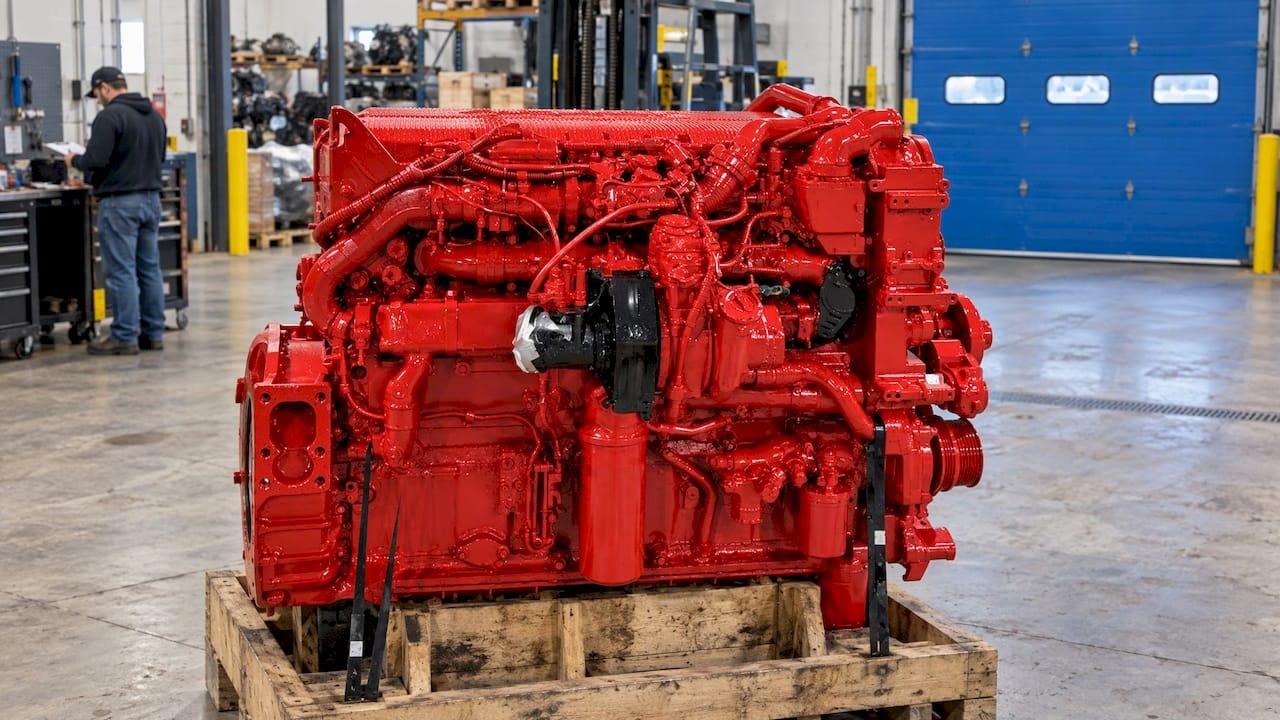
Diesel engine interchange means swapping one heavy-duty engine for another that bolts in, connects up and passes emissions in your truck. Two engines with the same name are not automatically interchangeable. The answer comes from the data plate, the engine serial number, the emissions year and the control module, and you confirm all of them before the engine ships. We sell tested, warrantied used engines at Nationwide Heavy Truck Parts, and we ship the same day, so the matching below is what we would walk you through on a call.
TL;DR
- Interchange is decided by the engine serial number, the emissions year, the control module (ECM) and the parts list tied to the engine, not by the model name alone.
- On a Cummins ISX, the CPL number (a parts list code that records exactly how the engine was built) is the key number to match.
- A 2010 ISX15 and a 2013 ISX15 differ in ECM and emissions hardware, so "same displacement" is not a green light.
- Check the transmission connection, mounts, wiring, fuel, cooling and exhaust, not just the engine itself.
- Send us your serial number and we match it to a tested engine from our inventory, which changes daily.
Table of Contents
- What diesel engine interchange actually covers
- The five numbers and checks that decide fit
- Cummins ISX interchange: why the CPL matters
- Other Cummins families: not every engine has the same options
- A step-by-step interchange check before you buy
- Emissions rules and the label
- Our perspective
- Find a matched, tested engine
- FAQ
- Sources
What diesel engine interchange actually covers
A swap is the removal of a truck's existing engine and the installation of another compatible diesel, either the same model or a different one. Shop guidance on engine swaps notes that the work reaches past the block: transmission connections, wiring, fuel systems, cooling, exhaust, mounts and the truck's overall configuration all come into play.
That is why a good interchange check has two layers:
- Engine identity. Is this the same engine family, built to the same specification as the one you are pulling?
- Truck fit. Will it connect to your transmission, harness, cooling package, aftertreatment and mounts without surprises?
Most failed swaps pass the first layer and miss the second. A fleet manager buys an engine that is the right family, then finds the wrong ECM calibration, a different flywheel housing or an emissions setup that does not match the truck.
Same-model replacement versus a different engine
The easy case is a same-model, same-year swap. Your engine's serial number and CPL point to an engine built the same way, and nearly everything transfers. The harder case is moving to a different model or a different emissions year, for example because the exact engine is hard to find. That can work, but every connection on the list below has to be verified, and the ECM and wiring usually come as a matched set.
If the old engine is repairable, an overhaul is the other route. A rebuild suits an engine whose block and major components are still usable, while a replacement suits severe damage or a case where a compatible engine is available and downtime matters. For a truck that needs to be moving this week, a tested replacement engine is often the shorter path.

The five numbers and checks that decide fit
1. The engine label
Every engine sold in the US for highway use carries a permanent emissions label. Under federal labeling rules, that label states the displacement, the engine family and model designations, the manufacture date, the advertised horsepower at a given rpm and the EPA model-year compliance statement. Photograph it on your old engine and on any candidate. If the family, horsepower rating and compliance year do not line up, stop there.
The label can be hard to read on a dirty or heat-aged engine. Our guide to finding a heavy duty truck engine by VIN and checking the VECI label shows where the label sits and what to read from it.
2. The engine serial number
The serial number is stamped on the block and printed on the data plate. It is the number manufacturers use to pull up the exact parts list for your engine. Locations differ by brand, and we cover where to find the serial number on Cummins, Cat and Detroit engines.
Cummins runs a free parts catalog that covers more than 16 million engines and lets you identify parts by serial number, VIN or part number. Its QuickServe Online service platform adds manuals and technical service bulletins, and is listed at $750.00 per year, with a free trial covering basic content for five serial numbers.
3. The CPL (Cummins)
On a Cummins, the CPL number is the control point list. It records the engine's configuration, from horsepower rating to the parts it was built with. Two engines of the same model can carry different CPLs, and the parts that fit one may not fit the other. Our explainer on Cummins CPL numbers covers what they mean and how to use them.
4. The ECM and emissions generation
The ECM is the engine computer. Different emissions years use different ECMs, and the engine, aftertreatment and truck wiring are built around the one that matches. If you swap into a different emissions year, the harness, sensors and aftertreatment follow the ECM. Match the ECM and its software to the engine, not only to the truck.
5. The truck side
This is the checklist for everything the engine plugs into:
- Transmission: flywheel housing and bell housing pattern, clutch or flywheel arrangement, and the transmission ECM if it is electronic.
- Mounts and engine position, including the oil pan and clearances.
- Wiring harness and connectors, including the dash and cab interface.
- Fuel system connections and any fuel lines or filters that differ by year.
- Cooling: radiator, charge air cooler and hose routing.
- Exhaust and aftertreatment layout.
Our heavy truck parts compatibility checklist for fleet managers lays this out as a printable list, and how to confirm engine compatibility for heavy trucks goes deeper on each item.
Cummins ISX interchange: why the CPL matters
The ISX is the engine most buyers ask about, and it is a good example of why "ISX15" is not enough information.
Cummins' own CPL cross reference guide for ISX overhaul kits tells technicians to find the CPL by entering the engine serial number in QuickServe, opening the Parts tab and then the Dataplate tab. It also points to technical service bulletins on cylinder liner compatibility, connecting rods and pistons before an ISX overhaul. When the manufacturer's own procedure starts with the serial number and CPL, a buyer's should too.
The same guide shows how much hangs on that number. For EPA 2013 CM2350 ISX engines, CPLs 3937, 3938, 4583, 4584, 4586 and 4761 each map to specific overhaul kits. A 152 mm liner kit is released for some of those CPLs and marked "No Release" for others. Even inside one emissions year, parts do not simply transfer from one ISX to another.
ISX15 by emissions generation
Cummins' midlife repair brochure ties its ISX12 and ISX15 kits to EPA 2010 (CM2250) and EPA 2013 (CM2350) engines, which tells you the two generations are treated as distinct builds. The shop page for a PRO-level kit for the ISX15L also lists CM2250 engines with CPLs 3348, 3376, 3490, 3491 and 3688 and offers serial-number verification by Cummins support before purchase.
| Generation | ECM | Example CPLs from Cummins documents | What to confirm |
|---|---|---|---|
| EPA 2010 ISX15 | CM2250 | 3348, 3376, 3490, 3491, 3688 | ECM, harness and aftertreatment from the same generation |
| EPA 2013 ISX15 | CM2350 | 3937, 3938, 4583, 4584, 4586, 4761 | Liner and kit release for the specific CPL |
The lesson is that the ECM generation travels with the engine. A 2010-era engine and a 2013-era engine can share a displacement and look alike on the stand, but the electronics and emissions hardware are different, so one is not a drop-in for the other without matching changes.
We keep a longer guide to Cummins ISX specs, years and ISX15 versus X15 if you need to place a specific engine in its generation.
A worked example
Say your 2012 ISX15 has a failed engine and you find a used ISX15 at a good price. You read your serial number and CPL off the data plate, then ask for the candidate's serial number and CPL.
- Same CPL: you are looking at an engine built the same way. Confirm the ECM part number and that the aftertreatment matches your truck.
- Different CPL, same emissions year: it may still work, but the rating, parts and calibration can differ. Have the match confirmed against the parts list before you pay.
- Different emissions year: treat it as a conversion, not a replacement. Expect ECM, harness and aftertreatment changes, and verify each one.
The first case is the fastest and the cheapest. It is also the case where a seller that publishes the CPL and tests the engine saves you the most time.
Other Cummins families: not every engine has the same options
Cummins' own brochure states that its tiered CLASSIC, PRO and ELITE overhaul kits apply only to ISX12 and ISX15 engines of specific emissions years, while other heavy-duty engines, including the older M11, N14 and ISM, use Classic-only kits. The practical point for a buyer is that older engines have fewer parts paths, which makes finding an exact-match complete engine more valuable than assembling one from parts.

The same logic applies to Caterpillar, Detroit, Volvo, Mack, International and the others. Each brand has its own serial number and parts-list system. The method is the same: identify the exact engine, then match the replacement to it. For a quick tour of the families, see our types of heavy truck diesel engines guide.
A step-by-step interchange check before you buy
- Record your engine's data. Photograph the emissions label and data plate. Write down the serial number, CPL if it is a Cummins, horsepower rating and build date.
- Record your truck's data. Note the VIN, the transmission model, the model year and any special equipment such as a PTO or a particular cooling package.
- Decide the goal. Exact replacement is the lowest-risk path. A different engine or emissions year turns the job into a conversion with a longer parts list.
- Get the candidate's identity. You need its serial number, CPL or equivalent, ECM part number and label data, not just a model name. We publish this on our engines and match it to yours on request.
- Match the electronics. ECM generation, harness and sensors should belong together. This is where most mismatches happen.
- Match the truck connections. Flywheel housing, mounts, fuel, cooling and exhaust, against the list above.
- Confirm the condition and the warranty. The engine should be tested and inspected, and you should know what the warranty covers before it is installed.
- Plan the install. Replace the parts that should not be reused, such as seals and hoses, and have the shop on schedule when the engine arrives.
Where this goes wrong is almost always step 4. Buyers compare price and mileage and skip the identification. When we match an engine for you, steps 4 to 6 are the part we take off your hands: you send the numbers, and we check them against our inventory before you commit. Fleets sourcing for several trucks can use the same process at scale, as covered in how to source diesel engines for multiple trucks.
Emissions rules and the label
An engine's emissions certification is tied to its label, and the label states the model-year compliance statement. That is the safe-use reason to keep the engine and its emissions system as a set: the engine you install should keep the aftertreatment and ECM calibration it was certified with. For a truck that runs on public roads, interchange means a certified engine in a certified configuration. Ask for the label data before you buy, and make sure your installer keeps the emissions system intact.
Our perspective
Most of the calls we get about swapping engines start with a model name and end with a serial number. The serial number is where the answer is. We built our process around that: every engine we sell is tested and inspected, it carries a standard warranty, and our inventory changes daily so the right match for your CPL and ECM may show up this week even if it was not there last week.
For a driver or fleet with a truck down, the cost is not only the engine. It is the days the truck sits. That is why we ship the same day, and why we would rather spend ten minutes confirming the match than have you find a mismatch on the shop floor. Our line covers Cummins, Caterpillar, Detroit, Volvo, International, Mack, Paccar and more, so the match you need is usually in one place.
If you have a serial number, start there. If you only have a VIN, our guides above show you how to get from the VIN to the engine.
John
Find a matched, tested engine
If you have your serial number and CPL, we can start from the match. Our truck engines are tested and inspected before sale, come with a standard warranty and ship same day across the US. Our listings include engines such as a 2012 Cummins ISX15, and ECMs such as the Cummins ISX15 CM2250 CPL 3719 computer when the electronics are what you need to match.

If the transmission or differential is part of the job, we carry transmissions and differentials as well, and exhausts for the aftertreatment side.
FAQ
Can a Cummins ISX15 from one year go into a truck built for another year?
Sometimes, but it is a conversion, not a simple swap. Cummins treats EPA 2010 CM2250 and EPA 2013 CM2350 engines as separate groups, so the ECM, harness and aftertreatment have to move together. Confirm the serial number and CPL against the truck before you buy.
Where do I find the CPL number on a Cummins engine?
The CPL is on the engine data plate and can be looked up from the serial number. Cummins' own guide directs technicians to enter the serial number in QuickServe and open the Dataplate tab. Our CPL guide explains how to read it.
Is the same displacement enough to say two diesels interchange?
No. The emissions label records the engine family, rating and compliance year in addition to displacement, and those must match what the rule requires on the label. Same displacement with a different family or year usually means different electronics and emissions hardware.
Do I need the transmission to match as well?
Yes, the engine has to connect to your transmission through the flywheel housing, and electronic transmissions have their own control links. Check this before the engine ships. Our compatibility guide covers the connection points.
What should I send to get an engine matched?
Send the engine serial number, the CPL for a Cummins, the VIN and the transmission model, plus a photo of the data plate. With those we can check a candidate engine against your truck.
Sources
- 40 CFR § 86.095-35, Labeling (Electronic Code of Federal Regulations)
- Cummins ISX Overhaul Kit CPL Cross Reference Guide
- Cummins Midlife Repairs for Heavy-Duty Engines brochure
- Cummins PRO Level Overhaul Kit for ISX15L and QSX15L
- Independent Service Shops, Cummins Inc.
- Diesel Engine Swap: What to Know Before Replacing Your Truck's Engine