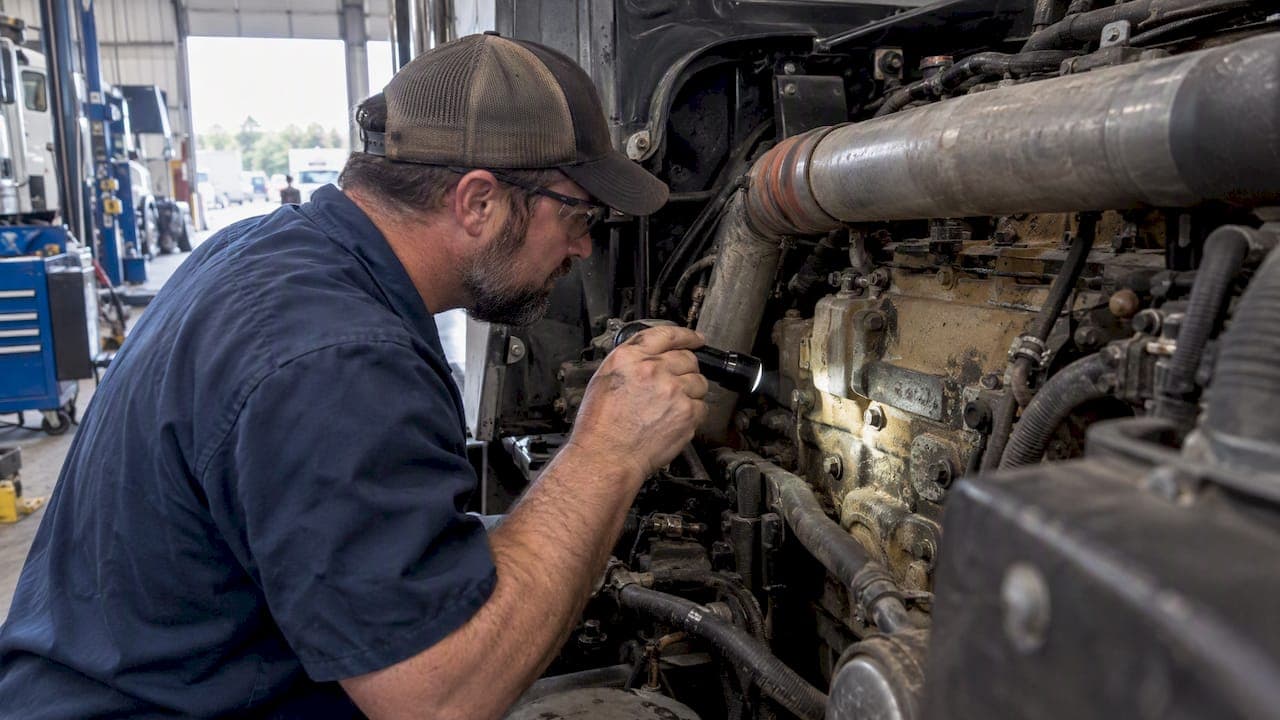
The engine serial number (ESN) is on a metal dataplate fastened to the engine, usually on the rocker cover or the side of the block. If the plate is gone, look for a number stamped or etched into the block itself. Cummins, Caterpillar and Detroit each put theirs in a slightly different spot, and your truck's VIN will not substitute for any of them. This guide shows where to look on each brand, what to do when the plate is missing, and how to use the number so the engine or part you order actually fits.
TL;DR
- Start with the dataplate. On most heavy-duty diesels it is a metal tag on the rocker cover, gear housing or side of the block.
- No plate? The number is often stamped or etched into the block, near the intake side, water pump or gear housing. On Detroit engines it is etched on a pad at the left front of the block.
- Your truck's 17-digit VIN identifies the chassis, not the engine. Always order from the ESN.
- Photograph the plate and write the number down before you pull anything. Heat, oil and grime wear labels out.
- Give a seller the ESN plus the engine family or CPL information, and ask to confirm it before you pay.
Table of Contents
- Why the engine serial number matters more than the VIN
- Where the dataplate usually sits
- Cummins engine serial number location
- Cat engine serial number location
- Detroit Diesel engine serial number location
- Other makes at a glance
- What to do when the plate is missing or unreadable
- How to document the number before you need it
- Using the ESN to buy the right engine
- Our perspective: the number on the plate is the part of the job you can't skip
- Ready to match your ESN to an engine
- Common mistakes when reading an engine serial number
- FAQ
- Sources
Why the engine serial number matters more than the VIN
A lot of wrong orders start with the same shortcut: reading the VIN off the door jamb and assuming it describes what is under the hood. It doesn't. Car and truck engines do not carry VINs. The 17-digit VIN belongs to the vehicle as a whole. To identify an engine you use its own serial number or its engine family name, both of which are on labels or stamps on the engine.
That matters because the same truck model can leave the factory with different engines, and the same engine model can carry different internals. Cummins guidance is clear that you should have the ESN ready before you contact a dealer or buy parts, since it is the primary way to determine the right components for your specific configuration. Running changes mid-production are common, so guessing from the model year is how people end up with a fuel system or emissions package that doesn't match.
Our own VIN-to-engine guide covers how far a VIN can take you. The short version: it can point you to a likely engine, but the ESN settles the question.

Where the dataplate usually sits
Across brands, the pattern is consistent enough to give you a search order:
- The dataplate. A metal tag riveted or screwed to the rocker cover or the side of the block. Cummins describes it as typically on the rocker cover or the side of the cylinder block.
- A stamped or etched number. If the plate is missing or painted over, the ESN is often stamped into the block, commonly on the intake side near the water pump or gear housing.
- Paperwork. The owner's manual, the operation and maintenance manual, or the engine's original build records may list it.
- The emission label. It carries the engine family name, which helps even when the serial number is unreadable.
Bring a flashlight, a rag and a degreaser. Most "missing" plates are just buried under years of oil film and road dirt. Wipe gently with a rag rather than scraping, since a wire brush can ruin a stamped number you may need later.
Cummins engine serial number location
Cummins ESNs are generally eight digits long. The example Cummins itself gives is 79012323, and the company says the number is found on the engine dataplate, typically on the rocker cover or the side of the block.
In practice, here is how to work through it:
- Look at the rocker cover first. On many larger Cummins engines the dataplate is there. Clean it and read the ESN line, not the part number or the date.
- Check the side of the block. If the plate isn't on the cover, look along the block side, particularly toward the gear housing at the front.
- Look for a stamp. With the plate missing, the number may be stamped in the block on the intake side near the water pump or gear housing.
- Note the CPL. Cummins parts lists use a Control Parts List code. It is frequently found close to the serial number and it is essential for matching parts on older, modified or non-original engines.
Locations vary by model family. An ISX15 on a long-haul tractor does not hide its plate in the same place a smaller Cummins engine does, so don't assume. If the plate you find lists a different model than you expected, that is information, not a problem: it may mean the engine has been swapped at some point.
When you're working with an ISX or ISX15 engine computer, the ECM carries its own part number and CPL, which is a separate item from the engine's ESN. The ECM must match the engine's calibration, so confirm both before ordering.

Cat engine serial number location
Caterpillar engines are identified by several numbers at once. According to a Cat service manual reprint, model numbers, serial numbers, performance specification numbers and arrangement numbers are all shown on the serial number plate mounted on the engine. That is the plate you want a photo of.
A few practical notes for Cat engines:
- The serial number starts with a three-character prefix. It is followed by a run of digits. The prefix tells you the engine family and rating, so copy it exactly. A transposed letter can point you to a different model.
- Photograph the arrangement number too. Two Cat engines of the same model can have different arrangements, and the arrangement is what determines the exact parts list.
- Plate positions differ between models. Older 3406 and 3306 engines, the C15 and the C13 do not all share a layout, so check the plate locations page for your specific model in the service manual if the plate isn't obvious.
The EPA's emission upgrade program letters for older Cat 3306 and 3406 engines show how seriously the ESN is treated: eligibility is determined by confirming the engine serial number against the engine arrangement and machine model. If regulators rely on it, so should you.
Detroit Diesel engine serial number location
Detroit is the easiest of the three to remember. Detroit's own literature for the Gen 5 DD15 says the fourteen-digit engine model and manufacturing serial number is etched on a pad at the left front of the cylinder block, above the date and time of manufacture.
The same page breaks down a sample number, 472912S0608850, like this:
| Segment | Meaning |
|---|---|
| 472 | Engine type (DD15) |
| 912 | Model |
| S | Assembly plant |
| 0608850 | Serial number |
The page also lists the DD15 model as 472912 (14.8 L) and the DD13 as 471952 (12.8 L). That means you can often tell at a glance whether an engine is a DD13 or DD15 from the first six characters of the etched number, which is useful when a truck has been repowered and the paperwork doesn't match.
Because the number is etched into the block rather than printed on a tag, grime and paint are the usual obstacles. Clean the pad, then use a flashlight held at a low angle so the etching throws a shadow.
Other makes at a glance
The same logic applies to International, Volvo, Mack, Paccar and the rest: find the dataplate, fall back on the stamped number, then confirm with the emission label. We don't want to guess at exact positions for every model family, so for anything outside Cummins, Cat and Detroit, check the manufacturer's operator manual for that engine. Our heavy truck parts compatibility checklist lists what to collect for each make.
| Brand | Where to look first | Fallback |
|---|---|---|
| Cummins | Dataplate on rocker cover or block side | Number stamped near water pump or gear housing |
| Caterpillar | Serial number plate mounted on the engine | Service manual plate-location page for your model |
| Detroit | Etched pad, left front of block | Engine records and MCM data |
| Others | Dataplate per operator manual | Emission label and stamped block number |
What to do when the plate is missing or unreadable
It happens on high-mileage trucks, on engines that have been through a body shop, and on anything that was repainted. Work through these steps:
- Clean the likely areas. Degrease the rocker cover, gear housing, front of the block and the intake side near the water pump.
- Look for the stamp or etch. A permanent mark in the block is the backup identification method.
- Find the emission label. Look for the engine family name and, on Cummins, the CPL code. The EPA material notes that the engine family name is a 12-character alphanumeric code on the emission label that says more about design and certification than the serial number does. Dealers use both to cross-check compatibility.
- Check the paperwork. Service records, invoices from a prior overhaul or the manual may have the ESN.
- Ask a dealer or machine shop. A diesel shop can often trace an engine from block casting numbers and configuration.
If you are still stuck, don't order on a hunch. A mismatched engine is an expensive mistake, and as we explain in our guide to confirming engine compatibility for heavy trucks, the ESN, the engine family and the application all need to line up.
How to document the number before you need it
Mechanics often advise recording the ESN as soon as you acquire a truck, because labels can become illegible from heat, oil and road grime. It takes two minutes and saves a day of downtime later. A good record includes:
- A close, flat photo of the dataplate and one of the stamped or etched number
- The ESN, written out, plus the CPL or arrangement number
- The engine family name from the emission label
- Truck unit number and VIN, so you can match the two later
Fleet records matter after a replacement too. One rebuild-versus-replace guide recommends keeping the engine serial number, mileage at installation, installation date, supplier, invoice and warranty information together. If you run more than a few trucks, keep this in a shared spreadsheet and tie it to each unit. Our guide on sourcing diesel engines for multiple trucks shows how fleets set that up.
Using the ESN to buy the right engine
Once you have the number, it does three jobs.
It confirms the engine arrangement. Sellers almost universally ask for it, because engines of the same model can differ in internal components, fuel systems or emissions hardware within a single production year.
It protects your core. Replacement engines usually come with a core charge, and it is refunded only if you return a matching, rebuildable core. One published example of a remanufactured long block notes core charges around $3,000 for heavy-duty applications. Get the ID wrong and you can end up arguing over a core that doesn't match what was quoted.
It lets you compare options fairly. Price ranges swing widely with engine size, condition and whether you're buying a bare block, a short block or a complete assembly. The same source shows bare heavy-duty blocks in a range of roughly $700 to $1,200 and remanufactured long blocks that can exceed $15,000 before the core. With the ESN in hand you can ask for like-for-like quotes. For the bigger picture on cost, see our engine swap cost factors and ways to save on heavy truck engine costs.
Cross-reference the ESN against the manufacturer's official parts catalog before you pay. That is the last check, and it catches most errors.
Our perspective: the number on the plate is the part of the job you can't skip
We sell tested used diesel engines, transmissions, differentials and exhaust parts, and we see the same pattern with new customers. The ones who call with a photo of the dataplate get a quick, confident answer. The ones who call with only the truck's year and make usually need a second conversation, because the year and make leave too many possible engines.
So our advice is simple. Before you shop for a replacement, spend ten minutes under the hood with a rag and your phone. Get the ESN, the CPL or arrangement number if your brand uses one, and the emission label. Then match that against what a seller says they have in stock. Our inventory changes daily, so the best match is often the one that came in this week, and a clear ID lets you move on it quickly.
We test and inspect each part before it is sold, and every part carries a standard warranty, but good testing can't fix a wrong order. Identification is the buyer's half of the job, and it is the half that costs nothing. If you're comparing a used engine to a rebuild, our replacement process guide walks through it.
— John
Ready to match your ESN to an engine
If you have the serial number and need a replacement, start with our used truck engines. We stock Caterpillar, Cummins, Detroit, Volvo, International, Isuzu, Mack, Mercedes, Hino, Mitsubishi and Paccar engines, and we ship the same day. Transmissions, differentials and exhausts are also available if the same truck needs more than an engine: see transmissions, differentials and exhausts.

Common mistakes when reading an engine serial number
- Reading the wrong line. Dataplates list part numbers, dates and ratings. Make sure you copy the line labeled as the serial number.
- Confusing similar characters. The 17-character VIN deliberately skips the letters I, O and Q to avoid confusion with 1 and 0, but engine numbers follow their own rules. Photograph the plate so you can zoom in rather than trusting your eyes.
- Trusting a previous owner's description. If an engine has been swapped, the truck's paperwork may describe an engine that is no longer there.
- Ordering by model year. Mid-production changes are common. The ESN is the safer guide.
- Forgetting the ECM. The computer has to match the engine's calibration, so confirm its part number and CPL as well.
For more on picking between engine types once you know what you have, see our guide to types of heavy truck diesel engines, and for what the block itself does, our piece on the engine block's role in truck performance. If you're hunting for a drop-in match, our guide to finding compatible used diesel engines is the natural next read.
FAQ
Where is the engine serial number on a diesel engine?
Usually on a metal dataplate attached to the rocker cover or the side of the block. If the plate is missing, check for a number stamped or etched into the block, often on the intake side near the water pump or gear housing. On Detroit engines, it is etched on a pad at the left front of the block.
Does a truck engine have a VIN?
No. The 17-digit VIN identifies the whole vehicle, not the engine. To identify an engine you use its serial number or its engine family name, found on labels or stamps on the engine.
How many digits is a Cummins engine serial number?
Cummins ESNs generally have eight digits, for example 79012323. Always copy the number exactly from the dataplate, and add the CPL code if you're ordering parts for an older or modified engine.
Can I order an engine without the serial number?
It is risky. Engines of the same model can differ in internals, fuel systems and emissions hardware, so sellers ask for the ESN to confirm the arrangement. If you can't find it, collect the engine family name and CPL or arrangement number and have a diesel shop verify the engine before you buy.
Sources
- Cummins: Finding your engine serial number
- Detroit: Engine model and serial number designation, Gen 5 DD15
- US EPA: Caterpillar emissions upgrade group, model 3306
- US EPA: Construction Fleet Inventory Guide
- Diesel Laboratories: 6.7L Powerstroke engine
- Rebuild vs Replace a Truck Engine