
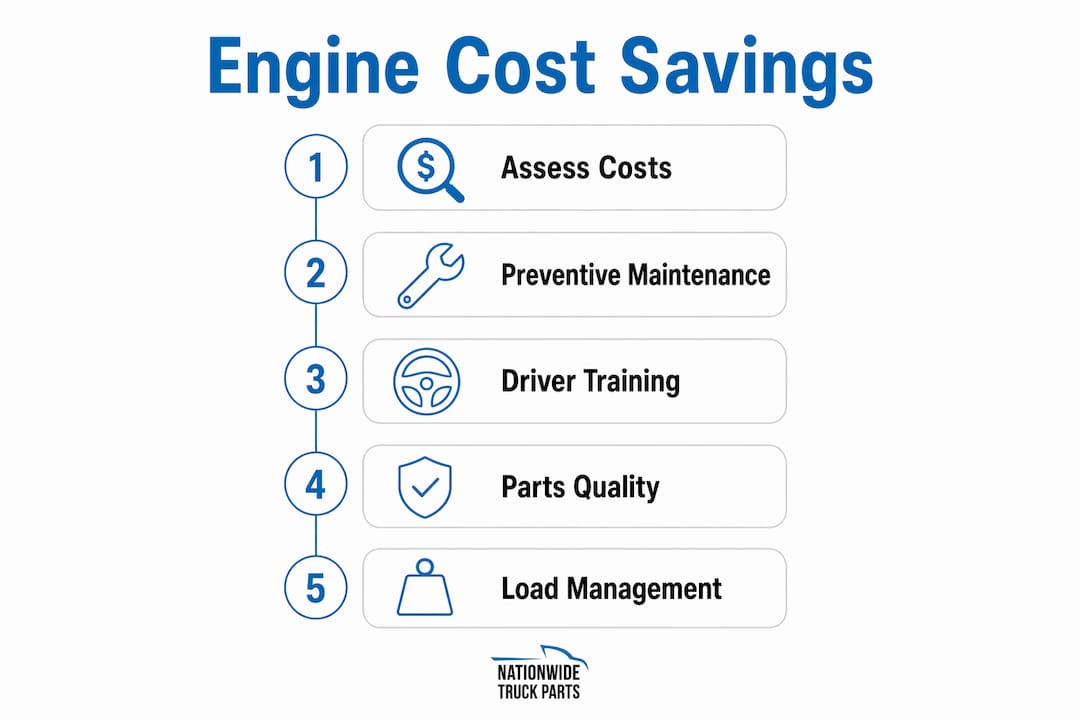
Cutting heavy truck engine costs comes down to three decisions you make before the engine fails: how aggressively you maintain it, how quickly you catch early wear, and whether you rebuild or replace when the time comes. Get those three right, and you can keep a Class 8 diesel running at significantly lower maintenance cost per mile than aging, reactive-maintenance trucks.
Here is what the highest-impact strategies look like in practice:
- Run daily pre-trip inspections religiously. They catch up to 80% of potential failures before a breakdown.
- Use oil analysis at every drain interval to detect wear metals and coolant contamination early.
- Shift from reactive to planned maintenance. Unplanned repairs cost 2–3x more than the same job done on a scheduled visit.
- Evaluate rebuild vs. replacement using total cost of ownership, not just the invoice price.
- Source quality parts with verified warranties, whether OEM or reputable aftermarket.
- Train drivers to operate within load limits and avoid habits that accelerate engine wear.
- Update your insurance after a major rebuild so a total loss payout reflects the truck's actual value.
How to save on heavy truck engine costs starts with understanding repair vs. replacement
The first number that hits you is the rebuild quote: a typical Class 8 engine rebuild runs $20,000–$35,000, covering a parts kit ($5,000–$9,000), labor ($8,000–$15,000), machining ($2,000–$4,000), and ancillaries like the turbo, water pump, and injectors. A new or remanufactured engine replacement costs $40,000–$55,000, but downtime drops from 7–14 days to 3–7 days.
That gap shrinks fast once you account for lost revenue. Downtime costs at a high rate in lost productivity can make a 10-day rebuild very expensive for a high-utilization truck. When you fold downtime into the math, the real cost difference between rebuild and replacement can narrow to as little as $11,000.
| Factor | Rebuild | Replacement |
|---|---|---|
| Typical cost | $20,000–$35,000 | $40,000–$55,000 |
| Downtime | 7–14 days | 3–7 days |
| Post-service life | 400K–600K miles | 750K–1M miles |
| Warranty | 1–2 years typical | 3–5 years factory |
| Fuel efficiency | Restored to ~95% | 100% (like-new) |
Signs your engine needs attention now:
- Persistent power loss or rough idle that worsens over time
- Oil consumption climbing faster than normal between services
- Coolant in the oil or white exhaust smoke (head gasket or liner failure)
- Metal particles showing up in oil analysis samples
- Compression readings dropping below spec on cylinder checks
A used low-mileage engine is a third path worth knowing. Cost typically ranges from $10,000–$20,000 for the engine plus labor, with a warranty of only 90 days to 6 months. That makes it a reasonable bridge for a truck with one to two years of service life left, not a long-term fix.
Preventive maintenance practices that actually cut repair bills
Planned maintenance is the single biggest lever for reducing heavy vehicle maintenance costs. Fleets running 85–90% planned maintenance versus the industry average of 60–65% spend dramatically less per truck per year because they avoid emergency labor rates, towing charges, and parts markups that stack up during unplanned breakdowns.
Pro Tip: Oil analysis at $25–$40 per sample is the cheapest insurance in trucking. It catches wear metals, coolant intrusion, and fuel dilution months before symptoms appear, preventing overhauls that run $15,000–$25,000. Run it at every drain interval, not just when something seems wrong.
Key maintenance practices that pay for themselves:
- Extend oil change intervals with data. Modern synthetic blend oils can safely run 35,000–50,000 miles with oil analysis verification. Each extended interval saves $400–$600 in parts, labor, and downtime.
- Consolidate service visits. If an oil change is due at 35,000 miles and a brake inspection at 40,000, do both at 37,500. Two separate shop visits cost more in labor and downtime than one combined event.
- Never skip DPF regeneration. Canceling active diesel particulate filter regeneration causes premature aftertreatment failures. A neglected DEF system can trigger $3,500+ repairs and DPF replacements costing $2,500–$4,000.
- Follow post-rebuild break-in protocols. New rings and liners need 10,000–15,000 miles to seat properly. Skipping proper break-in procedures and varying RPMs shortens engine life by up to 20%.
- Switch to condition-based scheduling for brakes, clutch, and suspension. Replacing components that still have usable life wastes money. Inspect first, then decide.
How parts quality and shop selection affect your long-term costs
OEM parts carry a higher upfront price, but they tend to deliver better fuel efficiency and fewer repeat failures. Aftermarket parts vary widely. A quality aftermarket rebuild kit from a reputable supplier can perform comparably to OEM at lower cost. A cheap kit with loose tolerances will cost you more in follow-up repairs within the first 300,000 miles.
Dealer shops charge 20–40% more than independent shops but offer factory-trained technicians, OEM parts, and standardized warranties. An experienced independent shop can save $5,000–$10,000 on a rebuild if they know your engine platform and use quality components. The key is verification, not assumption.
When evaluating shops and parts sources, check for:
- ASE or OEM certifications for the specific engine platform
- Written warranty terms (minimum 12 months; 24 months is better)
- References or documented rebuild history for your engine make
- Willingness to provide a detailed parts list before work begins
- Clear policy on what happens if a warranty claim arises
One detail fleet managers often miss: after a $30,000 rebuild, your truck's insured value needs to be updated. A total loss payout based on pre-rebuild value leaves you short by tens of thousands of dollars. Notify your insurance carrier and update asset records immediately after any major engine work.
For fleets considering remanufactured engine options, a factory reman comes with a transferable warranty and documented build specs, which also protects resale value better than a shop rebuild.
What total cost of ownership actually tells you about engine decisions
Upfront repair cost is the wrong metric. Total cost of ownership (TCO) includes the repair invoice, downtime-related lost revenue, expected remaining service life, and the risk of cascading failures in aging systems. When you calculate TCO correctly, some rebuilds that look cheap on paper turn out to be the more expensive choice.
Downtime at $760 per hour in lost productivity means a 14-day rebuild on a high-utilization truck can generate over $100,000 in lost revenue. That figure alone can flip the rebuild-vs-replacement decision.
TCO factors that change the math:
- Multiple prior rebuilds. After three major overhauls, the engine block's mechanical viability declines. Repeated rebuilds yield diminishing returns and rising failure risk. At that point, a remanufactured or crate engine is usually the smarter investment.
- Cascading failure risk. Rebuilding the engine in a truck whose transmission also needs $8,000–$15,000 in work, or whose chassis has frame damage, rarely pencils out. The engine fix becomes one item in a growing list.
- Cost-per-mile tracking. A rebuilt engine should deliver $0.08–$0.12 per mile in maintenance costs. If it climbs above $0.15 per mile, something is wrong and catching it early is cheaper than waiting.
- Resale value impact. A replacement engine adds a significant amount to resale value, while a rebuild adds somewhat less. If you plan to sell within two years, replacement protects your asset better.
When annual maintenance costs approach half the truck's current market value, replacement often becomes the more economical path. That threshold is not a hard rule, but it is a useful signal to run a full TCO analysis rather than just approving the next repair.
How driver training reduces engine wear and repair expenses
Driver behavior is one of the most underestimated variables in engine longevity. Hard acceleration from a stop, lugging the engine at low RPM under heavy load, and excessive idling all accelerate wear on pistons, rings, and bearings in ways that show up as repair bills 18–24 months later.

Structured driver training programs focused on smooth throttle application, proper gear selection, and idle management can extend engine service intervals and reduce the frequency of unplanned repairs. Drivers who understand how their habits translate into component wear tend to treat equipment differently. A 15-minute pre-trip inspection done thoroughly, as opposed to a walk-around checkbox, catches developing brake problems, fluid leaks, and tire issues before they compound into engine-related failures.
Fleet managers who tie driver performance metrics to fuel consumption and maintenance cost per mile create accountability that pays off in lower repair bills. The connection between driver behavior and engine failure types is direct and well-documented.
How load management and usage patterns affect engine life and costs
Running a truck consistently over its rated payload accelerates wear on every load-bearing component, including the engine. Overloaded trucks run hotter, consume more fuel, and stress the turbocharger and cooling system in ways that shorten the interval between major repairs.

Route planning matters too. Stop-and-go urban routes are harder on engines than steady highway miles because they involve more cold starts, more frequent gear changes, and less time for the engine to reach optimal operating temperature. A truck doing 80,000 miles per year on urban routes will typically need more frequent maintenance than one covering the same mileage on long-haul runs.
Matching the right truck and engine spec to the actual job reduces both fuel costs and wear rates. Fleets that right-size their equipment, rather than running oversized trucks on light loads or undersized trucks on heavy routes, consistently report lower maintenance costs per mile. Tracking load data alongside maintenance records helps identify which routes and usage patterns are driving disproportionate repair costs.
Nationwide Truck Parts makes affordable engine sourcing straightforward
Replacing a worn engine does not have to mean a $50,000 invoice. Nationwide Truck Parts stocks tested, inspected used diesel engines at prices well below new or dealer-reman units, with a standard warranty included on every unit. The inventory changes daily, covering a wide range of Class 8 platforms, so fleet managers can find the specific engine they need without weeks of searching.
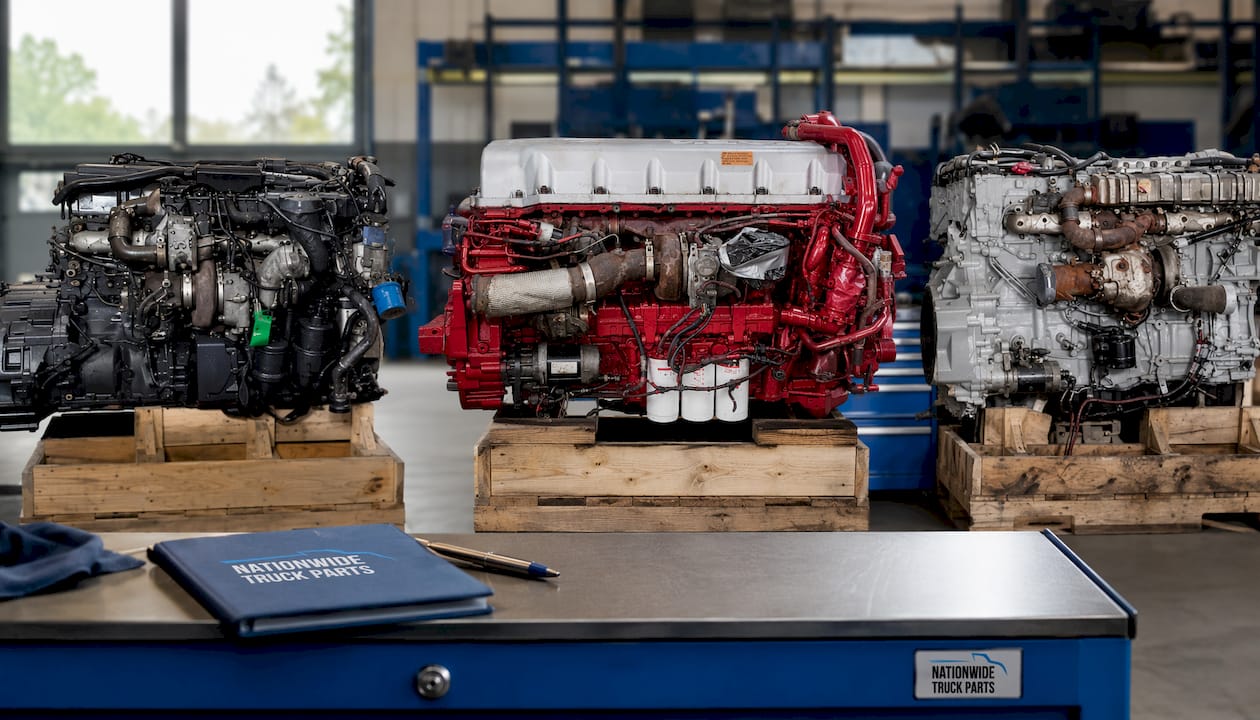
For a fleet manager who just ran the TCO numbers and decided replacement beats another rebuild, the next step is sourcing a quality unit fast. Nationwide Truck Parts ships same-day, which means less downtime and less lost revenue at that $760-per-hour rate. Current inventory includes units like the 2015 Detroit DD15, the 2015 Paccar MX13, and the 2013 Mack MP8 445. Browse the full inventory at Nationwide Truck Parts and get your truck back on the road without the wait.
Key Takeaways
Rebuilding or replacing a heavy truck engine costs far less over time when decisions are driven by total cost of ownership, not just the repair invoice.
| Point | Details |
|---|---|
| Rebuild vs. replacement cost | Rebuilds run $20,000–$35,000; replacements run $40,000–$55,000, but shorter downtime narrows the gap. |
| Downtime is a hidden cost | Lost productivity at $760/hr can reduce the real cost gap between rebuild and replacement to ~$11,000. |
| Oil analysis ROI | At $25–$40 per sample, oil analysis is a cost-effective early-warning system detecting wear metals and coolant contamination before catastrophic engine damage occurs. This proactive testing effectively prevents $15,000–$25,000 engine overhauls. |
| Planned vs. unplanned ratio | Unplanned repairs cost 2–3x more; best-in-class fleets run 85–90% planned maintenance. |
| Nationwide Truck Parts | Stocks tested used diesel engines with same-day shipping and a standard warranty, reducing both cost and downtime. |
FAQ
Is it cheaper to rebuild an engine or buy a rebuilt one?
A rebuild typically costs $20,000–$35,000, while a remanufactured replacement runs $40,000–$55,000. Rebuilding is cheaper upfront, but when you factor in 7–14 days of downtime versus 3–7 days for a replacement, the real cost difference can shrink to around $11,000.
How much does a truck engine replacement cost?
A new or remanufactured Class 8 engine replacement typically costs $40,000–$55,000, including the engine unit, labor, and ancillaries.
Is 300,000 miles on a diesel engine a concern?
Not necessarily. A well-maintained heavy-duty diesel rebuild can last hundreds of thousands of miles, and a replacement engine can reach significantly higher mileage. At 300,000 miles, the engine may have substantial life remaining if maintenance records are solid and oil analysis shows no abnormal wear.
What is the largest operating expense for a truck?
Fuel is the largest expense, followed by insurance. Maintenance ranks third, with the average Class 8 truck running around $15,000 per year. Engine and drivetrain work accounts for a significant portion of that total maintenance spend.