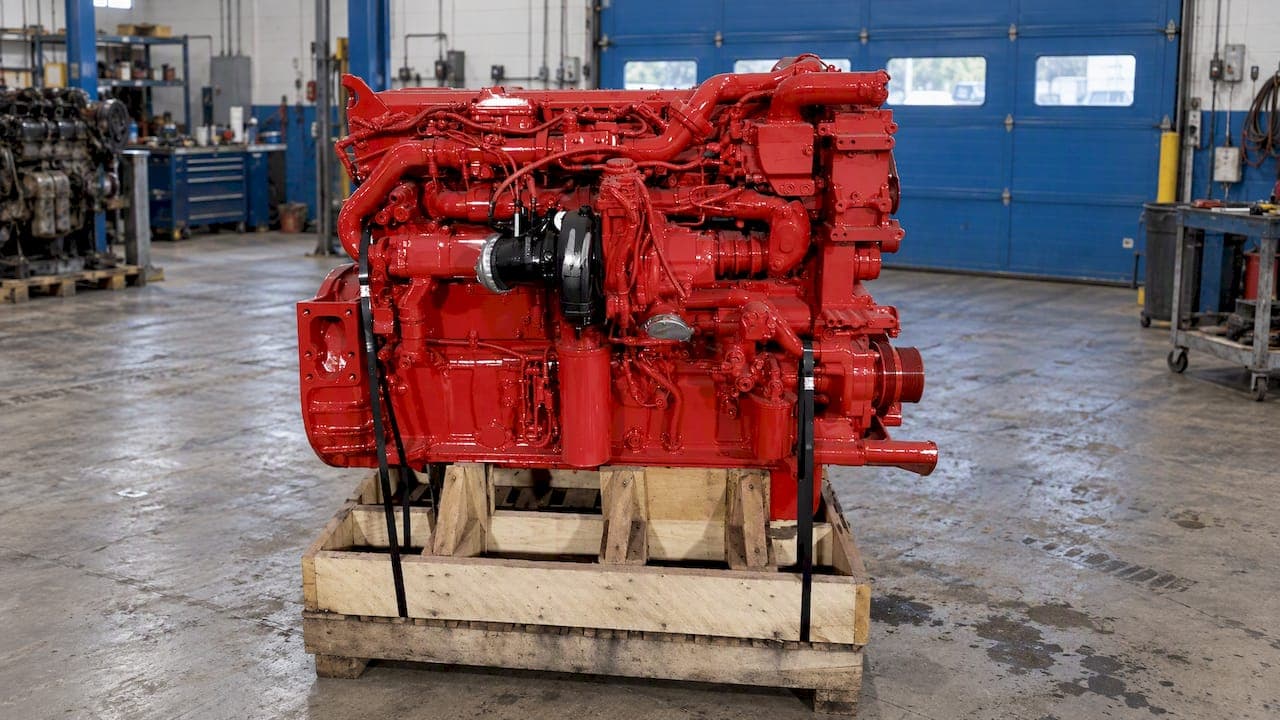
The Cummins ISX is an inline-six, heavy-duty diesel family built for on-highway trucks and motorcoaches. It runs from the late 1990s ISX, through the ISX12 and ISX15, to today's X15. If you are sizing up a replacement, comparing ratings, or trying to work out what an engine tag really means, this guide covers the specs, the generations, the differences between the models, and the checks that matter before you buy a used one.
TL;DR
- "ISX" covers a family: the original ISX (built 1998 to 2006), the ISX15 (2007 to 2016), and the X15 (2017 onward). The ISX12 is the smaller, compact sibling.
- ISX15 and X15 are not unrelated engines. Cummins describes the X15 as building on the ISX15, with the "IS" prefix dropped from the name.
- Ratings vary widely by year and configuration, from 385 to 600 hp on the EPA 2007 ISX, so match the engine to the exact rating and emissions generation, not just the badge.
- Service history predicts remaining life better than the model name does. Ask for records before you ask for a price.
- For a used swap, confirm series, emissions generation, application and warranty terms before you order.
Table of Contents
- What the Cummins ISX family includes
- Cummins ISX specs: what the numbers actually say
- ISX15 vs X15: same engine or not?
- ISX12 vs ISX15: when smaller makes sense
- Model years: where to be careful
- How long a Cummins ISX lasts
- What to check before you buy a used ISX
- Shopping for an ISX15 with us
- Our perspective on buying an ISX
- FAQ
- Sources
What the Cummins ISX family includes
The ISX is an inline-six heavy-duty diesel used in over-the-road trucks and motorcoaches. Its off-highway cousin is the QSX, sold for industrial, marine and oil-and-gas work, so if a listing says QSX, it was built for a different job than a Class 8 tractor (Cummins ISX overview).
Over the years the name has covered several engines. Cummins' own list of heavy-duty technologies built at its Jamestown, New York plant includes the X15, ISX12, ISX12N, and historically the ISX15 and ISX12G. That means the ISX label has covered both diesel and natural gas variants (Cummins Jamestown announcement). If you are shopping for a diesel, make sure a "G" or "N" engine is not what is in the listing.
The generations at a glance
Cummins' own quick-reference guide groups the family by production period (Cummins quick-reference guide):
| Name | Built | Notes |
|---|---|---|
| ISX | 1998 to 2006 | The original generation |
| ISX15 | 2007 to 2009 | EPA 2007 era |
| ISX15 | 2010 to 2016 | EPA 2010 era, with SCR and DEF |
| X15 | 2017 to 2020 | New naming, Performance and Efficiency series |
| X15 | 2021 and later | Current generation |
The split inside the ISX15 matters in the shop. An engine from the 2007 to 2009 window and one from the 2010 to 2016 window share a displacement and a name, but they do not share the same emissions hardware, so parts and wiring do not always carry over.
Cummins ISX specs: what the numbers actually say
There is no single ISX spec sheet, because the engine was sold in many ratings. A few official data points show the range.
- EPA 2007 ISX: Cummins lists 385 to 600 hp, 1,450 to 1,850 lb-ft of peak torque, a governed speed of 2,000 to 2,100 rpm, and six cylinders (Cummins ISX EPA 07 page).
- ISX15, 2013 guide: 400 to 600 hp and 1,450 to 2,050 lb-ft, with 1,000 lb-ft of clutch-engagement torque, a 3,204 lb system weight and a 2,964 lb dry engine weight (Cummins 2013 engine reference guide).
- X15 Productivity Series: Cummins lists both the 2020 and 2024 ratings at 430 to 605 hp and 1,650 to 2,050 lb-ft (Cummins heavy-duty engine features).
Two habits save money here. First, never buy on displacement alone: a 400 hp Efficiency-type rating and a 600 hp rating are very different engines under the same name. Second, check the engine's own data plate and the ECM calibration against the truck's job. A rating that was perfect for a line-haul tractor can be wrong for a heavy-haul unit.
ISX15 vs X15: same engine or not?
This is the question behind many searches, and the short answer is that the X15 is the next generation of the ISX15, not a different lineage.
Cummins announced the X15 in October 2016, saying it builds on the existing ISX15 while adding updated air handling, combustion, emissions, fuel-economy and performance technology. Full production began in January 2017 (Cummins X15 announcement). Cummins' nomenclature standards explain the naming: existing names such as ISX15 stay in use for engines produced before the change, while new names drop the "IS" market prefix and use X-series names (Cummins brand standards).
The X15 also arrived in two flavors. Cummins lists Performance ratings of 485 to 605 hp with up to 2,050 lb-ft, and Efficiency ratings of 400 to 500 hp with up to 1,850 lb-ft. The company positions Efficiency for line-haul and regional haul, and Performance for heavier loads (Cummins 2017 innovations).

What this means for a replacement: do not assume an X15 drops into an ISX15 chassis, or the reverse, without checking. Engine harness, ECM, aftertreatment and mounting details are where swaps go wrong. Our walkthrough on confirming engine compatibility for heavy trucks covers the checks in order.
ISX12 vs ISX15: when smaller makes sense
The ISX12 is the compact member of the family. Cummins describes it as a fit for mixers, dump trucks, refuse haulers, day cabs and LTL operations, with vocational ratings and front or rear engine PTO options (Cummins 2013 engine reference guide).
The 2013 RV specification sheet gives a clean side-by-side (Cummins 2013 ISX15 and ISX12 sheet):
| ISX15 | ISX12 | |
|---|---|---|
| Top rating | 600 hp / 1,950 lb-ft | 500 hp / 1,645 lb-ft |
| Next rating listed | 550 hp / 1,850 lb-ft | 450 hp / 1,550 lb-ft |
| System weight | 3,204 lb | 2,880 lb |
The ISX12 saves roughly 300 lb of system weight and gives up some peak torque. For regional and vocational work that trade is often right. For heavy gross weights, long grades and sustained high-torque loads, the ISX15 has the headroom. Choose by duty cycle, not by what is cheaper this week.
Model years: where to be careful
People search for the best year of the ISX, or the years to avoid. We will not hand you a blanket list, because the honest answer depends on the individual engine's history. What you can do is understand the big generation shifts, since each one changed what can go wrong and what it costs to fix.
- Early ISX (1998 to 2006): the oldest generation, now well into its second or third life. Condition and rebuild history matter far more than the original spec.
- ISX15 (2007 to 2009): an emissions-era engine with particulate filter hardware on the exhaust side. Ask whether the aftertreatment is intact and clean.
- ISX15 (2010 to 2016): adds SCR and DEF. Cummins' schedule for 2013 lists service intervals for the DEF filter and the particulate filter, so the records for those items tell you a lot (Cummins 2013 engine reference guide).
- X15 (2017 onward): newest, and the one most likely to still be inside some form of warranty coverage.
In practice a well-documented engine from a "less loved" year beats an undocumented one from a "good" year. Our guide on types of commercial truck engine failures shows which failure patterns to ask about.
How long a Cummins ISX lasts
Cummins does not publish a service-life guarantee for the ISX. What exists is field reputation. Ritchie Bros. reports that well-maintained ISX15 engines are commonly associated with roughly 1,000,000 or more miles, and presents that as an expectation from the field rather than a promise (Ritchie Bros. engine reliability comparison). The same guidance says service history matters more than brand and names the key predictors: oil-change discipline, coolant maintenance, idle hours, aftertreatment history, compression and blow-by, and overhead adjustment records.
Cummins' 2013 guide lists ISX15 maintenance intervals of 500,000 miles for valve adjustment, 300,000 miles for the DEF filter and 200,000 miles for particulate filter cleaning. Those are subject to duty cycle and the owner's manual, and oil-drain intervals vary by duty cycle too (Cummins 2013 engine reference guide).
So mileage is only half the story. A 700,000 mile engine with a full paper trail can be a safer buy than a 400,000 mile engine with none. For wider context, see our diesel engine mileage benchmarks and the lifespan indicators for diesel engines.

What to check before you buy a used ISX
Cummins' U.S. and Canada warranty document for EPA 2010 and newer automotive engines groups ISX11.9, ISX12, X12, ISX15 and X15 together. It confirms that the model name, emissions generation and application decide which coverage applies (Cummins warranty document). Build your checklist around that.
- Read the data plate. Record the engine serial number, series, CPL and rating. Cummins' engine manual lookup by serial number helps you pull the right documentation.
- Confirm the emissions generation. EPA 2007, 2010 and later engines use different aftertreatment. Your truck's exhaust, sensors and ECM have to match.
- Match the application. On-highway tractor, motorcoach and vocational ratings are tuned differently.
- Ask for service records. Oil analysis, coolant history, overhead adjustments and any prior rebuild.
- Ask what was tested. Compression, leak-down, oil pressure and a run test on a stand are what you want in writing.
- Read the warranty terms. Know the length, what is covered, what is excluded, and what installation proof is required.
- Plan the swap. Mounts, harness, cooling, turbo, and every sensor you will transfer from the old engine.
If you are unsure about the process end to end, how truck engine replacement works and how to find compatible used diesel engines walk through it. If you are weighing options by type, see types of used semi truck engines and examples of remanufactured truck engines.
Shopping for an ISX15 with us
We sell used heavy truck engines that are tested and inspected before sale, backed by a standard warranty, with same-day shipping nationwide. Our inventory changes daily, so the best way to see what is on the shelf is to browse our truck engines for sale. Examples of ISX15 listings include a 2013 Cummins ISX15, CPL 3937, EPA13 CM2350, a 2015 ISX15 S921 and a 2015 ISX15 S895. Replacing the driveline at the same time? We also carry transmissions and differentials.

Our perspective on buying an ISX
Most of the engines that come back to the conversation are not bad engines. They are mismatched ones: the wrong emissions generation for the chassis, the wrong rating for the job, or a unit bought without records. That is why we test and inspect every part and put a standard warranty behind it, because paper and a test report let you buy with your eyes open.
Our advice to an owner-operator or fleet manager is simple. Start with the serial number and the CPL, not the year. Decide which duty cycle the engine will run. Then compare engines on condition, documentation and warranty before you compare on price. A cheaper engine that needs a second swap is the most expensive one on the lot. When downtime is costing you a day rate, the same-day shipping and a clear warranty are worth more than a small discount.
— John
FAQ
What does ISX stand for?
Cummins does not use ISX as an acronym in the sources we reviewed, and its current naming standards simply say the "IS" market prefix was dropped for the X-series names such as X15 (Cummins brand standards). What matters in practice is the family: ISX, then ISX15 and ISX12, then X15 and X12 for newer builds.
Is the ISX the same as the X15?
Not exactly, but they are directly related. Cummins says the X15 builds on the ISX15 with updated air handling, combustion and emissions technology (Cummins X15 announcement). Treat it as a new generation and verify parts and ECM compatibility before a swap.
Which years of the Cummins ISX should I avoid?
There is no official avoid list, and we would not trust one. Judge each engine by its emissions generation, service records, aftertreatment condition and test results. An engine with a full history from any year is a safer bet than one without records.
How long will a Cummins ISX last?
Cummins gives no guarantee, but field reports link well-maintained ISX15 engines with roughly 1,000,000 or more miles (Ritchie Bros.). Oil changes, coolant care, idle hours and aftertreatment history shape that number more than the badge does.
Sources
- Cummins Jamestown Engine Plant announcement
- Cummins ISX overview
- Cummins quick-reference guide
- Cummins ISX EPA 07 page
- Cummins 2013 engine reference guide
- Cummins heavy-duty engine features
- Cummins X15 announcement
- Cummins brand standards
- Cummins 2017 innovations
- Cummins 2013 ISX15 and ISX12 sheet
- Ritchie Bros. engine reliability comparison
- Cummins warranty document