
A well-maintained diesel engine typically lasts up to a maximum lifespan observed in industry, and the five indicators that most reliably predict remaining life are: exhaust smoke color, oil condition on the dipstick, compression test results, fuel dilution in the oil, and new deep knocking noises. If you spot blue smoke at startup, a milky dipstick, or a knock that wasn't there last month, stop driving and schedule a diagnostic immediately. Mileage alone tells you almost nothing without these checks.
- Blue or white exhaust smoke at startup or under load
- Milky or frothy oil on the dipstick (coolant contamination)
- Compression below spec on one or more cylinders
- Fuel smell or raised oil level indicating fuel dilution
- New deep knock or rod knock that changes with RPM
Any single red flag warrants a shop visit. Two or more together mean park it.
Table of Contents
- What are the real diesel engine lifespan indicators by application?
- What symptoms tell you a diesel engine is aging or failing?
- What factors most affect how long a diesel engine lasts?
- How do you assess remaining engine life with diagnostics?
- Which maintenance tasks most reliably extend diesel engine life?
- Should you repair, rebuild, or replace your diesel engine?
- A quick pre-purchase or keep-or-sell checklist
- Key Takeaways
- The part most owners get wrong about diesel longevity
- Need a replacement engine? Nationwide Truck Parts has inspected options ready to ship
- Useful sources for deeper diagnostics and OEM guidance
- FAQ
What are the real diesel engine lifespan indicators by application?
Cummins reports a typical diesel lifespan notably longer than a gasoline engine's, roughly double or more in many cases. But that range is wide because application matters enormously. A light-duty pickup doing school-run duty and a Class 8 long-haul truck share the same basic technology, yet their wear profiles look nothing alike.
| Application | Typical Lifespan Range | Key Variable |
|---|---|---|
| Light-duty pickup (1/2–3/4 ton) | 400,000–1,000,000 miles (typically at the lower end of this range) | Towing frequency, oil change adherence |
| Medium-duty truck (Class 4–6) | 400,000–1,000,000 miles (middle of range more likely) | Load consistency, idle hours |
| Heavy-duty truck | 400,000–1,000,000 miles (upper half common with solid maintenance) | Preventive maintenance, fuel quality |
| Stationary/industrial diesel | Over 1,000,000 miles equivalent or 30+ years in continuous operation | Thermal stability, coolant management |
A well-maintained Cummins diesel commonly reaches a high mileage range observed in many cases, with some documented instances far exceeding typical lifespan under meticulous care. Stationary industrial engines can run for 30+ years. For fleet benchmarks by model year and platform, the diesel engine mileage benchmarks guide breaks it down further.
The wide range exists because duty cycle, maintenance consistency, and engine family interact. A concrete mixer engine sees far more stress per hour than a highway hauler at steady cruise, which is exactly what West Virginia University's duty-cycle research for Cummins confirmed: heavy haulers showed minimum power-cylinder component life, while concrete mixers, despite lower speeds, produced maximum life due to more stable load profiles.
What symptoms tell you a diesel engine is aging or failing?
Symptoms are your earliest and cheapest diagnostic tool. Each one points to a specific failure mode, and knowing which is which saves you from replacing parts that don't need replacing.
Exhaust smoke color guide:
- Black smoke: Rich fuel mixture, clogged air filter, failing injectors, or a worn turbo. Usually not an immediate stop-driving situation, but chronic black smoke accelerates wear.
- Blue smoke: Oil burning in the combustion chamber. Worn valve seals, piston rings, or a turbo seal leak. Persistent blue smoke means oil consumption is rising, and that trend only goes one direction.
- White smoke: Coolant entering combustion, or unburned fuel at cold start. Cold-start white smoke that clears in two minutes is normal. White smoke that persists, especially with a sweet smell, points to a head gasket or cracked head.
Cummins identifies hard starting, progressive power loss, turbo lag, rising fuel consumption, and new knocking or whining noises as the primary pre-failure indicators. Hard starting on a warm engine is particularly telling because a cold-start struggle can be glow plug related, but a warm-engine crank that takes four or five seconds usually means low compression.
Symptom urgency matrix:
- Monitor (schedule within 30 days): Mild black smoke under load, slight power reduction, marginally higher fuel consumption
- Inspect soon (within one week): Persistent blue smoke, hard warm starts, turbo lag that's getting worse
- Stop driving now: White smoke with sweet smell, deep knock, milky dipstick, confirmed fuel in oil
Pro Tip: Pull the dipstick after a cold overnight sit. Coolant contamination shows as a gray, frothy film near the top of the oil. Fuel dilution shows as a raised oil level with a thin, watery consistency and a strong diesel smell. Either finding means the engine should not move until a shop evaluates it.
Deferred repairs on platforms like some Duramax models have shown how quickly a small issue cascades: a CP4 pump failure can send metal debris through the entire fuel system, turning a $400 pump job into a $10,000+ fuel-system replacement. EGR cooler failures follow a similar pattern, leading to head gasket damage when ignored.

What factors most affect how long a diesel engine lasts?
Preventive maintenance consistency, fuel and lubricant quality, duty-cycle severity, and engine design are the four primary drivers of diesel engine longevity. Of these, maintenance consistency has the most direct owner control.
Duty cycle is the factor most people underestimate. A truck doing expedited freight runs at steady highway speeds puts far less stress on power-cylinder components than one doing stop-and-go urban delivery at high idle percentages. Engines that rarely reach normal operating temperature see higher wear because oil viscosity stays elevated and combustion is incomplete, leaving more soot and acids in the oil.

Environmental conditions add another layer. Engines operating in dusty or sandy environments wear faster because even small amounts of abrasive particles that bypass air filtration accelerate cylinder bore wear. Salt exposure from winter road chemicals attacks cooling system components and external hardware. High-altitude operation reduces air density, which affects combustion efficiency and turbo loading. Temperature extremes at both ends, deep cold starts and sustained high-heat operation, push lubrication systems toward their limits.
Fuel sulfur content has a documented effect too. EPA research found that reducing diesel fuel sulfur content produced a significant reduction in engine wear, particularly at coolant temperatures below normal operating range, where corrosive wear is highest. Ultra-low sulfur diesel, now the U.S. standard, has meaningfully extended average engine life compared to older high-sulfur fuels.
How do you assess remaining engine life with diagnostics?
Start with what you can do yourself before spending money at a shop.
Owner pre-checks (10 minutes):
- Pull the dipstick cold. Check color, consistency, and level. Gray/frothy = coolant. Raised level with diesel smell = fuel dilution. Black and gritty = overdue oil change.
- Check coolant reservoir. Oily film on the surface or brown discoloration suggests combustion gases entering the cooling system.
- Start the engine cold and watch the exhaust for the first 60–90 seconds.
- Listen for any knock, tick, or whine that wasn't present before.
- Note fuel economy trend over the last three to five fill-ups.
If any of those checks raise a flag, the next step is a shop. Here's the priority order for shop diagnostics:
- Compression or leak-down test: The single most direct measure of ring and valve seal condition. A cylinder more than 10–15% below spec, or more than 10% below the best cylinder, signals wear that will only progress.
- Oil analysis: Send a sample to a lab. Rising iron indicates cylinder or bearing wear; rising copper points to bushing or cooler degradation; high fuel dilution confirms injector or pump issues. Oil analysis trends give earlier and more reliable remaining-life signals than mileage alone.
- Borescope inspection: A camera through the injector bore or glow plug hole shows piston crown condition, ring land deposits, and cylinder wall scoring without disassembly.
- Scan tool fault codes and live data: Stored codes and live fuel trim, boost pressure, and EGT data reveal injector balance, turbo performance, and EGR function.
- Fuel pressure and injector return tests: Weak injector return flow or low rail pressure points to injector or pump wear before it becomes a no-start.
A milky dipstick is often a point-of-no-return for simple repairs. Coolant in the oil compromises the lubrication film across every bearing surface, which typically means a rebuild rather than a targeted fix. Get a professional inspection immediately if you find it, see persistent white smoke, or hear a deep knock that changes with engine speed.
Schedule diagnostic inspections periodically or annually, even when nothing seems wrong.
Which maintenance tasks most reliably extend diesel engine life?
Oil changes are the single highest-impact maintenance task. Fresh oil with the correct viscosity and additive package protects bearings, rings, and the turbo shaft. Under severe duty, standard intervals are too long. A truck hauling at maximum GVW in summer heat needs shorter oil-change intervals than the same truck doing light highway miles in mild weather.
| Service Task | Standard Interval | Severe Duty Adjustment |
|---|---|---|
| Engine oil and filter | Per OEM specification with adherence to recommended intervals | More frequent service needed under severe duty conditions |
| Fuel filter (primary/secondary) | Regular replacement intervals as per OEM guidance | More frequent replacement under severe conditions |
| Air filter | Regular inspection and replacement as needed | More frequent inspection in dusty environments |
| Coolant flush | Scheduled flushes per OEM guidance | More frequent flushes under severe duty or environments |
| Turbo inspection | Periodic inspection per OEM guidance | More frequent inspection under severe duty |
| Injector/fuel system service | Regular intervals according to OEM | More frequent service under heavy use |
- Change oil on schedule. No exceptions. This is the one task where deferred maintenance has the fastest and most measurable effect on engine wear.
- Replace fuel filters before they restrict flow. A starved high-pressure pump wears faster and can fail catastrophically on some platforms.
- Maintain coolant concentration and pH. Degraded coolant causes cavitation erosion on cylinder liners, a failure mode that looks like pitting on the outside of the liner.
- Keep the turbo fed with clean oil. Most turbo failures trace back to oil starvation at shutdown or contaminated oil, not the turbo itself.
For a detailed owner-operator maintenance schedule, the truck engine life extension guide covers intervals and duty-cycle adjustments in depth.
Should you repair, rebuild, or replace your diesel engine?
The decision comes down to four questions: How severe is the damage? What will the repair cost versus a replacement? How many miles can you realistically expect after the repair? And what is the truck worth relative to that investment?
- Repair makes sense when the failure is isolated (a single injector, a turbo, a water pump) and the engine's compression and oil analysis are otherwise clean. A targeted repair on a fundamentally sound engine is almost always the right call.
- Rebuild makes sense when compression is uniformly low, oil consumption is high, but the block and crank are still within spec. A quality in-frame overhaul can restore an engine to near-new performance, but expect costs that rival a good used engine.
- Replace makes sense when the block is cracked, the crank is damaged, coolant has been in the oil long enough to cause bearing damage, or the repair estimate approaches or exceeds the truck's value. Deferred maintenance costs can run roughly 40% higher over the long term compared to staying current on service, which means a neglected engine heading into a rebuild often has more hidden damage than the initial estimate suggests.
Ask your shop for three specific things before authorizing major work: the compression or leak-down test results in writing, the oil analysis report if one was done, and a post-repair warranty in writing with a mileage or time term. A shop confident in their rebuild will stand behind it. For cost-saving strategies on engine replacement, the heavy truck engine cost guide is worth reading before you commit.
A quick pre-purchase or keep-or-sell checklist
Run this in 10–15 minutes before buying a used diesel or deciding whether to keep yours running.
- Cold start smoke check: Start from fully cold. Watch exhaust for 90 seconds. Blue or white smoke that doesn't clear is a red flag.
- Dipstick check: Pull before starting. Look for milky film (coolant) or raised level with diesel odor (fuel dilution). Either is a stop-driving finding.
- Coolant check: Look for oily residue on the reservoir cap or brown discoloration in the coolant.
- Listen for knocks: At idle and at 1,500–2,000 RPM. A knock that changes with RPM and load is a bearing or rod issue until proven otherwise.
- Fuel economy review: Compare the last three to five fill-ups. A sudden 10–15% drop without a change in load or route is a mechanical signal.
- Request compression or oil analysis: If any of the above raise concern, don't buy or commit to a repair without these results.
Document every finding with a photo or written note and the odometer reading. This creates a baseline for future service decisions and gives you leverage in a purchase negotiation. For a deeper pre-purchase process, the used diesel engine buying checklist covers the full inspection sequence.
Red flags that mean stop driving immediately: milky dipstick, persistent white smoke with sweet smell, deep knock at idle, confirmed fuel in oil. These are not "monitor and see" situations.
Key Takeaways
Diesel engines last 400,000–1,000,000 miles when maintained properly, but oil condition, compression results, and exhaust smoke are more reliable remaining-life indicators than mileage alone.
| Point | Details |
|---|---|
| Benchmark lifespan range | Diesel engines typically last 400,000–1,000,000 miles, as reported by Cummins; well-maintained Cummins units commonly reach the 350,000–500,000 mile range, with some meticulously cared-for examples exceeding 1,000,000 miles. |
| Top red flags | Milky dipstick, persistent white or blue smoke, deep knock, and fuel in oil each require immediate inspection, not monitoring. |
| Most valuable diagnostics | Compression/leak-down test and oil analysis together give the clearest picture of remaining engine life. |
| Maintenance priority | Oil and fuel filter changes on schedule are the single highest-impact actions to extend engine life. |
| Replacement option | Nationwide Truck Parts offers inspected used diesel engines with a standard warranty and same-day shipping to minimize downtime. |
The part most owners get wrong about diesel longevity
There is a persistent belief that hitting 300,000 miles on a diesel means the engine is "used up." It is one of the most expensive misconceptions in trucking. A 300,000-mile Cummins ISX that has had every oil change on time, clean fuel, and no deferred repairs can have more useful life ahead of it than a 150,000-mile engine that spent two years on extended drain intervals and cheap off-spec oil.
The real signal is not the odometer. It is the trend. Rising iron in consecutive oil analyses, compression dropping five points per year, fuel economy declining without a load change — those trends tell you where the engine is heading. A single data point means little; the direction of travel over three or four service intervals is what matters.
The other thing worth saying plainly: the repair-vs-replace decision gets made emotionally far too often. Owners either over-invest in a tired engine out of attachment, or they replace prematurely because a repair quote scared them. Neither is good business. Get the compression numbers. Get an oil analysis. Then make the call with data, not gut feeling.
Need a replacement engine? Nationwide Truck Parts has inspected options ready to ship
When diagnostics confirm the engine is done, the next problem is downtime. Every day a truck sits is revenue lost, and sourcing a replacement through the wrong channel adds days or weeks to that gap.
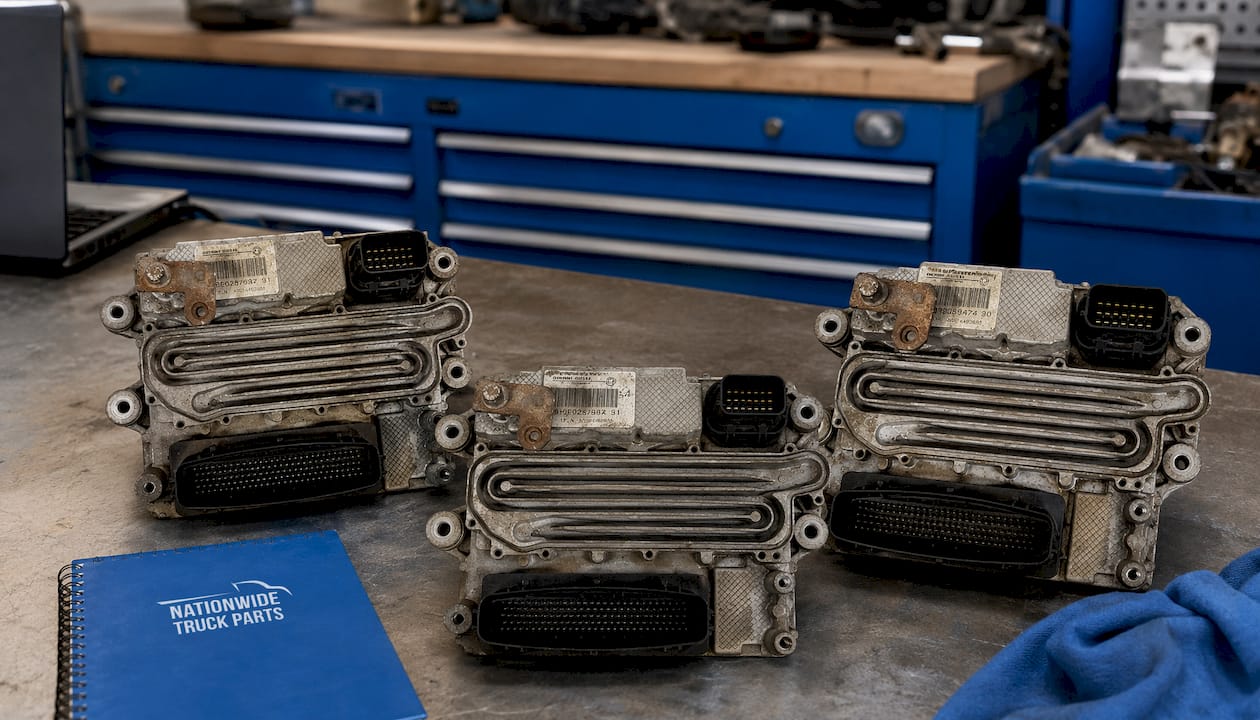
Nationwide Truck Parts stocks a daily-changing inventory of tested used diesel engines, including the Detroit Diesel MCM A0014462835, with each unit inspected before it ships. Every engine comes with a standard warranty, so you are not buying blind. Same-day shipping is available on in-stock units, which means your truck can be back on the road faster than most rebuild timelines allow. If you need to source engines for multiple trucks, the multi-truck sourcing guide explains how fleet buyers approach it. Browse the current inventory and check availability at Nationwide Truck Parts.
Useful sources for deeper diagnostics and OEM guidance
- Cummins Diesel Engine FAQ: Authoritative lifespan ranges, symptom descriptions, and OEM guidance on pre-failure indicators. Start here for Cummins-specific compression specs and service intervals.
- West Virginia University Duty Cycle Study: Peer-reviewed research on how duty cycle affects power-cylinder component life. Useful for understanding why application matters more than raw mileage.
- EPA Diesel Fuel Sulfur and Engine Wear Study: Documents the relationship between fuel sulfur content, operating temperature, and engine wear rates. Relevant for understanding why fuel quality affects longevity.
- OEM service manuals: Your engine's OEM manual is the authoritative source for compression specs, torque values, and service intervals. Available through dealer parts counters or OEM online portals (Cummins QuickServe, Detroit Diesel Connect).
- Oil analysis labs: Blackstone Laboratories and Oil Analyzers Inc. both offer mail-in oil analysis with trend reporting. Use these for baseline and trend data on iron, copper, silicon, fuel dilution, and soot percentage.
FAQ
What's the average lifespan of a diesel engine?
Diesel engines typically last 400,000–1,000,000 miles, easily outlasting gasoline engines, with well-maintained heavy-duty units often reaching 350,000–500,000 miles or more as documented by Cummins.
Is 300,000 miles a lot for a diesel engine?
Not necessarily. A well-maintained diesel at 300,000 miles can have significant life remaining, while a neglected one at 150,000 miles may already need a rebuild. Compression results and oil analysis matter far more than the odometer reading.
How long can a diesel sit without being driven?
Diesel fuel degrades and develops microbial growth after several months in storage, and an engine that sits without running can develop injector varnish, dry seals, and corrosion in the fuel system. If a diesel has sat long, change the fuel, inspect injectors, and do a compression check before putting it back into service.
Is 20-year-old diesel fuel still good?
No. Diesel fuel stored for multiple years will have oxidized, developed sludge, and likely contains microbial contamination. Even with stabilizer additives, fuel older than standard storage periods should be tested or replaced before use in a running engine.