
Engine age is the single most influential factor in used truck parts valuation because it serves as the market's primary proxy for wear, reliability risk, and remaining service life. Fleet managers and truck owners who understand why engine age affects used parts pricing gain a direct advantage when sourcing replacements or negotiating with suppliers. Mileage thresholds, maintenance documentation, and industry standards like the 300,000-mile and 750,000-mile benchmarks all shape what a used engine is worth. Nationwide Truck Parts operates in this market daily, and the pricing patterns are consistent: age and condition together determine value far more than either factor alone.
Why engine age affects used parts pricing: mileage and service history
Mileage is a more precise measure of engine wear than calendar age. A 2015 engine with 180,000 miles on a regional delivery route carries far less risk than a 2019 engine with 600,000 miles on long-haul runs. The market reflects this clearly.
Engines under 300,000 miles command premium pricing, while engines over 750,000 miles receive significant discounts because buyers must factor in the remaining lifespan risk. That gap in price is not arbitrary. It reflects the statistical reality that high-mileage engines are closer to major component failures, including injector wear, turbocharger degradation, and head gasket fatigue.

Maintenance records change this equation. Well-documented older engines can hold more value than newer undocumented ones because they lower the perceived risk of sudden failure. A fleet manager reviewing a used engine with a full service log, oil analysis records, and documented injector replacements is looking at a known quantity. An undocumented engine of the same age is a gamble.
The concept used by experienced buyers is the "service horizon," which refers to the documented remaining useful life of an engine based on its maintenance history rather than its build date. Evaluating the service horizon often outweighs chronological age as a pricing signal. This is why two engines from the same model year can carry price differences of thousands of dollars.
- Under 300,000 miles: Commands top-tier pricing; low wear risk, maximum remaining service life.
- 300,000–600,000 miles: Mid-range pricing; condition and records become the deciding factor.
- Over 750,000 miles: Discounted pricing; buyers negotiate based on remaining lifespan and known wear items.
- Full service documentation: Adds measurable value at any mileage band by reducing buyer risk.
Pro Tip: Always request oil analysis records alongside the service log. Oil analysis reveals internal wear patterns that a visual inspection cannot catch, and it gives you hard data to support or challenge the asking price.
How do market forces push used engine prices beyond age alone?
Engine age pricing does not exist in a vacuum. Macroeconomic conditions in 2026 have created a pricing floor that affects every used engine on the market, regardless of mileage or condition.
New truck supply constraints drive demand for used parts directly. When the backlog-to-build ratio exceeds 9 months, used engine pricing stays elevated because fleet managers cannot wait for new equipment. When that ratio drops below 4 months, used prices soften as new truck availability returns. This single metric explains why used engine prices can spike sharply during periods of manufacturing disruption.
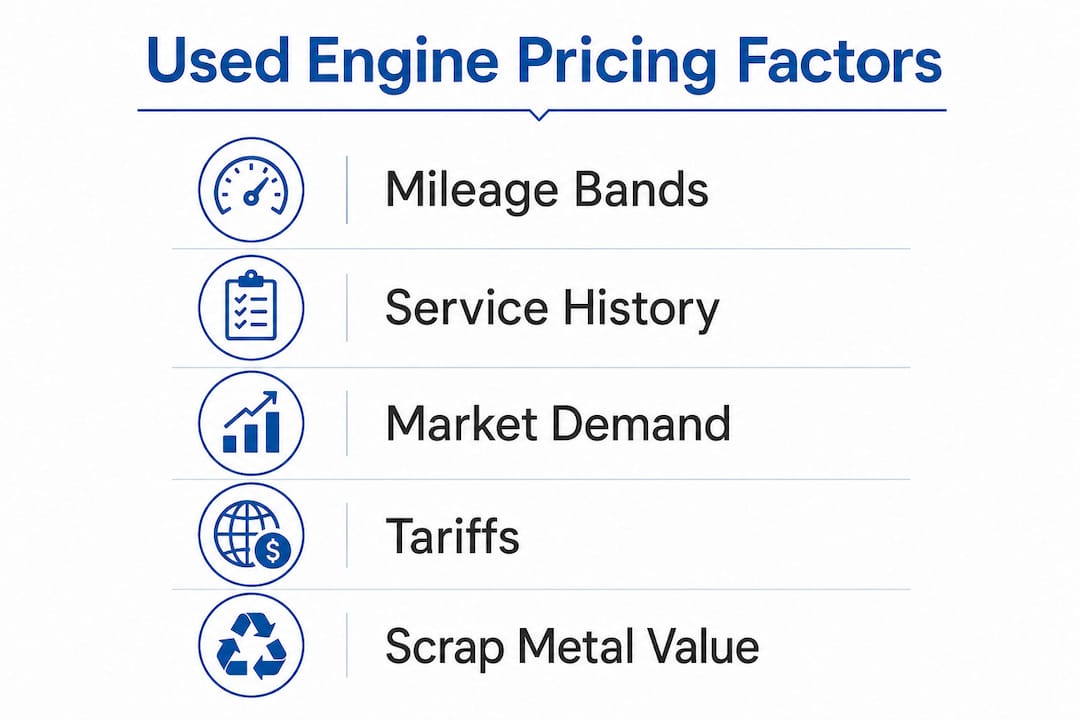
Tariffs compound the problem. Tariffs of 15–25% on imported parts, combined with rising rare-earth metal prices, have increased acquisition costs across the board. Salvage yards and parts dealers pass those costs forward, raising the base price of used engines even when the engines themselves are older and higher-mileage. For fleet managers sourcing used diesel engines, this means the price floor has risen independent of the engine's condition.
Scrap metal prices set the absolute minimum for any used engine's value. Even a worn-out engine above 900,000 miles carries a scrap value that establishes the lowest possible sale price. When steel and aluminum prices rise, that floor rises with them.
| Market factor | Effect on used engine pricing |
|---|---|
| Backlog-to-build ratio above 9 months | Elevates prices across all mileage bands |
| Tariffs of 15–25% on imported parts | Raises acquisition and resale costs |
| Rising scrap metal prices | Increases minimum pricing floor |
| Supply chain disruptions | Reduces available inventory, pushing prices up |
Pro Tip: Track the Class 8 backlog-to-build ratio quarterly. When it climbs above 9 months, lock in used engine purchases early. Prices will rise further as fleet managers compete for limited supply.
Does a warranty change what a used engine is worth?
A warranty changes the risk calculation, and risk is what buyers are actually paying for when they price a used engine. Tested and warrantied used engines command a premium because they transfer the failure risk from the buyer to the seller.
The math is straightforward. An as-is engine that fails within 60 days of installation triggers labor costs, downtime costs, and a second parts purchase. Those combined costs routinely exceed the price difference between a warrantied and an unwarrantied unit. Warrantied engines often cost less overall than cheaper as-is parts once you account for the full risk exposure.
For fleet managers running multiple trucks, this calculation scales quickly. One unexpected engine failure can ground a truck for days, disrupting delivery schedules and triggering penalty clauses in freight contracts. The testing standards behind a warranty are what make it meaningful. A warranty backed by documented compression testing, leak-down testing, and oil pressure verification is worth paying for. A warranty with no documented testing protocol is marketing language.
- Compression testing: Confirms ring and cylinder wall integrity before sale.
- Leak-down testing: Identifies valve and gasket failures that compression tests can miss.
- Oil pressure verification: Validates bearing clearances and pump function.
- Documented test results: Give buyers a paper trail that supports the warranty claim.
Nationwide Truck Parts tests and inspects every engine before it ships, which is why their used diesel engines carry a standard warranty. That testing process is the difference between a price tag and a value proposition.
What technical factors complicate used engine pricing in 2026?
Modern diesel engines carry technical complexity that older units did not. That complexity adds cost layers that interact with engine age in ways that are not always obvious to buyers.
Software locking is the clearest example. Programming requirements tied to a vehicle's VIN add technician labor and proprietary software access costs to the installation of many late-model engines. This means a newer engine can carry a higher total cost of ownership than its sticker price suggests. Buyers who focus only on the base price miss this expense entirely.
Emission compliance creates a parallel pricing dynamic. Engines that meet current EPA emission standards carry a premium because they can be installed without triggering regulatory issues. Older pre-emission engines may be cheaper upfront but face restrictions in certain states and freight corridors. Emission-sensitive engines show higher pricing volatility because their buyer pool shifts with regulatory changes.
Model-specific demand also matters. Common platforms with high production volumes have stable used pricing because supply and demand stay balanced. Rare configurations or discontinued spec combinations create pricing spikes when a fleet manager needs an exact match.
- Confirm software compatibility before purchasing any engine from 2018 onward. VIN-locked modules require dealer-level programming tools.
- Check emission tier compliance against your operating states. A Tier 4 engine may be required in California freight corridors regardless of its condition.
- Verify model-specific fitment against your truck's frame and mounting specs. A common platform engine is easier to source and price-stable.
- Request the ECM history on any late-model engine. Fault codes stored in the ECM reveal operational stress that the physical inspection cannot show.
Key Takeaways
Engine age affects used parts pricing through a combination of mileage-based wear risk, maintenance documentation, market supply conditions, warranty value, and technical compliance factors that together determine what a used engine is actually worth.
| Point | Details |
|---|---|
| Mileage bands drive base pricing | Engines under 300,000 miles command premiums; engines over 750,000 miles are discounted for wear risk. |
| Service horizon beats calendar age | Documented maintenance history reduces buyer risk and raises value for older engines. |
| Market forces set the price floor | Tariffs, scrap metal prices, and supply constraints raise used engine costs independent of condition. |
| Warranties transfer risk, not just cost | Tested and warrantied engines often cost less overall than as-is units when downtime is factored in. |
| Technical factors add hidden costs | Software locking and emission compliance add real expenses beyond the base engine price. |
What I've learned about pricing used engines after years in the field
The trucking industry has a habit of treating engine age as a simple number. Buy young, avoid old. That rule made sense when engines were mechanically simpler and maintenance records were inconsistent. It does not hold up as well today.
The most expensive mistake I see fleet managers make is chasing the lowest sticker price on an undocumented engine. They save $800 upfront and spend $4,000 on labor and downtime when the engine fails three months later. The age of the engine was not the problem. The absence of a service record was.
What actually matters is the combination of mileage band, documented service history, and warranty coverage. An engine at 480,000 miles with a complete oil analysis history and a 90-day warranty is a better buy than a 210,000-mile engine with no records and no warranty. The market does not always price this correctly, which creates real opportunities for buyers who know what to look for.
The 2026 market adds another layer. Tariffs and supply constraints have raised the price floor on everything. That means the gap between a warrantied and an as-is engine has narrowed in percentage terms, making the warrantied option an even stronger value. When the price difference is smaller and the risk difference is the same, the math is obvious.
Fleet managers who factor total cost of ownership, including downtime risk, into their purchasing decisions consistently outperform those who optimize for purchase price alone. The service horizon framework is the most practical tool I know for making that calculation quickly and consistently.
— John
Tested used engines at competitive prices from Nationwide Truck Parts
Nationwide Truck Parts stocks a daily-changing inventory of tested and warrantied used truck engines priced to reflect real market conditions, not guesswork.
Every engine ships with documented test results and a standard warranty, so fleet managers know exactly what they are buying before the truck goes back into service. The team at Nationwide Truck Parts understands how mileage bands, service history, and 2026 supply conditions affect pricing, and they apply that knowledge to every unit in inventory. Whether you need a Detroit Diesel engine for a high-mileage replacement or a lower-mileage unit for a critical fleet truck, the inventory covers both ends of the pricing spectrum. Same-day shipping keeps downtime short and trucks moving.
FAQ
Why does engine mileage matter more than model year?
Mileage reflects actual mechanical wear, while model year only indicates age. An engine at 280,000 miles carries significantly less wear risk than one at 700,000 miles regardless of build year.
What is the 750,000-mile threshold in used engine pricing?
Engines over 750,000 miles are generally valued significantly lower because buyers must negotiate based on remaining lifespan risks and the likelihood of near-term major component failures.
How do tariffs affect used engine prices in 2026?
Tariffs of 15–25% on imported parts have raised acquisition costs for salvage yards and dealers, which pushes used engine prices up even when the engines themselves are older or higher-mileage.
Does a warranty on a used engine justify the higher price?
The cost of engine failure after installation, including labor and downtime, typically exceeds the price premium for a warrantied engine. Warrantied units generally cost less over their full service life.
Can software locking make an older engine more expensive than a newer one?
Yes. Late-model engines with VIN-locked software require proprietary programming tools and technician time, which adds to the total installation cost beyond the base purchase price.