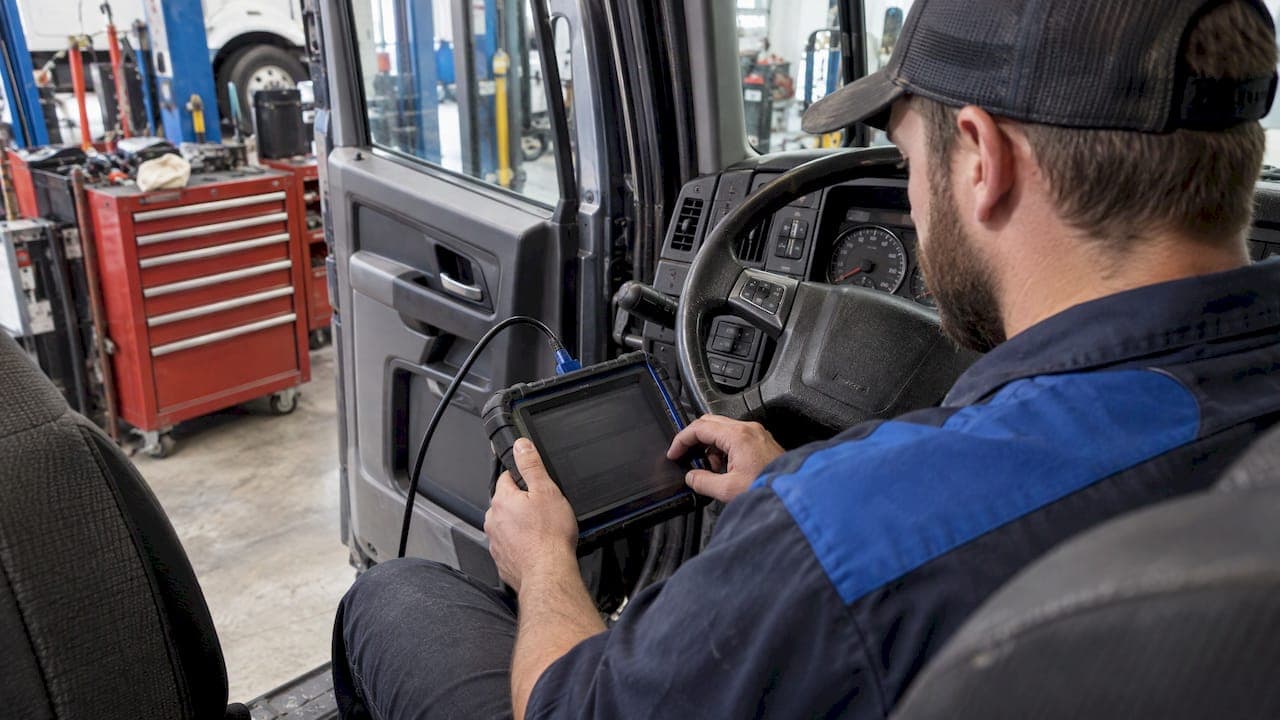
An aftertreatment relearn is a scan-tool procedure that tells the engine ECM a new or cleaned emissions component is installed, so it stops using the old component's stored values. It is not a regeneration, which burns soot, and it is not clearing codes, which only wipes diagnostic memory. Run it after the hardware changes, follow your engine maker's exact steps, and verify the result with a road test and a clean fault list.
TL;DR
- A relearn resets stored aftertreatment data after a DPF, SCR, DEF or sensor replacement. It does not clean anything.
- Regeneration burns soot out of the filter. Clearing codes erases history. Neither one replaces a relearn.
- Use the reset only after the filter has been cleaned or replaced, never as a shortcut for a loaded filter.
- The menu names and steps differ by manufacturer and engine family, so pull the OEM procedure for your exact engine.
- Fix the root cause before you clear anything. A relearn on top of a live fault just brings the fault back.
Table of Contents
- What a relearn actually does
- When a relearn is needed
- What you need before you start
- The procedure, step by step
- Manufacturer differences to expect
- Confirming the relearn worked
- Common mistakes that cause repeat failures
- Perspective: why tested used parts make relearns easier
- Need the engine or drivetrain part first?
- FAQ
- Sources
What a relearn actually does
Modern diesel engines track their aftertreatment hardware with stored numbers: estimated soot load, ash load, NOx conversion efficiency, DEF dosing corrections. The ECM uses those numbers to decide when to regenerate, how much DEF to inject, and when to derate. Swap a part and those numbers describe hardware that is no longer on the truck.
A relearn, sometimes called a reset or initialization, wipes the old values and lets the ECM start from a known baseline. One technical reference describes a DPF reset or soot relearn as initializing the DPF system after a filter is physically cleaned or replaced. In other words, it is a communication step: you are informing the computer, not changing the filter.
Relearn vs. regeneration vs. clearing codes
These three get mixed up constantly in shop talk, and mixing them up is how filters get damaged.
| Action | What it does | What it does not do |
|---|---|---|
| Regeneration (passive, active, parked, service) | Raises exhaust temperature so soot oxidizes in the filter | Update stored values for new hardware, or repair faults |
| Relearn / reset | Re-initializes stored soot, ash, NOx or DEF values after a component change | Remove soot or fix a failing part |
| Clearing codes | Erases active and inactive fault codes from memory | Regenerate the filter or relearn anything |
The regeneration side is well documented. A Volvo/Mack fault-tracing bulletin explains that the aftertreatment fuel injector adds fuel, the DOC creates the heat-producing reaction, and the soot is then oxidized in the filter. That is an operating process. Nothing in it updates the ECM's record of what hardware is installed.
Code clearing is also its own function. Volvo Trucks USA says its diagnostic system can clear active and inactive codes, and separately offers DPF regeneration and learned-data reset functions. Three separate tools in the menu means three separate jobs.
When a relearn is needed
The rule of thumb: if you replaced or physically serviced a component the ECM monitors, plan on a relearn. The usual list:
- Diesel particulate filter (DPF), replaced or removed and cleaned
- SCR catalyst
- DEF pump or DEF doser/injector
- NOx sensors (inlet and outlet)
- Aftertreatment control module or ECM, including a swapped engine
Diagnostic-tool publishers state that a relearn is expected whenever these parts are replaced so the ECM does not rely on old stored performance data, and that skipping it can lead to derates or returning codes. Because requirements differ by OEM, treat that as a strong field guideline and confirm the actual requirement in your engine maker's service information.
Do not use a reset as a shortcut
The same technical reference makes the key point: regeneration burns off soot, while a reset initializes soot values and should be used only after the filter has been cleaned or replaced. Resetting a loaded filter makes the ECM believe it is empty. The truck then skips regens it needs, and soot keeps building with no warning.
On some Cummins-family calibrations the warning is blunt. A technical service bulletin for CM2250/CM2350 products states that the Aftertreatment Maintenance Filter Installation Reset or Aftertreatment Maintenance Reset-All will not reset ash adjustment and will damage the DPF. Pick the wrong menu item and you can hurt a good filter. Read the bulletin for your calibration before you touch the menu.

What you need before you start
Most wasted time on a relearn comes from missing information. Gather this first:
- Engine make, model and family. Detroit DD13 and DD15 platforms, Cummins ISX15 and X15, Paccar MX-13, Volvo D13 and Mack MP8 all use different menus and sequences.
- Engine serial number and ECM software or calibration level. Procedures and bulletins are often tied to these.
- Exactly which parts changed. A DEF doser swap and a DPF swap call for different reset items.
- Old and new part numbers, and for the DPF, the serial number of the new unit.
- The right tool. OEM diagnostic software, or an aftermarket heavy-duty tool that actually lists the reset function for your engine. Tool coverage varies, so check the function list before you buy a subscription for one job.
- Battery in good shape and a charger or maintainer connected. Low voltage can stop a procedure partway.
If you are working on a Mack MP8 or a similar platform, our Mack MP8 guide covers the systems you will be dealing with.
Record keeping
Detroit Diesel expects an official service record for DPF cleaning and replacement, and it must include the date, mileage and DPF serial numbers to support future warranty claims. Write it down at the moment you do the relearn. It takes a minute and settles disputes later.
The procedure, step by step
Exact menu names vary by manufacturer, so the sequence below is the general shape, not a substitute for the OEM instruction. Technicians typically work through reset items such as NOx sensor reset, SCR efficiency reset and DEF system reset, depending on what was replaced.
- Confirm the root cause is fixed. Inspect the system, find why the part failed, and correct it. Diagnostic specialists put it simply: fault codes are evidence that guides diagnosis, not the repair itself. A new NOx sensor on a leaking exhaust will fail again.
- Install the new hardware correctly. Torque clamps, use new gaskets where specified, check wiring connectors and DEF lines for leaks and kinks.
- Connect the scan tool and read all codes. Save a snapshot before changing anything.
- Address active faults. Active component faults can stop regeneration and other routines from running.
- Select the reset function that matches the part replaced. Filter replacement, sensor replacement and DEF component replacement are different items. Do not choose a catch-all reset if the bulletin warns against it.
- Run the routine and watch for completion messages. Do not cycle the key mid-procedure unless the tool tells you to.
- Perform any required regeneration or DEF priming. Detroit states that tasks like DEF filter replacement and system priming require authorized procedures and special diagnostic tools to avoid system damage or reduced performance.
- Clear codes last, after the repair and the reset, and only once the applicable criteria are met.
- Road test and re-scan.
Prerequisites and safety for a parked or service regen
A relearn often ends with a forced or parked regen, and those carry real heat. In the Volvo/Mack procedure, parked regeneration requires neutral, the parking brake applied, released pedals, coolant above 35°C (95°F), adequate battery voltage and no active component fault codes. Beyond the paperwork, use common sense:
- Park outside on bare ground, away from grass, dry brush, fuel, and anything that can ignite. Exhaust gets very hot during a regen.
- Keep people and pets clear of the tailpipe.
- Never leave the truck unattended while it regenerates.
- Starting a forced regen without meeting its preconditions can lead to thermal overload, catalyst damage or incomplete burn cycles.
At higher soot levels, the driver cannot do it from the dash. The same bulletin notes that for Mack, parked regeneration is allowed from 110% to 170% soot, and at 170% a Mack dealer performs service regeneration with VCADS. If your truck is in that zone, it is a shop job with the OEM tool.
Manufacturer differences to expect
The broad idea is the same everywhere, but the details are not:
- Detroit: the operator manual stresses authorized service procedures. It also warns that unauthorized DPF cleaning methods can cause premature filter failure and damage to the wider DOC/SCR assembly.
- Cummins: reset items are calibration-specific, and the wrong one can skip ash adjustment, as the service bulletin above shows.
- Volvo and Mack: the diagnostic system separates regeneration, code clearing and learned-data reset into distinct functions. Service regen at high soot levels needs dealer tools.
- Paccar, International and others: the same logic applies, but menu wording differs. Pull the service information for your exact engine.
The shortcut for a mixed fleet is a one-page cheat sheet per engine family: part changed, reset item, regen required or not, tool needed. Build it from OEM documentation, not forum memory.
Confirming the relearn worked
A completion message on the screen is not proof. Check these:
- Fault list is clean and stays clean after a key cycle and a full warm-up.
- No derate or warning lamps on the dash after a road test under load.
- Soot and DEF-related values look sane in live data: soot load near the low end after a new filter, DEF dosing and NOx readings plausible at temperature.
- A regen completes normally when commanded, without aborting.
- Your service record shows the date, mileage and part serial numbers.
If warning lights come back, do not repeat the reset hoping for a different answer. Go back to root cause: sensor wiring, exhaust leaks before the sensor, DEF quality and supply, injector delivery, a failing DOC. Regeneration cannot fix every fault. The Volvo/Mack bulletin says active component fault codes can inhibit regeneration, and degraded AFI or DOC performance causes continued regeneration problems that need fault tracing and repair.
For related diagnostics, our guides to how diesel engine testing is done and the common diesel repair parts mistakes mechanics must stop cover the habits that prevent repeat comebacks.
Common mistakes that cause repeat failures
- Resetting instead of repairing. Wiping a soot value on a plugged filter hides the problem for a few hundred miles.
- Clearing codes and calling it done. The truck may run fine until the ECM's real numbers catch up.
- Choosing the wrong reset item. See the CM2250/CM2350 warning above.
- Skipping the regen prerequisites. Cold coolant, low battery or an active fault will abort or damage the process.
- Using non-approved filter cleaning, then relearning as if it were a new part.
- Not recording serial numbers, which can cost you in a warranty claim.
Perspective: why tested used parts make relearns easier
We see the aftertreatment side of the job from the parts counter every week. When a truck comes back with a repeat derate, the cause is usually upstream of the relearn: a part that was never confirmed good, or a repair that treated the code instead of the cause.
That is why we test and inspect every part we sell and back it with a standard warranty. If you are replacing an engine or transmission, you want to know the core hardware is sound before you spend hours on resets, regens and road tests. A known-good unit means that when a code returns, you are chasing one problem, not two.
Our inventory changes daily and covers Cummins, Detroit, Caterpillar, Volvo, Mack, International, Paccar and more. Match your engine family and serial information to the unit, keep the OEM procedure beside you, and do the relearn in the right order. Same-day shipping keeps the truck from sitting while you wait.
John
Need the engine or drivetrain part first?
If the root cause turned out to be a failed engine, we can help you get back on the road. We sell tested, warrantied used truck engines, plus transmissions, differentials and exhausts, with same-day shipping nationwide.
Not sure what failed? Our guide to types of commercial truck engine failures helps you narrow it down before you order. You can also start at Nationwide Truck Parts and browse current inventory.
FAQ
Is a relearn the same as a DPF regeneration?
No. A regeneration raises exhaust temperature to oxidize soot in the filter. A relearn updates the ECM's stored values after a component is replaced or cleaned. You may need a regen at the end of a relearn, but one does not substitute for the other.
Does clearing fault codes perform a relearn?
No. Clearing codes erases diagnostic memory only. OEM diagnostic systems list code clearing, regeneration and learned-data reset as separate functions, so run each one that your repair calls for.
Can I force a regeneration myself?
On many trucks a driver-initiated parked regen is available from the dash menu, but it has prerequisites: neutral, parking brake set, pedals released, warm coolant, good battery voltage and no active component faults. If soot is too high, the truck may require a dealer-level service regen with OEM tools.
What if the warning lights return after the relearn?
Stop repeating the reset and go back to root cause. Check sensor wiring, exhaust leaks, DEF quality, injector delivery and the DOC. Clear codes only after the repair, and confirm with a road test and rescan.
Where do I find the exact procedure for my engine?
Use the OEM service information for your engine make, model, serial number and calibration level. Bulletins are often specific to certain calibrations, and the wrong menu item can damage a filter.
Sources
- Exhaust Aftertreatment System Fault Tracing, Catalyzed DPF (Volvo/Mack bulletin)
- Volvo Trucks USA FAQs
- DD Platform Gen 5 Operator Manual
- Technical Service Bulletin, CM2250/CM2350 aftertreatment reset
- Understanding and Diagnosing Diesel Particulate Filter Systems
- How to Reset the DEF / SCR System After Repairs
- All Things Aftertreatment Diagnostics