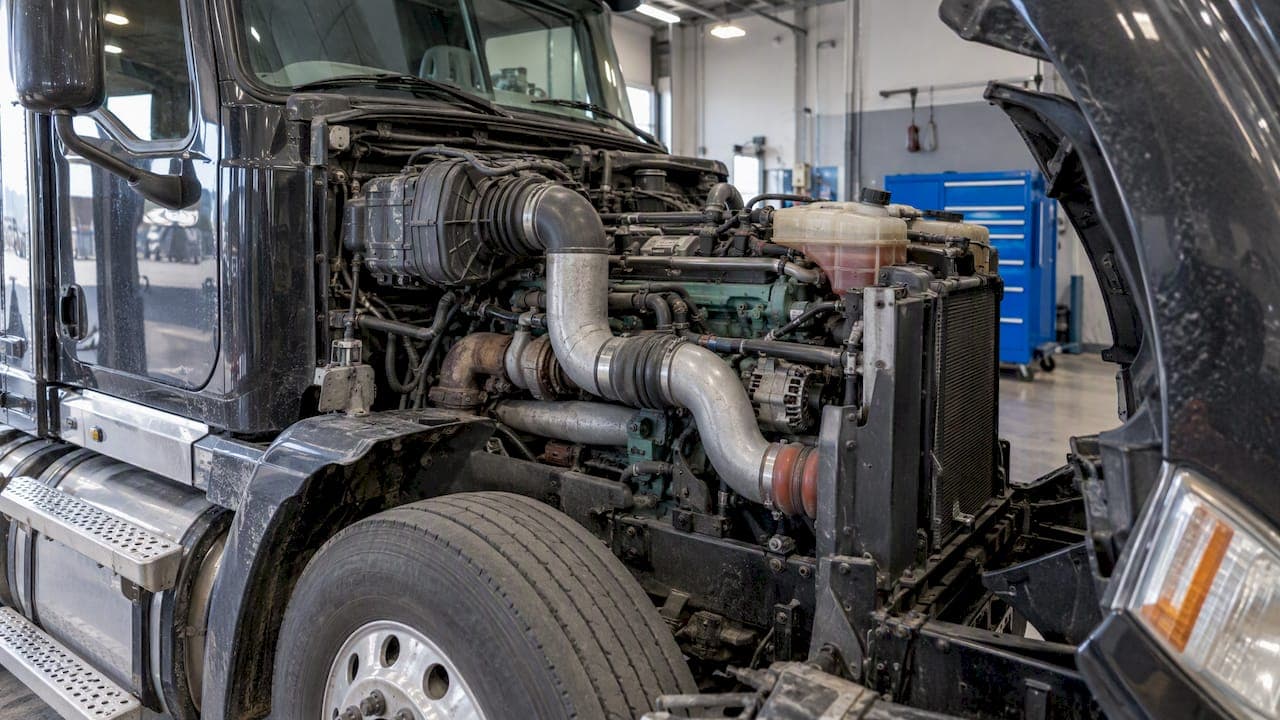
The Mack MP8 is a 6-cylinder, overhead-cam heavy-duty diesel rated from 415 to 505 horsepower and from 1,460 to 1,860 lb-ft of torque, according to Mack's MP8 specification page. It uses electronic unit injectors, cooled EGR and a variable geometry turbocharger, and it changed in small but important ways between model years. This guide covers the numbers, how the engine is built, what to watch in service, how it stacks up against the Volvo D13 and Cummins ISX, and what to verify before you replace one.
TL;DR
- The MP8 makes 415-505 hp and 1,460-1,860 lb-ft, with a 16:1 compression ratio and a 1-5-3-6-2-4 firing order.
- Unit injectors sit under the valve cover, and injector replacement and bore cleaning need the right tools and procedure.
- Model year matters: 2020 VGT and 2021 turbocompound engines dropped the bypass oil filter.
- Against the Volvo D13, the MP8 is the more compact-spec engine on paper, but the right choice depends on your chassis, duty cycle and what is already in the truck.
- Before buying a used MP8, match model year, configuration, ECM and accessories to your truck, and insist on tested, warrantied hardware.
Table of Contents
- Mack MP8 specs at a glance
- How the MP8 is built
- Model-year differences that change the parts you need
- Maintenance and service issues to know
- Mack MP8 vs Volvo D13
- Volvo D13 vs Cummins ISX
- What to verify before you replace an MP8
- Our perspective on used MP8 engines
- Find a tested engine for your truck
- FAQ
- Sources
Mack MP8 specs at a glance
Mack lists the MP8 at 415 to 505 horsepower and 1,460 to 1,860 lb-ft of torque, with a 16:1 compression ratio and a firing order of 1-5-3-6-2-4. Those ranges cover multiple ratings, so the number on your engine's data plate and in the ECM is what counts, not the family figure.
The MP8 comes in more than one form:
- Standard VGT versions use a variable geometry turbocharger and cooled EGR, the setup most owners know.
- Turbocompound versions add a second turbine that sends exhaust energy back to the crankshaft. Mack describes this as turbo compounding converting exhaust energy into crankshaft torque, along with a two-speed coolant pump that reduces parasitic loss.
- MP8HE uses Energy Recovery Technology, which captures waste heat and converts it to torque on the crankshaft. Mack cites up to 11 miles per gallon for it.
If you want to understand what those horsepower and torque numbers mean for the way a truck pulls, our piece on how diesel engine horsepower ratings work is a good companion.
How the MP8 is built
The MP8 has an overhead camshaft, a one-piece cylinder head and unit injectors. The Mack service manual describes electronic unit injectors, cooled EGR and a VGT, with lubrication handled by a multi-filter system. The unit injectors are encased by the valve cover, which shields them from exhaust heat.
That layout has practical consequences:
- Valve and injector work starts with pulling the valve cover, so keep the top of the engine clean before you open it.
- Injector replacement and injector bore cleaning call for specific tools and a set procedure. Skipping them is how a new injector ends up leaking or seating badly.
- Because the injectors are electronically controlled, the ECM and its calibration are part of the fuel system. For background on how injector condition shows up in performance, see our pro guide to fuel injectors and diesel performance.
The oil system
Engine Builder Magazine notes that the MP8's lubrication system is often misunderstood, with six internal valves that regulate pressure and control oil flow to the piston cooling jets. The takeaway for a shop: low or erratic oil pressure is not always a worn pump or bearings. Diagnose the valves and the filter housing before you condemn the bottom end.

Model-year differences that change the parts you need
This is where most wrong-part orders start. According to Mack's 2024 body builder instructions, the MP8 oil-filter housing carries two full-flow filters and a bypass filter, except on model-year 2020 VGT engines and model-year 2021 turbocompound engines, which no longer use the bypass filter.
So a 2019 engine and a 2021 engine may look alike from the driver's side and still differ in the oil filter housing, plumbing and service parts. Treat model year, VGT versus turbocompound, and rating as three separate checks.

There is also an emissions angle. The MP8 family was built to meet successive emissions standards, and Mack notes that its engines are designed to meet stricter emissions standards. An engine and its aftertreatment have to match, so swapping across emissions generations is not a simple bolt-in decision.
Maintenance and service issues to know
Intervals depend on engine model year and oil pan capacity, so follow the schedule in your vehicle's operator's manual. Mack's service documentation stresses preventive maintenance and authorized repair procedures, especially around injector replacement and bore cleaning, per the service manual. The same manual prohibits ether-based starting aids because of explosion risk. Do not spray starting fluid into an MP8 intake, even on a cold morning.
Some practical habits that pay off:
- Check for open service programs by VIN. Mack has run programs on specific build windows, for example on exhaust brake rocker arms and injector re-torque for certain 2014 builds. Ask a Mack dealer whether anything applies to your truck.
- Adjust valves cold. Valve work is done with the engine cold and the valve cover off.
- Keep the engine bay clean. Dirt around the valve cover and injector area is how contamination gets in. If you are degreasing before a job, these safe engine bay cleaning steps cover what to protect and what to avoid, so water stays away from connectors and the ECM.
- Log oil and coolant condition. Early warning signs are easier to catch than a failure. Our owner's diagnostic guide to diesel engine lifespan indicators and the rundown of common commercial truck engine failures help you read the signs.
For owner-operators trying to stretch the life of what they have, how to extend truck engine life covers the routine that matters most.
Mack MP8 vs Volvo D13
The MP8 and the D13 are the two engines most often cross-shopped by fleets running Mack and Volvo tractors. They are both inline-six, overhead-cam, SCR-equipped designs, so the real differences are in numbers and in what your truck is built around.
| Item | Mack MP8 | Volvo D13 |
|---|---|---|
| Layout | Inline six | Inline six |
| Rated power | 415-505 hp | See current D13 ratings on Volvo's site |
| Peak torque | 1,460-1,860 lb-ft | See current D13 ratings on Volvo's site |
| Compression ratio | 16:1 | 17:1 on the D13 family; 18:1 in the new VNL range |
| Displacement | Check your engine data plate | 12.8 liters (780 cubic inches) |
| Dry weight | Check your build sheet | About 2,605 lbs on the D13 family; about 2,635 lbs in the new VNL range |
| Fuel system | Electronic unit injectors | Common rail in the new VNL range |
| Turbo approach | VGT or turbocompound | Engine and software tuned per application |
A few things stand out.
Fuel system. The MP8 uses unit injectors under the valve cover. Volvo's newer VNL D13 uses common rail injection. For the mechanic, that changes how you diagnose a misfire and what parts you stock.
Displacement and weight. The D13 is a 12.8-liter engine weighing roughly 2,605 lbs dry according to Volvo's D13 brochure. Weight matters for front-axle loading and for regional haul trucks running near legal limits.
Tuning. Volvo says engine and transmission choices, with powertrain software settings matched to the operation, help balance performance and efficiency. The same logic applies to Mack. Gear ratio and downspeeding decisions can change fuel economy more than a few horsepower can. See our note on semi truck gear ratios and downspeeding.
Swapping between them. These engines are not interchangeable. Mounts, wiring, ECM, cooling and aftertreatment are all brand-specific. If your Mack lost an engine, the practical answer is another MP8 of the right year and configuration, not a D13.

Volvo D13 vs Cummins ISX
Readers comparing the D13 with the ISX are usually choosing between truck platforms. Cummins lists the ISX15 at 400 to 600 hp and 1,450 to 2,050 lb-ft of torque for the 2013 generation, a wider rating spread than the MP8 offers. The D13 is a 12.8-liter engine, and the ISX15 is a 15-liter class engine by its name, so the ISX has more displacement and a higher ceiling for heavy haul work.
The tradeoff is familiar: a larger engine gives more torque headroom for heavy or hilly work, while a smaller one is lighter and can suit regional and lighter linehaul duty. Mack's MP8, with a top rating of 505 hp, sits closer to the D13 than to the top-rated ISX. Choose by your heaviest realistic load and by what parts and service support you have along your routes.
What to verify before you replace an MP8
Ordering an engine is easier when you collect the right facts first.
- Engine serial number and data plate. This ties the engine to its exact build.
- Model year. The oil-filter system alone changes at 2020 and 2021, as covered above.
- VGT or turbocompound. The two use different turbo hardware and exhaust routing.
- Horsepower and torque rating. Confirm it against the ECM and the truck's spec sheet, so your driveline and cooling match.
- Emissions configuration. Your aftertreatment and ECM calibration must suit the engine you install. A used ECM is part of the conversation, for example this Mack MP8 ECM, part 21358126.
- Accessories to carry over. Turbo, EGR cooler, injectors, harness and sensors are often reused or replaced during a swap. Decide up front.
- Test records and warranty. Ask what was tested, how, and what is covered. We explain our approach in how diesel engine testing is done.
Mileage is also worth a look. Our diesel engine mileage benchmarks help you judge whether a used engine's history is reasonable for its age.
Our perspective on used MP8 engines
We sell used heavy truck engines every day, and the MP8 conversation nearly always starts the same way: a truck is down and the buyer needs to know what fits. Our advice is to spend ten minutes on identification before you spend a dollar. Pull the serial number, confirm model year, and decide whether you have a VGT or turbocompound engine. Most returns and delays we see in the industry come from a mismatched configuration, not from a bad engine.
We also believe a used engine only makes sense when it has been tested and inspected, and when it comes with a warranty you can read. That is our standard on every part we sell. For a down truck, a tested replacement with same-day shipping often beats a long wait for new or a rebuild with an uncertain schedule. For a truck with a healthy block that only needs injectors or a turbo, repair may be the better move. We would rather you pick the right option than the one that sells.
— John
Find a tested engine for your truck
If your MP8 is down, browse our used truck engines for sale. Our inventory changes daily, each part is tested and inspected, and every engine carries a standard warranty. We ship same day, nationwide. Need a transmission, differential or exhaust to go with it? Those categories are on the site too.

Have your serial number and model year ready, and you will get to the right match faster.
FAQ
What horsepower does the Mack MP8 make?
Mack lists the MP8 between 415 and 505 horsepower, with torque from 1,460 to 1,860 lb-ft, per its engine page. The exact rating depends on the build, so check the data plate and ECM for your engine.
Does the MP8 have a bypass oil filter?
Most do, with two full-flow filters and one bypass filter. The exception is model-year 2020 VGT engines and model-year 2021 turbocompound engines, which do not use the bypass filter. Confirm your model year before ordering filters or a housing.
Can I use starting fluid on an MP8?
No. Mack's service manual prohibits ether-based starting aids because of the risk of explosion. If the engine will not start in cold weather, have a diesel shop check the cause rather than reaching for a can.
Is the MP8 better than the Volvo D13?
Neither wins on every count. The MP8 has unit injectors and a 16:1 compression ratio, while the D13 is a 12.8-liter engine with higher stated compression and, in the newest VNL, common rail injection. Pick based on the truck you run, since each engine is built around its own chassis and electronics.
How do I know which MP8 engine fits my truck?
Match the engine serial number, model year, VGT or turbocompound configuration, and horsepower rating to your truck. Then confirm ECM and emissions equipment. A supplier that tests each engine and backs it with a warranty can help you check these before shipping.
Sources
- MP8 Semi Truck Engine, Mack Trucks
- MP8HE with Energy Recovery Technology, Mack Trucks
- Mack MP8 Diesel Engine Service Manual
- Mack MP7 and MP8 engines brochure
- Understanding the Mack MP8, Engine Builder Magazine
- Mack Body Builder Instructions, August 2024
- Volvo D13 engine family brochure
- Volvo VNL Powertrain brochure
- Cummins ISX15 (2013) engine page