
Before you place a single order for a used diesel component, run a J1939/OBD scan, confirm the OEM part number from the VIN, and request documented load or bench-test results from the supplier. That sequence prevents the single most expensive mistake in diesel procurement: ordering before you know what actually failed.
Quick pre-order checklist:
- Run an OBD/J1939 scan and capture all active and pending fault codes
- Confirm the OEM part number using the VIN (all 17 characters)
- Request load or bench-test reports from the supplier
- Verify warranty terms, RGA process, and return policy before checkout
- Factor core charges, shipping lead time, and daily downtime cost into your total budget
Ordering before diagnosis is a primary driver of wrong-component purchases, multiplied downtime, and secondary repair bills. A truck sitting an extra period while a second part ships costs far more than the part itself.
Table of Contents
- What common diesel repair parts mistakes mechanics keep repeating?
- How to run a diagnosis-first procurement workflow
- How do you verify the quality of a used diesel engine before buying?
- Compatibility and fitment: will the part actually work in your truck?
- Warranty, returns, and how to calculate real Total Cost of Ownership
- How do you vet a used diesel parts supplier before ordering?
- Real-world cost of getting it wrong (and right)
- Key Takeaways
- The diagnosis-first discipline most shops skip
- Nationwide Truck Parts delivers tested diesel parts with full documentation
- Useful sources
- FAQ
What common diesel repair parts mistakes mechanics keep repeating?
Most errors in diesel parts procurement fall into a short list. Recognizing them is the first step to cutting rework costs.
- Ordering before a full diagnostic. Swapping a turbo when the real fault is a clogged EGR cooler means two labor pulls, two parts orders, and extra downtime. Always confirm root cause first.
- Searching by generic name instead of OEM part number. "Fuel injector for a Detroit DD15" returns dozens of options. The VIN narrows it to one. VIN-based lookup maps make, model year, and engine code to the correct part and eliminates fitment errors.
- Chasing the lowest sticker price. A $400 savings on a used engine means nothing if the part fails at 20,000 miles and pulls $2,000 in labor. Total Cost of Ownership beats upfront price every time.
- Ignoring documented test results and donor VIN. No service history means unknown mileage, unknown failure mode, and elevated fraud risk. Counterfeit and unsafe parts are most common in safety-critical categories; missing documentation is the clearest warning sign.
- Forgetting core charges and lead time. Core charges on rebuilt turbos, alternators, and starters are refundable but must be budgeted up front. A part that ships with a delay when your truck is idle can lead to significant costs, making the shipping timing a critical factor in the decision.
- Skipping return-policy checks on ECMs and sensors. Many suppliers mark electronic control modules non-returnable. Confirm this before purchase, not after a failed calibration attempt.
How to run a diagnosis-first procurement workflow
Follow this sequence before approving any purchase order for a used diesel part.
- Capture symptoms. Document driver complaints, operating conditions, and any recent repairs. Attach this to the work order.
- Run OBD/J1939 scan. Heavy-duty diagnostic scanners that read J1939 fault codes narrow the search from "engine problem" to a specific subsystem. This takes a short amount of time to complete.
- Visual and basic bench checks. Inspect for leaks, cracks, worn connectors, and obvious mechanical damage. Budget a reasonable amount of time for this step.
- Compression and leak-down tests where applicable. For engine blocks and cylinder heads, these tests require sufficient time to confirm whether the block is worth rebuilding or replacing.
- Verify VIN and OEM part number. Cross-reference the engine plate, the VIN, and the supplier's catalog. Check for superseded part numbers.
- Request inspection and test reports. Demand dated photos with measurements, bench or load-test results, and donor VIN documentation. Allow 1–3 days for a supplier to produce these.
- Approve the order with a TCO calculation. Include purchase price, core charge, shipping, labor to install, and ancillary parts. Compare two shipping options using your daily downtime cost.
Pro Tip: When your truck's daily downtime cost exceeds the premium for expedited shipping, pay for the faster option. A $150 overnight fee is cheap against $800 in lost revenue.
Check the used diesel engine buying checklist for a printable version of these steps.

How do you verify the quality of a used diesel engine before buying?
Inspection goes beyond a visual once-over. Demand these checks and the documentation that proves them.
| Test / Check | What to Verify | Acceptance Guideline |
|---|---|---|
| Compression test | Cylinder-to-cylinder variance | Acceptable variance across all cylinders, according to OEM guidelines. |
| Turbo shaft endplay | Axial movement at the shaft | Axial movement at the shaft within OEM-specified tolerance. |
| Magnaflux / crack test | Block and head castings | Zero cracks at critical stress points |
| Oil metallurgy / analysis | Bearing and wear metals | No spikes in iron, copper, or aluminum |
| Electrical resistance | Sensors and solenoids | Within OEM resistance range (Ω) |
| Aftertreatment scan | DPF, EGR, SCR fault codes | No active regen faults or pressure differential errors |
Aftertreatment repairs can be very costly and are commonly missed during visual inspections. Always pull J1939 aftertreatment fault codes before committing to a purchase.
Trust signals to insist on from any supplier:
- Dated inspection photos with visible measurements
- Load or bench-test report with pass/fail criteria
- Documented donor VIN and service history
- Serial number and casting mark verification
- Written warranty with stated terms and RGA process
Pro Tip: Ask specifically whether a part is remanufactured or rebuilt. A remanufactured engine includes full teardown, magnaflux crack testing, line boring, and dyno testing. A rebuilt unit may only have select components replaced. The warranty scope usually reflects the difference.
Compatibility and fitment: will the part actually work in your truck?
Physical fit is only half the problem. Electronic compatibility can kill an otherwise perfect swap.
- Run a VIN lookup to confirm production plant, engine code, and model year.
- Cross-reference the OEM part number and check for any superseded or revised numbers in the manufacturer's parts catalog.
- Verify ECM firmware dependencies. Detroit Diesel, Cummins, and Volvo ECMs often require specific software versions tied to the engine serial number.
- Confirm emissions calibrations. DPF, EGR, and SCR systems are calibrated to specific engine families. A mismatch triggers fault codes immediately after installation.
- Check connector and pinout compatibility, especially on sensors and MCMs.
Compatibility items to verify before ordering:
- Full 17-character VIN
- Engine serial number and production date code
- ECM part number and current firmware version
- Emissions system configuration (DPF-delete vs. full aftertreatment)
- Connector type and pin count for electronic components
Some warranties are voided if the part is installed by a shop without OEM-certified technicians. Confirm installer requirements before purchase, particularly for ECMs and emissions modules.
Warranty, returns, and how to calculate real Total Cost of Ownership
Sticker price is the least useful number in a used-parts decision.
| TCO Line Item | Why It Matters |
|---|---|
| Purchase price | Starting point only |
| Core charge | Refundable deposit; must be budgeted and tracked via RGA |
| Shipping cost and speed | Faster shipping reduces downtime cost |
| Labor to install | Often equals or exceeds part cost on major assemblies |
| Ancillary parts (gaskets, seals, fluids) | Frequently overlooked; adds $100–$500 per job |
| Early-failure risk premium | Unwarranted parts carry hidden cost |
Warranty clauses to verify before checkout:
- Does it cover parts only, or parts and labor?
- What is the turnaround time for a warranty replacement?
- Who backs the warranty: the seller or the remanufacturer?
- Is the warranty transferable if the truck is sold?
- What does the RGA process require, and how long does it take?
Pro Tip: Build a simple daily cost figure: divide your truck's weekly revenue by five. That number is your downtime cost per day. Use it to compare shipping options and warranty turnaround times side by side. A faster warranty replacement often pays for itself.
For a deeper look at long-term value factors, see heavy truck engine costs.
How do you vet a used diesel parts supplier before ordering?
Ask these questions before placing any order.
- Can you provide the donor VIN and documented service history?
- What compression or load-test results are available for this part?
- Do you have dated inspection photos with visible measurements?
- What are your return and RGA policies, including timelines?
- How is the core charge handled, and when is the refund issued?
- What are the warranty terms, and who backs them?
- What is the shipping lead time, and do you offer same-day dispatch?
- Are installation instructions or calibration notes included?
Red flags that should stop a purchase:
- No VIN, serial number, or casting marks on the part
- Price dramatically below market with no explanation
- Vague product descriptions ("fits most DD15 applications")
- Non-returnable policy stated without compatibility proof
- No test documentation available
Pro Tip: Consolidating orders with one verified supplier simplifies warranty claims and RGA tracking. Split orders across three vendors for one repair job and you will spend more time managing paperwork than turning wrenches.
For guidance on evaluating vendors, the reputable used truck parts supplier guide covers qualification criteria in detail. When selecting replacement parts across equipment categories, choosing replacement parts carefully follows similar verification principles regardless of the machine type.
Real-world cost of getting it wrong (and right)
Scenario A — Ordering before diagnosis: A fleet manager orders a replacement turbocharger based on a driver's complaint of low power. The turbo arrives in two days. After installation, the fault code returns. A J1939 scan then reveals a collapsed EGR cooler was the root cause. The shop pulls the turbo, orders the correct part, and reinstalls. Total additional cost: one extra part, two additional labor pulls, and roughly three days of extra downtime. At $800/day in lost revenue, that is $2,400 in downtime alone before counting rework labor.
Scenario B — Diagnosis-first with verified donor VIN: The same fleet runs a J1939 scan first, identifies the EGR cooler fault, requests a bench-test report and donor VIN from the supplier, and orders the correct part with same-day shipping. The truck returns to service in 36 hours. No rework, no second order, and the documented inspection report gives the shop a warranty baseline if the part fails early.
Used engines from low-mileage donors under approximately 60,000 miles can deliver 80,000–150,000 additional miles when verified with proper documentation. The difference between Scenario A and Scenario B is almost entirely process, not luck.
The #1 cause of early failure for used and reman engines is improper installation: skipping cooling system flush, omitting oil pump replacement, or failing to pre-lube before first start. Even a perfect part fails fast when the install is rushed.
Key Takeaways
Avoiding the most expensive diesel repair parts mistakes comes down to one discipline: diagnose first, verify documentation, and calculate total cost before you approve any order.
| Point | Details |
|---|---|
| Diagnose before ordering | Run a J1939/OBD scan and confirm root cause before placing any parts order. |
| Match VIN and OEM part number | Use all 17 VIN characters to confirm exact fitment and check for superseded numbers. |
| Calculate full TCO | Include core charges, shipping, labor, and ancillary parts — not just the purchase price. |
| Demand test documentation | Require bench or load-test reports, dated photos, and donor VIN from every supplier. |
| Nationwide Truck Parts | Provides tested used diesel engines with documented inspection reports, donor VIN traceability, standard warranty, and same-day shipping. |
The diagnosis-first discipline most shops skip
The most consistent pattern in costly diesel repairs is not a parts quality problem. It is a process problem. Shops that standardize a scan-first, document-everything workflow before ordering cut rework dramatically. The checklist in this article is not theoretical. Every item on it maps to a real failure mode: wrong part ordered, incompatible ECM, counterfeit component, or a good part destroyed by a rushed install.
What gets overlooked most often is the TCO calculation. Fleet managers who compare two quotes on purchase price alone are making a decision with roughly 40% of the relevant data. Labor, core charges, shipping speed, and warranty turnaround are the numbers that actually determine whether a repair was cheap or expensive. Build that calculation into your standard purchase approval process and the sticker-price trap disappears.
If you need help sourcing a specific tested component or want a parts dossier before committing to an order, reach out through the Nationwide Truck Parts contact page.
Nationwide Truck Parts delivers tested diesel parts with full documentation
Skipping the verification steps above is expensive. Nationwide Truck Parts eliminates most of that risk at the source: every used diesel engine and component in the inventory is load-tested or bench-tested before listing, with documented inspection reports and donor VIN traceability available on request.
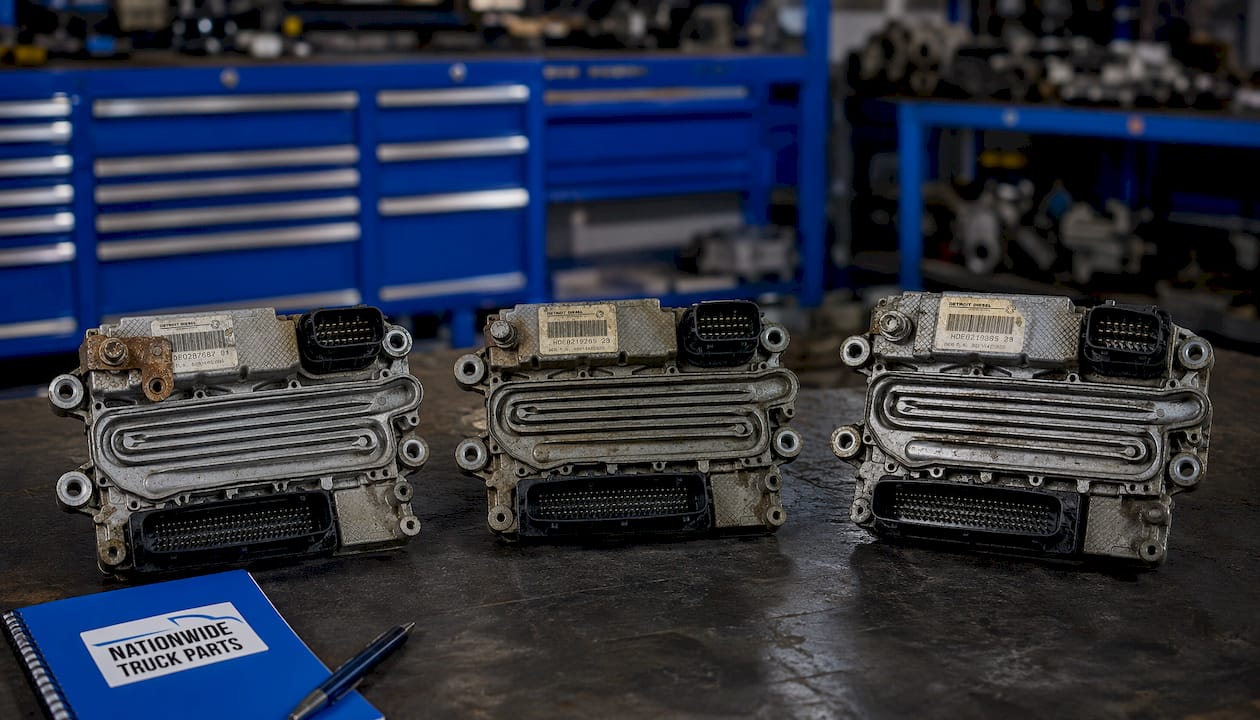
Fleet managers and mechanics get a standard warranty, a clear RGA process, and same-day shipping on in-stock units. The inventory updates daily and covers Detroit, Cummins, Caterpillar, Volvo, Mack, International, and more. Need a tested Detroit Diesel MCM? The Detroit Diesel MCM A0014462835 is available now, along with additional verified MCM units and further MCM stock options for cross-reference. Request a parts dossier or place a verified order at nationwideheavytruckparts.com.
Useful sources
- Buying Truck Parts — TruckPartSmart: Covers ordering errors, VIN lookup, core charges, and counterfeit part identification.
- Fleet Vehicle Pre-Purchase Inspection Checklist — OxMaint: 50-point checklist including aftertreatment health checks and OBD/J1939 scan guidance.
- Used vs. Remanufactured Engines Buyer's Guide — Turbo Auto Parts: Explains reman vs. rebuilt standards, installation requirements, and warranty expectations.
- What to Check When Buying a Used Diesel Engine — Pool Trading: Mileage thresholds, service history verification, and donor documentation guidance.
- Avoid Costly Mistakes When Purchasing Diesel Engine Spare Parts — Wiedson Engineering: Covers compatibility checks, storage and handling, and counterfeit part identification.
- Used Diesel Engine Buying Checklist — Nationwide Truck Parts Blog: Printable pre-purchase workflow for mechanics and fleet procurement teams.
- How to Find a Reputable Used Truck Parts Supplier — Nationwide Truck Parts Blog: Supplier qualification criteria and red-flag checklist.
FAQ
What is the most common diesel repair parts mistake mechanics make?
Ordering a replacement part before completing a full diagnostic scan is the most frequent and costly error. It leads to wrong-component purchases, repeated labor pulls, and extended downtime.
How do I verify a used diesel engine before buying?
Request a bench or load-test report, dated inspection photos with measurements, donor VIN documentation, and serial number verification. Compression variance across cylinders should stay within OEM guidelines.
What should I include in a Total Cost of Ownership calculation for a used part?
Add purchase price, core charge, shipping cost, installation labor, ancillary parts (gaskets, seals, fluids), and an early-failure risk premium. Sticker price alone covers less than half the real cost.
How do I spot a counterfeit or fraudulent diesel part?
Watch for prices dramatically below market, missing serial or casting numbers, vague product descriptions, and no test documentation. The Automotive Body Parts Association flags brake components as a frequently counterfeited category.
Does Nationwide Truck Parts provide inspection documentation with used diesel parts?
Yes. Nationwide Truck Parts supplies load-tested or bench-tested used diesel engines and components with documented inspection reports, donor VIN traceability, a standard warranty, and same-day shipping on in-stock units.