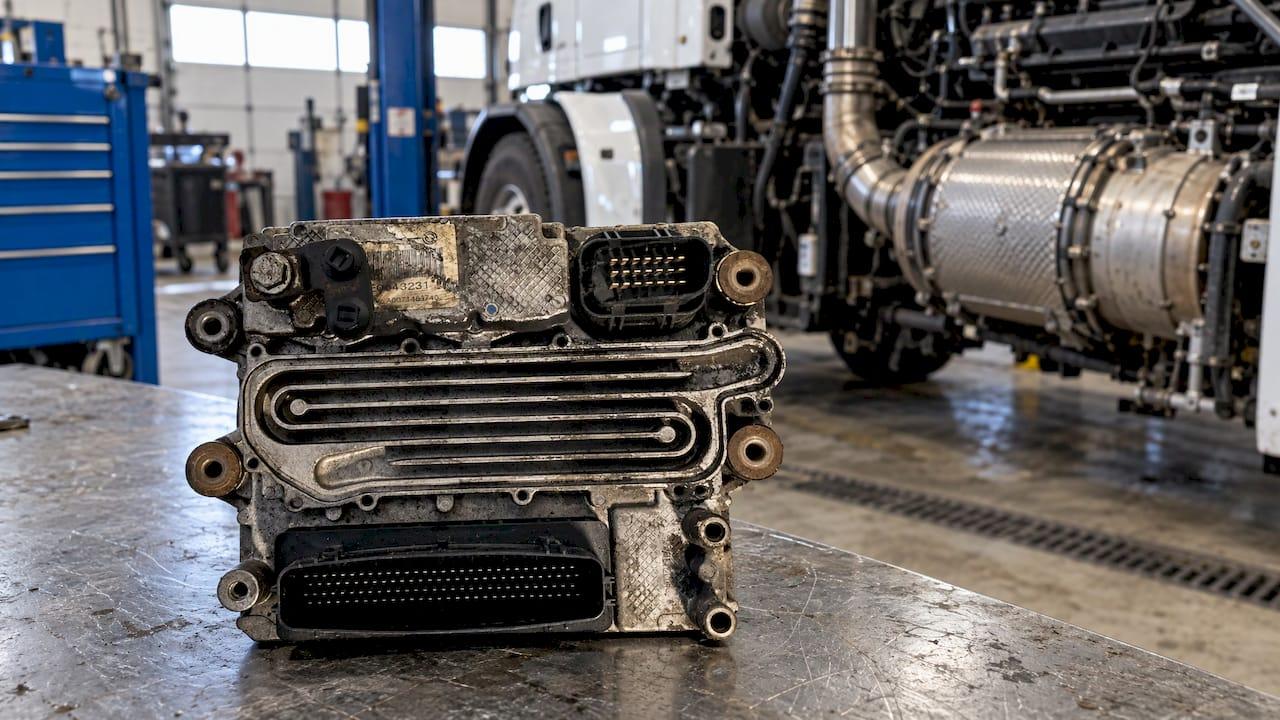
A DPF is compatible with a swapped engine when it is approved for that engine's emissions family and model year, and when the ECM calibration and parts list (CPL) on the engine match that DPF's part number. Physical fit is the easy part. The paperwork on the engine label, the software in the ECM and the federal rules on replacement engines decide whether the truck runs clean or derates a week later.
This guide walks through what has to match, in the order a shop should check it, for owner-operators, fleet managers and mechanics buying a used engine or ECM.
TL;DR
- Start with the emission label: the engine family name, model year and serial number tell you which DPF, ECM calibration and CPL belong together.
- Under federal rules, a replacement engine must be the same or a later model year configuration than the original, and it must be equivalent from an emissions standpoint to a certified configuration.
- A new, cleaned or reconditioned DPF can require an ECM calibration update, so cross-check the DPF part number against the calibration before the truck leaves the shop.
- Swapping an ECM from another engine only works when serial number suffix, ECM part number and flash file match, and parameters are copied with the OEM service tool.
- Clear no fault codes to "make it pass": diagnose them first.
Table of Contents
- What actually determines compatibility
- Read the label before anything else
- The federal rules for replacement engines
- Why the DPF part number and calibration have to agree
- Can you swap an ECM from another engine?
- Step by step: checking a swap before the truck leaves the bay
- Our perspective
- Find a matching engine or ECM
- FAQ
- Sources
What actually determines compatibility
Three layers have to agree: the hardware, the software and the certification.
Hardware. The engine, turbocharger, EGR design and aftertreatment (DOC, DPF, SCR) are certified together as a system. The EPA's DPF installation bulletin lists what is needed to pick a filter for a specific vehicle: manufacturer, model and model year, displacement, horsepower, engine location, turbocharger, EGR, and the EPA engine family name from the emission label, which is 12 or 13 characters long.
Software. The ECM calibration tells the engine how to dose, regenerate and monitor the filter. A DPF with a different substrate or part number can expect different calibration values than the one the engine was built with.
Certification. The engine family name ties the engine to a specific emissions certification. Everything else, including which DPF is legal to install, hangs off that.
If any layer is mismatched, the typical results are persistent fault codes, failed regens, derates and, in the worst case, a damaged filter. Our guide to confirming engine compatibility for heavy trucks covers the wider checklist, including the ECU side.
Read the label before anything else
Do not assume the engine family from the make and model. The MECA pre-installation checklist says to use the exact information from the engine label and engine serial number rather than guessing the family name from the manufacturer and model. Two engines with the same badge and displacement can sit in different families with different aftertreatment.
Record these from the donor engine and from the truck:
| Item | Where to find it | Why it matters |
|---|---|---|
| Engine family name (EFN) | Emission label on the engine | Ties the engine to a certification and to approved DPFs |
| Engine model year | Emission label | Replacement must be same or later configuration |
| Engine serial number | Engine dataplate | Needed for ECM and calibration lookups |
| ECM part number and calibration ID | OEM service tool (for example INSITE for Cummins) | Must match the DPF part number being installed |
| CPL (Cummins) | Dataplate and ECM | Defines the build the calibration belongs to |
| DPF part number | Filter housing or tag | Cross-referenced against calibration |
| Chassis model year and GVWR | Door-jamb label | Needed for the legal check below |
The federal rules for replacement engines
The baseline is 40 CFR 86.004-40. When a heavy-duty engine is replaced, the replacement must be an engine of, or rebuilt to, a configuration of the same or later model year as the original, and the model years of the resulting configuration must be identified. The same section requires a reasonable technical basis that the engine is equivalent, from an emissions standpoint, to a certified configuration, covering tolerances, calibrations and specifications. Any parameter or design change has to follow the original manufacturer's instructions or be backed by data showing it will not hurt in-use emissions.
The rule applies to heavy-duty engines under model year 2004 or later standards, and a deviation is a prohibited act under the Clean Air Act. For nonroad and other equipment, 40 CFR 1068.120 says a used engine may replace a certified one only if it is built or rebuilt to a certified configuration meeting equivalent or more stringent standards, and a same-or-newer model year engine meets that test.
Putting an engine into a different vehicle is a separate trap. EPA enforcement guidance treats installing an engine in a different vehicle as tampering unless the vehicle is in the same product category and identical in emissions-related design to a certified configuration of the same or newer model year as the chassis. In plain terms: a 2013 engine in a 2013 or older tractor of the same type is the clean path. A 2007 engine in a 2014 chassis is not.
For a broader walk-through, see our piece on engine swap emissions laws for heavy-duty trucks.
California and CARB states
If the truck operates in California, DPF choice is also a CARB question. CARB verifies DPFs for specific engine families, and before installing one you need the engine model year and engine family name. The DPF's Executive Order sets conditions such as engine type or use, engine size, model year, fuel, engine design (EGR or DOC), GVWR, exhaust temperature and the engine's PM emissions. CARB's verification database covers 1981 through 2012 heavy-duty diesel engines, and the applicant is responsible for confirming it is accurate, so confirm through the manufacturer or an authorized installer.
Why the DPF part number and calibration have to agree
This is where swaps most often go wrong, and it is easy to miss because the filter bolts on either way.
Cummins. Cummins TSB 101096 explains that new ISX CM871 DPFs use a revised substrate that may not be backward compatible with the engine's current calibration and CPL. A new calibration for the correct CPL may be needed when you install a DPF with a new part number, and installing the wrong one can damage the filter and count as an improper repair. The same bulletin says that any time a new, cleaned or reconditioned DPF goes on, the ECM calibration (viewed in INSITE) and CPL must be cross-referenced to the DPF part number.
On SCR, Cummins service bulletin SB-10085481-0335 says a new aftertreatment catalyst requires a calibration update, and the new CPL and calibration base code go on an authorized change label installed near the engine dataplate.
International/Navistar MaxxForce. For 2007 to 2009 MaxxForce DT, 9 and 10 engines, the DPF size is the third letter of the calibration name, and a DPF that needs a calibration change means moving from G or H to K or M, or from L to R on 2010 to 2012 engines. The same document says 2008 to 2009 MaxxForce 11 and 13 engines need the calibration updated when new DPF parts are installed, or the DPF component will fail.
The lesson is not specific to those two builders. Whatever the brand, look up the DPF part number against the calibration and parts list in the OEM's own tool or documentation before you call the job finished. Our Cummins CPL guide explains how to read the CPL.

Can you swap an ECM from another engine?
Sometimes, but only with matching identifiers. Caterpillar's service documentation for the C7.1 says that when a new ECM is not available, you can use one from an engine that is not in service if it has the same serial number suffix and the replacement ECM and flash-file part numbers match the suspect ECM. Parameters are then loaded with the service tool's Copy Configuration ECM Replacement function.
The pattern holds across brands, though the details differ:
- Match the ECM part number to the original, not just the engine model.
- Match the software or flash file to the engine's build, serial range and calibration.
- Match the engine family and model year so the result stays equivalent to a certified configuration.
- Copy or program parameters with the OEM tool: injector trim, torque ratings, idle and governor settings, aftertreatment configuration.
- Check immobilizer or security pairing where the platform uses it, so the ECM and truck talk to each other.
An ECM tuned for a different engine rating or a different aftertreatment package can run, but it is not equivalent to the certified configuration, which is the standard the federal rule sets. If you are sourcing a controller, Detroit DD15 ECMs, DD13/DD15 modules and PACCAR MX13 ECMs are listed with their part numbers, so you can compare against your original before you order.
Step by step: checking a swap before the truck leaves the bay
- Document the original. Photograph the emission label, dataplate and ECM tag on the old engine and the chassis label.
- Verify the donor. Pull the same data from the replacement engine. Confirm same or later model year and a compatible engine family for the application.
- Confirm the original certified configuration. The MECA checklist asks that the engine have no added aftermarket parts or special modifications that are not direct replacements, and that all active ECM fault codes be corrected before DPF work.
- Match the ECM and calibration. Read the calibration and CPL with the OEM tool. Update if the DPF or SCR part number requires it.
- Cross-reference the DPF. Check the filter part number against the calibration, including for cleaned or reconditioned units.
- Program and relearn. Load parameters, run any aftertreatment or injector relearn procedures the OEM specifies, and record the new calibration and CPL.
- Diagnose, never just clear. At rebuild, 40 CFR 86.004-40 prohibits erasing or resetting emissions-related codes without diagnosing and responding to them, and the system must be free of such codes when the engine returns to service.
- Road test and regen. Watch soot load, differential pressure and regen behavior under load before handing back the keys.
For code handling and manufacturer-approved adjustments, a capable commercial vehicle workshop can take on the diagnostic side when your own shop lacks the OEM software.
Our perspective
Most swap failures we hear about are not bad engines. They are mismatched paperwork: a model year that does not line up, an ECM that was never meant for that build, or a DPF part number that the calibration does not recognize.
That is why we put testing and inspection ahead of everything else. Every engine, transmission and differential we sell is tested and inspected before sale and comes with a standard warranty. Our inventory changes daily and we ship the same day, so the sensible approach is to give us the engine family name, model year and ECM details up front and let us help you find a match rather than guessing from the badge.
Used engines are the practical answer for owner-operators and fleets that cannot afford long downtime. A tested engine from a matching configuration gets the truck back on the road faster, and verifying compatibility first keeps it there.
John
Find a matching engine or ECM
If you have the engine family name, model year and ECM numbers from the steps above, we can help you match a tested replacement. Browse our used truck engines, plus transmissions, differentials and exhausts, covering Caterpillar, Cummins, Detroit, Volvo, International, Mack, PACCAR and more. Every part is tested, inspected and backed by a standard warranty, and orders ship the same day.

For planning budget and downtime around the job, our guides to engine swap cost factors and finding compatible used diesel engines are a good next read.
FAQ
Can I put a DPF from one engine on another engine?
Only if the filter is approved for the receiving engine's family and model year, and its part number is compatible with the ECM calibration and CPL. Cross-reference the part number in the OEM tool before installing, since a mismatched calibration can damage the filter.
Do I need to reprogram the ECM after replacing a DPF?
Sometimes. Cummins and International service documents both describe cases where a new DPF part number requires a calibration update. Check the filter part number against the current calibration, and follow the OEM instructions for the engine.
Can I use a newer-model-year engine in an older truck?
Federal rule 40 CFR 86.004-40 allows a replacement of the same or a later model year configuration than the original engine, as long as it is equivalent to a certified configuration. Confirm the specifics for your chassis and application with the engine manufacturer.
How do I find the engine family name?
It is on the engine's emission label and is 12 or 13 characters long. Read it directly from the label and serial number instead of inferring it from the make and model.
Sources
- EPA Technical Bulletin: Diesel Particulate Filter Installation
- CARB: How to Find and Install DPFs
- MECA Diesel Retrofit Pre-Installation Checklist
- eCFR: 40 CFR 86.004-40
- Cornell LII: 40 CFR 86.004-40
- Cornell LII: 40 CFR 1068.120
- EPA enforcement filing on engine installation and tampering
- Cummins TSB 101096, new DPF part numbers
- Cummins SB-10085481-0335, aftertreatment SCR catalyst
- International/Navistar MaxxForce DPF service document