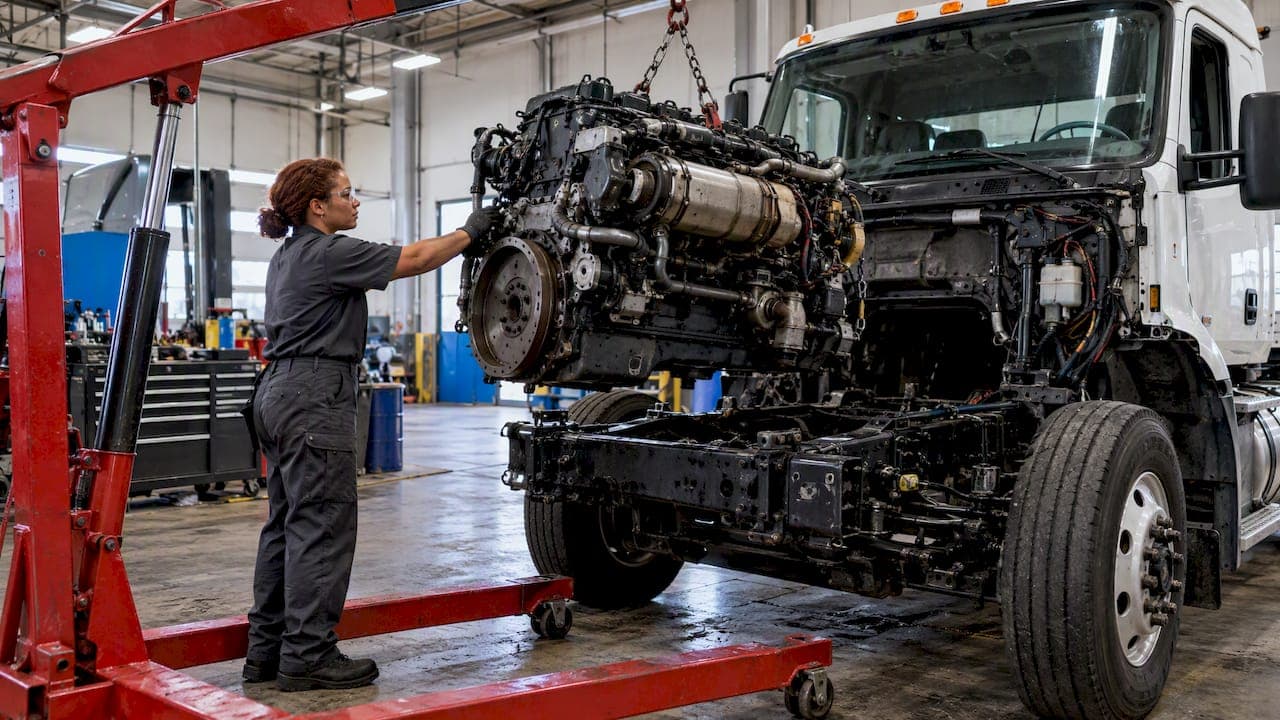
You can legally swap a used diesel engine into a heavy-duty truck, but the replacement has to be the same model year or newer than the engine it replaces, and it has to match a certified emissions configuration at least as clean as the original. Keep every emissions component on the engine, document what you did, and a swap is a routine repair. Skip any of that and it can become a federal tampering problem or a failed registration.
This guide covers the federal rules, California's stricter process, what counts as tampering, the records to keep, and a pre-purchase checklist for owner-operators, shop mechanics, and fleet managers.
TL;DR
- Federal and California rules require a replacement engine to be the same model year or newer than the original, in a certified configuration at least as stringent.
- Off-road or industrial engines do not belong in on-road trucks, and a used engine is not exempt from tampering law.
- Removing or disabling EGR, DPF, or SCR hardware is tampering, and shops that sell or install delete parts have paid multi-million dollar penalties.
- California adds a BAR Referee inspection for engine changes, and its Truck and Bus rules push fleets toward 2010 or newer engines.
- Keep records of the original engine, the replacement, and your reasoning for at least two years.
Table of Contents
- The core rule: same model year or newer
- What the federal tampering law actually prohibits
- The "reasonable technical basis" standard
- California: the strictest case
- Quick comparison: federal, California, other states
- What tampering enforcement looks like
- Keep records like you may be asked for them
- A pre-purchase checklist for a compliant swap
- Our perspective: compliance starts at the sourcing step
- Where to find a replacement engine that fits the rules
- Common swap mistakes that cause compliance trouble
- FAQ
- Sources
The core rule: same model year or newer
The principle behind every engine swap rule is that a repair must not make the truck dirtier. The Bureau of Automotive Repair (BAR) states the requirement plainly: under the federal Clean Air Act and California law, the replacement engine cannot be older than the original, and the new engine-and-chassis combination must be certified to standards at least as stringent as the original configuration.
Two practical consequences follow:
- Model year is a floor, not a target. Dropping a 2012-era engine into a 2016 chassis is the wrong direction. Going from a 2016 engine into a 2012 chassis is generally the right one, as long as everything that came with the newer engine comes along too.
- Certification is about the whole configuration. The engine's calibration, aftertreatment, sensors, and wiring all belong to the certified setup. Taking the block and leaving the rest behind is how swaps go wrong.
The EPA's Engine Switching Fact Sheet is the older federal reference. It is dated 1991, so read it for the principle and check current regulations for details, but its core logic still anchors how regulators think about swaps.
What the federal tampering law actually prohibits
The federal tampering prohibition sits in section 203(a)(3) of the Clean Air Act. In plain terms, nobody may remove or render inoperative an emission control device on a certified vehicle or engine, and nobody may sell or install parts whose principal effect is to bypass, defeat, or render inoperative those controls. The EPA lays this out in the Engine Switching Fact Sheet and its tampering enforcement policy.
On a modern diesel, that covers:
- Exhaust gas recirculation (EGR) systems
- Diesel particulate filters (DPF)
- Selective catalytic reduction (SCR) and the related dosing hardware
- The calibration and software that run them
Why "it's a used engine" is not a defense
The most common mistake is assuming a used engine sits outside these rules. It does not. The replacement still has to be the same model year or newer and match the original certified emission configuration. A used engine is fine. A used engine that is older than your original, or that came from a different certified family without the right supporting parts, is the problem.
Industrial and off-road engines
A non-certified off-road or industrial engine in an on-road truck is prohibited under the rules BAR summarizes. One forum answer ranking for this topic claims industrial swaps are legal because no emission requirement applies to them. That reasoning does not hold for a highway truck: the on-road vehicle must still end up in a certified on-road configuration.
The "reasonable technical basis" standard
Regulators do not expect you to carry a lab report. They do expect you to be able to explain, if challenged, why your swap does not increase emissions. The EPA's guidance on rebuilding and maintaining certified engines calls this having a reasonable technical basis for knowing the engine matches its original certified configuration in tolerances, calibrations, and specifications. For heavy-duty engines of model year 2004 and later, the rebuilding practices are written into 40 CFR 86.004-40.
In practice, a reasonable technical basis looks like this:
- The engine's serial and family information matches a certified configuration.
- The ECM calibration is the one that belongs to that engine and application.
- Every emission component that shipped on the donor engine is present and working.
- The seller or installer can tell you what the engine is, not just what it fits.
Swapping parts without verifying their emissions-certified status is the most common reason a swap fails regulatory scrutiny.
California: the strictest case
If the truck is registered in California, or could be, plan for more steps. BAR requires an engine swap to pass a smog inspection by a BAR Referee. After a successful inspection, a Referee label goes on the vehicle in the engine compartment. The truck stays subject to ordinary periodic requirements afterward, so the label is not a lifetime exemption.

BAR's anti-tampering goal is simple: prevent degraded emission control. If a swap changes the control system, for example by leaving off a required catalytic converter or EGR valve, the vehicle will fail inspection and the repair facility may be liable. The agency's Smog Check Reference Guide summarizes the same point: no engine change that degrades emission control effectiveness.
Truck and Bus Regulation
California fleets face a second layer. The California Air Resources Board's Truck and Bus Regulation is a common reason a fleet replaces an engine in the first place. Replacing an older, higher-emitting engine with a 2010 or newer certified configuration is a typical route to avoid DMV registration problems. CARB's own compliance summary notes that vehicles with 1995 and older engines were due for replacement by January 1, 2015, with requirements tightening further by 2023.
For a fleet manager, that changes how to think about a swap. It is a regulatory event, not only a repair. The engine you pick can decide whether the truck stays registrable in California.

Transport refrigeration units have their own rule. If your reefer's engine is the issue, CARB's TRU advisory 13-18 explains how repowering with new or rebuilt replacement engines fits the regulation.
Quick comparison: federal, California, other states
| Topic | Federal (EPA) | California (BAR / CARB) | Other states |
|---|---|---|---|
| Replacement engine age | Same model year or newer | Same model year or newer | Federal rule still applies |
| Certified configuration | Required | Required | Federal rule still applies |
| Inspection after swap | No single federal swap inspection | BAR Referee inspection and label | Varies by state, check your DMV or emissions agency |
| Off-road engine in on-road truck | Prohibited | Prohibited | Federal prohibition applies |
| Delete or defeat parts | Prohibited to sell, install, or use | Prohibited | Federal prohibition applies |
If you are outside California, you are not free of emissions law. You are under federal rules, plus whatever your state's inspection and registration process requires. Check with your state's emissions or motor vehicle agency before you buy.
What tampering enforcement looks like
The EPA has not limited its attention to individual owners. Companies that sell and install defeat devices have paid heavily:
- A North Carolina parts seller and its owner agreed to pay $10 million in criminal fines and civil penalties for making, selling, and installing emissions defeat devices (announced September 2024).
- A diesel tuning company and its president agreed to pay $3.1 million for illegal delete devices and tunes for diesel trucks (announced March 2022).
- In a separate case, the EPA says one aftermarket company sold over 140,000 tampering devices between January 2016 and August 2021.
The lesson for a mechanic or truck stop shop is direct. A customer asking for an EGR delete or a tune alongside the new engine is asking you to take on liability. Decline it, no matter how the request is phrased.
Keep records like you may be asked for them
BAR guidance says mechanics and fleet managers should keep engine swap and rebuild records for at least two years. A good file includes:
- The original engine's make, model, model year, serial number, and emissions configuration
- The replacement engine's same details, plus the donor truck's year if known
- Invoices and the seller's description of what shipped with the engine
- Photos of the aftertreatment, sensors, and ECM installed on the truck
- A short note on why the swap does not degrade emissions
Without that file, an inspection flag can leave you arguing from memory. With it, the conversation is usually short.
A pre-purchase checklist for a compliant swap
Before you pay for an engine, work through these questions:
- What is the original engine's model year and emissions label? Find it on the engine's emissions label under the hood, not just on the registration.
- Is the replacement the same year or newer? If the seller cannot say, keep looking.
- Does it come with the right ECM and the emission hardware it was certified with? On Cummins, Detroit, Paccar, and similar platforms, the ECM calibration is part of the certified configuration.
- Does it match your chassis? Compatibility is more than bolt patterns. Our guides on confirming engine compatibility for heavy trucks and finding compatible used diesel engines walk through it.
- Is the state a factor? In California, plan for the BAR Referee process before the truck is back on the road.
- Is the engine tested and warrantied? A warranty does not replace compliance, but it shows the seller stands behind the engine.
If you are new to the process, how truck engine replacement works covers the job from diagnosis to install.
Our perspective: compliance starts at the sourcing step
We sell used heavy truck engines, transmissions, differentials, and exhausts, so we see the same pattern from buyers. The engine that causes trouble is rarely the one that failed testing. It is the one bought on price alone, with no check on year, family, or what came with it.
That is why we test and inspect every part before sale and back it with a standard warranty. Our inventory changes daily, and we ship the same day, which matters when a truck is down. But speed only helps if the engine is the right one. When a fleet manager calls with a dead engine and a delivery window, the first question we want answered is not price. It is the model year and emissions configuration of what is coming out.
For multi-truck jobs, the same discipline scales. Our notes on coordinating multi-truck engine replacements and sourcing diesel engines for multiple trucks cover keeping records consistent across units. We would rather help you confirm a match than sell you the wrong engine quickly.
— John
Where to find a replacement engine that fits the rules
If you have the original engine's year and configuration in hand, you can narrow the field fast. Our truck engines for sale page lists tested, warrantied used diesel engines across brands including Caterpillar, Cummins, Detroit, Volvo, International, Mack, and Paccar. If the job also involves the drivetrain, we carry transmissions and differentials too, plus exhausts when the swap calls for the correct exhaust components.
Need the engine computer to match? Listings such as the Paccar MX13 ECM and the used Detroit DD15 ECM show the kind of platform-specific computers that belong with the engine they were certified with.

Common swap mistakes that cause compliance trouble
- Leaving the aftertreatment behind. Buying a bare engine and reusing an older chassis exhaust setup that does not match.
- Mixing ECM and engine. A calibration from another engine family can break the certified configuration.
- Going older. Choosing a cheaper, older engine because it is simpler to install.
- Deleting to fix a fault. Treating a derate or a DPF problem as a reason to remove hardware instead of repairing it.
- No paperwork. Doing everything right and having nothing to show for it.
If you are weighing a swap against a bigger purchase, our piece on why engine replacement beats buying a full truck puts the economics in context, and what a used diesel engine is explains what to expect from one.
FAQ
Can I swap any engine into my truck?
No. The replacement must be the same model year or newer than the original and in a certified configuration at least as stringent. Non-certified off-road or industrial engines are not allowed in on-road trucks. Check the original engine's emissions label before shopping.
Is a used engine exempt from emissions rules?
No. Federal tampering law applies to used engines the same way it applies to new ones. A used engine is acceptable when it meets the model year and certification requirements and keeps its emission controls intact.
Do I need an inspection after an engine swap?
In California, yes: a BAR Referee inspection and label are required for engine changes. Other states vary, so contact your state's emissions or motor vehicle agency. Federal rules still apply wherever you are.
What records should I keep?
Keep the original engine's configuration, the replacement engine's details, and proof that the swap does not degrade emissions. BAR guidance points to at least two years. Invoices and photos of the installed emission components help.
Can I delete the EGR, DPF, or SCR during a swap?
No. Removing or disabling them is tampering under the Clean Air Act, and companies that sold or installed such parts have paid penalties up to $10 million. If a component is faulty, repair or replace it with a compliant part.
This article is general information, not legal advice. For a specific truck, confirm requirements with the EPA, your state's emissions agency, or California's BAR before you buy.
Sources
- BAR: Engine changes
- BAR: Smog Check Reference Guide
- EPA: Engine Switching Fact Sheet
- EPA: Tampering enforcement policy
- EPA: How to Maintain or Rebuild Engines Certified to EPA Standards
- eCFR: 40 CFR 86.004-40, heavy-duty engine rebuilding practices
- CARB: Truck and Bus Regulation
- CARB: Truck and Bus Regulation compliance overview
- CARB: TRU Advisory 13-18
- EPA: North Carolina parts seller $10M settlement
- EPA: PPEI and Kory Willis plea
- EPA: Turn 14 settlement summary