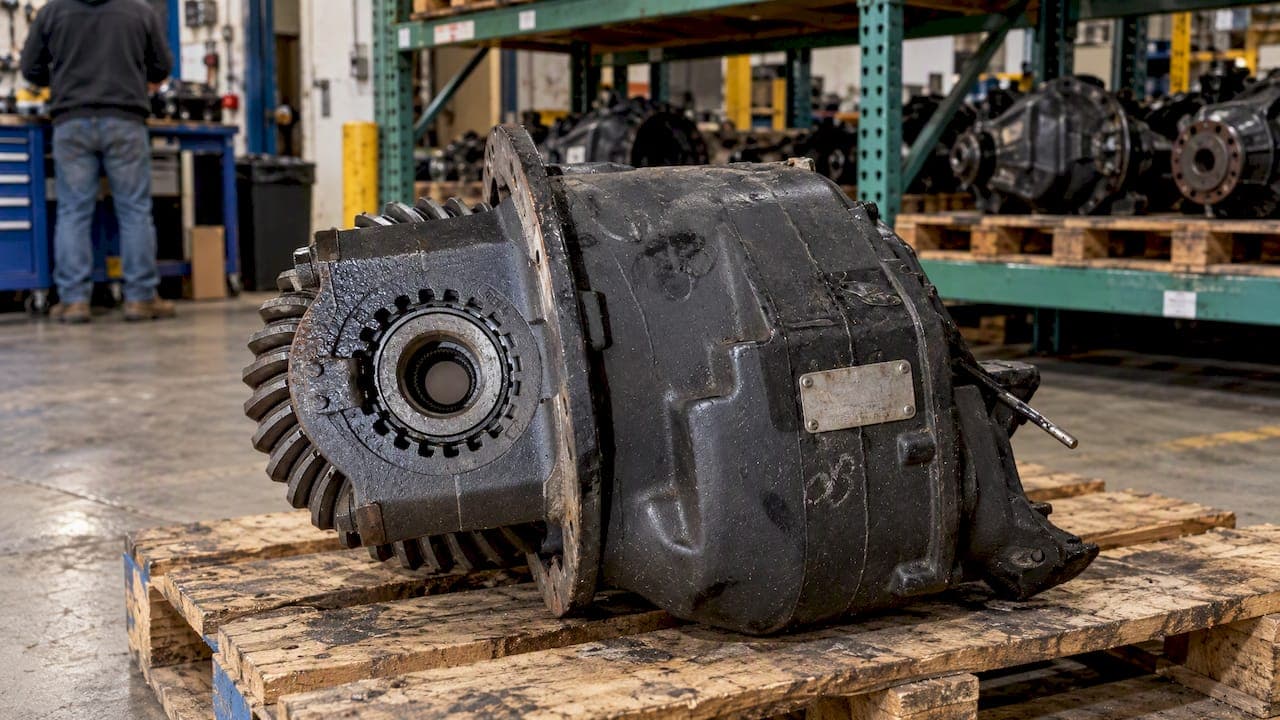
To identify a Meritor differential, find the identification tag on the axle housing or the differential carrier, then read the model number, the ratio and the carrier part number off it. Those three items tell a parts counter what you have. If the tag is gone, the casting numbers, the ratio count and the axle spline give you a fallback, and a VIN lookup through a dealer can confirm the original build.
This guide walks through each step in the order you would do it under a truck, then shows how to carry the result into a used differential order.
TL;DR
- The ID tag sits on the axle housing or the differential carrier. Model number, ratio and carrier part number are the three entries to record.
- A VIN alone does not reveal the internal differential setup, but a dealer or service portal can use the full 17-digit VIN to look up the original factory axle configuration.
- Model numbers carry the axle position and rating (for example RT or RR plus a capacity figure), and the ratio sets the gearing. Both must match what you are replacing.
- If the tag is missing, count the ring gear and pinion teeth, check the spline count and photograph the casting numbers before you call anyone.
- Send a photo of the tag with your order. It prevents the most common wrong-part returns.
Table of Contents
- Why the tag matters more than the brand name on the housing
- Step 1: Find the identification tag
- Step 2: Read the three numbers that count
- Step 3: Use a table to sort what you found
- Step 4: When the tag is missing or unreadable
- Step 5: What the VIN can and cannot do
- Step 6: Check the rest of the driveline before you order
- Common identification mistakes
- Our perspective: identify first, then buy used with confidence
- Ready to match a used Meritor differential?
- A short checklist to carry under the truck
- FAQ
- Sources
Why the tag matters more than the brand name on the housing
Meritor is the name most drivers use for a whole family of drive axles, and many of them still carry Rockwell heritage. A housing that looks identical from the driver's seat can hold a different carrier, a different ratio or a different spline count. Looking at the housing and guessing is how people end up with a differential that bolts in but does not mate with the driveline or the other axle in a tandem.
The tag solves that. According to a Meritor carrier maintenance manual, an identification tag is attached to the axle housing or the differential carrier, and the model number and ratio on the tag, plus the number on the carrier, are what you use to get replacement parts. Start there, not with a guess.
Step 1: Find the identification tag
The location varies by axle family, so check both spots.
- Clean the area. Road grime and undercoating hide stamped metal. Use a wire brush and a rag, not a grinder.
- Check the housing. Look at the axle housing near the carrier, usually on the front or rear face of the banjo.
- Check the carrier. On some units the tag is bolted to the carrier flange instead.
- Use a light and a phone camera. Tags are often on a surface you cannot see directly. Take a close photo and read it on screen.
- Record everything. Write down every line, even the ones that seem unimportant.
If the vehicle has a front-drive or tandem layout, remember that each drive axle has its own tag. A forward-rear and a rear-rear in the same tandem are not interchangeable simply because they came off the same truck.
Step 2: Read the three numbers that count
On a differential tag, three entries do most of the work.
Model number
Meritor model numbers follow a pattern: letters for the axle position and type, a figure tied to the load rating, and a series number tied to the carrier family. A designation such as RT-40-145 reads as a rear tandem forward axle in the 145 series, and RR-20-145 is its rear-rear partner. The listings you see for used units, such as the MD2014X 2.47 ratio differential assembly, use the same style of code, with a specification suffix after the base model.
The base model identifies the axle. The additional letters and digits identify the particular specification. Two units with the same base model can still differ in ratio, differential lock or carrier arrangement, so never stop reading after the first group of characters.

Ratio
The ratio is the number of ring gear teeth divided by the number of pinion teeth, written like 3.25 or 2.47. It decides how many times the driveshaft turns for each turn of the wheels. Mixing ratios between the two axles of a tandem causes the axles to fight each other, which is why a ratio mismatch is a fail, not a compromise. Examples on our shelf include the MT40-14X*C 3.25 ratio differential, where the ratio is part of the listing title for exactly this reason.
If you are changing ratio on purpose, for example to run lower rpm at highway speed, that is a spec decision for the whole driveline, not a swap. Our piece on semi truck gear ratios and downspeeding covers why the axle ratio has to be chosen together with the engine and transmission.
Carrier part number
The carrier has its own number, separate from the axle model. It is what pins down the exact internal parts. When you have the tag and the carrier number together, a parts specialist can usually tell you in one call whether a used unit is a true match.
Step 3: Use a table to sort what you found
Copy this into your notes or a message to your parts supplier.
| Item | Where to find it | Why it matters |
|---|---|---|
| Axle model number | ID tag on housing or carrier | Identifies axle position, rating and series |
| Specification suffix | End of the model line on the tag | Separates variants of the same base model |
| Ratio | ID tag, confirmed by tooth count | Must match the other drive axle in a tandem |
| Carrier part number | Carrier tag or casting | Pins down the internal parts |
| Serial number and date | ID tag | Helps trace build year and revisions |
| Differential lock or inter-axle differential | Visual check, spec line | Affects driveline and shifting hardware |
| Axle spline count | Axle shaft end | Shaft must fit the side gears |
Step 4: When the tag is missing or unreadable
Tags fall off, get painted over or are scraped off by a rebuild. You still have options.
- Count the teeth. With the carrier out or the cover off, count the ring gear teeth and the pinion teeth, then divide to get the ratio. A mechanic can also turn the driveshaft flange and count how many turns it takes for the wheel to complete one rotation.
- Photograph the castings. Casting numbers on the carrier and housing narrow the series. Photograph them with a scale in frame.
- Measure the shaft. Count splines and measure the diameter on an axle shaft. The shaft has to fit the side gears.
- Note the layout. Single drive axle, forward-rear of a tandem, rear-rear, with or without an inter-axle differential. A supplier needs this to read the castings correctly.
- Note the brake and hub setup. Wheel ends help narrow down which axle family you are dealing with.
When you cannot settle it from the axle itself, move to the VIN.
Step 5: What the VIN can and cannot do
A VIN does not spell out the internal differential model by itself. What it can do is let an authorized source look up the factory build. Meritor's own dealer program material says the full 17-digit VIN must be provided when you enter vehicle information for a claim, along with the OEM and the engine and transmission details. The Cummins-Meritor OnTrac web form is a way for a facility to start a warranty or technical case, and it requires the facility's Cummins-Meritor ID number, though no individual registration is needed.
The practical read: if you are an owner-operator without a dealer account, ask a dealer or your truck's OEM service department to run the VIN. Keep in mind the result shows the original build. A truck that has had axles swapped over the years may no longer match.
VIN lookup is also the right route for the engine. We cover it in how to find an engine from the VIN and check the VECI label, and the same discipline applies to the axle: confirm the paperwork against the metal.

Step 6: Check the rest of the driveline before you order
The differential does not work alone. Before you buy a used unit, confirm:
- Ratio match with the other drive axle, if you run a tandem.
- Transmission and engine pairing. The axle ratio, tire size and engine rpm range need to work together. For transmission identification, see our guide to reading an Eaton transmission tag and finding an Allison serial number.
- Yoke or flange type so the driveshaft connects without adapters.
- Suspension and brake mounting on the housing, if you are replacing a whole axle rather than the carrier.
- Driveline angles after the swap. A correct part installed at the wrong angle still vibrates. Our driveline angle setup guide shows how to measure and correct it.
Fleet managers who want one page to hand to the shop can use our parts compatibility checklist for fleet managers.
Common identification mistakes
Trusting the housing shape. Similar housings hold different carriers. Always confirm by tag or by tooth count.
Matching only the base model. The suffix and the ratio are part of the identity.
Ignoring the other axle. A tandem is a pair. A new ratio on one side with an old ratio on the other is a recipe for heat and wear.
Using a rebuilt or swapped axle's old paperwork. If the axle has been changed, the VIN build record may describe a different unit than the one under the truck.
Skipping the core check. If you are returning a core or comparing to a listing, verify the numbers on the old unit, not the numbers you remember.
Our perspective: identify first, then buy used with confidence
We sell used heavy truck parts, including differentials, and every part we ship is tested and inspected and comes with our standard warranty. In our experience, the best way to avoid a wrong-part return is to settle identification before anyone talks about price. Send us a clear photo of the tag, the ratio and the carrier number, and we can match your request against what is in stock. Our inventory changes daily, so the unit you need may be on the shelf today even if it was not last week.
The habit we would push on every shop is simple: photograph the tag before you pull anything. Once the axle is on the floor and the tag is covered in gear oil, the easy answer is gone. A photo costs nothing and saves a day of downtime.
We also encourage owner-operators not to treat a used differential as a compromise. A tested unit with a matched ratio, from a supplier that stands behind it, is a sensible way to get a truck back in service without paying for new.
— John
Ready to match a used Meritor differential?
If you have the tag information in hand, browse our used differentials for sale. Listings such as the MT40-14X*C Meritor-Rockwell differential, 3.25 ratio show the model, ratio and fitment in the title, so you can compare against your tag directly. We offer same-day shipping, and each unit is tested and inspected before it leaves.
If you also need an engine or transmission, see our truck engines and transmissions pages. Not sure what you are looking at? Send us the photo and the ratio, and we will help you narrow it down.

A short checklist to carry under the truck
- Clean and photograph the ID tag, close up and from a step back.
- Write down the model, specification suffix, ratio, carrier number and serial number.
- Note whether it is a single axle, forward-rear or rear-rear, and whether it has an inter-axle differential.
- Check the other drive axle's tag, if you run a tandem.
- Count splines on the axle shaft and note the yoke or flange type.
- If anything is missing, count the ring and pinion teeth and photograph the castings.
- Send all of it with your parts request.
FAQ
How do I identify a Meritor differential?
Find the identification tag on the axle housing or the differential carrier, and record the model number, ratio and carrier part number. Those three entries are what a parts supplier uses to match a replacement. If the tag is gone, tooth count, spline count and casting numbers narrow it down.
Can I identify a Meritor axle from the VIN?
Not by yourself. The VIN does not show the internal differential configuration, but a dealer or service portal can use the full 17-digit VIN to look up the original factory build. If the axle has been replaced since the truck was built, the record may not match what is installed.
What does the ratio on a Meritor differential tell me?
It is the relationship between ring gear and pinion teeth, such as 3.25 or 2.47. It sets how the driveshaft speed relates to wheel speed, and it affects engine rpm at highway speed. Both axles in a tandem should carry the same ratio.
Is the Meritor axle identification the same as differential identification?
They overlap. The axle tag identifies the whole axle assembly, and the carrier has its own number for the differential inside. For a carrier or differential replacement, you need both the axle model and the carrier information.
Can I buy a used Meritor differential once I know the model?
Yes. Match the model, specification suffix and ratio to the listing, and confirm yoke type and spline count. Our used differentials are tested and inspected, come with a standard warranty and ship the same day.
Sources
- Meritor carrier maintenance manual, MM-15103
- Get the ArvinMeritor Advantage brochure
- Cummins OnTrac WebForm