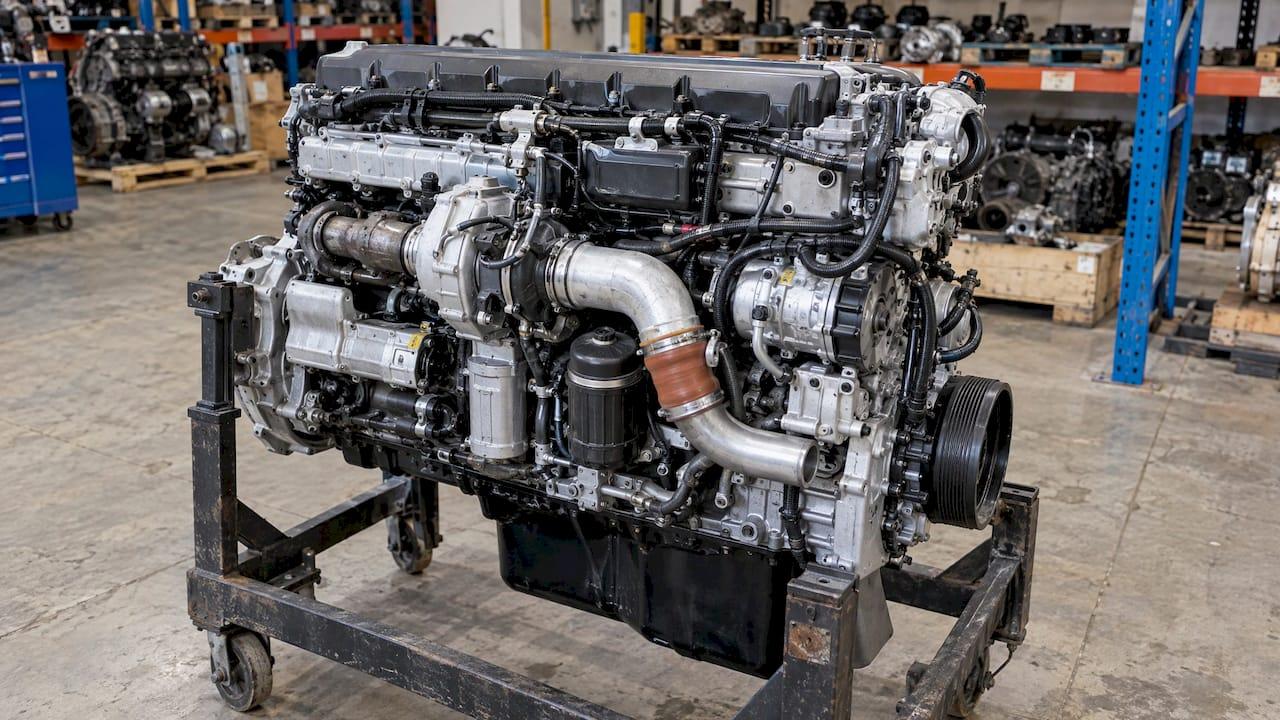
A PACCAR MX-13 is interchangeable with another MX-13 only when the emissions generation, horsepower rating, ECM calibration and chassis match. The displacement is the same on every one, so the name on the valve cover tells you very little. The EPA label, the engine serial number and the SIR engine family code tell you what you have. Read those three from your own engine before you shop. Then match them to the replacement, and buy a used engine that was tested and inspected and comes with a warranty. Our used truck engines are tested and inspected before sale and carry a standard warranty.
TL;DR
- Every MX-13 is a 12.9-liter inline six, but "MX-13" does not mean "drop-in." Emissions generation (EPA 2010, 2013, 2017, 2021, 2024) is the first thing that must match.
- Identify your engine from the EPA label on the valve cover or mixer manifold, the dataplate serial number, and, for 2021 engines, the SIR code: "L" for 2021A, "M" for 2021B.
- A different generation or rating usually means different calibration, ECM programming and aftertreatment compatibility, so a mismatch is a project, not a swap.
- Moving from an MX-13 to another engine family is a conversion, not an interchange, and some states regulate it.
- Before installing a used engine, confirm identification, rating, ECM match and condition. Tested and warrantied units take most of the risk out of the last item.
Table of Contents
- What the MX-13 is, and why "same engine" is not enough
- Step 1: Identify the engine you have
- Step 2: Know the generations
- Step 3: Match the engine to the truck
- Step 4: ECM numbers and EPA certification records
- Step 5: Expect programming
- Step 6: Inspect the used engine before it goes in
- Swapping to a different engine family is a conversion
- Where our tested engines fit
- Our view on MX-13 swaps
- FAQ
- Sources
What the MX-13 is, and why "same engine" is not enough
PACCAR's operator's manual describes the MX-13 as a 12.9-liter (787 cubic inch) inline six-cylinder turbocharged diesel with a 130 mm bore and 162 mm stroke. The same manual gives a firing order of 1-5-3-6-2-4 and a dry weight of 2,500 lb. Ratings in the U.S. run from 405 to 510 hp.
Those numbers are common to the family. They are not what decides whether an engine fits your truck. What changes between engines is the emissions generation, the rating, the software calibration and the parts bolted to the engine. A 2013 engine and a 2024 engine share a block design but are certified to different standards and run different calibrations.
If you are comparing used engines across brands or generations, our guide on how to confirm engine compatibility for heavy trucks covers the general routine. What follows is specific to the MX-13.
Step 1: Identify the engine you have
You need three pieces of information from the engine you are replacing. Write them down before you call anyone.
The EPA label and horsepower rating
PACCAR says the horsepower rating is shown on the EPA label on top of the valve cover or on the mixer manifold. That label also names the emissions generation. If the label is painted over, missing or unreadable, move on to the serial number.
The engine serial number
The serial number is on the engine dataplate. A seller or dealer can use it to look up how the engine was built. It is the number to quote when you ask whether a replacement is a true match, because it ties to the build rather than to a marketing name.
The 2021 split: 2021A versus 2021B
2021 is the year that trips people up. PACCAR service bulletin E282, published through NHTSA, defines 2021A engines as built January through May 2021 and 2021B as May 2021 and newer. Two ways to tell them apart:
- In the SIR Engine Family field, 2021A codes begin with "L" and 2021B codes begin with "M."
- Physically, a 2021A has one engine-mounted fuel filter. A 2021B has two.
Two engines that are both "2021 MX-13s" may therefore not be the same configuration. Check the fuel filter count on both before you commit.
Step 2: Know the generations
PACCAR's U.S. engines are sorted by EPA emissions generation. The generations you will meet on used engines are EPA 2010, 2013, 2017, 2021 and 2024. California also has a low NOx version, which Peterbilt announced on June 4, 2024 in 510 hp and 455 hp ratings.
A few differences matter in practice:
| Item | EPA 2021 | EPA 2024 |
|---|---|---|
| U.S. ratings | 405 to 510 hp | 405 to 510 hp |
| Governed speed | 2,200 rpm | 2,100 rpm |
| Peak torque (EPA 2024 sheet) | Not listed | 1,550 to 1,850 lb-ft |
| Dry weight | 2,500 lb | 2,500 lb |
PACCAR's EPA 2024 spec sheet also lists an oil change interval of up to 75,000 miles, a 2-year/250,000-mile base warranty and a 5-year/500,000-mile major components warranty. Those are PACCAR's terms for new engines. A used engine from us carries our own standard warranty, not PACCAR's factory coverage.
Older trucks sit in earlier generations. Kenworth's spec sheet for the engine in the T680 era shows ratings of 405 to 510 hp and peak torque of 1,450 to 1,850 lb-ft. The pattern holds across generations: the same displacement, different tuning and different hardware around it.
Step 3: Match the engine to the truck
The MX-13 is used mainly in Kenworth and Peterbilt chassis in the U.S. The models you will most often see are the Kenworth T680, T880, W900 and W990 and the Peterbilt 579, 567 and 389. Which engine generation a given truck was built with is a function of its model year, so the truck's build date is your first filter.
A workable rule of thumb for a like-for-like replacement:
- Same emissions generation as the engine coming out.
- Same horsepower rating, or a rating the truck's calibration and drivetrain are set up for.
- Same configuration details, such as the fuel filter count on 2021 engines.
- ECM that matches the engine, or a plan to program the replacement.
If any of those four differ, you are no longer doing a simple swap. You are changing the engine's configuration, and the rest of the truck has to agree with it.
Step 4: ECM numbers and EPA certification records
This is where a lot of searching for "interchange" goes wrong. EPA certification data lists which ECM part numbers were certified against which engine models. It is tempting to read that as a compatibility chart. It is not one. A part number being certified with both MX-11 and MX-13 engines does not make it a substitute for a similar-looking number.
The safe approach is to use the exact part number on the module in your truck, or the one the engine's build calls for. Don't assume a number that is close, or one in the same sequence, will work. If you are working through the software side and want to see how original calibration files are organized by brand, model, engine variant and ECU identifiers, original ECU software files show the kind of identifiers that matter when matching software to hardware.
We list MX-13 ECMs too. If you need the module along with the engine, our MX13 ECM listings for part numbers 2037394, 2298833, 2160770 and 2295122 are on our site.

Step 5: Expect programming
Even a correct swap is not purely mechanical. PACCAR's service practice shows why. In a Kenworth technical bulletin on 2017 MX-13 and MX-11 engines, software updates were issued for specific chassis, and the technician was told to verify applicable campaigns in DWWC/SIR and use PACCAR's DAVIE4 tool for the update procedure.
The lesson for a buyer: the right calibration for a given truck is a documented, per-chassis fact. After installing an engine, plan for the shop to confirm the calibration, check for open software campaigns on the truck's VIN, and have access to PACCAR's diagnostic software. Many independent shops do this routinely, but ask before you book the install so the truck does not sit.
If you are swapping an engine or ECM across configurations, aftertreatment needs the same attention. Our guide to DPF compatibility when swapping a heavy-duty engine or ECM covers it.
Step 6: Inspect the used engine before it goes in
A matching engine is only useful if it is sound. For a used MX-13, verify:
- Identification. The serial number and EPA label on the engine match what the seller quoted.
- Rating and generation. They match your truck's build.
- ECM and sensors. The module part number matches, and the harness connectors on the engine suit your chassis.
- Mileage and history. Our diesel engine mileage benchmarks help you judge what an engine's miles mean.
- Test and inspection record. A tested engine with a warranty lets you move on to installation instead of discovering a problem on the first run.
For reference, PACCAR's overhaul service manual for the EPA13 engine includes turbocharger axial clearance checks with a dial gauge, with tolerances as tight as 0.025 mm (0.001 in). Work at that level is shop work. It is also a reminder that the best time to catch a problem is before the engine is in the frame, which is why we test and inspect each engine before it ships.
Swapping to a different engine family is a conversion
Sometimes the question behind "interchange" is whether an MX-13 can go in place of another engine, or the reverse. Moving between engine families (for example, an MX-13 to a Cummins X15) is a conversion. It involves different mounts, wiring, cooling and aftertreatment, and the truck's other systems have to agree.
Regulators treat it differently as well. In California, the Bureau of Automotive Repair defines a replacement engine as one of the same make, number of cylinders and engine family as the original with original emission controls reinstalled, or one matching a manufacturer-offered configuration. Any other installation is an engine change, and it needs a BAR Referee Center inspection and a Referee label. That is California's rule. Check your own state's requirements before planning a conversion.
For a like-for-like replacement, a matched MX-13 keeps you on the simple side of that line.

Where our tested engines fit
If you are replacing an MX-13 or looking at other heavy-duty engines, start with our truck engines. Each part we sell is tested and inspected before sale and comes with a standard warranty. Our inventory changes daily, and we ship the same day, which matters when a truck is down and a logistics company is waiting on it.

We also carry transmissions, differentials and exhausts, plus brands including Caterpillar, Cummins, Detroit, Volvo, International, Mack and Paccar. If you are replacing several units at once, our guide on coordinating multi-truck engine replacements lays out the planning.
Our view on MX-13 swaps
Most failed swaps we hear about did not fail because the engine was bad. They failed because two engines that looked the same were not. A 2021A and a 2021B share a name and differ in the fuel system. An earlier-generation engine can share a block design with a newer one and still need different calibration.
That is why we put so much weight on testing and inspecting each engine, and on matching by identification, not by name. Read the label, read the serial number, read the SIR code, and give us those details when you ask about an engine. A tested engine with a standard warranty, shipped the same day, is how we try to keep a truck from sitting while someone sorts out a mismatch.
For fleets, the same discipline scales. Record the generation, rating and ECM number for every unit once, and every later replacement gets faster.
John
FAQ
Can I put a 2021 MX-13 in a 2017 truck?
Not as a simple swap. The two sit in different emissions generations, with different calibrations and hardware around the engine. Treat it as a configuration change that needs software, ECM and aftertreatment to be confirmed for that truck by a qualified shop, and check emissions rules for your state.
How do I tell a 2021A from a 2021B MX-13?
Look at the fuel filters and the SIR code. A 2021A has one engine-mounted fuel filter and an SIR engine family code starting with "L." A 2021B has two filters and a code starting with "M." PACCAR defines 2021A as built January to May 2021 and 2021B as May 2021 and newer.
Where is the horsepower rating on an MX-13?
It is on the EPA label on top of the valve cover or on the mixer manifold, according to PACCAR's operator's manual. U.S. ratings run from 405 to 510 hp.
Does a used MX-13 need programming after installation?
Plan on it. PACCAR's own bulletins treat software campaigns as chassis-specific and point technicians to DAVIE4 for the update procedure. Ask your shop whether it has the PACCAR software before the engine arrives.
Sources
- PACCAR MX-13 Operator's Manual
- PACCAR service bulletin E282 (NHTSA)
- PACCAR EPA 2024 MX-13 spec sheet
- Kenworth MX-13 spec sheet
- TruckBusWorld: PACCAR MX-13 engine generations
- Kenworth technical information bulletin (NHTSA)
- California Bureau of Automotive Repair: Engine Changes