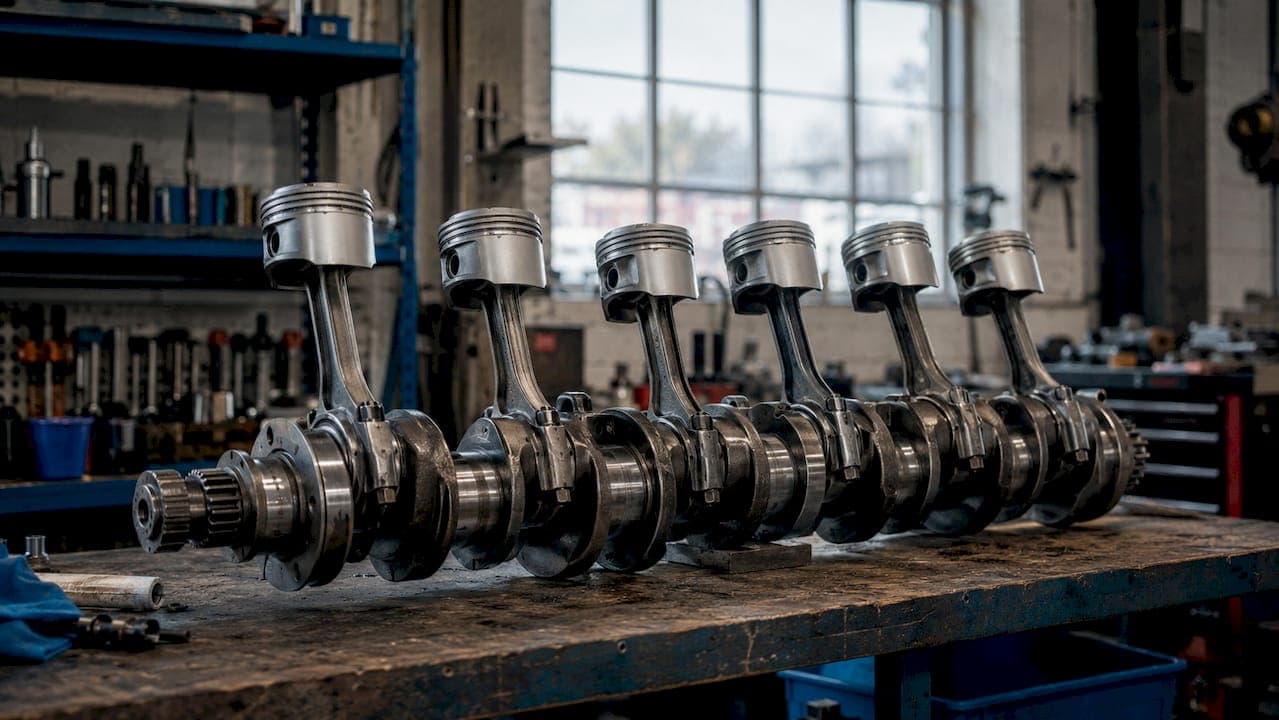
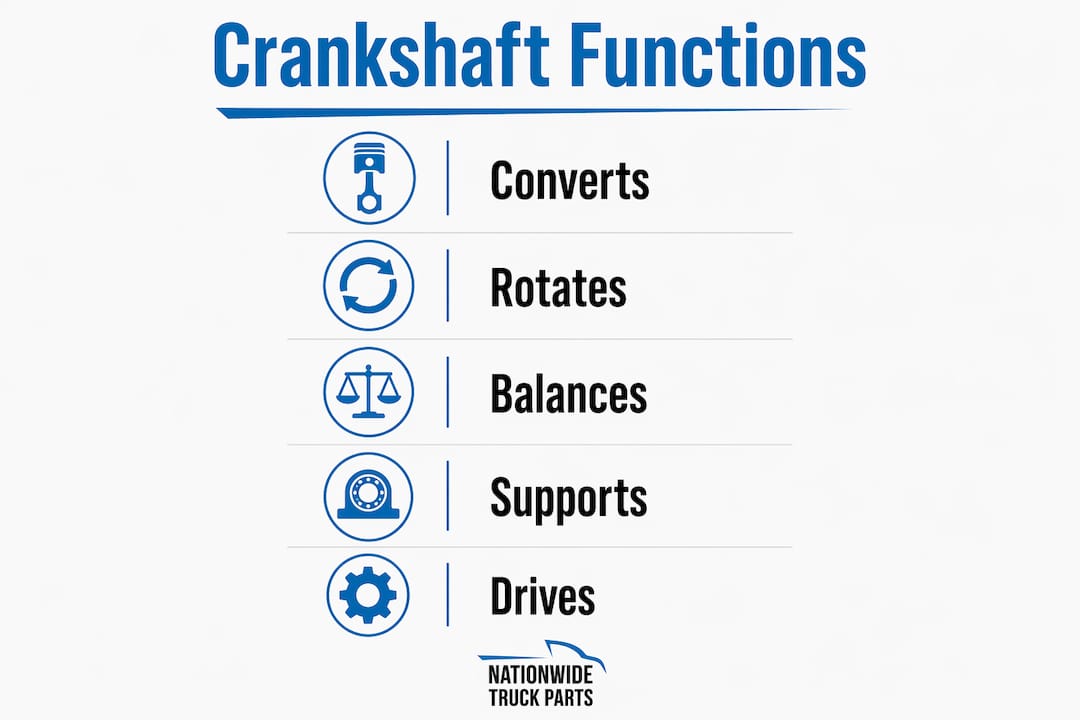
The crankshaft is defined as the primary mechanical component that converts the linear, reciprocating motion of pistons into rotational torque, making it the backbone of every diesel engine's drivetrain. In the context of the role of crankshaft in diesel engines, this conversion happens under combustion loads that are 2–3 times higher than those found in gasoline engines. That pressure difference is why diesel crankshafts demand stiffer construction, more main bearings, and tighter machining tolerances than their gasoline counterparts. For engineers and mechanics working with heavy trucks, understanding how the crankshaft functions is not optional. It determines whether an engine delivers reliable power for 500,000 miles or fails prematurely on the highway.
How does the crankshaft convert piston movement into rotational force?
The crankshaft converts piston energy through a geometry of offset journals called crankpins and throws. Crankpins offset from the center rotation axis translate each piston's downward thrust into a rotating moment. The connecting rod links the piston pin to the crankpin, transmitting combustion force directly into the crank's rotational path. Without this lever geometry, combustion energy would have nowhere to go.
Firing order and multi-cylinder balancing
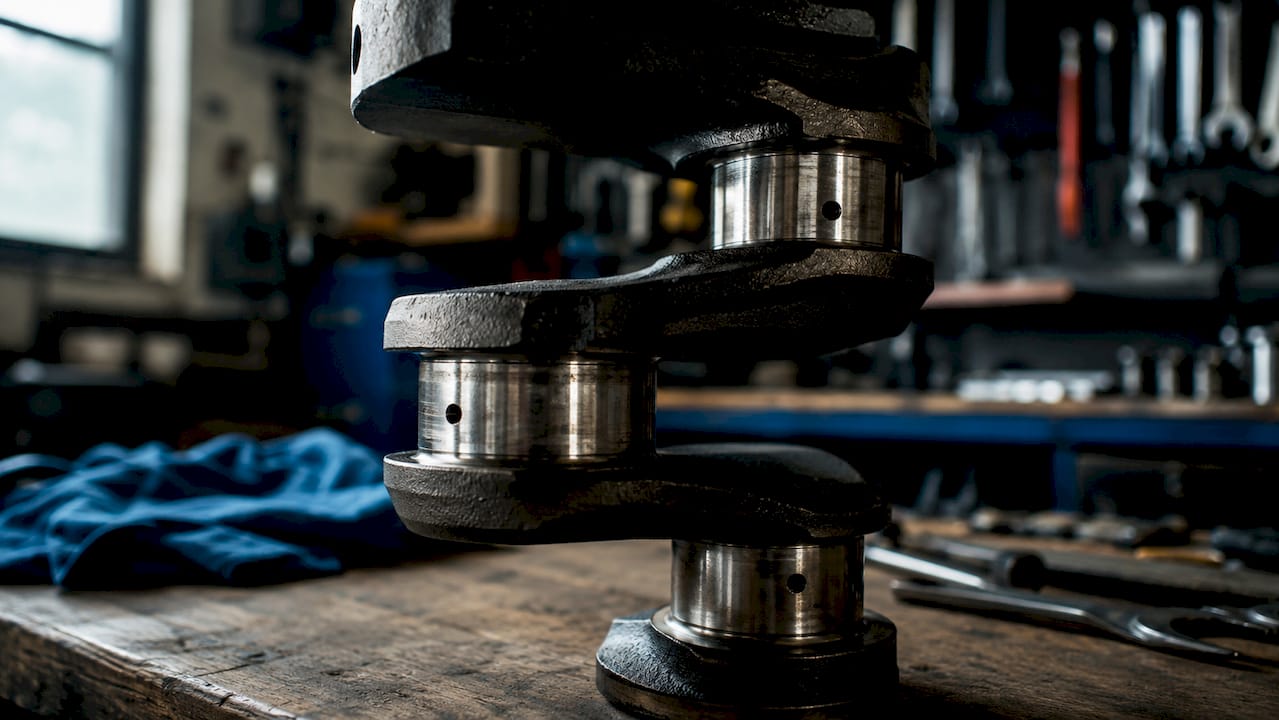
In a multi-cylinder diesel, the throws are arranged at specific angles to match the engine's firing order. A six-cylinder diesel typically fires in a sequence like 1-5-3-6-2-4, with throws spaced 120 degrees apart. This arrangement spreads power pulses evenly across the crankshaft's rotation, preventing torque spikes that would otherwise shake the engine apart. The result is the smooth, continuous power delivery that makes diesel engines suited for heavy hauling.
Counterweights cast or forged opposite each throw offset the centrifugal force generated by the rotating crank and reciprocating pistons. Without counterweights, vibration would fatigue the crankshaft journals and main bearings within a fraction of their design life. Diesel engines also use harmonic balancers, mounted at the front of the crankshaft, to dampen torsional vibrations that build up along the shaft's length during high-load operation.
Key mechanical elements in the conversion process:
- Crankpins: offset journals where connecting rods attach, creating the lever arm for torque generation
- Throws: the offset sections of the crankshaft that determine stroke length and firing geometry
- Connecting rods: rigid links that transmit piston force to the crankpin without flexing under load
- Counterweights: cast masses that cancel rotational imbalance and reduce bearing stress
- Harmonic balancer: a damping device that absorbs torsional vibration along the crankshaft's length
Pro Tip: When reassembling a diesel engine, verify that the harmonic balancer's rubber isolator shows no cracking or separation. A failed balancer allows torsional vibration to build unchecked, accelerating journal wear far faster than normal operating cycles.
What design and material characteristics ensure diesel crankshaft durability?
Diesel crankshafts carry loads that would destroy a standard gasoline engine crankshaft within hours. The material choice starts the conversation: forged steel is the standard for heavy-duty diesel applications because the forging process aligns the steel's grain structure along the crankshaft's length, producing superior fatigue strength compared to cast iron. Cast iron crankshafts appear in lighter diesel applications where peak combustion pressures are lower, but they are not appropriate for commercial truck engines running at sustained high loads.
The bearing configuration is equally critical. Diesel crankshafts typically carry a main bearing between every cylinder and at both ends of the shaft. That arrangement distributes torsional and horizontal forces across more contact points, reducing the stress concentration at any single location. A gasoline engine might use fewer main bearings because its combustion pressures are lower. A diesel cannot make that compromise.
Four engineering requirements that separate diesel crankshafts from lighter designs:
- Fatigue strength: the crankshaft must withstand millions of load cycles without developing cracks at fillet radii or journal surfaces
- Wear resistance: journal surfaces are induction-hardened or nitrided to resist abrasion from bearing contact under high oil film pressure
- Precision machining: journal and web integrity directly govern engine reliability, with tolerances measured in ten-thousandths of an inch
- Internal oil passages: drilled passages route pressurized oil from main journals to rod journals; blockage causes bearing starvation and catastrophic failure
Improper bearing substitution in diesel crankshafts induces vibrations that destroy the surface hardening on journals over time. That is a failure mode unique to diesel applications because the combustion forces are high enough to amplify any clearance error into a destructive vibration cycle.
Pro Tip: Always source replacement main and rod bearings to OEM specifications. An aftermarket bearing with even a slight clearance deviation will change the oil film thickness, altering heat dissipation and accelerating wear on both the bearing and the journal surface.
What are common crankshaft performance issues and how are they diagnosed?
Crankshaft problems produce symptoms that overlap with fuel system and air system failures, which is why technicians must prioritize crankshaft inspection using precision measurement tools before tearing into more complex systems. A knocking sound from the lower end of the engine is the most common symptom, but low oil pressure and excessive vibration also point directly to crankshaft or bearing problems. Misdiagnosing these symptoms as injector or turbo issues wastes time and leaves the root cause untouched.
Diagnostic steps for identifying crankshaft problems:
- Micrometer measurement of main journals: check each journal for taper and out-of-round; any deviation beyond OEM tolerance confirms wear requiring regrind or replacement
- Rod journal inspection: repeat the same micrometer checks on rod journals, which wear faster due to higher dynamic loads from combustion
- Oil passage inspection: probe each internal oil passage for debris or sludge; blocked oil passages cause bearing starvation that destroys journals within minutes of engine restart
- Visual inspection of fillet radii: cracks initiate at the transition between journals and webs; a magnifying glass or dye penetrant test reveals early fatigue cracks before they propagate
- Oil pressure testing: a sustained drop in oil pressure at idle, after the engine reaches operating temperature, indicates excessive bearing clearance from journal wear
Early detection is the difference between a crankshaft regrind and a complete engine replacement. A worn journal caught at 0.003 inches out-of-round can be reground to the next undersize bearing specification. The same journal left to run will score deeply, making the crankshaft unrepairable. For fleet operators, understanding common engine failure patterns prevents a single crankshaft problem from cascading into a full engine replacement.
Maintenance best practices center on oil change intervals and oil quality. Diesel crankshafts depend entirely on a clean, pressurized oil film to separate journal surfaces from bearing shells. Extended oil change intervals allow combustion byproducts to contaminate the oil, increasing its abrasive content and accelerating journal wear. Checking the engine block's role in supporting crankshaft bearing bores also matters, because a warped or worn block saddle misaligns the crankshaft and creates uneven bearing loads.
How does the crankshaft interact with other engine components?
The crankshaft does not operate in isolation. It coordinates with the camshaft, flywheel, and engine block to deliver power efficiently through the drivetrain. Failure to synchronize the crankshaft and camshaft causes catastrophic engine damage, because the camshaft controls valve timing while the crankshaft controls piston position. If the timing chain or gear set slips, intake and exhaust valves open at the wrong point in the combustion cycle, destroying power output and potentially bending valves against pistons.
The flywheel bolts directly to the crankshaft's rear flange and stores rotational energy between power strokes. In a diesel engine, the flywheel's mass smooths the power pulses from each cylinder's combustion event, delivering consistent torque to the transmission. The flywheel also carries the ring gear for the starter motor and, in manual transmission applications, provides the friction surface for the clutch. The crankshaft's condition directly determines how evenly the flywheel rotates, which affects clutch engagement quality and transmission input shaft life.
| Component | Relationship to crankshaft | Impact on engine performance |
|---|---|---|
| Camshaft | Driven by crankshaft via timing chain or gears | Controls valve timing relative to piston position |
| Flywheel | Bolted to crankshaft rear flange | Stores energy between power strokes, smooths torque output |
| Main bearings | Support crankshaft within engine block | Determine journal clearance and oil film integrity |
| Connecting rods | Link pistons to crankpins | Transmit combustion force into rotational torque |
| Harmonic balancer | Mounted on crankshaft front snout | Absorbs torsional vibration to protect journals |
The engine block's main bearing bores hold the crankshaft in precise alignment. Any distortion in those bores, from overheating or improper torque during assembly, misaligns the crankshaft and creates a bending load that no crankshaft material can sustain indefinitely. For fleet operators running multiple trucks, crankshaft condition is a direct indicator of overall powertrain reliability and [engine longevity](https://blog.nationwideheavytruckparts.com/blog/how-to-extend-truck-engine-life-as-an owner-operator).
Key Takeaways
The crankshaft is the mechanical core of every diesel engine, converting combustion force into rotational torque while coordinating with the camshaft, flywheel, and bearings to sustain reliable power delivery under extreme loads.
| Point | Details |
|---|---|
| Core function | The crankshaft converts piston linear motion into rotational torque through offset crankpins and connecting rods. |
| Diesel-specific design | Diesel crankshafts use forged steel and carry a main bearing between every cylinder to handle elevated combustion pressures. |
| Oil passage maintenance | Blocked internal oil passages cause bearing starvation and catastrophic failure; clear them during every rebuild. |
| Early diagnosis saves engines | Micrometer measurement of journals at first symptom prevents a regrind from becoming a full replacement. |
| Camshaft synchronization | Crankshaft and camshaft timing must stay synchronized; any slip causes immediate and severe engine damage. |
What 20 years around diesel engines taught me about crankshafts
Most crankshaft failures I have seen were not caused by the crankshaft itself. They were caused by neglected oil changes, wrong bearing clearances installed by someone trying to save money, and blocked oil passages that nobody bothered to clean during a rebuild. The crankshaft gets blamed, but the maintenance record tells the real story.
The measurement step is where most shops cut corners. A technician pulls a crankshaft, looks at the journals, decides they look "okay," and reinstalls it with new bearings. Three months later, the engine is back on the stand. A micrometer takes five minutes per journal. That five minutes is the difference between a repair that lasts and one that fails before the warranty expires.
The other thing I have learned is that diesel crankshafts are unforgiving of wrong bearing specifications. A gasoline engine will tolerate a slight clearance error and keep running. A diesel will turn that error into a vibration that strips the hardening off the journal surface within 50,000 miles. OEM bearing specs exist for a reason, and they are not negotiable on a high-compression diesel. If you are sourcing a replacement engine and want to know what to check before you buy, the used diesel engine checklist covers the inspection points that actually matter.
— John
Diesel engine parts for commercial trucks at Nationwide Truck Parts
When a crankshaft problem points to a full engine replacement, the quality of the replacement unit determines how long you stay off the road.

Nationwide Truck Parts carries a daily-changing inventory of tested and inspected heavy truck diesel engines, including Detroit Diesel engines and a broad range of commercial truck engines suited to fleet and owner-operator needs. Every engine goes through inspection before it ships, and same-day shipping gets your replacement moving the same day you order. Fleet managers and independent mechanics can browse current inventory at Nationwide Truck Parts and confirm compatibility before committing to a purchase.
FAQ
What does the crankshaft do in a diesel engine?
The crankshaft converts the up-and-down motion of pistons into rotational torque that drives the wheels. It accomplishes this through offset crankpins and connecting rods that translate linear combustion force into continuous rotation.
Why do diesel crankshafts need more main bearings than gasoline engines?
Diesel engines produce combustion pressures 2–3 times higher than gasoline engines, requiring a main bearing between every cylinder to distribute torsional and horizontal forces and prevent metal fatigue.
What causes crankshaft knocking in a diesel engine?
Crankshaft knocking results from excessive journal clearance, typically caused by worn bearing shells or scored journals. Micrometer measurement of main and rod journals confirms whether the clearance exceeds OEM tolerance.
How does a blocked oil passage damage a crankshaft?
A blocked internal oil passage starves the bearing of lubricant, causing metal-to-metal contact between the journal and bearing shell. This destroys both surfaces within minutes of engine restart.
How are the crankshaft and camshaft connected in a diesel engine?
The crankshaft drives the camshaft through a timing chain, belt, or gear set at a 2:1 ratio, so the camshaft rotates once for every two crankshaft revolutions. Loss of synchronization between them causes immediate and severe engine damage.