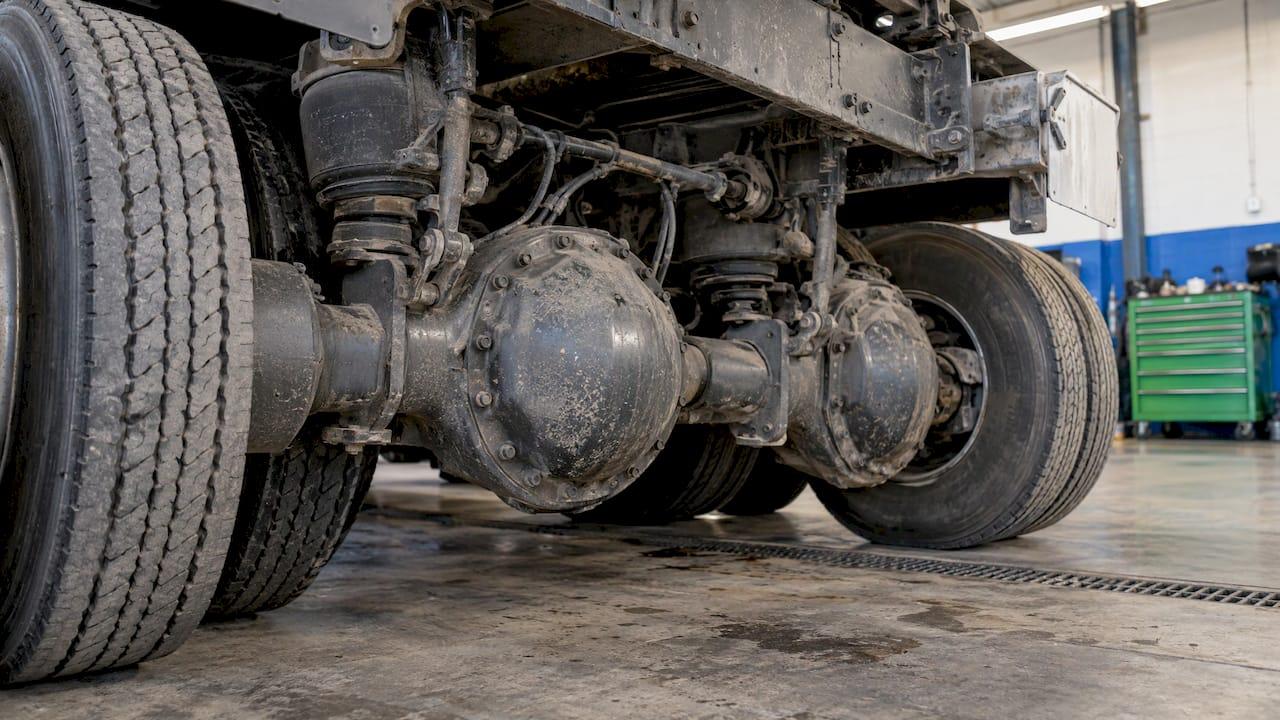
A differential gear ratio chart shows what engine speed each rear axle ratio produces at a given road speed. The chart below does this for a typical heavy truck: it runs ratios from 2.64 to 4.33 and shows RPM at 60 and 65 mph. It also explains how to read a ratio like 3.36:1, where to find the ratio on your own axle, and how to match a replacement differential so it fits your drivetrain.
TL;DR
- A ratio such as 3.36:1 means the driveshaft turns 3.36 times for each turn of the wheels. It comes from the ring gear tooth count divided by the pinion tooth count.
- Higher numbers give more wheel torque and higher cruising RPM. Lower numbers give lower RPM and usually better fuel economy.
- Engine RPM = axle ratio × mph × 336 ÷ tire rolling diameter in inches, with the transmission in direct drive (1:1).
- Read the ratio from the axle tag or carrier stamp. Count teeth only if it is unreadable.
- A replacement differential should match the original ratio unless you are re-gearing the whole truck on purpose.
Table of Contents
- What a differential gear ratio chart shows
- The chart: RPM by axle ratio at 60 and 65 mph
- How to read a ratio like 3.36:1
- What the ratio does to RPM, torque and fuel economy
- Picking a ratio by duty cycle
- Finding the ratio on your own axle
- Eaton ratios and matching a replacement differential
- Our perspective on swapping differentials
- Find your carrier
- Common mistakes when reading ratio charts
- FAQ
- Sources
What a differential gear ratio chart shows
Most charts are grids. One axis lists tire sizes or road speeds, the other lists axle ratios, and each cell gives engine RPM. For a semi truck the useful version fixes the tire size and the transmission gear (usually top gear in direct drive) and lets the ratio change. Then you can see at a glance how much engine speed you pay for each step up in numerical ratio.
The chart is only as good as its inputs. It assumes direct drive in the transmission, no tire slip, and a known rolling diameter. If you run an overdrive transmission, multiply the result by the overdrive ratio. If your tires are worn or a different size, adjust the diameter.
The chart: RPM by axle ratio at 60 and 65 mph
This table assumes a 40-inch tire rolling diameter and a transmission in 1:1 direct drive. The numbers come from the formula in the next section, rounded to the nearest RPM. Measure your own tires before relying on them.
| Axle ratio | RPM at 60 mph | RPM at 65 mph | Typical character |
|---|---|---|---|
| 2.64 | 1,331 | 1,441 | Very tall gearing, steady highway running |
| 2.79 | 1,406 | 1,523 | Tall gearing |
| 2.93 | 1,477 | 1,600 | Tall gearing |
| 3.08 | 1,552 | 1,682 | Highway fuel-economy focus |
| 3.36 | 1,693 | 1,835 | Common all-round highway ratio |
| 3.42 | 1,724 | 1,867 | All-round highway |
| 3.55 | 1,789 | 1,938 | Mixed highway and regional |
| 3.73 | 1,880 | 2,037 | More pull, more RPM |
| 3.90 | 1,966 | 2,129 | Regional, heavier or hilly work |
| 4.10 | 2,066 | 2,239 | Pulling power over speed |
| 4.33 | 2,182 | 2,364 | Low gearing, vocational duty |
The jump from 3.36 to 3.90 adds about 294 RPM at 65 mph. That is the trade at the heart of axle selection: the engine works at a higher speed to get more leverage at the wheels.
How to read a ratio like 3.36:1
A ratio is the number of driveshaft turns for one turn of the wheels. FreightWaves explains that with a 3.55 ratio the driveshaft turns 3.55 times to spin the tires once. The "to 1" is always implied, so 3.36 and 3.36:1 mean the same thing.
The ratio is set by the gears inside the carrier. Spicer's gear ratio calculator works it out by dividing the ring gear tooth count by the pinion tooth count. A pinion with 11 teeth driving a ring gear with 37 teeth gives 37 ÷ 11 = 3.36. A 41-tooth ring on an 11-tooth pinion gives 3.73.
Two things follow from that:
- Ratios are never round. Gear sets are cut in matched pairs, so you see 3.36, 3.55, 3.73 and 4.10 rather than 3.5 or 4.0.
- The ring and pinion are a matched set. You cannot swap one gear and keep the ratio you wanted. If someone tells you they changed only the pinion, the pair no longer meshes correctly.
The formula behind the chart
To see engine RPM at any speed, use this:
RPM = axle ratio × mph × 336 ÷ tire rolling diameter (inches)

The 336 comes from unit conversion: it is the number of inches in a mile divided by 60 minutes and by pi, rounded. Worked example for a 3.36 axle at 65 mph on 40-inch tires: 3.36 × 65 × 336 ÷ 40 = 1,835 RPM. Spicer also offers a transmission ratio RPM calculator that takes the transmission gear, tire height, speed and ring and pinion ratio.
Rearranged, the same formula tells you what ratio gives a target RPM. Say you want 1,700 RPM at 65 mph on 40-inch tires: 1,700 × 40 ÷ (65 × 336) = 3.11. The nearest real ratios are 3.08 and 3.36, and your choice depends on the work.
What the ratio does to RPM, torque and fuel economy
The numbers in the chart have real consequences. FreightWaves describes the pattern this way: higher numerical ratios deliver more wheel torque but lower top speed, higher cruising RPM and worse fuel economy, while lower ratios improve fuel economy and top speed but reduce wheel torque.
In practice:
- Higher numerical ratio (3.90, 4.10): The truck pulls harder off the line and holds speed on grades with less downshifting. It suits heavy hauls, hilly regional routes and stop-and-go work.
- Lower numerical ratio (2.64 to 3.08): The engine turns slower on the highway. It suits long, steady hauls where the truck spends most of its time in the top gears.
- The middle (3.36 to 3.55): The compromise most owner-operators land on when their routes vary.
This is where modern engines change the picture. Fleet Equipment explains that faster axle ratios let the engine deliver the needed wheel-end power at a lower RPM, which is the idea behind downspeeding. The same article quotes a Meritor engineer saying aggressive downspeeding should be limited to long-haul customers who spend 80% to 90% of their time in the top two gears and run at least 30 miles between stops.
So a low ratio is not simply better. It has to fit the engine's torque curve and your duty cycle. We cover that in more depth in our post on semi truck gear ratios and downspeeding, and our explainer on diesel engine torque shows why the engine's peak torque RPM matters for the choice.

Picking a ratio by duty cycle
Axle ratio ranges for commercial trucks track how the truck is used, and a buying guide such as this Volvo truck buying guide helps when you are comparing spec sheets across models. Whatever the brand, the logic is the same:
- Write down your real route. Flat interstate miles, mountain passes, or short regional hops with frequent stops?
- Find your average cruising speed. If you run 62 mph, use the 60 and 65 columns to estimate between them.
- Check the engine's sweet spot. Your engine maker publishes the RPM band where torque and fuel use are best. Pick the ratio that puts your cruising speed in that band.
- Think about weight. A truck regularly at 80,000 pounds on hills usually wants a numerically higher ratio than one running light.
- Match the transmission. An overdrive transmission already lowers cruising RPM, so the same axle behaves differently than with a direct-drive box.
If your cruising RPM sits far above the engine's best band, the ratio is probably too high for the work. If the truck lugs on grades and downshifts constantly, it may be too low.
Finding the ratio on your own axle
You do not need to guess. In order of reliability:
- The axle tag. Eaton and Spicer drive axles carry model, part number and serial information, usually on a tag at the axle centerline, and the carrier identification may also be stamped on the carrier itself. The ratio is part of that information. For the Meritor equivalent, see our guide on reading a Meritor differential tag.
- The build sheet or spec sheet. Fleet records and the original window sticker list the axle ratio.
- The carrier stamp. Some carriers are stamped with the ratio near the pinion area.
- Counting teeth. If tags are missing or painted over, pull the cover or carrier, count ring and pinion teeth, and divide as Spicer's method describes.
- The driveshaft turn test. Jack up the drive wheels safely, mark the driveshaft and a tire, and count driveshaft turns per wheel turn. This works as a sanity check, though on a differential with an inter-axle or lock setup it takes care.
For a light-duty pickup the process differs. Ford, for example, uses a two-digit axle code on the door label and its owner support page says to match that code to the towing guide. Heavy-duty tandem axles do not work that way: look at the axle itself.
Tandems: check both axles
On a tandem, the forward-rear and rear-rear axles must carry the same ratio. A mismatch fights itself and wears tires, gears and driveline parts. If you replace one carrier, confirm what is in the other axle before you order.
Eaton ratios and matching a replacement differential
Eaton and Spicer carriers such as the DSP40, DS404 and similar models come in a range of ratios, and the range depends on the axle model and its capacity. The tag gives you the model and the exact ratio of your unit, so you start from facts rather than a catalog table.
To match a replacement, confirm these items:
- Axle model. The housing and carrier family must match, for example a DSP40 carrier for a DSP40 axle.
- Ratio. Match your current ratio exactly, on both tandem axles, unless you are re-gearing the truck.
- Single or tandem position. Forward-rear carriers with the inter-axle differential are not the same as rear-rear units.
- Lock option. Check whether your axle has a driver-controlled lock and that the replacement has the same setup.
- Transmission and tires. If either has changed since the truck was built, run the formula again before you pick a ratio different from stock.
For the same approach on the transmission side, see our guide on heavy-duty transmission interchange and our walkthrough on Eaton transmission identification. The drivetrain works as a system, and the driveshaft between the two matters too, as covered in the role of drive shafts in heavy trucks.
Our perspective on swapping differentials
We see the same mistake every week: someone orders a differential by price and finds out the ratio was wrong after it is bolted in.
Our advice is to start from the tag. Get the axle model and the ratio, confirm the tandem partner, and only then shop. A carrier with the right ratio and model drops into the same driveline and keeps the truck behaving the way the engine was tuned to behave.
That is why we test and inspect each used part before it ships, and why our parts come with a standard warranty. Used does not have to mean a gamble when the part is checked and the match is right. Our inventory changes daily, so if the exact Eaton ratio you need is not listed today, check again soon.
If you are unsure what you are looking at, send us the tag details. A thirty-second check beats a week of downtime.
John
Find your carrier
If you have your axle model and ratio in hand, browse our used differentials. Each unit is tested and inspected and backed by a standard warranty, and we offer same-day shipping nationwide. Examples of Eaton carriers we have listed include a 2015 Eaton RSP40 rear differential carrier at 3.36 ratio and an Eaton DSP40 front differential carrier at 3.36 ratio.

Need an engine or transmission to go with it? See our truck engines and transmissions.
Common mistakes when reading ratio charts
- Using the wrong tire diameter. Nominal tire size is not rolling diameter. Measure from the ground to the axle center under load and double it, or use the tire maker's data.
- Forgetting the transmission. The chart above assumes direct drive. In an overdrive gear, multiply the RPM by the overdrive ratio.
- Treating lower as always better. A very tall ratio can leave the engine below its useful torque range on grades.
- Mixing ratios on a tandem. Both axles need the same ratio.
- Trusting a stamp that has been painted over or a previous owner's word. Verify with the tag or by counting teeth.
FAQ
What does a 3.36 rear end ratio mean?
It means the driveshaft turns 3.36 times for each full turn of the wheels. The ring gear has about 3.36 times as many teeth as the pinion, for example 37 and 11. On 40-inch tires at 65 mph with a direct-drive transmission, that works out to roughly 1,835 RPM.
How do I read a gear ratio from the carrier or tag?
Look for the ratio on the axle tag at the axle centerline or on a stamp on the carrier. If neither is readable, count the ring and pinion teeth and divide the ring count by the pinion count. Spicer uses the same method in its gear ratio calculator.
Is a higher or lower axle ratio better for fuel economy?
A lower numerical ratio lowers cruising RPM and generally helps fuel economy, as FreightWaves notes. It trades away some wheel torque, so it fits steady highway work best. Match it to your engine and duty cycle.
Can I use a different ratio when I replace a differential?
Only if you are re-gearing on purpose and have run the RPM math for your tires and transmission. On a tandem, both axles must carry the same ratio. For a straight replacement, match the original ratio and axle model.
Sources
- Spicer Parts gear ratio calculator
- Spicer Parts transmission ratio RPM calculator
- FreightWaves: How to Understand Truck Specs, Gear Ratios
- Fleet Equipment: Inside axle ratios and downspeeding
- Ford: How to find the axle ratio