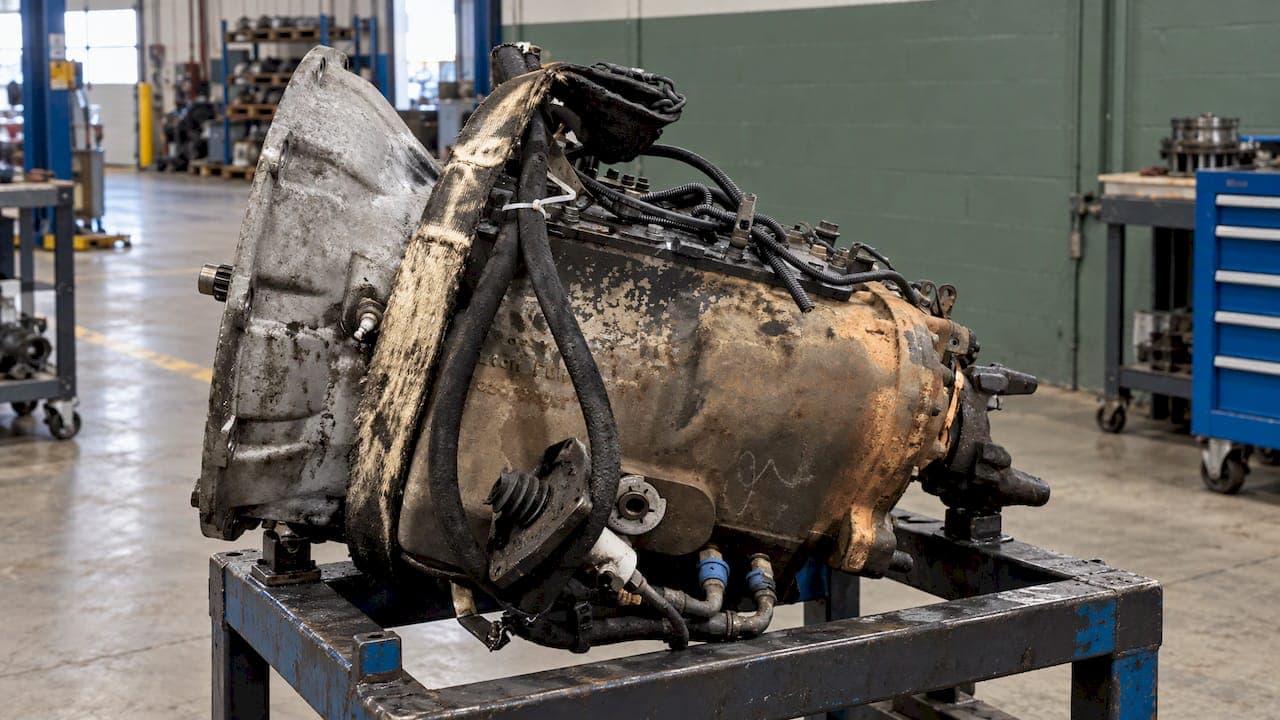
Transmission interchange means confirming that a replacement transmission, or a differential carrier, will bolt in and work in your truck as the original did. The answer never comes from model year or a similar look. It comes from the tag: the model designation, ratio set, options, and for automated units the controls. Read those, match them to the manufacturer's interchange reference, and only then buy.
This guide is for owner-operators, mechanics and fleet managers shopping for used heavy-duty drivetrain parts. It covers Eaton Fuller manual transmissions, automated units and differential carriers, and shows what to check before you order.
TL;DR
- Identify the unit by its tag first. If the tag is gone, use an identification chart, then tooth counts, bearing numbers and case casting numbers.
- Two transmissions that look the same outside can have different ratios, and a wrong ratio can leave you with a truck that does not suit its engine and chassis.
- For differential carriers, match the carrier assembly number, ratio, axle-shaft diameter, spline count and ring-gear diameter, not just the axle brand.
- Automated manual transmissions add a second check: the control module, wiring harness and software calibration.
- Send us the tag details and we will help you match a tested, warrantied unit from our transmission and differential inventory.
Table of Contents
- What interchange really means on a heavy truck
- Step 1: Read the transmission tag
- Step 2: Check the ratio, not just the housing
- Step 3: Automated manual units need a controls check
- Differential carrier interchange
- A worked example: from tag to order
- Checking before you buy used
- Our perspective
- Find a matched unit
- FAQ
- Sources
What interchange really means on a heavy truck
In passenger-car swap guides, interchange often means "it came on a similar model." Heavy-duty work is stricter. Eaton's unit exchange guide for Fuller transmissions is built around a process: identify the current model, then use the guide to order the right Reman, New or New Exchange unit. It points you to the transmission tag first, and to an identification chart if the tag is missing.
That guide covers Fuller models produced from 1985 to 1998, so it is a strong reference for older units and a starting point, not the last word, for newer ones. The principle holds across generations: the designation tells you what the unit is, and the interchange tables tell you what it can replace.
A replacement has to satisfy four things at once:
- Mechanical fit. Bellhousing, input shaft and spline, mounting points, output yoke or flange.
- Torque capacity. The unit must handle what the engine puts out.
- Ratio set. The gearing must suit the engine, rear axle ratio and tire size.
- Options and controls. Shift bar housing, power takeoff provisions, and for automated units the electronics.
Miss any one and you may have a part that fits on the bench but fails the truck.
Step 1: Read the transmission tag
The tag is the fastest route to certainty. According to Eaton, the model designation on the tag carries information on torque capacity, forward speeds, ratio set, shift bar housing and options. One string of characters answers most of your fitment questions.
Take a clear photo of the tag, with the full model and serial number legible. Write the number down as well, because tags get painted over and photographs get blurry. If you are working on an Eaton unit, our walkthrough on Eaton transmission identification shows where the tag sits and how to read model and serial. For Allison units, the serial number location guide does the same job.
Reading a model designation
Fuller designations compress a lot of information. As a general pattern, the letters show the series, the digits show torque rating and number of forward speeds, and trailing characters show the ratio set and variants. Do not decode it from memory when money is on the line. Check it against the manufacturer's chart, because the options chart and the interchange section of the guide exist for exactly this.
When the tag is missing
This is common on salvaged and repainted units. Eaton's guide offers a transmission identification chart for this case. An industry identification article adds that, without tags, tooth counts, bearing numbers and case casting numbers matter for ordering parts and for checking that the unit is right for the engine and chassis.
That means opening an inspection cover and counting gear teeth, or having a shop do it. It is slower than reading a tag, but far cheaper than installing the wrong unit.
Step 2: Check the ratio, not just the housing
The most expensive interchange mistake is trusting looks. Transmissions with the same external design can carry different ratios, and a wrong swap can leave the truck with ratios unsuited to its engine and chassis. The same author describes a familiar shop problem: a customer arrives with the wrong unit already installed, and the tag is missing, so identification starts from casting numbers.
What a mismatched ratio looks like in the real world:
- The truck cannot hold the engine in its torque band at highway speed.
- Gaps between gears are too wide for the load you pull.
- Fuel economy suffers because the engine runs outside the range it was tuned for.
The transmission is only half of the gearing equation. Rear axle ratio and tire size finish it. Our piece on semi truck gear ratios explains why downspeeding takes more than a single axle ratio, and it is worth reading before you pick a ratio set that differs from the one you are replacing.
The safest rule: match the original ratio set unless you have a reason and a plan to change it, and if you do change it, change it on paper with the engine, axle and tire numbers first.
Step 3: Automated manual units need a controls check
Manual boxes are mostly mechanical. Automated manual transmissions are not. Eaton's unit exchange program guide notes that replacements require checking the transmission control module, wiring and software calibration. The hard part can fit perfectly while a mismatched harness, module or calibration keeps the truck down.
Before you buy an automated unit, confirm:
- The model and serial of the donor unit match your truck's unit.
- The TCM you have is compatible with the replacement, or you know which module has to come with it.
- The harness connectors and routing match.
- Someone with the right diagnostic tools can load or verify the calibration.
If any of those answers is "not sure," ask before you order. A phone call with tag numbers in hand takes minutes.
Differential carrier interchange
Carriers follow the same logic as transmissions: identify, then match. The details differ.

Where the numbers live
Spicer's service documentation says the carrier tag carries the carrier serial number, carrier assembly number and ratio, while the housing tag holds its own serial number, model number and axle assembly number. The carrier and housing are tagged separately, so photograph both. If you are dealing with Meritor axles, our guide to Meritor differential identification covers how to read the tag and find the model.
What to match
Eaton's differential application guide tells you to identify the axle type and verify axle-shaft diameter, spline count and gear ratio, and its listings also specify ring-gear diameter. Put together, a carrier match checklist looks like this:
| Check | Why it matters |
|---|---|
| Carrier assembly number | Identifies the exact carrier build |
| Gear ratio | Must agree with the other axle in a tandem set and with the drivetrain plan |
| Ring-gear diameter | Sets the carrier size class |
| Axle-shaft diameter | Determines whether shafts fit and carry the load |
| Spline count | Shafts must engage the side gears |
| Housing model | The carrier must suit the housing it goes into |
Eaton also flags that listings marked with an asterisk in its application guides may require specialized technical knowledge or components, and recommends consulting a mechanic. Treat an asterisk as a stop sign for guesswork.
Same carrier, different axle
Dana's Spicer division explains that drive axle models share common internal carrier designs, with differences in load capacity coming from pairing those carriers with different housings and wheel ends. So a carrier can look right and still sit in the wrong axle. Confirm the housing model, not only the carrier.
Installation matters too
A matched carrier can still fail if it is installed badly. For S132 axles, Spicer's procedure calls for a clean housing, Spicer-approved RTV and fasteners torqued to 142 to 158 lb-ft (193 to 214 N·m). That figure applies to that axle. For any other model, use the torque specification for that model from its own service manual.
A worked example: from tag to order
Say your truck has a 10-speed Eaton Fuller direct-drive unit that is failing. Here is the sequence we would follow:
- Wipe off the tag and photograph the model and serial number.
- Look up the designation in the manufacturer's chart and note torque rating, speeds, ratio set, and shift bar housing.
- Write down your engine model and rating, rear axle ratio and tire size.
- Confirm the replacement's designation is identical, or listed as interchangeable in the manufacturer's interchange section.
- Check any options that affect the install: power takeoff openings, clutch housing, output configuration.
- Ask for the replacement's tag photo before you pay.
The clutch is a part of this chain as well. A transmission that fits but meets a mismatched clutch will cause trouble, so see our guide on Eaton clutch compatibility. And the driveline between the transmission and the axle needs attention too; our overview of drive shafts in heavy trucks shows what to inspect while everything is apart.
Checking before you buy used
Buying used makes the interchange step more important, not less. You are working from a donor unit, and the paperwork may be thin. A good seller helps you with the match. Ask:
- Can you send the tag photo of the exact unit?
- Was the unit tested and inspected, and what warranty comes with it?
- What truck or application did it come from?
- What does shipping look like, and how fast?
For the bigger picture, our heavy truck parts compatibility checklist for fleet managers covers the same discipline across parts, and our guide on what a used truck transmission really costs helps you weigh a used unit against the alternatives. If the repair also involves the engine, read how to confirm engine compatibility for heavy trucks, and check engine swap emissions laws before you swap an engine.
Our perspective
We handle heavy-duty drivetrain parts every day, and the pattern is consistent: the jobs that go smoothly start with a tag photo, and the ones that go wrong start with "it looks the same."
That is why we test and inspect each part before it is sold and back it with a standard warranty. A used transmission or carrier is only a good value if it is the right one for your truck, and a good value if it works. We would rather spend ten minutes matching numbers with you than have you wait on a return.
Used units are also how many owner-operators and fleets keep a truck earning. Our inventory changes daily and we ship the same day, so a correct match turns into a truck back on the road quickly. Send us your tag numbers, engine and axle details, and we will help you confirm the fit.
John
Find a matched unit
If you have your tag numbers, we can help you find a tested, warrantied unit. Browse our used transmissions, differentials, truck engines and exhausts, all shipped nationwide.

Looking at an Eaton Fuller unit now? See the listing for a 2014 Eaton-Fuller FRO-16210C transmission, or the Eaton DSP40 front differential carrier with a 3.36 ratio if you are matching a carrier.
FAQ
Can I swap a heavy-duty transmission for a different model?
Sometimes, but only when the manufacturer's interchange information says the units are compatible, or when you have verified torque capacity, ratio set, mounting and options yourself. Matching the original designation is the safest route. A change in ratio should be planned against your engine, rear axle and tires.
How do I find the Eaton Fuller interchange for my transmission?
Start with the model designation on the transmission tag. Then use the manufacturer's unit exchange guide, which includes an identification chart, options chart, interchange section and conversion chart. If the tag is missing, tooth counts, bearing numbers and case casting numbers help identify the unit.
What decides whether a differential carrier interchanges?
The carrier assembly number, gear ratio, ring-gear diameter, axle-shaft diameter, spline count and the housing model it goes into. The carrier tag and housing tag are separate, so check both. For listings that need specialized parts or knowledge, consult a mechanic.
Does a matching model year guarantee a fit?
No. Same-looking transmissions can have different ratios, and automated units also depend on the control module, harness and calibration. Use the tag and the manufacturer's reference rather than the year.
Sources
- Eaton Fuller heavy-duty transmissions unit exchange guide
- Domestic-Truck Transmission Identification Guide
- Eaton unit exchange program guide
- Spicer heavy axle components
- Eaton Differential Application Guide
- Spicer AXSM-0059 axle service manual