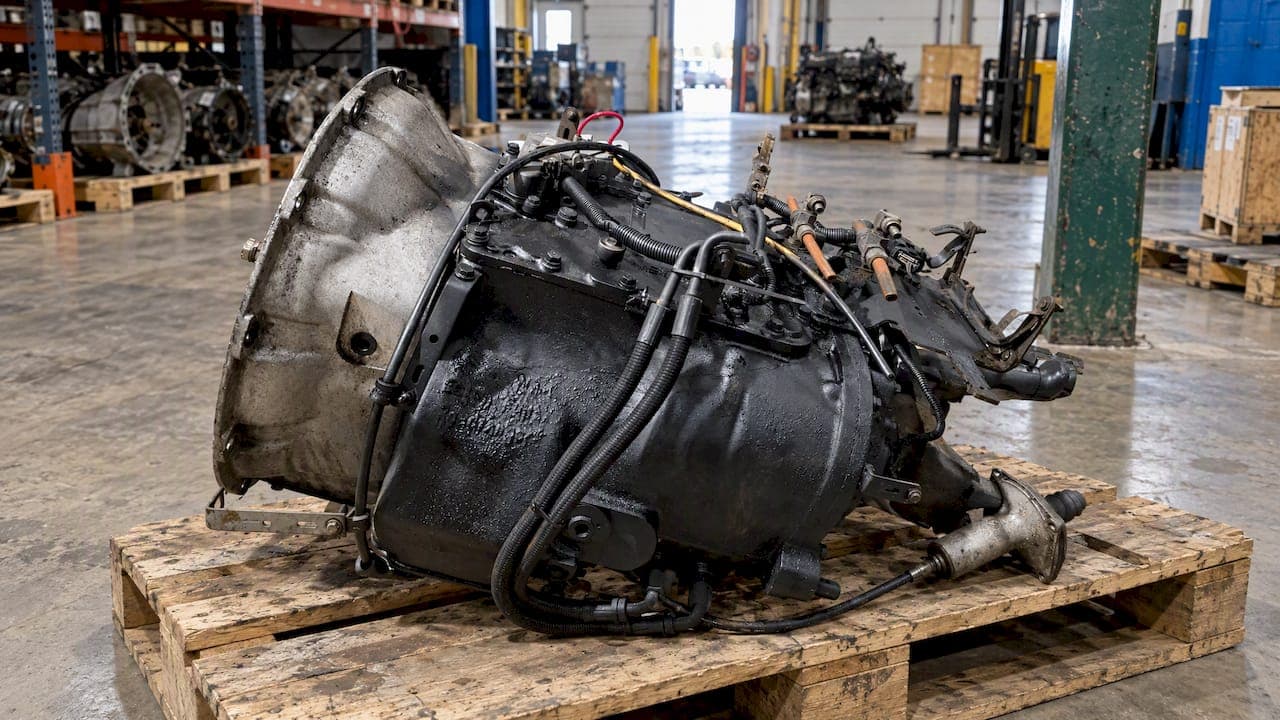
A used heavy-duty truck transmission has no single price. The unit depends on model, gear count, mileage, and whether it is manual or automated. The price on the listing is also only part of the bill. Freight, a core charge, fluids, and shop labor all land on top. This guide walks through each piece so you can build a real number before you order, and decide whether used, rebuilt, or something else fits your truck.
We sell tested, warrantied used heavy-duty parts, so we see these budgets from the buyer's side every day. Where we can't back a figure with a published source, we say so rather than guess.
TL;DR
- Used transmission prices vary widely by model and condition. Across all vehicle types, one 2026 price guide puts used units at $300 to $4,629, and that excludes shipping, core charges, and installation.
- Budget freight separately: shipping a transmission can run $200 to $1,000 depending on weight, distance, and LTL or full truckload.
- A core return can earn credit, but deductions for damage, missing tags, or the wrong carrier can eat into it.
- Rebuilding or replacing a heavy-duty transmission at a shop is often quoted at $8,000 to $15,000, which is why a tested used unit with a warranty is a common choice.
- Confirm fit from the transmission tag before you pay, not from the truck's year and make alone.
Table of Contents
- What a used heavy-duty transmission costs
- The costs on top of the unit price
- Used versus rebuilt: how the costs compare
- Is it cheaper to replace the engine or the transmission?
- Signs your transmission needs repair or replacement
- How to check that a used transmission fits and is tested
- Our perspective: where used makes sense
- Find a tested transmission for your truck
- How to keep the total down
- FAQ
- Sources
What a used heavy-duty transmission costs
Start with the honest limits. Published price guides mix passenger cars, pickups, and trucks, so their averages are a rough background rather than a quote for a Class 8 gearbox. The 2026 guide above shows a spread from a few hundred dollars to over four thousand, and it says plainly that shipping, core charges, and installation are not in those numbers.
For a heavy-duty unit, the practical way to think about it is in tiers:
| Tier | What it is | What drives the price |
|---|---|---|
| Basic manual, older | Fuller-style 9, 10, or 13 speed with higher miles | Model, gear ratios, condition of the case and shafts |
| Late-model manual | Newer 10 or 18 speed, lower miles | Mileage, PTO provision, overdrive |
| Automated manual | Eaton, Detroit DT-12 and similar | Electronics, software compatibility, clutch condition |
| Rebuilt or remanufactured | Taken apart, inspected, worn parts replaced | Labor and parts content, plus the warranty |
We don't publish a flat price for a used transmission on our category pages, because the unit you need is specific to your truck and changes with daily inventory. The most reliable way to get a number is to give us your transmission model and serial and see what is in stock. You can browse the current used transmissions for sale at any time.
The factors that move the price
Model and gear count. A 10 speed manual and an automated unit with electronics are different products. The Fuller line alone covers many ratios, and the wrong ratio for your rear axle is a costly mistake.
Mileage and service history. Lower miles and a known history cost more. A unit from a wrecked truck can be cheaper than one pulled from a running one, but with less certainty about what is inside.
Testing and warranty. A part that has been inspected and tested, and that carries a warranty, costs more than an untested one pulled from a yard. That premium buys you protection against paying for the job twice.
Configuration. PTO provisions, overdrive, input shaft style, and output yoke type all affect compatibility and price. You can see the difference in listings like the Eaton/Fuller FRO14210C 10 speed with overdrive and PTO, the 2014 Eaton-Fuller FRO-14210B, or the Detroit DT-12 DT-12DA.

The costs on top of the unit price
This is where budgets go wrong. A transmission that looks cheap can cost much more once it is on your shop floor.
Freight
A heavy-duty transmission weighs several hundred pounds and ships on a pallet. Freight for a transmission can range from $200 to $1,000, depending on weight, size, distance, and whether it moves as LTL or full truckload. Ask whether the quote is delivered to a commercial address with a dock or liftgate, because residential delivery and liftgate service add charges at many carriers.
We ship nationwide, with same-day shipping on in-stock parts, so the time between your order and a truck moving is short. Freight is still a real line in the budget, and it is worth pricing before you compare two sellers.
Core charge and core return
Many sellers, and manufacturer exchange programs, tie the price to an old unit you send back. Eaton's U.S. unit-exchange guide is a good picture of how strict this can be. It says a core credit requires one eligible core for each transmission purchased, the core must match the applicable core group, and you receive the core value less deductions. Its examples of deductions include $500 for one or two cracked or welded housings, $250 for a missing serial tag, $150 for failure to drain the unit, and $200 for use of an unapproved freight carrier.
That is Eaton's program, not a rule for every seller. The lesson carries over: keep the serial tag on, drain the old unit, don't weld a cracked housing, and ask the seller who pays for return freight before you agree.

Installation labor
Labor depends on the shop and the truck. One U.S. guide estimates 8 to 18 hours for a rebuild and 12 to 20 hours for a replacement, with commonly reported rates of $75 to $150 per hour. Treat these as broad estimates, not a heavy-duty tariff. Dealer and truck stop shop rates often differ, so get a written estimate for your specific truck.
A quick example of the arithmetic, using that guide's ranges: a 12 to 20 hour swap at $75 to $150 per hour works out to roughly $900 at the low end and $3,000 at the high end, before parts. If you can swap it in your own shop, you keep that money.
Fluids, clutch, and the small items
New gear oil, a clutch if the old one is worn, a fresh pilot bearing, and gaskets are routine on a swap. Putting a worn clutch in front of a good transmission is a common way to lose the benefit of the swap. Price these with the job, not after it.
Downtime
For a working truck, downtime often outweighs the part price. Eaton's own service manual stresses that the cost of new parts is a small fraction of the total cost of downtime and labor, which is why proper inspection matters. A cheaper unit that takes a week to arrive can cost more than a pricier one that ships today.
Used versus rebuilt: how the costs compare
Shop-based rebuilds or replacements of heavy-duty transmissions are commonly quoted at $8,000 to $15,000, depending on the severity of the failure and the labor. That range covers the repair job, not just the part.
A rebuilt (remanufactured) unit is taken apart, inspected, rebuilt to spec with wear parts and seals replaced, and typically tested before it ships. It usually costs more than a used unit but carries less risk. A used unit costs less up front and leans on the quality of the testing and the warranty behind it.
Here is how we'd frame the decision:
| Situation | Usually better fit |
|---|---|
| Older truck, tight budget, you need it running | Tested used unit with warranty |
| Newer truck still within OEM coverage | Follow the manufacturer's route; Eaton Cummins says components with over 100,000 miles that fail within coverage are typically replaced with remanufactured units |
| High-mileage truck you plan to run for years | Compare a used unit against a remanufactured unit on total cost |
| Fleet with many identical trucks | Standardize on one proven model and keep a spare |
Neither choice is objectively better. It comes down to how long you will keep the truck, how much risk you can absorb, and what the truck earns while it sits.
If you are weighing the transmission against an engine problem at the same time, the same logic applies. Our guides on truck engine swap cost factors and why engine replacement beats buying a full truck walk through the numbers.
Is it cheaper to replace the engine or the transmission?
On raw part price, a transmission is usually the smaller purchase. A heavy-duty diesel engine is a bigger unit with more labor around it. But the better question is which component has actually failed. Replacing a healthy component doesn't help, and a worn engine paired with a fresh transmission can leave you with two jobs instead of one.
Before you decide, confirm the diagnosis in a shop. Many shifting complaints trace back to clutch, linkage, air supply, or electronics rather than the gearbox itself. If the truck is otherwise sound and the transmission is the confirmed fault, a tested used replacement is often the lowest-cost route back onto the road. If both are tired and the truck has life left, see how truck engine replacement works before committing.
Signs your transmission needs repair or replacement
Common warning signs are delayed or erratic shifting, grinding or growling noises, fluid leaks, and jerking when a gear engages. Failures in heavy trucks often trace back to neglected fluid changes, heavy loads, overheating, and aggressive driving, and ignoring early signs like rough shifting can turn a small repair into severe internal damage.
What to do when you notice them:
- Check fluid level and condition first. Burnt smell or metal in the fluid points to internal wear.
- Look for leaks at the output seal, the rear housing, and the cooler lines.
- Have a shop road-test the truck and read any fault codes if it is an automated unit.
- Get a written diagnosis before you buy a replacement.
Catching it early often means a rebuild or a single swap, not a tow and an emergency order.
How to check that a used transmission fits and is tested
Fit is the most common reason a swap goes wrong, and it is avoidable.
- Read the tag. The model and serial number on your current transmission are the starting point, not the truck's year and make. Our guide to Eaton transmission identification shows where the tag sits and how to read the model and serial.
- Match the specifics. Compare the gear count, ratios, input and output shaft, PTO provision, engine, and drive type with the replacement.
- Ask what testing was done. Some used units are sold with nothing beyond the fact that the donor truck ran. Ask what inspection and testing the seller performs, and get it in writing.
- Read the warranty. Look at what it covers, whether labor is included, how long it lasts, and what the core or return requirements are.
- Confirm the return path. Know who pays for freight if the part isn't right.
Manufacturer protection plans show how conditional warranty terms can be. Eaton says its Roadranger extended protection plans can cover parts and labor for warrantable failures in the U.S. and Canada, subject to eligibility, fluid, time, mileage, and other conditions. Read any warranty with the same care, including ours.
Our perspective: where used makes sense
We talk to owner-operators, fleet managers, and shop mechanics who all ask the same thing: what is the cheapest way to get this truck earning again without paying for it twice? Our answer is rarely the lowest sticker price.
Here is what we believe, based on how we run our business:
- A tested part with a warranty beats a cheap unknown. Every part we sell is inspected and tested before sale and comes with a standard warranty. That is the reason to buy from us over pulling a unit from a random yard.
- Used saves real money when the truck is worth keeping. Heavy trucks hold their value and run for years, so putting a good used component in an otherwise sound truck is usually smarter than retiring it. We cover the thinking in why independent truckers choose used parts.
- Speed has a dollar value. Our inventory changes daily and we ship the same day, because an idle truck costs more each day than most buyers expect.
- Total cost is the number that matters. Add the unit, freight, core handling, labor, and fluids. Then compare.
If you have the model and serial in hand, send them to us before you shop elsewhere and we will tell you what we have.
— John
Find a tested transmission for your truck
We stock used heavy-duty transmissions, along with engines, differentials, and exhausts, for major brands, all tested and inspected, with a standard warranty and same-day shipping. Start with our transmissions page, and keep your model and serial number handy so we can confirm fit.

How to keep the total down
- Get delivered pricing. Compare the unit plus freight, not the unit alone.
- Protect your core. Keep the tag, drain the fluid, avoid welding, and use the carrier the seller specifies.
- Replace wear items together. Do the clutch and seals during the swap.
- Use your own shop if you can. Labor is often the biggest variable after the part.
- Plan ahead. An unplanned breakdown limits your choices. Our guide to saving on heavy truck engine costs applies the same planning to engines, and much of it carries over.
FAQ
How much does a used semi truck transmission cost?
It depends on the model, gear count, mileage, and whether it is manual or automated. One 2026 price guide covering used transmissions across vehicle types shows a range of $300 to $4,629, excluding shipping, core charges, and installation. For a specific heavy-duty unit, the surest answer is a quote based on your transmission's model and serial number.
Is it cheaper to buy a used transmission or rebuild mine?
A used unit usually costs less up front, while a rebuild gives you a known build but adds labor and downtime. Shop rebuilds and replacements on heavy-duty trucks are commonly quoted at $8,000 to $15,000. Compare the full job, including freight and labor, for both routes.
How long does it take to rebuild a truck transmission?
One U.S. guide estimates 8 to 18 labor hours for a rebuild, depending on access and whether other components need service. A swap with a replacement unit is estimated at 12 to 20 hours in the same guide. Your shop's schedule and parts availability add to the calendar time.
What extra costs come with a used transmission?
Expect freight, possible core charges or deductions, fluids, a clutch if the old one is worn, and shop labor. Freight alone can run $200 to $1,000. Ask for a delivered price and the core terms in writing.
How do I know a used transmission will fit?
Match the model and serial number from your transmission tag, then compare gear count, ratios, shafts, PTO provision, engine, and drive type. Don't rely on the truck's year and make alone. If you are unsure, send us the tag details and we will check them against what is in stock.
Sources
- Eaton unit exchange program guide
- Eaton Roadranger extended protection plan for replacement transmissions
- Eaton Cummins Automated Transmission Technologies warranty guide
- Eaton Fuller transmission service manual
- How Much Does It Cost to Ship a Transmission?
- Used Transmission Prices (2026 data)
- Truck Transmission Repair Cost: Price Guide for U.S. Buyers
- Most Common Semi Truck Breakdowns