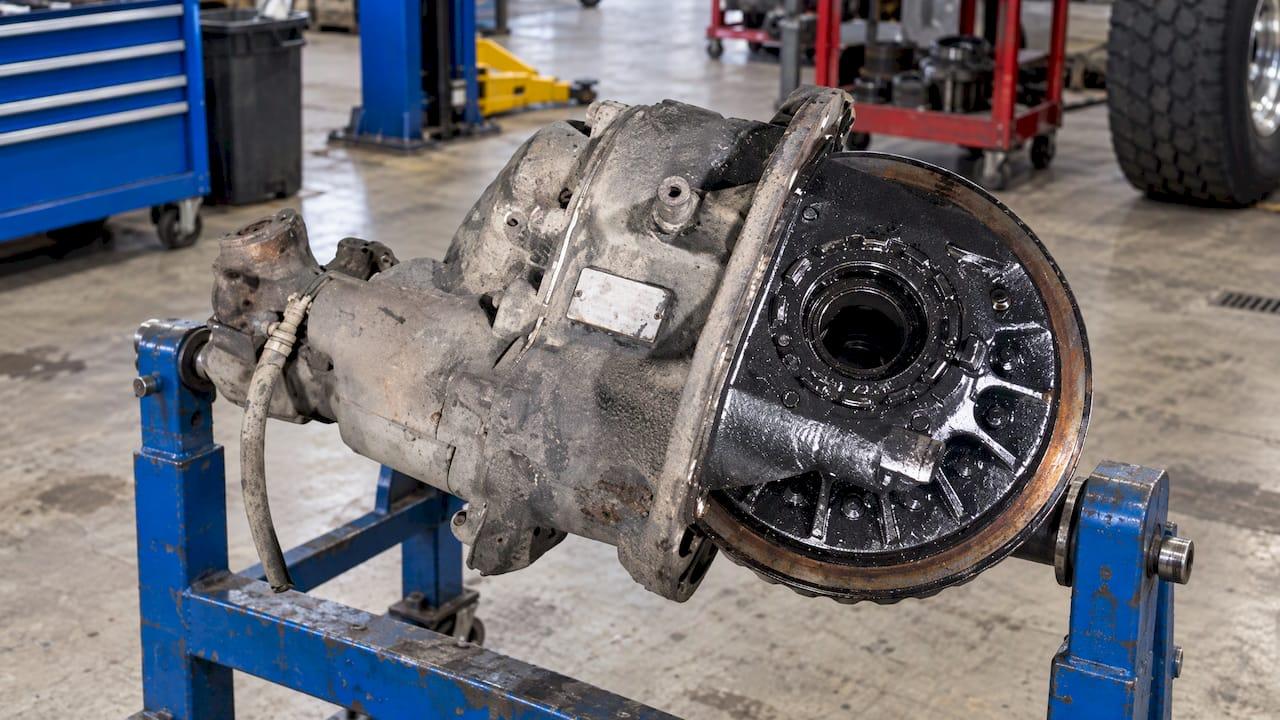
A limited-slip differential sends extra torque to the wheel with grip while still letting the wheels turn at different speeds. A locker ties both axle shafts together so they turn at the same speed. For a working truck, that one difference decides how it handles ice, mud, a muddy lot, a loaded grade and a tight turn. On a tandem-drive semi there is a third piece, the power divider, and mixing it up with the other two is how drivelines get damaged. When you are matching a replacement unit, our tested used differentials ship nationwide, so you can settle the spec first and then get the right axle parts moving.
TL;DR
- Limited slip ("posi"): works automatically, behaves like an open differential in normal driving, and shifts torque toward the wheel with more traction. It cannot give 100% lockup.
- Locker: mechanically joins the two axle shafts, so both wheels pull even if one is in the air or on ice. Some lock automatically, some are driver-controlled.
- Power divider: a different job. It splits power between the two drive axles on a tandem, and its driver-controlled lock is not a wheel-to-wheel locker.
- Lock rules: engage a driver-controlled lock only when traction is lost, at low speed, and never while cornering on firm pavement.
- Replacing a unit: match the ratio, carrier and tag data before you order. Our differentials are tested, inspected and carry a standard warranty.
Table of Contents
- Start with the open differential
- How a limited-slip differential works
- How a locker works
- Limited slip vs. locker at a glance
- Where the power divider fits on a tandem
- Using a lock without breaking something
- Choosing for your operation
- Replacing a differential: what to bring to the order
- Get the right unit and keep the truck moving
- Our perspective
- FAQ
- Sources
Start with the open differential
You cannot judge either option without knowing what they fix. Every drive axle needs a differential because the outer wheel travels farther than the inner wheel in a turn, so the two wheels must be free to turn at different speeds.
The plain open differential does that well, but it has a flaw. According to Eaton's differential guide, an open unit sends engine torque to the wheel with the least resistance. A wheel on ice or off the ground spins freely and the truck goes nowhere, while the wheel with grip gets almost nothing. Eaton also notes that on asphalt, heavy acceleration produces the familiar one-wheel peel.
Limited slips and lockers are two answers to the same problem. They differ in how hard they push back against the spinning wheel.
How a limited-slip differential works
A limited slip is built to act like an open differential most of the time. When one wheel starts to slip, it shifts a share of torque to the wheel that has traction. Eaton describes the main designs this way:
- Clutch-pack style (the classic "posi"): preloaded clutch discs behind each side gear resist slip before it builds.
- Helical-gear style: it runs like an open differential until the gears mesh with increasing force and move torque across.
The key number is the torque bias ratio, which describes how much more torque the high-traction wheel can receive than the slipping one can hold. Torsen explains that with a 4:1 ratio, the unit will not differentiate until the low-traction tire has less than a quarter of the other tire's traction. Eaton's helical Truetrac can send up to 3.5 times more torque to the high-traction wheel.
What a worked example looks like
Say the slipping wheel on a wet shoulder can only hold 200 lb-ft. With a 3:1 bias, the gripping wheel could receive up to 600 lb-ft. That is a real improvement over an open unit, where the grip wheel would see only about 200. But if the slipping wheel has no traction at all, a multiple of zero is still zero. Eaton states the limitation plainly: a limited slip cannot provide 100% lockup, so with complete loss of traction at one wheel there may not be enough torque to move the vehicle.

Where limited slips fit in trucks
Because they stay smooth in turns and need no driver input, limited slips suit work that is mostly on pavement with occasional slick spots. Eaton lists emergency vehicles, delivery trucks, landscape trucks and motor homes for the Truetrac. Its heavy-duty Suretrac is aimed at on/off-highway trucks, loaders and articulated trucks, and Eaton says it also reduces shock loads on drivetrain components.
Clutch-type units want the right fluid. HOT ROD's technical staff explain that most clutch or cone designs use friction modifiers in the lubricant to cut chatter in turns, so follow the axle maker's fluid spec when you service one.

How a locker works
A locker removes the compromise. Torsen's engineers note that lockers have an essentially infinite bias ratio and can send 100% of torque to either tire, because they use a direct mechanical block (a spline, dog clutch or ratchet) instead of friction. The cost is maneuverability: two wheels forced to the same speed fight each other in a tight turn on firm ground.
There are three families you will meet:
- Manual or driver-controlled lockers. You flip a switch and air or a cable engages the lock. On heavy trucks the in-cab switch for the main differential lock is standard hardware, as Meritor's service bulletin on the driver-controlled differential lock shows.
- Automatic lockers that stay locked. Eaton's guide describes the Detroit Locker as normally locked, unlocking automatically during turns.
- Automatic lockers that stay open. The Eaton MLocker is normally open and locks automatically when it senses a loss of traction below 20 mph.
HOT ROD adds that positive lockers suit straight-line traction and off-road work, with Detroit-style units using spring-loaded dog teeth that ratchet out when one wheel turns faster.
Limited slip vs. locker at a glance
| Open | Limited slip | Locker | |
|---|---|---|---|
| Normal turning | Smooth | Smooth, may chatter if fluid is wrong | Smooth if automatic or unlocked; fights you if locked on pavement |
| One wheel on ice | Spins, truck stalls | Some torque to grip wheel | Both wheels pull |
| Total loss of grip at one wheel | No drive | Possibly not enough drive | Full drive |
| Driver action | None | None | None or a switch |
| Best for | Highway, dry pavement | Mixed on-road work, wet and light snow | Mud, ice, off-road, dump and vocational work |
The decision is rarely about which is better. It is about where the truck lives. If it runs mostly linehaul on pavement and sees an occasional slick yard, a limited slip or an open unit with good tires covers it. If the truck lives in logging roads, job sites or unplowed lots, a driver-controlled lock earns its place.
Where the power divider fits on a tandem
The search results around this topic often skip the part that matters most on a semi. On a tandem (two drive axles), the power divider, also called the inter-axle differential, sits at the input of the forward-rear axle. Its job is not to split power between the left and right wheels. It splits power between the two axles, letting them turn at slightly different speeds to absorb differences in tire diameter and wear, which prevents driveline windup.
It has its own driver-controlled lock. When engaged, the two axles are forced to turn together. That is the same idea as a locker, but one level up the driveline: it keeps the second axle pulling if the first loses traction.
So a typical tandem has up to three differentials working:
- the power divider between the axles,
- a main differential in each axle, which may be open, limited slip or lockable,
- and optionally a driver-controlled lock on the power divider, the axle differentials, or both.
When someone asks about "power divider vs. differential," the short answer is that the divider balances axle against axle and the differential balances wheel against wheel.
Using a lock without breaking something
The rules are consistent across makers, and they are safety points, not suggestions.
- Engage at low speed, when traction is lost. One inter-axle lock FAQ says to stay below 25 mph with the lock engaged and notes that driving regular roads with it on is not advisable.
- Do not lock up while cornering on firm ground. Locked wheels cannot differentiate, so the driveline winds up, loading axle shafts and wheel studs and making steering heavy.
- Do not engage during high-speed wheel spin. Ease off the throttle, let the spinning wheels slow, then engage.
- Unlock as soon as you have traction again. Leaving a lock on when you reach dry pavement is the most common way these parts get abused.
- Check the air supply and indicator. The lock is air-operated on most heavy trucks, so low system pressure or a failed switch can leave it stuck either way.
If a lock will not release, or you hear banging in turns, have a diesel mechanic inspect the axle before the truck goes back on the highway.
Choosing for your operation
Use these questions in order:
- Where does the truck work? Pavement-only favors open or limited slip. Mud, ice and off-road favor a lock.
- Who drives it? A fleet with many drivers is safer with automatic or limited-slip units than with a lock that depends on correct switch use. An owner-operator who knows the truck can use a manual lock well.
- What does the rest of the drivetrain expect? Ratio, carrier family and axle model all have to match. Our guide to reading a Meritor differential tag shows how to identify what you already have, and the gear ratio chart shows what each ratio means for RPM at 65 mph.
- What is the replacement path? If the differential has failed, a tested used unit often gets a truck back to work sooner than a long wait for something new. For the ratio side of that decision, see how downspeeding takes more than a 3.42 axle.
A lock or limited slip also changes how the whole driveline is loaded, so it helps to understand the role of drive shafts in heavy trucks and how torque travels from the engine. Our explainer on diesel engine torque covers the front half of that path.
Replacing a differential: what to bring to the order
Have this ready before you call or check out:
- The axle make and model from the tag
- The gear ratio (for example, 3.08 or 3.36)
- Whether it is a front-rear or rear-rear unit on a tandem
- Whether the unit has a driver-controlled lock or a limited slip
- The truck's year, engine and transmission, since ratios must stay compatible with them (see our transmission interchange guide)
Examples of what a listing looks like: a 2015 Eaton-Spicer DSP40 336 ratio front-rear differential or a Detroit Alliance RT40-4N 3.08 ratio front-rear assembly. Each is identified by model and ratio, which is exactly the data you should have in hand.
Get the right unit and keep the truck moving
Once you know whether your axle needs a limited slip, a lockable unit or a straightforward open differential, the next step is finding one in stock. We sell used heavy-duty differentials alongside engines, transmissions and exhausts. Every part is tested and inspected before sale, comes with a standard warranty, and ships same day. Inventory changes daily, so browse our differentials page for what is available now.

Our stock covers major brands including Cummins, Detroit, Volvo, International, Mack and Paccar, with complete and component parts, so a downed truck does not have to wait on a long search.
Our perspective
Most of the differentials that cross our desk are not failing because of the design. They are failing because of how they were used or because of a mismatch: a lock left engaged on dry pavement, the wrong fluid in a clutch-type unit, or a ratio that does not agree with the rest of the driveline.
That is why we push buyers to identify the unit first. Tag, model, ratio, front-rear or rear-rear. Once that is settled, a used differential that has been tested and inspected is a sound, cost-effective way to put a truck back to work, and the standard warranty backs it up.
For urgent jobs, same-day shipping and a daily-changing inventory mean you can often find the exact spec instead of settling for a near match. Match the part to the job, and you can keep a driveline healthy for a long time.
John
FAQ
What is the difference between a locker and a posi?
"Posi" is the common name for a clutch-type limited slip. It shifts a portion of torque to the wheel with more grip but still lets the wheels turn at different speeds, and it cannot fully lock. A locker mechanically joins both axle shafts, so both wheels receive torque even when one has no traction.
What are the advantages of a limited-slip differential?
It works without driver input, drives like an open differential in everyday turning, and sends more torque to the wheel with traction on slick surfaces. Eaton also says its heavy-duty Suretrac helps reduce one-wheel spin-outs and limits shock loads on drivetrain parts. That makes it a good fit for trucks that cross mixed surfaces.
How fast can I drive with a diff lock on?
Keep it slow. One inter-axle lock guide says to stay under 25 mph with the lock engaged, and manufacturers specify that you should not use it on regular roads or in corners on firm ground. Follow your axle maker's operator instructions for the exact limit on your truck.
Is a power divider the same as a locking differential?
No. A power divider splits power between the two drive axles of a tandem, while an axle differential splits it between the two wheels of one axle. The power divider's driver-controlled lock forces both axles to turn together, which is similar in effect to a locker but applied between axles.
Limited slip vs. open diff: which is better for a work truck?
An open differential is simple and fine on dry pavement, but it sends torque to the wheel with the least resistance. A limited slip keeps more torque on the wheel with grip, which helps on wet roads, snow, towing and loaded starts.
Sources
- Eaton: 5 Things You Need to Know Before Buying an Aftermarket Differential
- Eaton: What is a limited slip differential?
- Eaton: Truetrac differential brochure
- Eaton: Suretrac heavy duty limited slip differential
- Torsen: Torque bias ratio questions
- HOT ROD: Differential Differences
- Meritor TP-1162: Driver-Controlled Differential Lock
- Inter-Axle Differential Lock Operation FAQ