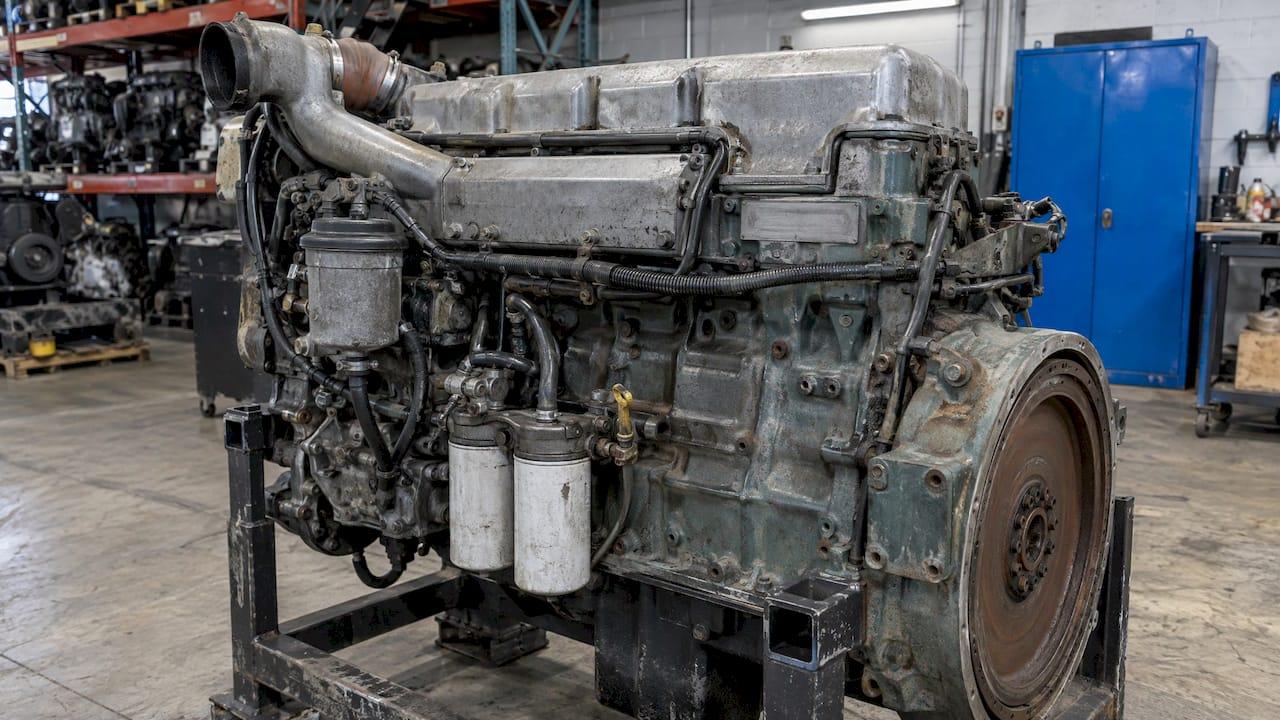
To identify a Detroit Diesel Series 60, find the laser-etched serial and model numbers on the left side of the cylinder block, then decode the model designation (for example 6067-WK60) for displacement, engine control generation and application. The serial number tells you which engine you have. The model designation tells you how it was built. You need both before you order a part, a rebuild kit or a replacement engine.
This guide walks through where the numbers live, what each character means, why the electronic control generation alone can mislead you, and what to do when the stamp is missing or unreadable.
TL;DR
- The permanent serial and model numbers are laser-etched on the left side of the block, below the intake manifold and above the cast Detroit Diesel logo, as seen from the flywheel end.
- The option plate on the left side of the valve cover lists the serial number, model number and optional equipment. The plate can be swapped or lost, so the block etching is the one to trust.
- A designation such as 6067-WK60 spells out series, cylinders, application, displacement, control type and customer designation.
- DDEC generation (T, U, K) identifies the electronics, not the internal parts. Confirm the full model and serial number before buying pistons, rods or a complete engine.
- If the stamp is damaged, work from the VIN, the emissions label records and the manufacturer's label-replacement process rather than guessing.
Table of Contents
- What the Series 60 is, in one minute
- Where to find the Series 60 serial number
- How to read a Series 60 serial number
- Decoding the model designation
- Why DDEC generation is not enough
- What to confirm before buying a replacement engine or part
- When the stamp is damaged, missing or unreadable
- Common identification mistakes
- Our perspective
- Need a Series 60 or another Detroit engine?
- FAQ
- Sources
What the Series 60 is, in one minute
The Series 60 is an inline six-cylinder, four-stroke diesel with wet replaceable liners, an overhead camshaft and electronic engine control. It came in 11.1-, 12.7- and 14.0-liter versions. It was also the first fully electronically controlled heavy-duty diesel from Detroit, and it was in US production by March 1987.

That long production run is why identification matters. Two Series 60 engines can look almost identical from the driver's side and still use different pistons, injectors, ECMs and EGR hardware. Ordering by "it's a Series 60" is how mismatched parts end up on the bench.
Where to find the Series 60 serial number
Check these locations in this order.
1. The block, left side
Per Detroit's own operator's manual, the permanent model and serial numbers are laser-etched on the left side of the cylinder block. Stand at the flywheel end and look just below the intake manifold and above the cast Detroit Diesel logo. A certification label may also be attached to the valve rocker cover.
This etching is the permanent record. It stays with the block through valve cover swaps, accessory changes and rebuilds.
2. The option plate on the valve cover
The option plate sits on the left side of the valve cover and carries the engine serial number, model number and a list of optional equipment. It is the fastest place to check on a running truck. Treat it as a cross-check, though. Valve covers get replaced, and a plate that came off a different engine tells you nothing about the one in front of you.
3. Emissions and certification labels
Later engines carry an emissions label with engine family information. These labels are assigned to a specific engine. Detroit's service bulletin on emission label replacement warns that a label must not be used on an engine other than the one it was issued for. If you buy a used engine, make sure the label, the plate and the block etching all agree.
Tips when you can't see it
- Degrease the left side of the block and use a bright light at a low angle. Etched numbers can disappear under road grime.
- Look from the flywheel end, not from the front of the engine. Reading from the wrong side is the most common reason people can't find the number.
- Photograph the number before you start any parts search so you can read it back character by character.
For other engine families, our guide to engine serial number location on Cummins, Cat and Detroit shows where each manufacturer puts its tag.
How to read a Series 60 serial number
Series 60 serial numbers begin with the digits 06 followed by the letter R and a run of digits, for example 06R followed by the sequence number. The prefix marks the engine family and cylinder count. The digits that follow are the sequence number.
The common mistake is trying to convert the sequence into a model year with a single formula. There isn't one. Parts references often quote ranges. For instance, one parts reference covers its 12.7-liter premium-engine range as roughly serial numbers 6R411,649 through 6R740,000, produced from 1998 through 2003, according to IPD's technical material. That is a reference range for one engine group, not a rule for every Series 60.
So use the serial number as the engine's unique ID, and use the model designation to learn how it is configured. If you need the build date, the manufacturer's records for that serial number are the reliable source.
A serial number is not the same thing as a truck VIN. If you are working backward from the truck, this explainer on what a vehicle identification number is covers how VINs are structured. Then use our walkthrough on how to find a heavy-duty engine by VIN and check the VECI label to get from the truck to the engine.
Decoding the model designation
The model designation is where the configuration lives. Take 6067-WK60:
| Character | Meaning in 6067-WK60 |
|---|---|
| 6 | Series 60 |
| 06 | Six cylinders |
| 7 | Vehicle application |
| W | 11.1 liters |
| K | DDEC III or IV electronic control |
| 60 | Customer designation: 1991-and-later on-highway truck |
This breakdown follows Detroit's Series 60 model identification chart. The engine-control letter varies: T means DDEC I, U means DDEC II, and K means DDEC III or IV.
A second example from the same family of references: 6067PK28 is a Series 60, six-cylinder, automotive, 12.7-liter premium, DDEC III/IV engine intended for a 1991-and-later coach. The pattern is the same, only the displacement letter and the final customer code change.
Quick displacement check
| Displacement | Typical use |
|---|---|
| 11.1 L | Lighter on-highway and vocational applications |
| 12.7 L | The mainstream highway tractor and coach engine |
| 14.0 L | Heavy-haul and higher-output highway work |
The displacement letter in the model code should match what you expect from the truck's spec sheet. If the letter says 11.1 liters and the truck was sold as a 14.0, someone has swapped the engine, and you need to know that before ordering anything.
Why DDEC generation is not enough
It is tempting to shop by control generation: "I need a DDEC IV engine." That narrows the field, but it does not finish the job. IPD's technical bulletin makes the point that DDEC identifies the engine-control type, not the piston design, and that later mechanical design changes do not line up one-to-one with control generations.
A concrete example: DDEC III and early DDEC IV engines used steel-crown articulated pistons with rifle-drilled trunk-style connecting rods. Later DDEC IV and newer engines moved to one-piece steel pistons released in 2003. Two engines both labeled DDEC IV can therefore need different internal parts. The full model number plus serial number settles it.
This is the same logic behind any good compatibility check. Our guide on confirming engine compatibility for heavy trucks lays out the full list of things to match.

What to confirm before buying a replacement engine or part
Use this checklist and write down each answer.
- Full serial number from the block etching (and whether it matches the valve cover plate).
- Full model designation, character by character.
- Displacement (11.1, 12.7 or 14.0 liters) and whether it matches the truck.
- Control generation: DDEC I, II, III or IV, plus the ECM part number if you are buying electronics.
- Application: highway truck, coach or other, since customer designations differ.
- Emissions and EGR configuration, because catalogs list turbochargers, EGR systems, electronic injector controls and cylinder kits by option type. The Detroit parts catalog structure reflects how many separate options exist inside one engine family.
- Mounting and accessories: flywheel housing, accessory drive and exhaust arrangement, which you can compare against the engine you are removing.
If the engine is going into a different truck than the one it came from, also check the engine-to-transmission and wiring interface. Our guide to finding compatible used diesel engines covers swaps in detail.
When the stamp is damaged, missing or unreadable
Sometimes the block has been painted, pitted or machined, and the plate is gone. Here is a sensible order of operations.
- Clean and re-inspect. Most "missing" numbers are hidden under grease. Check the flywheel-end view of the left block again.
- Check every label. Look at the valve cover plate, the certification label and any VECI label in the cab or on the engine.
- Work from the truck. The chassis VIN can lead you to the original engine specification.
- Go to the manufacturer. Detroit's service bulletin describes a process for requesting replacement emission labels or engine-family information using the engine's serial-number records. It is the route for a legitimate label, and it also reminds you that a label belongs to one engine only.
- Don't fabricate or transfer numbers. A number that doesn't belong to the engine causes registration, emissions and warranty trouble later.
A mechanic who can't confirm the serial number should treat the model as unknown and match the engine by physical measurements and component inspection before ordering.
Common identification mistakes
- Reading the plate and nothing else. The valve cover is a removable part.
- Treating the serial number as a year code. There is no universal serial-to-year formula.
- Ordering by DDEC generation alone. Piston and rod design changed on a different timeline.
- Mixing up displacement and horsepower. Horsepower ratings vary within a displacement. Our piece on diesel engine horsepower ratings explains how.
- Skipping the label match on a used engine. Block, plate and label should all tell the same story.
Our perspective
We handle used diesel engines every day, and the single most expensive mistake we see is not a bad engine. It is a good engine that does not match the truck it was ordered for.
With the Series 60 that risk is real, because the engine ran for so many years across three displacements and several generations of electronics. Our advice is simple: write down the block etching, the full model designation and the ECM details before you call anyone, and give all three to whoever is quoting you.
That is also why we put so much weight on testing and inspection. Each engine we sell is tested and inspected, and it comes with our standard warranty. Our inventory changes daily, so the match you need can show up on any given morning, and we ship the same day so a down truck is not waiting on freight longer than it has to.
For fleets and owner-operators, a verified, tested used engine is a practical way to get a truck back to work at a fair price. Get the identification right and the rest of the job gets much easier.
John
Need a Series 60 or another Detroit engine?
If you have your serial number and model designation in hand, you are ready to look for a match. Browse our tested, warrantied truck engines for sale, or see the full range of used heavy-duty parts on the Nationwide Truck Parts home page. We also stock transmissions and differentials for the same trucks.

Send us the serial number and model designation with your inquiry and we can compare them against what is in stock today.
FAQ
Where is the serial number on a Detroit Series 60?
It is laser-etched on the left side of the cylinder block, below the intake manifold and above the cast Detroit Diesel logo, viewed from the flywheel end. A secondary option plate sits on the left side of the valve cover. If the block is dirty, clean it before you decide the number is missing.
Can I tell the model year from a Series 60 serial number?
Not with a single formula. Parts references quote serial ranges for specific engine groups, such as 6R411,649 through 6R740,000 for 1998 through 2003 12.7-liter premium engines, but those are not universal. For an exact build date, use the manufacturer's records for your serial number.
What does 6067-WK60 mean?
The 6 is Series 60, the 06 is six cylinders, the 7 is vehicle application, the W is 11.1 liters, the K is DDEC III or IV, and the 60 is the customer designation for 1991-and-later on-highway trucks. Reading the full code this way avoids ordering parts for the wrong configuration.
Is DDEC generation enough to choose pistons or rods?
No. DDEC describes the electronic control, while piston and connecting rod design changed on its own schedule. One-piece steel pistons arrived in 2003, so two DDEC IV engines can need different internal parts. Confirm the full model and serial number.
What if the serial number tag is gone?
Check the block etching, the valve cover plate and any emissions label, then work from the truck's VIN. Detroit has a process for replacement emission labels and engine-family information based on serial-number records. Never transfer a label from another engine.
Sources
- Detroit Diesel Series 60 Operator's Manual (DDC-SVC-MAN-0006)
- Emission Label Replacement and Engine Family Requests
- ODA launches Series 60, Commercial Motor, 14 March 1987
- IPD technical bulletin on Detroit Series 60 information
- IPD Series 60 engine parts guide
- Detroit Diesel Series 60 parts catalog group nomenclature