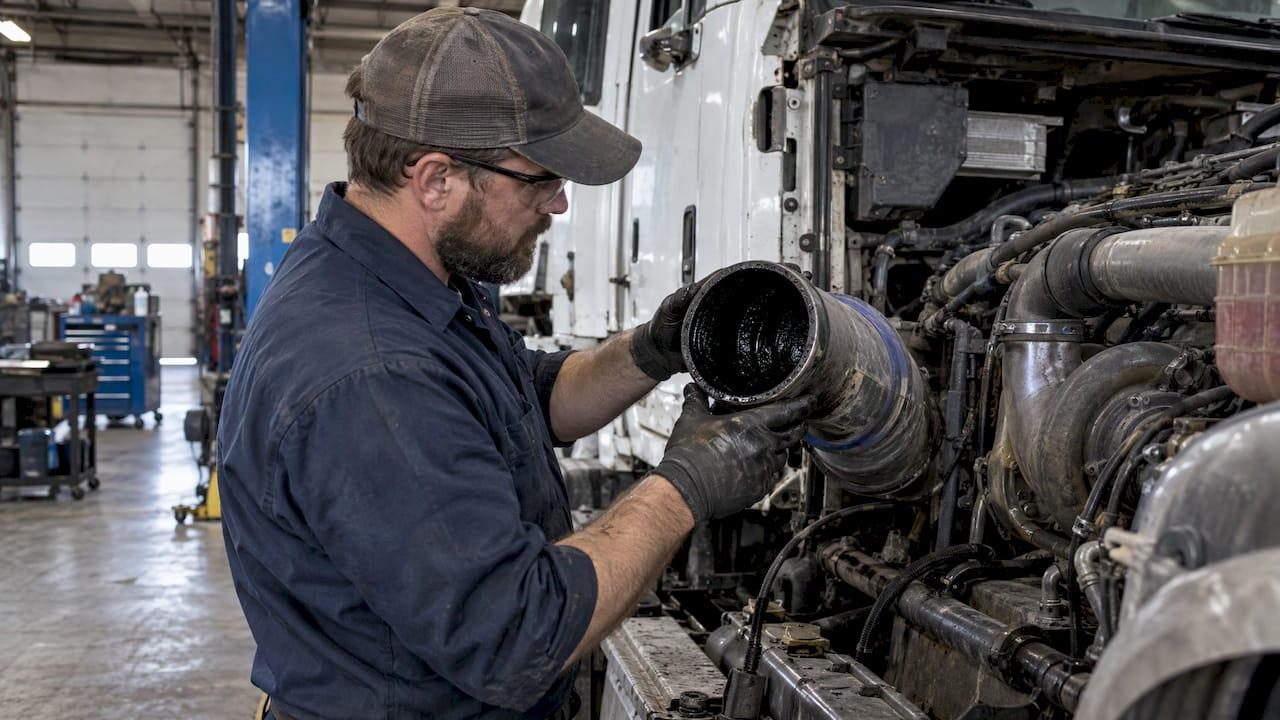
A diesel runaway happens when the engine burns a fuel source other than the metered fuel from its injectors, most often its own engine oil pulled in through the air intake. Because the engine is no longer running on the fuel you control, switching the key off does not stop it. The most common trigger is a failing turbocharger seal, followed by crankcase ventilation problems, an overfilled sump, worn rings or valve seals, flammable vapors in the air, and, on older mechanical engines, a fuel pump or governor that loses control of fuel metering. Runaway is rare, but when it happens it can destroy an engine in seconds, so knowing the causes is how you stay ahead of it.
TL;DR
- Runaway means the engine is burning fuel you are not metering, usually engine oil pulled into the intake, so shutting off the ignition or the fuel will not stop it.
- The usual culprits are a failing turbo seal, high crankcase pressure from a clogged ventilation system or worn rings, an overfilled oil sump, and flammable vapors near the intake.
- Early signs are RPM climbing without throttle input, blue-gray smoke, a changed engine note, and oil residue in the intake piping.
- The only dependable way to stop a runaway is to cut off the air, which is why air intake shut-off valves exist.
- A runaway engine is often too damaged to repair economically, and a tested used replacement can get the truck back on the road quickly.
Table of Contents
- What a diesel runaway actually is
- The main causes of diesel runaway
- Warning signs worth acting on
- What overspeed does to an engine
- How to stop a runaway: cut the air
- Preventing runaway in your fleet
- After a runaway: getting the truck moving again
- Perspective
- FAQ
- Sources
What a diesel runaway actually is
A gasoline engine controls power by limiting air through a throttle. A diesel does the opposite: it takes in all the air it can and controls power by how much fuel the injectors deliver. That design is the reason a runaway is possible. If something else supplies fuel, the engine has no way to say no.
Ram's own owner's manual describes diesel engine runaway as a rare condition in which the engine consumes its own lubricating oil and runs at higher and higher RPM until it overspeeds to the point of self-destruction, through mechanical failure or seizure from lack of lubrication. A technical association for water-jet and industrial engine work describes the same event as an engine running on an external fuel source, where turning off the ignition, the fuel system, the solenoid, or the load will not stop it. If the engine is also drawing in flammable vapor, it is likely to backfire through the intake, and the result can range from minor damage to an engine explosion.
The cycle feeds itself. Oil enters the intake, the engine burns it and revs higher, higher RPM creates more blow-by and boost, and more oil gets pushed or pulled into the intake. Every turn of the loop makes the next one worse.

The main causes of diesel runaway
1. A failing turbocharger seal
This is the cause mechanics hear about most. The turbo shaft spins on a film of engine oil, and seals at each end are supposed to keep that oil out of the compressor side (which feeds the intake) and the exhaust side. When a seal wears or fails, oil can be drawn straight into the intake charge. A bearing that has worn and allows shaft play makes it worse.
A turbo seal is not a perfect barrier by itself. It works through pressure balance and a clear oil drain. A Mercedes-Benz service bulletin filed with NHTSA explains that the turbo's dynamic oil seal relies on pressure balance, and that pressure reductions can let oil pass into the intake or exhaust. The same bulletin lists a restricted air filter, incorrect engine oil, loose intake hose clamps, and excessive crankcase pressure among the common causes.
Takeaway for the shop: a leaking turbo is often the symptom of something upstream or downstream, such as a restricted air filter, a blocked oil drain, or pressure in the crankcase. Replace the turbo without fixing that and the new one can fail the same way.
2. High crankcase pressure and a clogged ventilation system
Every engine leaks some combustion gas past the piston rings into the crankcase. That is blow-by. A closed crankcase ventilation system routes those gases back into the intake after separating out the oil. When the separator clogs or the system malfunctions, oil that should be filtered out rides along with the gas and goes into the intake.
NHTSA-hosted bulletins give a careful picture here. One notes that oil in the intake is common on closed ventilation systems and is not a good indicator of turbo failure, because blow-by production and intake demand do not always match. Another, from 2015, says some dry, soot-like residue at the compressor housing is acceptable, while excessive wet oil can come from high intake restriction, boost leaks, high crankcase pressure, an obstructed turbo oil drain, or a failed turbo. It instructs technicians not to replace the turbocharger before completing diagnostics, including a crankcase pressure test.
That guidance is worth following on any heavy-duty engine. A little oil film in the charge piping is not a runaway waiting to happen. A steady, growing amount of wet oil is a reason to test crankcase pressure before it becomes one.
3. An overfilled or incorrect oil level
More oil is not safer. The same Mercedes bulletin says a high or overfilled oil level can force excessive oil through the closed crankcase ventilation system into the intake. It is one of the simplest causes to prevent: check the level on a level surface, fill to the mark, and use the oil specification the engine calls for. The bulletin also lists incorrect engine oil among the common contributors.
After an oil change or a top-off at a truck stop, confirm the level before you roll. If you added oil to a truck that was already full, drain the excess.

4. Worn piston rings, valve seals and bores
Engines with high hours or mileage can let oil past worn rings or valve seals into the combustion chamber. Worn rings also raise blow-by, which raises crankcase pressure, which pushes oil toward the turbo seals and the ventilation system. So one wear problem can set up several of the pathways above at once.
If you are already seeing rising oil consumption, that is the early version of this problem. Our guide on how diesel engine oil consumption works walks through what is normal and what points to wear.
5. Flammable vapors in the surrounding air
A diesel will burn whatever combustible vapor it inhales. That includes fumes from a fuel spill, leaking hydrocarbon lines, or gas at industrial sites. A fire-service article explains that when an atmosphere of combustible vapors enters the air intake, engine speed increases. Ram's manual also names flammable fumes from fuel spills or turbocharger oil leaks being sucked into the engine as a cause.
For most over-the-road trucks this is the least likely cause. For trucks working at fuel terminals, oilfield sites, or anywhere there may be gas in the air, it is the one to plan for.
6. Injection pump or governor failure on older mechanical engines
On mechanical engines, the injection pump and governor meter fuel. If the pump or governor loses its ability to control fuel delivery, the engine can receive more fuel than it should and accelerate. This is mainly a concern on older mechanical engines and on small single-cylinder diesels, where a broken governor spring or loose limit screw is a known cause. Modern electronically controlled engines manage fuel through the ECM and injectors, so the oil-in-the-intake route dominates there. If you are chasing high-pressure fuel faults or leaking injectors, our piece on bad diesel injector symptoms lists what to check.
Warning signs worth acting on
Most runaways give a short window of warning. Watch for:
- RPM surging without throttle input, or an idle that hunts upward on its own.
- Blue-gray smoke, especially under acceleration, which points to oil being burned.
- A changed engine note, such as clatter or a high-pitched whine from the turbo.
- Oil residue in the charge-air piping, intercooler connections, or at the compressor housing.
- Vapor from the oil fill cap or dipstick tube, and power loss under load, which suggest heavy blow-by.
- Oil consumption climbing over a short period.
None of these alone means a runaway is imminent. Together, or when they get worse quickly, they mean the truck should be parked and inspected, not driven to the next stop.
A quick pre-trip routine
- Check the oil level on level ground and make sure it is not above the full mark.
- Look at the charge-air piping and clamps for oil film and loose connections.
- Check the air filter restriction indicator, if equipped.
- Note any change in oil consumption from your last service.
- Watch for smoke color and unusual turbo noise on the first climb.
Our engine lifespan indicators guide covers the wear signs that tend to travel with these symptoms.
What overspeed does to an engine
An academic paper on a real industrial incident, presented through ASME, gives the numbers. A heavy-duty diesel typically idles at 600 to 700 RPM and has a no-load maximum of 2,100 to 2,200 RPM. Anything above full-load RPM, roughly 1,950 to 2,050, is overspeed. Extreme overspeed can cause valve float, piston-to-valve contact, damaged valve components, bent pushrods, and a destructive backfire through the intake.
In plain terms: the valves cannot close fast enough, the pistons hit them, and the engine wrecks itself. Add the lack of lubrication Ram's manual describes once the oil supply is consumed, and the engine often ends in a seizure.
How to stop a runaway: cut the air
The consistent answer across the evidence is that you have to starve the engine of air. The ASME paper concludes that controlling combustion air is the key to absolute control in a runaway emergency. It describes two kinds of air intake shut-off valves, both of which block the path between the air cleaner and the turbocharger: passive valves that close automatically when RPM goes too high, and active valves that the driver closes with a pull cable or push button. A fire-service article puts it simply: no air, no combustion. A manufacturer of engine safety systems also notes that in a runaway the engine runs on an external fuel source, so turning off the ignition will not shut it off.
If it happens to you
- Do not rely on the key. It will not stop an engine that is burning oil or vapor.
- Keep yourself clear of the intake and the engine. An overspeeding diesel can throw parts or backfire through the intake.
- Follow your truck maker's procedure. Ram's manual says, for runaway caused by flammable fumes or turbo oil leaks, to turn the ignition off and then use a CO2 or dry-chemical fire extinguisher, directing the spray into the driver-side grille so it enters the air intake. Procedures differ by vehicle, so know yours.
- Do not try to stall an automatic. Stalling by dropping a manual transmission into a high gear is sometimes mentioned, but it is hard on the drivetrain and unsafe in many situations. Prioritize getting people away and calling for help.
- Call emergency services if there is smoke, fire, or any danger to people nearby.
If your truck works around flammable vapors, an air intake shut-off valve is the standard protection to ask your shop about. For the rest of the fleet, prevention is where the money is.
Preventing runaway in your fleet
- Keep oil at the correct level and use the right spec. This closes off two of the documented causes at once.
- Service the crankcase ventilation system on schedule. A clogged separator sends oil to the intake.
- Inspect turbos for shaft play and oil residue, and diagnose before replacing, including a crankcase pressure test, as the NHTSA-hosted bulletin instructs.
- Fix intake restrictions and boost leaks such as a clogged air filter or loose clamps.
- Track oil consumption. A sudden rise is the cheapest early warning you have.
- Retire engines with heavy blow-by rather than running them until something gives.
For more on the habits that keep engines alive, see our guide on extending truck engine life as an owner-operator and our overview of types of commercial truck engine failures.
After a runaway: getting the truck moving again
An engine that has overspeeded may have bent pushrods, damaged valves, scored cylinders, or a seized crank. Even when it looks intact, the internal damage can make a rebuild a gamble. For a fleet manager or owner-operator, every day down costs freight revenue, so the decision comes down to how fast you can get a sound engine in the frame.
That is where a replacement engine makes sense. We sell used heavy truck parts, including diesel engines and transmissions, and every part is tested and inspected before sale and backed by a standard warranty. Our inventory changes daily and ships nationwide with same-day service, covering Caterpillar, Cummins, Detroit, Volvo, International, Isuzu, Mack, Mercedes, Hino, Mitsubishi, and Paccar. Browse truck engines for sale, or check transmissions and differentials if the event also damaged the drivetrain.

If you are replacing the engine under time pressure, our emergency engine sourcing guide lays out what to line up before you order.
Perspective
Runaway is a cause-and-effect problem, and almost every cause on this list starts small: a seal that weeps, a breather that clogs, an oil level a quart too high. The engines that end up in a catastrophic failure are the ones that ran with those small problems for too long.
When a truck is down, the question is not only what failed but how fast you can be rolling again. We built our approach around that: tested and inspected parts, a standard warranty, and same-day shipping on a daily-changing inventory, so a fleet manager or an owner-operator is not stuck waiting. A tested used engine is a practical way to turn a bad week into a short one.
Fix the upstream cause, whether that is the crankcase ventilation, the turbo drain, or the oil level, and the replacement engine gets a fair chance to last.
John
FAQ
Why does a diesel keep running with the key off?
Because in a runaway it is not running on the fuel the injectors meter. It is burning oil, vapor, or another outside source, so the ignition and fuel shut-off no longer control it. Cutting off the air is what stops combustion.
What is the most common cause of diesel runaway?
A failing turbocharger seal that lets engine oil into the intake is the most commonly cited cause. High crankcase pressure and an overfilled oil level can push oil into the intake as well. Oil in the intake is also common on closed ventilation systems, so test before you replace parts.
How do I stop a runaway diesel on an automatic?
The dependable method is to block the air intake, for example with an air intake shut-off valve. Your truck maker's manual may give a procedure, such as shutting the ignition off and using a CO2 or dry-chemical extinguisher at the intake, as Ram's does. Stay clear of the engine and call emergency services if there is any danger.
Can a modern engine run away?
Yes, though it is rare. Any engine that can draw oil or vapor into the intake can do it, and the usual path on modern engines is oil through a failed turbo seal or ventilation system. Regular oil-level checks and ventilation service lower the risk.
Can a runaway engine be saved?
Sometimes, but overspeed can bend pushrods, damage valves, and cause seizure. Have a qualified diesel technician inspect it. If it is beyond repair, a tested replacement engine is often the faster route back to work.
Sources
- Ram 2022 2500/3500 owner's manual: Engine Runaway, Diesel Engine
- Western Jet Technicians Association, Jet News, February 2013
- NHTSA-hosted service bulletin MC-10208874-0001
- NHTSA-hosted service bulletin SB-10058363-2818
- Fire Engineering: Engine Runaway
- The Runaway Diesel: A Side by Side Mechanical Analysis (ASME)
- AMOT: Is Your Diesel Engine At Risk?