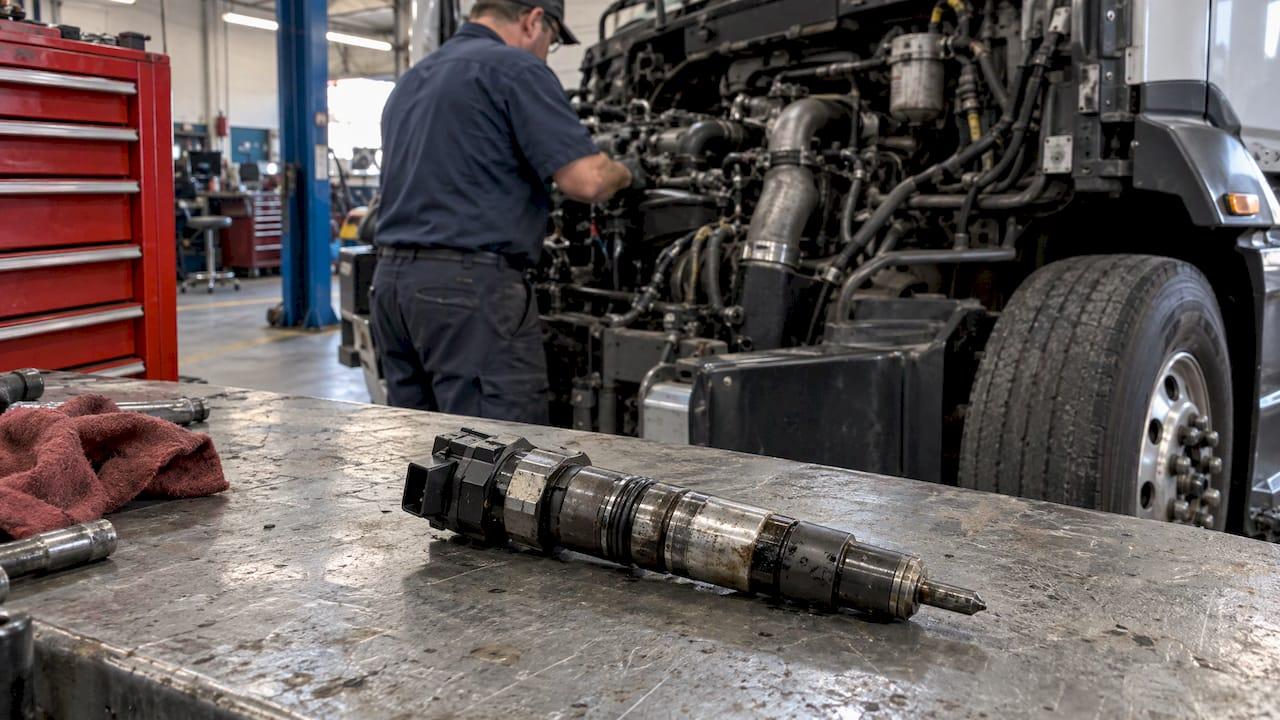
A failing diesel injector usually shows up as a rough or lumpy idle, a knock or misfire on one cylinder, smoke from the stack, hard starting, lost power and worse fuel mileage. Any one of these can also point to something else, so the job is to read the pattern, confirm it with a few tests, and stop the truck before a leaking injector turns a repair into a dead engine. This guide is written for owner-operators, fleet managers and shop mechanics who need to decide quickly what they are dealing with.
TL;DR
- The most common signs of a bad injector are rough idle, cylinder knock or misfire, white or black smoke, hard starts or long cranking, power loss, higher fuel use, and diesel in the oil.
- Smoke color helps: black points to incomplete combustion, white to unburnt fuel or coolant, blue to engine wear.
- Confirm before you replace: scan codes, run a cylinder cut-out test, check return flow and rail pressure, and rule out low compression.
- Park the truck if it overheats, loses major power, pours smoke, or the oil level is rising. Driving on a leaking injector can damage the engine.
- If the engine is already damaged, a tested, warrantied used engine can get the truck back to work faster than waiting on a rebuild.
Table of Contents
- The main symptoms of a bad diesel injector
- What the smoke is telling you
- Is it the injector or something else?
- When to stop driving
- What causes injectors to fail
- After the diagnosis: replace, repair or go further
- Getting a tested replacement engine
- A quick field checklist
- Perspective: why a tested engine beats guessing
- FAQ
- Sources
The main symptoms of a bad diesel injector
An injector meters and atomizes fuel into the cylinder at very high pressure. When a nozzle wears, sticks, clogs or leaks, that cylinder burns fuel badly, and the whole engine feels it. A professional diesel repair guide lists the usual signs: rough or lumpy idle, a cylinder misfire or knock, white or black smoke, hard starting or long cranking, reduced power and fuel economy, a rising oil level or diesel-smelling oil, and frequent DPF regenerations. Perkins, an engine manufacturer, describes the same group of indications: poor starting, power loss, higher fuel consumption, poor idling, excessive or black smoke, cylinder knock, uneven running and misfiring.

Here is what each looks like from the driver's seat or the shop floor.
Rough or lumpy idle
One cylinder that is not firing cleanly makes the idle uneven. You feel it in the steering wheel and the cab, and the tach needle may wander. It is often the first sign, and it is easy to dismiss as a cold-morning quirk. If it stays after warm-up, treat it as a real symptom.
Knock or misfire on one cylinder
A stuck-open or leaking injector can dump too much fuel at the wrong moment, which sounds like a sharp knock. A dead injector does the opposite: the cylinder contributes nothing, and the engine runs rough and weak. Perkins lists cylinder knock and misfiring among the common signs of a fuel-injection problem.
Hard starting and long cranking
Injectors that leak or spray poorly make the engine slow to catch, especially cold. Ford's service job aid for the 6.7L diesel lists crank-no-start, long crank or hard start, rough running, reduced power, knocking, exhaust smoke and slow fuel-rail pressure build as possible symptoms of contaminated fuel damaging injectors and other high-pressure parts. A truck that suddenly needs extra cranking after a fuel stop deserves a closer look.
Power loss and poor fuel economy
When cylinders burn fuel poorly, you give up power and mileage at once. Drivers notice it on grades and when pulling a loaded trailer. Because fuel use is tracked per truck at most fleets, a slow slide in miles per gallon on one unit, with no change in routes or loads, is a useful early flag.
Diesel in the oil
A cracked or leaking injector can let fuel run past into the crankcase. The oil level creeps up, the oil thins out and smells of diesel. This is the symptom that should end any "I'll drive it a bit longer" thinking, because thinned oil protects bearings poorly. If you are tracking oil level changes, how diesel oil consumption works is a good companion read for telling consumption from dilution.
Frequent DPF regenerations
Extra unburnt fuel and soot load the particulate filter faster, so regens come more often. If the truck is regenerating more than usual and also idles rough or smokes, look at the injectors before you blame the aftertreatment system.
What the smoke is telling you
Smoke is the symptom people search for most, and color narrows the list.
| Smoke color | What it usually means | Injector link |
|---|---|---|
| Black or dark gray | Incomplete combustion: too much fuel or not enough air | Damaged or leaking injectors, but also a blocked air filter, pump timing, poor compression or contaminated fuel |
| White | Raw unburnt diesel or coolant in the cylinder | Severely defective injectors, but also poor compression, incorrect injection timing or a coolant leak into a cylinder |
| Blue | Oil burning | Normally engine wear or damage, not the injector itself |
The black and gray smoke causes come from the New South Wales EPA's guide to smoky vehicles, an Australian regulator, and the combustion physics apply to any diesel. The same page says blue smoke from a diesel normally means engine wear or damage. For white smoke, a diesel performance shop explains that raw diesel from badly defective injectors is one cause, alongside poor compression, wrong injection timing and coolant entering a cylinder.
The takeaway: black or white smoke with a rough idle makes injectors a strong suspect. Blue smoke sends you toward rings, valve seals or turbo seals. White smoke with a sweet smell and falling coolant sends you toward a head gasket or cracked head. Our guide to types of commercial truck engine failures helps sort those out.
Is it the injector or something else?
Injector trouble looks like a lot of other problems: a weak turbo, a clogged fuel filter, a leaking high-pressure line, low compression, even a wiring fault. Replacing injectors on a hunch is expensive, so confirm first. The order below follows the approach in the diesel repair guide.
- Scan for codes and cylinder balance data. Injector circuit codes can come from a failed injector coil or solenoid, but also from wiring and connector problems. Check the harness and connector before you condemn the injector.
- Run a contribution or cut-out test. The scan tool disables or compares each cylinder. A cylinder that contributes little, or whose cut-out changes nothing in the idle, is the weak one.
- Check return flow and fuel-rail pressure. Excess return flow from an injector points to internal leakage. Slow rail pressure build or low pressure points to the injector or the high-pressure side.
- Run a compression test. This rules out a mechanical fault that looks like an injector problem. A cylinder with low compression will misfire and smoke no matter how good the injector is. A diesel leak down test goes a step further by showing where the pressure escapes.
- Look for causes outside the injector. Perkins notes that contamination can cause injector wear, poor sealing, incorrect spray patterns or blocked holes, and that poor repairs, high-pressure pipe leaks, restrictions and sticking nozzle valves can also cause injector problems.
If you want the bigger picture on how engines are evaluated, how diesel engine testing is done walks through the process in more depth.
One more point for owner-operators: a diesel smell around the engine is a symptom that tells you something, just as any odor does. Tracing a smell to its source before treating it is the same discipline you would use for diagnosing the source of car odors. Find the leak first, then fix it.
When to stop driving
A leaking or stuck injector can do damage fast. Shut the truck down if it is overheating, has major power loss or is pouring smoke, according to a diesel service shop's guidance. The same source says not to keep driving if the truck is overheating or losing coolant, and to avoid repeatedly cranking if coolant may be in a cylinder, since the cylinder can fill with liquid.
Two other situations call for caution:
- Rising oil level or fuel-smelling oil. Fuel is diluting the oil. Park it and get the injectors checked.
- DEF in the fuel tank. If diesel exhaust fluid has been put in the fuel tank, Ford says to not turn the key to RUN or start the vehicle and to follow the applicable fuel-system repair procedure.
On the road, a driver can limp to the next exit on a rough idle. A driver with fuel in the crankcase, coolant loss or heavy smoke should not.
What causes injectors to fail
Contamination is the cause you can most easily prevent. Ford's job aid says contamination and poor filter maintenance can cause premature wear of the high-pressure pump and injectors. Perkins likewise says contamination accelerates injector wear and can block nozzle holes.
Practical habits that protect injectors:
- Change both fuel filters on schedule, and more often if you fuel at unfamiliar stops.
- Drain water from the separator as part of every service.
- Keep tanks closed and clean, and avoid running them near empty, where sediment gets pulled in.
- Use quality diesel and keep oil changes current, since oil condition also affects injector life.
For a wider routine, see how to extend truck engine life as an owner-operator and the diesel engine lifespan indicators guide. For how injector condition ties to power and efficiency, our pro guide to fuel injectors and diesel performance goes deeper.
After the diagnosis: replace, repair or go further
What comes next depends on how far the damage went.
Caught early, one injector. If a single injector is confirmed bad and the oil is clean, replacing it, along with a fresh set of fuel filters, is often the whole job. Fix the cause too. A bad filter or contaminated fuel will kill the new injector.
Contaminated fuel reached the system. This is a bigger repair. For the 6.7L Power Stroke, Ford instructs technicians to drain and clean the tank, use fresh diesel, flush the system, replace both fuel filters, and replace all the specified high-pressure components: pump, rails, lines, injectors, return hose assembly and pressure switch. Skipping steps leaves debris to destroy the new parts.
Fuel in the oil, scored cylinders or low compression. Now the problem is the engine, not the injector. Thin oil, washed cylinder walls and failed bearings are the usual result of running a leaking injector too long. Here the choice is between a rebuild, which takes the truck off the road for days or weeks, and swapping in a tested replacement engine.
For fleets and owner-operators, downtime is the real cost. A truck sitting in a shop bay earns nothing, and a logistics company with a late load needs the power unit moving. That is where a replacement engine earns its place.

Getting a tested replacement engine
When the diagnosis says the engine itself is finished, we can help. Nationwide Heavy Truck Parts sells used heavy truck engines, transmissions, differentials and exhausts. Every part is tested and inspected before sale and comes with a standard warranty. Our inventory changes daily, and orders ship the same day. We stock engines from Caterpillar, Cummins, Detroit, Volvo, International, Isuzu, Mack, Mercedes, Hino, Mitsubishi and Paccar.

Browse our truck engines for sale to match your make and model. If the same event damaged the drivetrain, we also list transmissions, differentials and exhausts. Before you order, our used diesel engine buying checklist shows what to match, and the engine inspection checklist explains what a good inspection covers.
If the failure took out the engine computer too, there are also listings such as the PACCAR MX13 ECM on our related store.
A quick field checklist
Use this list at the curb, in the yard or at the shop.
- Does the idle surge or shake after warm-up?
- Is there a knock you can pin to one cylinder?
- Is smoke black, white or blue, and does it happen cold, under load, or both?
- Is the truck cranking longer than it used to?
- Has fuel mileage dropped on this unit alone?
- Is the oil level up, thin, or smelling of diesel?
- Are DPF regens more frequent?
- Are there injector codes, and have you checked the wiring first?
Three or more yes answers, or any yes on the oil question, justify pulling the truck out of service for the tests above.
Perspective: why a tested engine beats guessing
Injector problems waste time because they hide behind other symptoms. A truck owner pays for a set of injectors, the idle is still rough, and the real cause turns out to be compression or fuel contamination that was never fixed.
Our view is simple. Diagnose first, and when the damage has reached the engine, do not let the truck sit while you wait on an open-ended rebuild. We test and inspect every engine, transmission and differential we sell, and each one carries a standard warranty. The inventory turns over daily, and we ship the same day, so a fleet manager or an owner-operator can find the unit that matches and have it moving.
A tested used engine puts the truck back to work at a price that makes sense for a working unit. That is the reason we do what we do.
John
FAQ
Can a bad diesel injector cause smoke?
Yes. Raw diesel from severely defective injectors can cause white smoke, and over-fueling or poor atomization can cause black smoke. Blue smoke normally points to engine wear or damage instead. Confirm with a cylinder test and compression check, since other faults smoke too.
What are the first signs of a failing injector?
Usually a rough or lumpy idle, longer cranking when cold, and a small drop in fuel mileage. A knock on one cylinder, more DPF regens and fuel-smelling oil follow as the injector gets worse. Any of these is a reason to scan the truck.
How do I know it is the injector and not something else?
Scan for codes and cylinder balance, run a cut-out or contribution test, check return flow and rail pressure, then do a compression test. Check wiring and connectors before replacing an injector for a circuit code, since the harness can be the fault.
Can I keep driving with a bad injector?
Not with major power loss, overheating, heavy smoke, coolant loss or a rising oil level. Shut the engine down. Fuel in the oil thins it and raises the risk of engine damage, so have the truck checked first.
What shortens injector life?
Contaminated fuel and neglected filters are the main causes, according to Ford's service guidance. Oil condition and fuel quality also matter. Changing both fuel filters on schedule and draining the water separator are the best protection.
Sources
- Bad Diesel Injector Symptoms and How to Test Them
- Fuel system symptoms and diagnosis: injectors (Perkins)
- 6.7L Diesel Fuel System Service Tips Job Aid (Ford)
- Causes of smoky vehicles (NSW EPA)
- Black Smoke, White Smoke, Blue Smoke from Diesel Exhaust
- Why Is My Diesel Smoking? Causes and Fixes
- Diagnosing the source of car odors