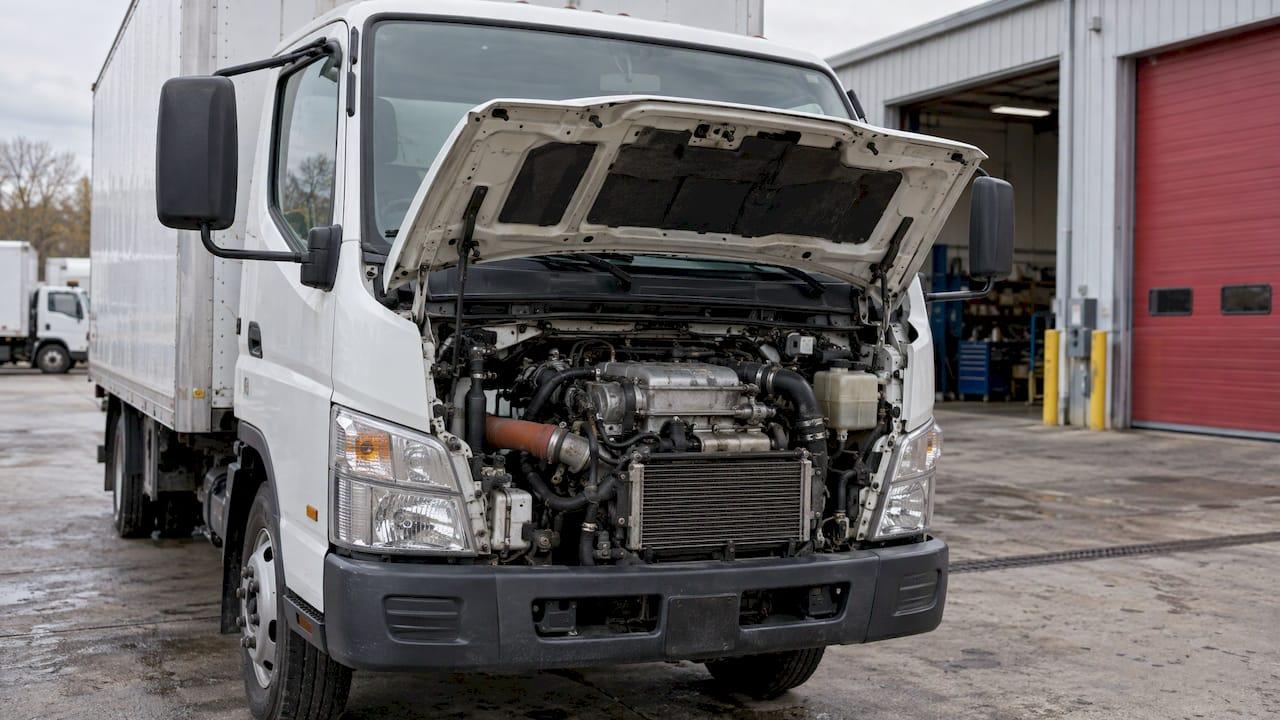
Most Fuso engine complaints trace back to a short list: a clogged diesel particulate filter (DPF) that forces a power derate, fuel and air faults that cause hard starts and stalls, a handful of recalled parts on specific model years, and oil or coolant leaks. Find which of these you have, and you know whether you need a repair or a replacement engine. If the block is the problem, we supply tested, inspected used engines with a standard warranty and ship the same day.
This guide is for owner-operators, fleet managers and shop mechanics running Mitsubishi Fuso Canter, FE, FG and FEC-series trucks. It covers what fails, what the lamps mean, which recalls matter and how to diagnose a fault in order.
TL;DR
- Power loss and derate on a Fuso most often come from a restricted DPF, a fuel or charge-air problem, or a bad sensor reading, not from a worn-out engine.
- Hard starts, rough idle and stalling usually point to fuel supply: clogged filters, air or water in the fuel, or injection faults.
- A red lamp means stop when it is safe. A flashing DPF, DEF or check-engine lamp means act the same day.
- U.S. recalls touched the 2017 FEC and FGB rocker arms, the 4P10 timing chain bolt on 2012-2015 trucks and the 2024-2025 Rizon ECU software.
- When the fault is internal damage, a tested used engine with a warranty gets the truck back to work faster than a long teardown.
Table of Contents
- Where Fuso engine trouble usually starts
- Power loss and derate: the DPF and emissions chain
- Hard start, stall and rough idle
- What the warning lamps mean
- Recalls that touched Fuso engines
- How to diagnose a Fuso engine fault, step by step
- Oil and coolant leaks
- When repair stops making sense
- Replacement engines, tested and shipped the same day
- Our view: fix the cause, then decide on the engine
- FAQ
- Sources
Where Fuso engine trouble usually starts
Fuso engines are not one design. A Canter with a 4M50 or 4P10, an FE with a 4D3-family diesel and a Fighter with a 6M70 have different fuel systems and different emissions hardware. The symptoms overlap, so the first job is to match the symptom to a system, not to a part.
Four groups cover most of what shows up:
- Emissions hardware: a loaded DPF, a sooted EGR (exhaust gas recirculation) valve or cooler, and SCR/DEF faults on newer trucks.
- Fuel system: restricted filters, air or water in the fuel, injector or injection pump faults.
- Air and sensors: charge-air leaks, a leaking turbo, and sensors that feed wrong pressure or temperature data to the engine computer.
- Mechanical: valve train wear, head gasket failure, oil leaks, timing chain issues.
A note on reputation: Japan's transport ministry, which collects owner complaints, says complaint counts do not necessarily show failure rates, because they rise with how many trucks were sold and how long they have been on the road. Treat any list of Fuso problems as a map of what to check, not a verdict on the truck.
Power loss and derate: the DPF and emissions chain
Derate means the engine computer cuts power to protect the engine or the exhaust system. On a Fuso it is most often tied to the DPF, which traps soot and burns it off in a process called regeneration. Regeneration needs hot exhaust.
Mitsubishi Fuso explains that the DPF indicator flickers when the exhaust is not hot enough for automatic regeneration, for example in a traffic jam. Its guidance for the driver is to stop in a safe place and hold the DPF cleaning switch to start a manual regeneration, and it notes that restrictions may be imposed if you keep driving while the indicator flickers.
The California Air Resources Board's DPF handbook for truck drivers adds the cost of ignoring it: continuing to run a truck that needs attention can severely derate the engine, damage the DPF or the engine and void the DPF warranty. It also lists what feeds the problem. Worn fuel injectors, dirty air filters, leaking turbocharger seals and coolant leaks all raise soot output or damage the filter.

That last point is the practical lesson. A DPF that keeps clogging is often a symptom. Stop-start delivery work is the usual reason regeneration never completes, but if the filter loads up again soon after a clean regeneration, look upstream at injectors, turbo seals and air intake before blaming the filter.
One more cause belongs on newer trucks. A 2015 Heavy Duty Trucking report described a class action in which a grocery chain alleged that the emissions-control software on 2012 FE125 trucks shut engines down without apparent reason. Whatever the outcome, it shows why a derate or shutdown with no mechanical fault should lead to a software and sensor check, not a parts swap.
Hard start, stall and rough idle
On the diesel side, hard starting and rough idle are almost always fuel or timing. The factory workshop manual for the Canter 4D3 diesel engine, published by Mitsubishi Fuso Truck and Bus Corporation, lists the usual causes:
- a clogged fuel filter
- air or water in the fuel system
- low-quality fuel
- incorrect injection timing
- stuck plunger, control rack or delivery valve in the injection pump
For low power and abnormal noise the same manual adds incorrect valve clearance, a defective cylinder head gasket, worn valves and seats with carbon deposits, a weak valve spring, worn piston rings, a clogged air cleaner and a clogged muffler.
The order matters. Cheap, fast checks come first: fuel filter, water in the separator, air filter, exhaust restriction. Only after those do you move to injectors, injection pump and compression. A truck that has been sitting, or that was filled at an unfamiliar pump, deserves a fuel check before anything else.
What the warning lamps mean
Most Fuso trucks give you warning before they quit. Reading the lamps correctly is the difference between a short stop and a ruined engine.
The general heavy-truck color rule, as explained by a heavy-truck service shop, is simple. Red means stop as soon as it is safe, because the truck believes continued running risks the engine or safety. Amber means a fault is logged and needs attention soon. Flashing means the condition has escalated: a flashing DPF, DEF or check-engine lamp can be followed by a derate or shutdown, so act the same day. One root fault can light several lamps at once, and the codes are stored in the engine computer for diagnosis.
A practical routine for the driver:
- Note which lamps are on and whether they are steady or flashing.
- If red, pull over safely and shut down. Do not try to reach the next exit on a hot engine.
- If the DPF lamp flickers, follow the manual regeneration procedure for your truck from a safe stop.
- If the lamp keeps returning, get the codes read before the next run.
CARB also warns that a DPF can mask engine problems that used to be obvious from exhaust smoke, so a lamp deserves attention even when the truck still seems to drive normally.
Recalls that touched Fuso engines
Before you spend money on a repair, check whether the truck's VIN falls under a recall. Recall repairs are done by authorized dealers at no charge to the owner, so this step belongs to the dealer network, not to the shop floor. Search the VIN on the NHTSA recall lookup. Three U.S. campaigns are worth knowing:
| Recall | Trucks | Problem | Remedy |
|---|---|---|---|
| 19V-597 (2019) | 2017 FEC52, FEC72, FEC92, FGB7; 2,015 vehicles | Rocker arms made incorrectly can wear early and make noise; a broken one can cause misfire, warning lamps and stalling while moving | Replacement under the recall |
| 15V-195 (2015) | Certain 2014-2015 FEC72 and 2012-2015 FEC92 with the 4P10 engine; 30 trucks | Lower timing chain bolt may be under-tightened, causing an oil leak or, at worst, an inoperative engine | Tighten bolt to specification and replace both timing chain tensioners |
| 26V126000 | Certain 2024 Rizon FEC7K, FEC9K and 2025 FECXK | Control unit software error at idle can prevent the truck from being driven | Dealers reprogram the battery management system and DC-Box software |
Sources for the table: NHTSA report 19V-597, NHTSA bulletin 15V-195 and a FleetOwner recall roundup.
After the timing chain repair, NHTSA's bulletin says to confirm the coolant level, check for oil leaks at the upper and lower chain tensioners, confirm A/C operation and listen for abnormal engine noise before the truck goes back into service. That is a good checklist for any engine repair on these trucks.
How to diagnose a Fuso engine fault, step by step
Guessing costs more than diagnosing. This is the order that wastes the least time and money.
1. Collect the story
Write down when it happens: cold start, uphill, under load, in hot weather, after a regeneration. The Fuso workshop manual stresses that intermittent faults are found by gathering operating and weather conditions so you can recreate the trigger. A fault that appears only uphill points toward fuel delivery or boost. One that appears only after short city runs points toward the DPF.
2. Read the codes
Pull the stored codes and freeze-frame data before clearing anything. Codes name a circuit, not always a failed part. For example, a documented case of a 2005 FE180 with the check-engine lamp on and power limited to 59 mph stored fuel rail pressure sensor and fuel quantity solenoid codes, which sent the technician to the fuel system, not the engine internals.
3. Check the cheap basics
Fuel filter, water in the fuel, air filter, charge-air hoses and clamps, exhaust restriction. Diesel trucks that lose power under load often have a restricted fuel filter, a charge-air leak, bad manifold pressure sensor data or a restricted DPF, so these checks catch a large share of cases.
4. Test the circuit before the part
For intermittent electrical faults, the workshop manual suggests gently moving connectors, harnesses and sensors while watching live data, since vibration is often the trigger. A guide to advanced vehicle diagnostics covers the same connector-and-wiring approach in more general terms.
5. Measure fuel pressure
When a truck will not pass a certain speed, feels like it is starving for fuel or misfires under load, a common-rail pressure gauge settles it. A documented 2007 FG140 kept the problem after a new EGR cooler and head gasket until the injection system was measured. Parts installed without a measurement are the most expensive way to find out.
6. Fix the root cause before resetting anything
Clearing a DPF lamp or forcing a regeneration does not repair a leaking turbo seal or a worn injector. If you reset without fixing the cause, the derate comes back.
Oil and coolant leaks
Leaks deserve their own check because they escalate. Reported Fuso complaint data lists coolant leaks and oil-separator leaks among engine-related reports. Oil dripping onto hot exhaust or turbo parts is a fire risk, so clean the area, find the source and fix it before the next trip. Coolant loss that is not traced can lead to head gasket failure, which is one of the causes of low power and noise in the workshop manual.
When repair stops making sense
Some faults are not worth chasing: a cracked block, a spun bearing, severe overheating damage, a head gasket failure on a high-mileage engine or a repeat failure after a rebuild. Downtime is the cost that matters. A truck that sits for weeks waiting on machine work and parts loses more than the price difference between repair and replacement.
If you are weighing it, these pages walk through the decision:
- Types of commercial truck engine failures helps you tell a repairable fault from a terminal one.
- How truck engine replacement works covers the process from order to install.
- How to confirm engine compatibility matters before you buy, because the engine, ECM and emissions hardware have to match.
- DPF compatibility when swapping an engine or ECM and engine swap emissions laws cover the emissions side of a swap, which is regulated.
If the engine has to come out, a tested used engine is often the quickest route back to revenue, and replacing the engine can beat buying another truck.
Replacement engines, tested and shipped the same day
Nationwide Heavy Truck Parts sells used heavy-duty diesel engines, transmissions, differentials and exhausts. Every part is tested and inspected before sale and carries a standard warranty. Our inventory changes daily and covers major brands including Caterpillar, Cummins, Detroit, Volvo, International, Isuzu, Mack, Mercedes, Hino, Mitsubishi and Paccar, with same-day shipping nationwide.
If your Fuso is down for an internal engine failure, start with our truck engines for sale. Drivetrain damage shows up too, and our transmissions and differentials are listed separately. Have the engine model, ECM number and truck VIN ready so the match is right the first time.
Our view: fix the cause, then decide on the engine
Fleets come to us at the worst moment: a truck on the shoulder and a customer waiting. The best thing we can say is to separate the two kinds of problem. Derates, lamps and hard starts are usually fuel, air or emissions faults, and a good diagnosis fixes them without touching the engine.
The other kind is internal damage, and there the question is time. We test and inspect every part before it is sold, back it with a standard warranty and ship the same day, because a truck that is parked earns nothing. Our inventory changes daily, so the engine you need is often available now.
Match the engine to the truck before you order: model, ECM and emissions equipment. Get that right and a replacement is a straightforward way to put the truck back on the road.
John
FAQ
Why does my Fuso go into derate?
The most common reason is a restricted DPF that could not regenerate, often after short stop-start driving. Faulty injectors, a leaking turbo, a sooted EGR or bad pressure and temperature sensors can also trigger it. Read the codes before you clean or replace anything.
What should I do when the DPF lamp flickers?
Mitsubishi Fuso says the lamp flickers when exhaust is not hot enough for automatic regeneration. Stop in a safe place and hold the DPF cleaning switch to start a manual regeneration. Do not keep driving with the lamp flickering, since restrictions may follow.
Are Fuso trucks reliable?
Complaint counts depend on how many trucks are sold and how long they have been on the road, so they do not measure reliability on their own. Most reported engine trouble comes from the DPF and emissions system, fuel supply or specific recalled parts, all of which can be checked by VIN and by diagnosis. Regular filter changes and proper regeneration help.
How do I know if my Fuso is under recall?
Enter the VIN on the NHTSA recall lookup. Recalls covered rocker arms on 2017 FEC and FGB trucks, the timing chain bolt on certain 4P10 trucks and software on 2024-2025 Rizon models. Authorized dealers perform recall repairs.
Can I put a used engine in my Fuso?
Yes, when the replacement matches the truck's engine model, ECM and emissions hardware. We list used engines that are tested, inspected and covered by a standard warranty, and our compatibility guides explain what to confirm before ordering.
Sources
- Mitsubishi Fuso: Diesel Particulate Filter
- CARB: A Truck Driver's Guide to Care and Maintenance of Diesel Particulate Filters
- Heavy Duty Trucking: Mitsubishi Fuso Class Action Moves Forward
- Mitsubishi Canter 4D3 Diesel Engine Workshop Manual
- Semi Truck Dashboard Warning Lights
- NHTSA recall report 19V-597
- NHTSA recall bulletin 15V-195
- FleetOwner: Recall Roundup
- Fuso complaint data, Japan MLIT summary
- iATN: 2005 Fuso FE180 MIL lamp on
- iATN: 2007 Fuso FG140 hesitation
- Advanced vehicle diagnostics guide