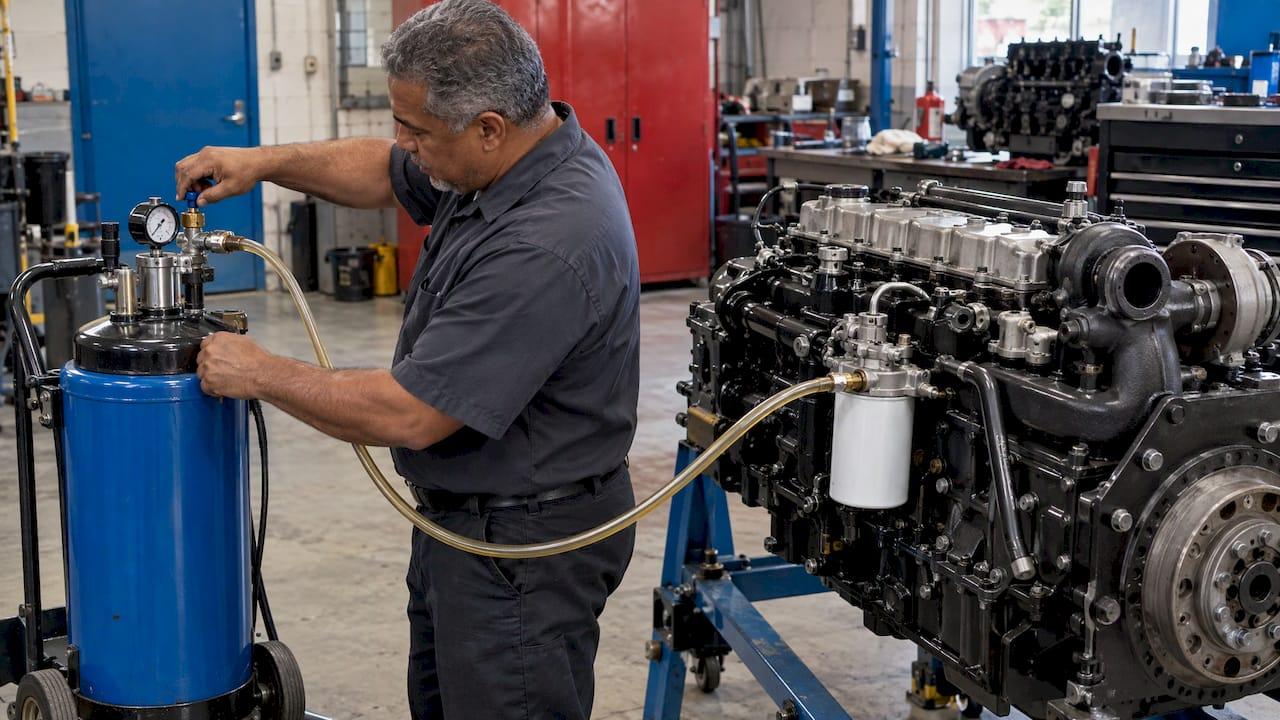
To prelube a diesel engine is to push oil through the lubrication system under pressure before the crankshaft turns, so every bearing is wet on the first revolution. Factory-fitted systems do it automatically when you hit the start switch. On a rebuilt or replacement engine, you do it by hand with a pressure prelubricator before the very first start. Below you'll find how each approach works, what the manufacturer manuals say, and how to avoid the mistakes that cost bearings.
TL;DR
- Prelubing charges the oil system with pressurized oil before cranking. Priming is a different job: it fills the fuel system after repairs.
- A fresh, rebuilt, swapped or long-stored engine is most exposed on its first start, because bearing surfaces may be dry.
- Fitted systems (such as Caterpillar's) run a timed cycle or wait for a pressure target, then release the starter.
- After a major repair or engine swap, charge the oil system with a pressure prelubricator before the first start, then watch the oil pressure gauge.
- Stop the engine if no oil pressure shows within 10 to 15 seconds of starting.
Table of Contents
- What prelubing a diesel engine actually means
- Why startup is the hard part
- Types of prelube systems
- How to run a fitted prelube system
- How to prime the oil system before the first start of a rebuilt or swapped engine
- Engines that have been sitting
- Prelube and engine life
- Our perspective
- Need a replacement engine to prelube?
- FAQ
- Sources
What prelubing a diesel engine actually means
When an engine sits, oil drains off the bearings, cam surfaces and valvetrain and collects in the pan. At the next start, the crankshaft turns, and the oil pump needs a few seconds to build pressure and push oil to the far ends of the galleries. For that short window, metal rides on a thin residual film.
Prelubing closes that gap. Detroit Diesel's Series 50 Operator's Guide says the lubrication system should be charged with a commercially available pressure pre-lubricator so oil reaches all bearing surfaces immediately at initial startup. The same guide warns that insufficient lubrication at startup can seriously damage engine components.
There are two situations, and they call for different tools:
- Automatic prelube on a running fleet truck or machine. A pump and controller do it before every start.
- Manual prelube after a rebuild, overhaul or engine swap. A technician charges the system once, before the first start.
Prelube is not priming
The two words get mixed up in shops. Prelubing is about oil. Priming, in the diesel world, usually means getting fuel to the injection system after air has entered the fuel lines.
Detroit Diesel's Series 50 guide says the fuel system must be primed if air has entered it, using a manual or electric priming pump connected at the secondary fuel filter adapter. For the Series 60, the EPA07 operator's manual says to work the hand pump on the filter until you feel resistance. Then crank for 30 seconds at a time at most, wait at least two minutes between attempts, and expect a start within six attempts.
After a major job you will usually do both: prelube the oil system, then prime the fuel system. Do the oil first, so that when the engine finally fires, it already has protection.
Why startup is the hard part
The evidence for prelubing comes from engine makers and from some demanding applications.
Navistar's service bulletin on I6 prelubrication after major engine repair explains that after work such as an in-frame overhaul, many bearing surfaces may be dry. That can mean metal-to-metal contact at first start, leading to accelerated wear and a shorter engine life.
The U.S. Nuclear Regulatory Commission looked at a related problem on standby generators. Its investigation of bearing distress in emergency diesel generators found the most probable cause was marginal lubrication during fast starts without upper crankshaft prelubrication. It also noted the engines had tolerated more than 100 automatic starts with prelubrication. A separate NRC safety analysis report describes a prelube function whose purpose is to prevent dry starting and keep oil warm on standby for quick starts.
A trade-magazine piece on engine pre-oiling makes two points worth repeating to a customer or a new tech. A new, freshly rebuilt or long-stored engine can be damaged quickly if its bearings are not lubricated before the first start. And pre-oiling is still needed even if assembly lube was used. It also notes that some people assume the oil pump will deliver oil fast enough on its own, while pressure prelubrication avoids damage to bearings and valvetrain parts.
For a truck that starts and stops many times a day, the same logic applies in a smaller dose. Every cold start has a dry moment. Prelube systems exist to shorten it.

Types of prelube systems
Pressure tank pre-oilers (manual, for builds and swaps)
This is the simple version. According to the pre-oiling article, you fill the tank with oil, pressurize it with compressed air, and open the valve so the oil flows through a hose into the engine. It is a shop tool, not something that stays on the truck. It is the right choice for a freshly rebuilt or replacement engine.
Navistar's bulletin describes its own version for the I6: a plastic tank holding two gallons of oil with a hand pump, feeding through a clear hose to a shut-off valve at the hydraulic hose fitting. The feed line connects to the oil filter header at the port on the dirty side of the filter, so the oil is filtered before it reaches the bearings. About two gallons fills the filter, oil cooler, turbocharger and the entire lubrication system.
Electric pump systems (automatic, on the machine)
These use an electric pump that draws oil from the sump and delivers it to the engine's oil manifold before the starter is allowed to engage. Caterpillar documents the logic well:
- On the G3500 A3 engines, the prelube output circuit is enabled when the prelube timeout period is programmed between 30 and 300 seconds. A pressure switch closes once the pump has raised oil pressure to the target, confirming the oil is moving.
- Caterpillar's 3600 basics document explains that a one-way check valve sits in the line between the prelube pump and the oil manifold. After the engine starts, it stops pressurized oil from the engine's own pump from flowing back through the prelube pump.
The design idea is the same everywhere: pump first, confirm pressure, then crank.
Quick comparison
| Type | Used for | Who runs it | Typical moment |
|---|---|---|---|
| Pressure tank or hand-pump tool | Rebuilt, overhauled or replacement engines | Technician | Once, before the first start |
| Electric pump with controller | Engines that start often or sit on standby | The engine control logic | Before every start |
How to run a fitted prelube system
Exact behavior depends on the make and model, so your operator's manual wins. Caterpillar's 794 AC starting procedure is a useful example of what a fitted system does:
- If equipped, prelubrication activates when you turn the start switch to START.
- The cycle ends after 45 seconds or when oil pressure reaches 48 kPa (7 psi).
- The starter will not engage until the engine speed is 0 rpm and prelubrication is complete or overridden.
- The system will not activate if the engine has been stopped for less than 2 minutes.
- To override, return the key to OFF and then to START within 6 seconds. The override is logged in the engine ECM.
That last point matters for fleets. Overrides leave a record, so a driver who habitually skips the cycle can be spotted.
Two habits keep a fitted system useful. Let the cycle finish instead of overriding it. And report a cycle that runs to its time limit without reaching pressure, since that can point to low oil level, a pump problem or a leak.
How to prime the oil system before the first start of a rebuilt or swapped engine
This is the job most of our customers face: a replacement engine has arrived, it is in the frame, and the question is what happens before the key turns. Use this as a framework and follow the procedure for your specific engine.
- Finish the installation checks. Fluids, filters, connections and fuel supply, per the engine's manual.
- Fill the crankcase to the proper dipstick mark with the correct oil.
- Connect a pressure prelubricator at the point the manufacturer specifies. Navistar's I6 procedure uses the oil filter header port on the dirty side, so oil passes through the filter first.
- Charge the system until oil has reached the bearings, turbocharger and valvetrain. On the I6, roughly two gallons fills the whole system.
- Recheck the dipstick and top up, since the filter, cooler and passages have taken oil.
- If a pressure prelubricator is impractical, Detroit Diesel's Series 50 guide describes a fallback: remove the rocker covers, pour clean oil of the same weight and viscosity as the crankcase oil over the rocker arms, then bring the level to the dipstick mark.
- Prime the fuel system if needed, using the procedure for the engine, for example the 30-second cranking limits in the Series 60 manual.
- Start and watch the gauge immediately.
The oil-pressure check is the final safeguard. Detroit Diesel's Series 60 manual calls 5 psi (35 kPa) at idle a good indicator that moving parts are getting lubrication. The MBE 900 guide gives 7 psi (50 kPa) at idle. Both say that if no pressure shows within 10 to 15 seconds, stop the engine and check the lubrication system.
The MBE 900 guide adds two safety points. Do not operate the engine with the rocker covers removed, because of the risk of injury from hot oil. And if you see an oil leak, stop the engine immediately.
If you want the bigger picture of what comes next, our guides on engine break-in under load and how truck engine replacement works walk through the steps on either side of that first start.
Engines that have been sitting
Storage is another case where startup is risky. The Series 50 guide notes that an engine stored for an extended period, over winter for example, can collect water in the oil pan through condensation on cold internal surfaces. Oil diluted by water cannot give adequate bearing protection at startup, so Detroit Diesel recommends replacing the engine oil and filters after extended storage.
So for a truck or spare engine that has been parked for months, the sequence is: change the oil and filters, then prelube, then prime the fuel system if needed, then start. Prelubing old, water-contaminated oil is just pushing a poor film to the bearings faster.

Owner-operators also ask about cold weather. Prelube helps with oil delivery, but it does not replace the cold-weather starting aids your engine maker lists, such as block heaters. Check the operator's manual for your engine's recommendations.
Prelube and engine life
Bearing wear rarely announces itself at the moment it happens. It shows up months later as falling oil pressure, noise, or a bearing failure. If you want to know what to watch for, see our diesel engine lifespan indicators and our overview of commercial truck engine failure types. For owners who run hard miles, extending truck engine life as an owner-operator puts prelube in the context of oil, filters and routine habits. The crankshaft explainer shows why those main and rod bearings matter so much.
Our perspective
We sell tested used engines, transmissions and differentials, and we see the same pattern again and again. A good engine can go into a truck and still be hurt in its first ten seconds, because nobody charged the oil system before the key turned.
That is why we treat the first start as part of the job, not an afterthought. Our engines are tested and inspected before sale and come with a standard warranty. Our team's view is that a tested engine deserves a careful first start: oil in, filter fitted, system charged with a pressure prelubricator, fuel primed, gauge watched.
If you are replacing an engine under time pressure, a same-day shipment only helps if the install goes right too. Build the prelube step into your checklist and your shop will protect its work and your customer's truck.
John
Need a replacement engine to prelube?
If an engine has failed and you need a replacement quickly, we stock used heavy truck engines for Caterpillar, Cummins, Detroit, Volvo, International, Mack, Paccar and other major makes. Each is tested and inspected, carries our standard warranty, and ships nationwide with same-day service. Our inventory changes daily, so browse the truck engines for sale for what is in stock today, or look at the Paccar MX13 listing as an example of a complete engine.

If you are also replacing drivetrain parts in the same job, our transmissions and differentials pages list what we have.
FAQ
Is prelubing the same as priming a diesel engine?
No. Prelubing sends oil under pressure to the bearings and valvetrain before the engine turns. Priming normally means filling the fuel system and removing air, as Detroit Diesel's manuals describe with a hand or electric priming pump. After a major repair, you generally do the oil first and the fuel second.
How long does a prelube cycle last?
It depends on the system. On the Caterpillar 794 AC, the cycle ends after 45 seconds or when oil pressure reaches 7 psi, whichever comes first. Caterpillar's G3500 A3 prelube timeout can be programmed between 30 and 300 seconds. Check your engine's manual for its own settings.
What if no oil pressure shows after the engine starts?
Shut the engine down. Detroit Diesel's operator manuals say that if no pressure is indicated within 10 to 15 seconds, you should stop the engine and check the lubrication system. Look at oil level, filters, connections and leaks before trying again.
Do I still need to prelube if I used assembly lube?
Yes. The pre-oiling article in Engine Professional magazine states that pre-oiling is mandatory even if assembly lube was used on a new or rebuilt engine. Assembly lube protects surfaces during the first turns, but pressurized oil is what feeds the whole system.
Sources
- Detroit Diesel Series 50 Operator's Guide
- Detroit Diesel EPA07 Series 60 Operator's Manual
- Detroit Diesel MBE 900 Operator's Guide
- Navistar I6 Prelubrication after Major Engine Repair
- NRC investigation of engine bearing distress in emergency diesel generators
- NRC EPR Final Safety Analysis Report, Chapter 9
- Engine Pre-Oiling, Engine Professional
- Caterpillar 3600 Basics (LEKQ9085)