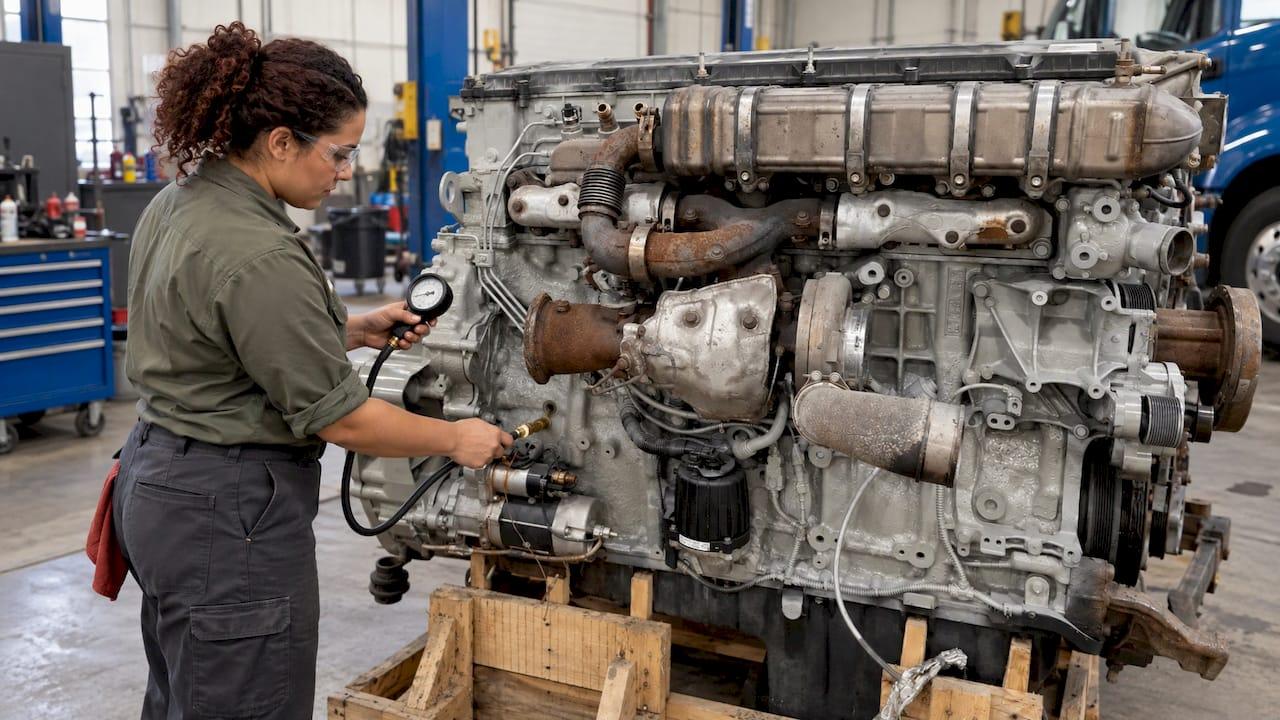
High blow-by means combustion gas is getting past the piston rings and into the crankcase faster than the engine can vent it. Sometimes the rings and liners really are worn. Often the turbo, the air compressor, the breather or a valve guide is the real source, so the order you test in decides whether you fix the truck or spend money on the wrong repair. If the testing does end at a worn-out engine, we supply tested, inspected used diesel engines with a standard warranty and same-day shipping, so the truck is not parked while you decide what comes next.
TL;DR
- Blow-by is combustion gas leaking past the rings into the crankcase. A small amount is normal even in a new engine.
- Heavy breather vapor, oil in the intake, rising oil use, blue smoke, leaks at seals and low power are the classic signs. One sign alone proves little.
- Measure crankcase pressure with a manometer or blow-by meter and compare it to your engine maker's limit. The oil-cap trick only gives a rough idea.
- Rule out the turbo, air compressor, breather and valve guides before you condemn the rings.
- When the cylinders are confirmed as the source, a tested replacement engine is a straightforward way to get the truck back in service.
Table of Contents
- What blow-by is and why every diesel has some
- Symptoms of excessive blow-by
- How much blow-by is too much
- How to test for blow-by, step by step
- Reading the result
- When the engine is the problem
- Keeping blow-by from coming back
- Where a replacement engine fits
- Our view on blow-by
- FAQ
- Sources
What blow-by is and why every diesel has some
In a diesel, combustion pressure can exceed crankcase pressure, so gas leaks past the piston rings into the crankcase, mostly during the power stroke and then the compression event. Rings are not perfectly airtight, so even a new engine shows some.
The cylinders are not the only source. Turbochargers, air compressors and valve stems together can account for as much as 40% of crankcase blow-by, and the amount varies with engine design, temperature, operating conditions and wear. That is why a single number from a forum rarely applies to your engine.
A closed crankcase ventilation system routes those gases back through the intake. Oil in the charge air cooler, hoses, turbo or intake manifold is normal with a closed system, so oil in the intake pipe is a reason to measure, not proof of a bad engine.
Symptoms of excessive blow-by
A service manual for Caterpillar engines describes the picture: too much crankcase pressure, rough running and more fumes than normal from the breather. The same manual notes that the fumes can quickly restrict the breather, which pushes oil out through gaskets and seals.
In the yard or at a truck stop, the pattern usually looks like this:
- Heavy vapor or a steady oil mist at the breather or dipstick tube
- Oil leaking at the rear main, valve cover, oil pan or other seals that were dry before
- Oil consumption climbing from one change interval to the next
- Persistent blue-gray smoke
- Low power under load, hard starting, worse fuel economy
- Oil pushed into the intake or charge air piping
Count the signs. Three or four together point toward the engine. A single one, such as a little vapor at idle, can sit on a healthy motor.
How much blow-by is too much
There is no universal figure. DieselNet cautions that rules of thumb for maximum blow-by should be used with caution because the amount depends so heavily on the engine and how it is run. Limits are published per engine family, and the test conditions matter: engine temperature, rpm, load and the orifice or adapter used.
To show how much specs differ, one GMC ventilation document sets a ceiling of 16 inches of water crankcase pressure measured at the oil level tube with a manometer. Your Cummins, Detroit, Volvo, Cat or International engine has its own number and its own test setup. Pull the service manual for your exact engine and serial range and use that.
Oil consumption is the second half of the picture. Cummins' customer support director has described the warning sign as an engine that used to go 2,000 to 3,000 miles on a gallon of oil and won't make 1,000 miles, which signals serious wear in the cylinder kits. Our guide on how diesel engine oil consumption works covers how to log it.
How to test for blow-by, step by step
1. Start with the quick visual check
With the engine warm and at high idle, no load, watch the breather tube. The Army's field procedure looks for significant fumes or dripping oil at the breather. Make sure the breather element and tube are clear first, since a plugged one inflates every symptom. The old oil-cap test (does the cap hop or blow off?) is fast, but ambient temperature, idle speed and ventilation routing change what you see, so treat it as a reason to keep testing.
2. Measure crankcase pressure
This is the step that turns a guess into a number. Engine Professional argues for a manometer or blow-by meter instead of judging by breather fogging, because symptoms such as low power and oil use do not tell you how severe the leakage is. The usual procedure:
- Park on level ground and confirm the breather is unobstructed.
- Install the manufacturer's adapter and orifice tool, or a manometer on the oil level tube, as the manual specifies.
- Bring the engine to normal coolant temperature.
- Run at the specified rpm, usually high idle with no load, and record the average reading over a couple of minutes.
- Compare it to the limit for that engine.
Write down the reading, mileage and date. A single reading is a snapshot. Two or three readings across oil changes show the trend.
3. Isolate the turbo
This is where many shops save a customer from the wrong repair. The Army procedure disconnects the turbo oil drain line into a bucket: if blow-by drops, the turbo is the source. Engine Professional describes the same idea with a catch can, noting that boost escaping past worn or badly fitted turbo seals is often mistaken for piston-and-ring blow-by. Cummins' customer support director says a good shop isolates the turbocharger when troubleshooting blow-by.
4. Rule out the other sources
Cummins' NT855 troubleshooting manual lists the causes of excessive crankcase gases as a restricted breather vent, leaking turbo seals, a malfunctioning air compressor, worn valve guides and broken or worn piston rings. Work through them in that spirit: cheapest and easiest first. The breather, the air compressor and the turbo drain take minutes to check. Valve guides and rings take a teardown.

5. Test the cylinders
If everything above is clean, check what the cylinders are doing. A leak-down test pressurizes the cylinder at TDC and shows the percentage of air lost. Where you hear the air tells you the culprit: at the crankcase, rings, piston or cylinder wall; at the intake or exhaust, valve sealing. We walk through the numbers in our diesel leak-down test guide. Compression, injector balance, a borescope look and oil analysis fill in the rest. Weak injectors can also muddy the picture, so see our list of bad diesel injector symptoms if the smoke or power loss does not match the readings. Our overview of how diesel engine testing is done shows the full sequence we think a used engine should go through before it is sold.
Reading the result
| What you find | What it likely means | Next move |
|---|---|---|
| High reading, drops when turbo drain is disconnected | Turbo seal or drain problem | Repair or replace the turbo, retest |
| High reading, restricted or fouled breather | Ventilation problem | Clean or replace breather components, retest |
| High reading, air compressor suspect | Compressor passing air or oil into the crankcase | Check or replace compressor, retest |
| High reading, turbo, breather and compressor clear, leak-down air at crankcase | Rings, pistons or liners | Plan a repair or replacement |
| Air at intake or exhaust during leak-down | Valve sealing | Head work |
| Slightly high reading, normal oil use and full power | Wear, not a failed engine | Log it, retest at the next interval |
Engine brakes deserve a mention. MotorTrend notes that engine brakes can contribute to blow-by because they make rings move and vibrate, breaking their seal when activated. Keep the engine brake state in mind when you compare readings.
When the engine is the problem
The engine is the source when the reading is high against the published limit, the turbo, breather and compressor are ruled out, and cylinder tests show the leakage. Rising oil consumption, power loss under load and persistent blue smoke confirm it.
That leaves two roads: an in-frame overhaul or rebuild, or a replacement engine. Overdrive reports typical truck engine overhaul costs of $20,000 or more, and the truck sits through the work. If you are weighing a rebuild, our article on what a diesel engine rebuild kit includes lists the parts involved. If downtime is what costs you most, a tested replacement is worth pricing alongside it.
Overdrive also suggests that engines in the 750,000 to 800,000 mile range deserve closer scrutiny, and that oil analysis at $10 to $20 a sample at every change interval can catch fuel or coolant in the oil and early signs of ring or liner wear. For more on what points to a tired engine, see our diesel engine lifespan indicators and the types of commercial truck engine failures.

Keeping blow-by from coming back
Whatever route you take, the habits are the same. Change oil and filters on schedule, run oil analysis, keep the breather and ventilation path clean, avoid long idling and overloaded lugging, and fix turbo and air intake leaks early. More on this in our guide to extending truck engine life as an owner-operator.
Where a replacement engine fits
Once testing says the cylinders are done, the question is how fast you can be rolling again. Every engine we sell is tested and inspected before sale and carries a standard warranty. Our inventory changes daily, we ship the same day, and we stock engines from Caterpillar, Cummins, Detroit, Volvo, International, Mack, Paccar and other makes. Browse our truck engines for sale, or look at specific units such as a 2015 Detroit DD15 or a 2015 Volvo D13.

If the diagnosis also turned up damage elsewhere in the driveline, we carry transmissions and differentials too.
Our view on blow-by
Most blow-by calls start with a truck owner who sees vapor at the breather and fears the worst. Our advice is to measure first. Get a reading, isolate the turbo, check the breather and the compressor, and only then decide about the cylinders. A good diagnosis saves you from replacing an engine that only needed a turbo.
When the numbers do say the engine is worn out, the cost that hurts most is the days the truck is not earning. That is why we test and inspect every engine, back it with a standard warranty and ship the same day. Our inventory changes daily, so the match for your make and model may be listed right now.
Know your engine's limit, log your readings, and make the call with data.
John
FAQ
What causes high blow-by in a diesel engine?
The cylinders are one cause: worn or broken piston rings and liners. Others are a restricted crankcase breather, leaking turbo seals, a malfunctioning air compressor and worn valve guides, all listed in Cummins' troubleshooting manual. Check the cheap ones first.
How much blow-by is normal in a diesel?
Some is normal in every engine, and the limit depends on the engine family, so use the figure in your engine's service manual. DieselNet warns that generic rules of thumb should be used with caution. Measure with a manometer under the manual's test conditions and track the trend over time.
Is the oil-cap test a reliable blow-by test?
It is a quick first look, not a verdict. Temperature, idle speed and ventilation design all change what you see. A manometer or blow-by meter gives a number you can compare with the spec, which is the approach Engine Professional recommends.
Can a bad turbo cause high blow-by?
Yes. A leaking turbo seal can send oil and boost into the crankcase, and it is often mistaken for ring blow-by. Disconnecting the turbo oil drain into a catch can and re-measuring shows whether the turbo is the source.
What do I do if the engine is worn out?
Confirm it with pressure readings and a cylinder test, then choose between a rebuild and a replacement. If downtime is the concern, look at our tested engines, which ship the same day and carry a standard warranty.
Sources
- What Is Diesel Blow By, MotorTrend
- Crankcase Ventilation, DieselNet
- Engine Crankcase Pressure (Blowby) Test, Caterpillar service manual
- Crankcase ventilation, GMC service document 4290140
- Time for an overhaul, Overdrive
- Check for Excessive Engine Crankcase Pressure (Blow-By), TM 5-3805-280-24-2
- Blow-By Measurement and Detection, Engine Professional
- NT-855 Series Engines troubleshooting manual, Cummins