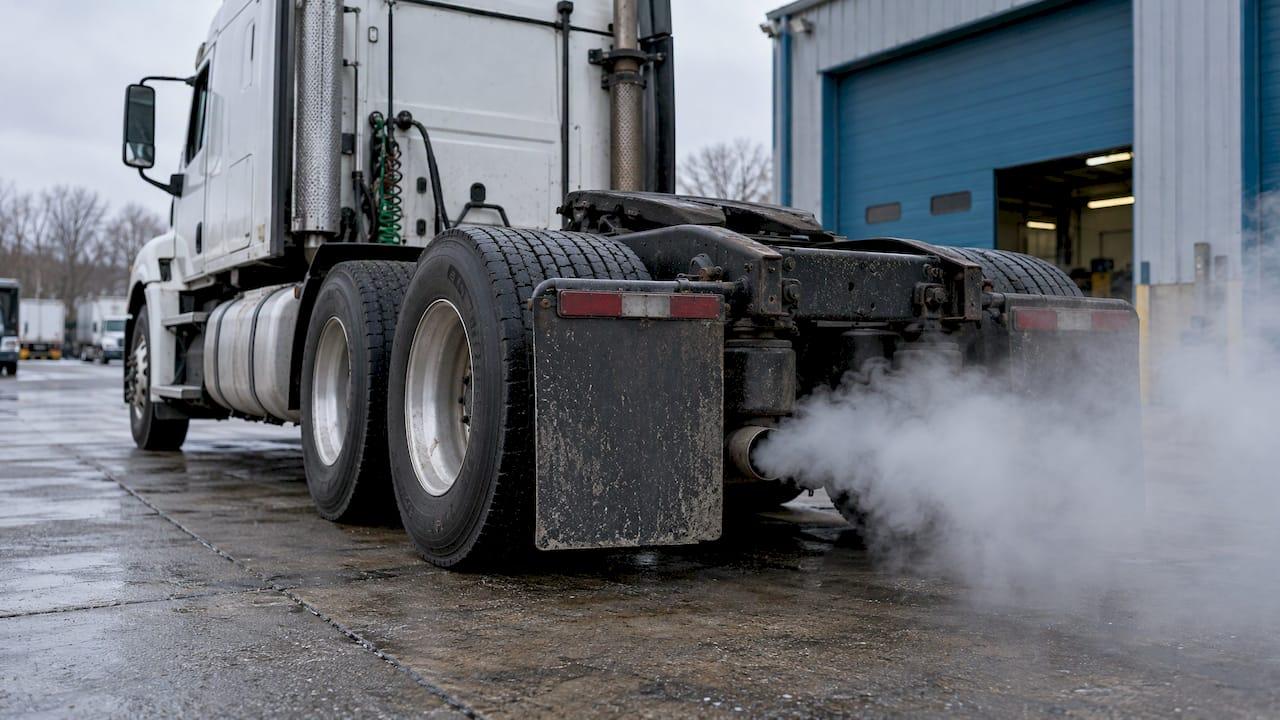
White smoke from a diesel engine means one of three things: harmless condensation, unburned fuel, or coolant getting into the cylinders. The first two are usually fixable with a filter, a glow plug or an injector. The third can end in a failed engine. The deciding factor is how long the smoke lasts and what comes with it. Thin vapor that clears as the engine warms is normal. Heavy smoke at operating temperature, a sweet smell, falling coolant or milky oil is not. If you reach that point and the block or head is damaged, a tested, warrantied replacement from our truck engine inventory is how you get the truck back on the road.
TL;DR
- A little thin white smoke on a cold start that disappears as the engine warms is usually normal.
- White smoke that lingers at operating temperature points to fuel-system trouble (injectors, timing, glow plugs) or coolant entering the cylinders.
- A sweet smell, coolant loss with no visible leak, milky oil or overheating means stop driving: liquid in a cylinder can bend a connecting rod and lock the engine.
- Smoke color is a clue, not a diagnosis. Confirm with a coolant check, codes, a compression test and injector tests.
- Repairs range from a few hundred dollars for an injector to several thousand for head work, so catching it early matters.
Table of Contents
- What white smoke is telling you
- Is white smoke on startup normal?
- The main causes, from cheapest to most serious
- How to diagnose it step by step
- How long can you drive with white smoke?
- Repair or replace the engine?
- Get a tested engine when the diagnosis says replace
- Our view on white smoke
- FAQ
- Sources
What white smoke is telling you
A diesel burns fuel by compressing air until it is hot enough to ignite the fuel spray. White smoke shows up when something in that chain fails: the cylinder is too cold to burn all the fuel, the fuel is not atomizing properly, or something other than fuel and air is in the cylinder.
The Oregon Department of Environmental Quality ties white diesel smoke to an improper air and fuel mixture and lists fuel injection faults, incorrect injection or valve timing, overheating, and fuel or injection pump faults as common causes. The same document says its color table is a list of common causes and should not be used as a diagnostic test. Treat color as a starting point.
The quick color guide, for reference:
| Smoke color | What it usually points to |
|---|---|
| White | Condensation, unburned fuel, or coolant in the cylinders |
| Blue | Burning engine oil: worn rings, valve-stem seals, turbo seals or a PCV problem |
| Black or gray | Too much fuel or too little air: injectors, air filter, intake or boost issues |
The blue and black rows come from UTI's diesel troubleshooting guide. If your smoke is blue, our piece on how diesel engine oil consumption works covers it in more detail.
Is white smoke on startup normal?
Often, yes. Cold air lowers the temperature in the cylinder at the end of compression, so some injected fuel does not burn completely and leaves as white droplets. Agriculture.com's guide to reading smoke explains this and notes that the smoke should disappear as the engine warms, with older mechanically governed engines taking longer than electronically controlled ones.
The Iowa Department of Natural Resources makes the same call: white smoke from low engine temperature at startup needs no repair. It also notes that in cold weather what looks like smoke is often just water vapor from condensation, the same thing you see from a car tailpipe on a freezing morning.
There is no universal cutoff such as 30 seconds or a minute. The window depends on the engine, the ambient temperature and the aftertreatment strategy. Use this rule: if it thins out and is gone once the engine is up to temperature, with no warning lights and no coolant loss, keep an eye on it. If it comes back every morning and gets worse, start diagnosing.
Another normal case: air in the fuel system
After running a tank dry or changing a fuel filter, air can be trapped in the system. Ford's owner's guide for its diesel says the engine purges the trapped air on its own and may run rough and puff white smoke for a short time, which is normal. The same guide warns that bad fuel, such as high water content, low cetane or gasoline contamination, can cause poor running after a fill. If rough running and white smoke follow a fill-up, think fuel quality before you think engine damage.
The main causes, from cheapest to most serious
Work through the list in this order. It follows the likelihood and the cost of each repair.

1. Water or contaminated fuel
Water in the fuel does not burn, and it shows up as white smoke, rough running and sometimes a water-in-fuel lamp. Drain the separator, replace the filters and make sure the tank is clean. This is the cheapest fix on the list, so rule it out first, especially after a fill at an unfamiliar stop.
2. Weak glow plugs or grid heater
On a cold start, a dead glow plug leaves a cylinder too cold to burn its fuel. The signs are hard cold starts, rough warm-up and white smoke that fades after a few minutes. Innova's glow plug guide cautions that wiring, relays or control modules can cause the same symptoms, and that a fault code alone does not prove a plug has failed. Measure resistance at the plug before you replace anything. Smoke that appears only on cold starts and disappears at temperature leads here first.
3. Faulty injectors
A leaking, dribbling or poorly atomizing injector sends raw fuel into the cylinder. You get white smoke, a raw diesel smell, a rough idle, and often a misfire you can trace to one cylinder. UTI's guide says unburned fuel is the usual cause of white smoke at cold start, so a worn injector is a common reason that normal-looking startup smoke becomes constant.
On electronically controlled engines, a scan tool helps. Heavy Duty Journal's Cummins ISX guide says injector balance rates beyond plus or minus 4 point to a problem injector. It gives $400 to $600 per injector installed and $2,400 to $3,600 for a full set on that engine (September 2026 figures). For the symptoms in more detail, see bad diesel injector symptoms in heavy trucks and fuel injectors and diesel performance.
4. Injection pump or timing faults
Retarded injection timing delivers fuel too late to burn fully, and it comes out the exhaust as white smoke. This lines up with the Oregon DEQ's list of incorrect injection or valve timing and pump faults. Timing issues usually come with lost power and poor fuel economy, not just smoke.
5. Low compression
Worn rings or valves let compression leak, so the cylinder never gets hot enough to burn all the fuel. White smoke with hard starting, power loss and sometimes blue smoke too suggests worn internals. A compression test settles it.
6. Coolant entering the cylinders
This is the cause that matters most. Coolant burned in the cylinder makes thick white smoke, often with a sweet smell. Typical sources are a failed head gasket, a cracked head or block, or a leaking EGR cooler. UTI says persistent smoke can indicate coolant entering combustion through these routes. Our coolant system guide for heavy truck engines explains why this system is so critical to engine life.
Heavy Duty Journal reports that persistent white smoke after warmup is a key indicator of head gasket failure. It puts shop rates at $100 to $175 an hour and total head gasket replacement at $2,500 to $6,000, with heavy-duty work running above $10,000, and head machining adding $150 to $400 per head if the head is warped.
Before anyone pulls a head, pressure-test the EGR cooler on its own. A leaking cooler can mimic a head gasket failure, and the teardown is much more expensive.

How to diagnose it step by step
A methodical routine beats guessing at parts. Record the facts first, then test.
- Note when the smoke appears. Cold start only, idle, acceleration, under load or continuous? Note the ambient temperature and whether it clears. Cold-start-only smoke points to glow plugs or condensation. Smoke after warmup points to fuel, coolant or compression.
- Smell it. A sweet odor suggests coolant. A raw fuel smell suggests an injector or timing problem.
- Check coolant level over several days. A level that keeps dropping with no puddle under the truck is a red flag for internal leakage.
- Check the oil. Milky oil or a rising oil level means coolant is getting into the crankcase.
- Scan for codes. Look at injector balance rates and glow plug circuits, remembering that codes point to a circuit, not always a failed part.
- Run a compression test. This separates mechanical wear from fuel-system trouble.
- Pressure-test the cooling system and run a combustion gas test. Bubbles or exhaust gas in the coolant confirm an internal leak.
- Isolate the EGR cooler. On engines with a variable geometry turbo, one shop tip is to unplug the VGT actuator and watch the bubbles. If they disappear, suspect the EGR cooler. If they continue unchanged, suspect the head gasket.
If the engine passes the fuel checks and fails the coolant and compression checks, you are looking at major internal work or a replacement engine.
How long can you drive with white smoke?
It depends on what is behind it. Use the truck's condition, not the look of the cloud:
| Situation | What to do |
|---|---|
| Thin vapor at cold start, clears in minutes, no warning lights, no coolant loss | Keep driving and watch it |
| Smoke repeats, hard starting, rough idle, water-in-fuel light | Get it diagnosed before the next long run |
| Heavy smoke after warmup, sweet smell, rising coolant temperature, dropping coolant, milky oil, stop-engine warning, knock | Pull over at the first safe spot, shut down and tow |
The stop-and-tow rule comes from hydrolock. Liquid does not compress. If coolant fills a cylinder, the piston cannot complete its stroke and something bends or breaks. A 2020 simulation study in the Journal of Mechanical Engineering and Sciences, as cited by Heavy Duty Journal, found a connecting rod begins to deform once liquid fills about 80 percent of the combustion chamber. That is why a truck with confirmed coolant intrusion should be stopped and towed, not nursed home.
No additive or tune fixes a bad injector, a timing fault or a coolant leak. The part causing it has to be repaired or replaced, and the longer you drive on it, the more it costs.
Repair or replace the engine?
If the cause is a glow plug, a filter or one injector, repair is the obvious answer. When coolant has been running into the cylinders, the math changes. Heavy Duty Journal's head gasket range of $2,500 to $6,000, and more for heavy-duty work, assumes the block and head are still good. If the truck has been run with smoke, overheated, or hydrolocked, the damage may reach the block, rods or crank.
This is where a replacement engine is worth pricing against the repair. Our guides on types of commercial truck engine failures, diesel engine lifespan indicators and diesel engine mileage benchmarks help you decide whether the engine you have is worth rebuilding. If you are swapping, read engine swap emissions laws for heavy-duty trucks before you choose the replacement.
Get a tested engine when the diagnosis says replace
When the compression test, coolant test and oil check say the engine is done, downtime is the real cost. Nationwide Heavy Truck Parts sells used diesel engines that are tested and inspected before sale and carry a standard warranty. Our inventory changes daily, covers Caterpillar, Cummins, Detroit, Volvo, International, Mack, Paccar and other major brands, and ships same day.

Start with our truck engines. If the problem has also taken out a driveline part, we carry transmissions, differentials and exhausts. Detroit DD15 owners can also look at the 2015 Detroit Diesel DD15 engine.
Our view on white smoke
White smoke is the symptom operators most often wave off, and it is the one that most often turns into a tow. The cold-morning puff is nothing. The smoke that stays after warmup, with a sweet smell or a dropping coolant level, is an engine telling you it is about to lose cylinders to liquid.
Our advice is to settle the cheap causes first: fuel, filters, glow plugs, injectors. Then test for coolant and compression before you spend on teardown labor. If the engine is truly finished, a swap beats a long shop stay for most fleets and owner-operators, because every day parked is a day without revenue.
That is why we test and inspect every engine, back it with a standard warranty and ship the same day. A replacement should be one decision, not a second round of risk.
John
FAQ
Why does my diesel blow white smoke on startup?
Cold cylinders do not burn all the injected fuel, so some leaves as white vapor. It should thin out and disappear as the engine warms. If it comes with hard starting, check the glow plugs or grid heater first.
Is it normal for a diesel to smoke white?
Briefly, on a cold start, yes. It is also normal for a short time after air gets into the fuel system following a filter change or a dry tank. White smoke that continues at operating temperature is not normal and needs diagnosis.
How long can I drive with white smoke from the exhaust?
Thin smoke that clears within minutes can be monitored. Heavy smoke after warmup, a sweet smell, overheating, falling coolant or milky oil means stop at the first safe place and have the truck towed, since coolant in a cylinder can lock the engine.
What color is unburned diesel smoke?
Unburned fuel usually shows as white or light gray, often with a raw diesel smell. Coolant smoke is also white but is thicker and smells sweet. Blue smoke is burning oil, and black smoke is excess fuel or too little air.
How do I fix white smoke in a diesel engine?
Fix the cause, not the smoke. Drain water and change filters for bad fuel, replace failed glow plugs, replace or recalibrate bad injectors, correct timing faults, and repair the head gasket, head or EGR cooler for coolant intrusion. Additives do not repair any of these.
Sources
- Smoking Vehicles, Oregon Department of Environmental Quality
- Vehicle Exhaust, Iowa Department of Natural Resources
- Common Diesel Engine Problems: Your Troubleshooting Guide, UTI
- Reading Smoke Signals on Tractors, Agriculture.com
- Ford owner's guide, diesel fuel system
- Glow Plugs guide, Innova
- Cummins ISX Problems, Heavy Duty Journal
- Detecting and Repairing Diesel Head Gasket Failure, Heavy Duty Journal
- Diesel Fuel Cooler Leak, Heavy Duty Journal