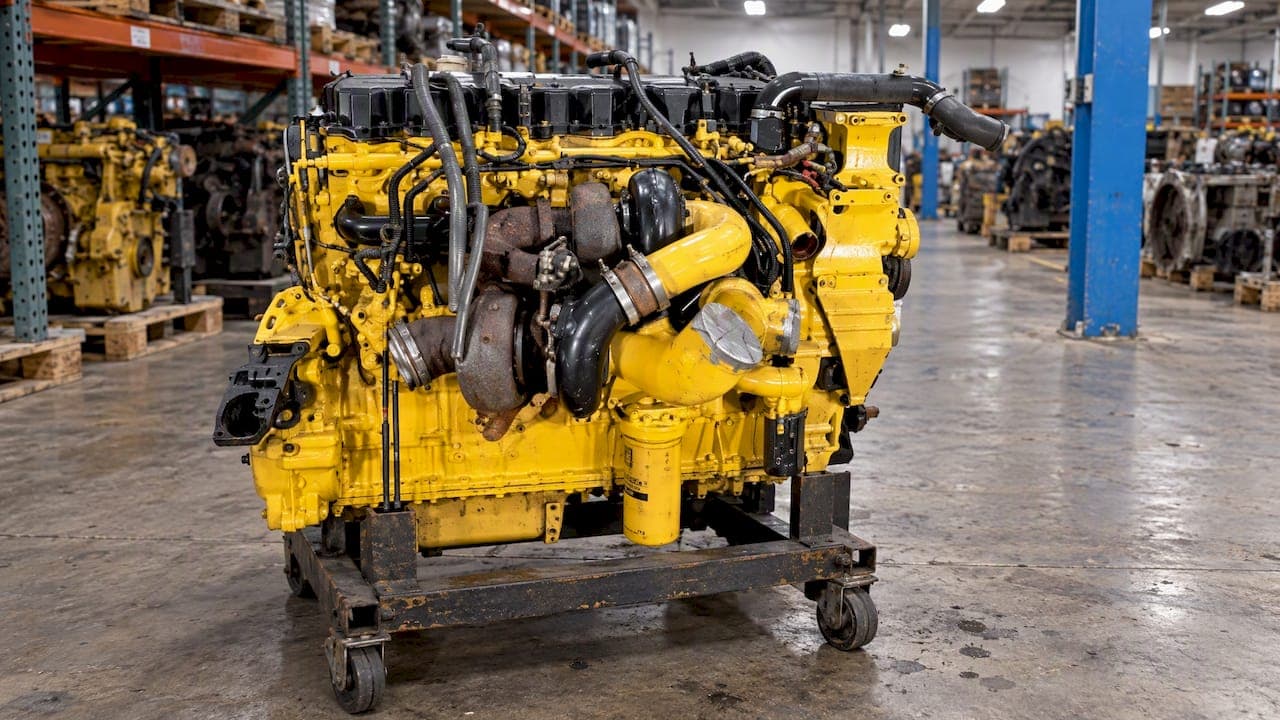
The Caterpillar C15 is a 15.2-liter inline-six diesel that replaced the 3406E in North American heavy trucks. It is still one of the most common engines in used-engine searches. Early C15s, the MBN versions and the twin-turbo ACERT engines look alike from across the shop, but they are not interchangeable. This guide covers what each one is, how the ratings compare, where the weak spots are and how to verify the exact engine you need before you spend money.
TL;DR
- The C15 is a 15.2-liter inline-six that Caterpillar's own spec sheet describes as turbocharged and aftercooled. It came after the 3406E and was built in on-highway and industrial forms.
- "C15" is a family name. Early, MBN and ACERT engines differ in emissions hardware, fuel system and parts, so match the serial number and arrangement number, not the name.
- Known trouble spots reported by owners include head gaskets on earlier engines, and rocker studs, exhaust manifold studs and injectors on earlier ACERT engines.
- A tested used engine with a warranty is often the fastest way to get a down truck moving again.
Table of Contents
- What the Caterpillar C15 is
- Where the C15 was used
- Cat C15 specs at a glance
- Early, MBN and ACERT: the three C15 families
- Cat C15 vs 3406E
- Common C15 problems and maintenance concerns
- How to identify the right C15 before you buy
- Why replace instead of rebuild or retire the truck
- Our perspective on buying a used C15
- Find a tested C15 for your truck
- FAQ
- Sources
What the Caterpillar C15 is
Caterpillar launched the C15 in 1999 as the next step after the 3406E. Truck News reported at the time that it borrowed heavily from the 14.6-liter 3406E and was almost 200 pounds lighter. The engine is a four-stroke, inline six-cylinder with 15.2 liters (927.6 cubic inches) of displacement, turbocharged and air-to-air aftercooled, according to Caterpillar's industrial engine specification sheet.
It was sold two ways. The on-highway version powered line-haul and vocational trucks. The industrial version went into equipment such as pumps, cranes, loaders, mining machines and generator sets. If you are shopping for a truck, you want the on-highway arrangement. The industrial and truck engines share a block family but not necessarily accessories, ECM programming or mounting.
The on-highway line ended when Caterpillar stopped building highway truck engines, reported to be in 2010. Industrial C15s continued after that. Because so many trucks were built with the engine, parts and used cores are still plentiful, and that is why the C15 stays in demand with owner-operators who prefer to keep a paid-off truck running.

Where the C15 was used
In 2003, Heavy Duty Trucking said the engine was used by large North American fleets and owner-operators and was also popular in fire trucks and emergency vehicles. Peterbilt buyers could order ACERT C15s in the 379, 387, 385, 378 and 357, with ratings of 435 to 550 hp at that point.
Other common homes, per a listing of legacy on-highway applications, include the Freightliner Coronado, International 9900i, Kenworth T800 and W900, and Peterbilt 379 and 389. The Freightliner Century Class also listed the C15 alongside the 3406E among its available powertrains.
That spread matters when you buy. The same C15 name can appear in a glider-style W900 and a vocational dump truck, with different ratings, ECMs and wiring. Always buy for your chassis, not just your engine badge.
Cat C15 specs at a glance
Published figures vary by source because ratings changed across years and applications. Use this as a map, then confirm against your information plate.
| Item | Typical figure | Notes |
|---|---|---|
| Displacement | 15.2 L (927.6 in³) | Cat spec sheet |
| Bore | 137 mm | Same sheet |
| Stroke | 171 mm on Cat's industrial sheet | Some summaries list 165 mm, so check the sheet for your arrangement |
| Industrial ratings | 440 to 595 hp at 1,800 to 2,100 rpm | Industrial applications |
| On-highway ACERT ratings (2003) | 435 to 550 hp | Heavy Duty Trucking |
| Later Freightliner options | 600 hp / 1,850 lb-ft and 625 hp / 2,050 lb-ft | Truck News, 2005 |
| Torque across the family | Roughly 1,550 to 2,050 lb-ft | Depends on rating |
| Basic industrial engine weight | About 3,395 to 3,673 lb | Cat sheet, 2016 |
| Oil capacity | About 51.1 U.S. quarts | Per one summary |
A few practical notes on those numbers:
- Horsepower is not the whole story. Two C15s at 475 hp and 550 hp may run different cam, fuel and ECM setups. Torque rise and peak torque rpm matter for hills and heavy loads.
- Industrial figures are not truck figures. When a spec sheet mentions Tier 4 Final or well-service ratings, it describes off-highway engines. The C15 ACERT Tier 4 Final well-service engine, for example, is rated 475 to 580 bhp for oilfield work, not for your Kenworth.
- Compression ratio changed. Early engines run about 17.0:1 and the ACERT version about 18.2:1, according to one engine summary. That is one reason you cannot casually mix pistons, heads or ECMs across versions.
Early, MBN and ACERT: the three C15 families
When readers ask about "Cat C15 vs ACERT," they are really asking which generation of C15 they have or should buy. ACERT is not a different engine family. It is a later version of the C15 that used Caterpillar's ACERT emissions approach instead of the earlier single-turbo setup.
Early C15 (6NZ and 9NZ)
The original on-highway engines carried 6NZ and 9NZ serial prefixes, as listed in one history of the engine. These are the closest relatives to the 3406E in feel and in the way they are serviced. They use the earlier fuel and electronic architecture, run the lower compression ratio and are generally the simplest of the three to diagnose.
MBN "Bridge" engines
The MBN was introduced in 2001 and ran through 2003, per the same source. Mechanics call it a bridge engine because it sits between the early C15 and the ACERT. Parts and ECM compatibility can be tricky here. This is where having the arrangement number in hand saves the most time.
C15 ACERT
Caterpillar's 2003 on-highway introduction of ACERT was covered by Heavy Duty Trucking when the engine received EPA certification. Truck News later described the C15 in the Coronado as using ACERT and complying with EPA 2004 standards. Twin-turbo ACERT engines are the ones most commonly called "C15 Acert" in the used market, and some are listed as MXS-type configurations.
In practice, owners looking at ACERT engines weigh higher ratings and fuel-economy goals against more emissions-related and electronic complexity. Owners looking at the earlier engines often value the simpler setup. Neither is automatically better. The right one is the one that matches your truck's year, ECM and wiring.
Cat C15 vs 3406E
The 3406E is the engine the C15 replaced, and many drivers still debate which is the better long-haul motor. The 3406E is a 14.6-liter inline-six. The C15 moved to 15.2 liters and shed weight, according to Truck News' 1999 launch coverage, which also gave the C15's early ratings as 355 to 550 hp with peak torque up to 1,850 lb-ft.
Here is how the practical differences usually play out:
- Size and weight. The C15 is bigger in displacement and lighter in weight. That helps with front-axle loading on some setups.
- Ratings. The C15 line later reached higher torque, including 2,050 lb-ft in certain Freightliner ratings.
- Familiarity. Plenty of shops have decades of 3406E experience. The early C15 is close to that, while ACERT engines add more modern emissions components.
- Swaps. Do not assume a 3406E and a C15 trade places. Mounts, ECMs, harnesses, cooling and accessories can differ. If you are considering a swap between families, plan it as a project, not a bolt-in. Our walkthrough on how truck engine replacement works shows what to line up before the old engine comes out.
Common C15 problems and maintenance concerns
No high-mileage engine is trouble free. The patterns reported most often for the C15, per one engine summary, are:
- Head gasket failures on earlier C15 engines.
- Broken rocker studs on earlier ACERT engines.
- Exhaust manifold and stud problems, also on earlier ACERT engines.
- Fuel injector failures on those same early ACERT builds.
What to do about it:
- Watch for the early signs. Coolant loss with no visible leak, white smoke, or oil in the coolant point to a head gasket. A ticking exhaust leak at cold start often points to manifold studs.
- Keep to the oil schedule. Caterpillar's industrial sheet lists oil change intervals up to 500 hours depending on operating conditions and maintenance. That is an industrial figure. For an on-highway engine, follow the interval in your own operation and maintenance manual and your oil analysis results.
- Test the engine brake circuit. Pacbrake's service data for 3406E, C-15 and C-16 engines gives solenoid resistance of 15.5 ohms plus or minus 15 percent at 70°F, and 20.0 ohms plus or minus 15 percent at 180°F. If the brake is weak or inconsistent, that is a quick, cheap check before you blame the engine.
- Ask for records. When buying a used engine, ask what testing was done and what the warranty covers. A teardown history or compression and leak-down results say more than a mileage claim.
If you are weighing a rebuild against a replacement, our guide to what a diesel engine rebuild kit includes helps you price the parts side honestly, and examples of remanufactured truck engines lays out the middle option.
How to identify the right C15 before you buy
This is where most wrong-engine orders start. Caterpillar's operation and maintenance manual says to record the engine serial number, model, arrangement number and the information plate details such as horsepower and full-load speed. Dealers use those identifiers to find the original component configuration and the correct replacement part numbers.
A short checklist:
- Find the plate and the block stamping. Our guide to engine serial number location on Cummins, Cat and Detroit engines shows where to look.
- Write down the serial prefix and arrangement number. Photograph the plate before you start calling.
- Match the emissions generation. Early, MBN and ACERT engines are not interchangeable just because each is called a C15.
- Match the rating and application. Confirm horsepower and torque rating against your truck and ECM.
- Confirm what ships with the engine. Ask whether the turbos, injectors, ECM, wiring and manifolds are included, and what you will reuse from the old engine.
- Ask about testing and warranty in writing. A used engine should come with a stated warranty and a description of how it was tested.
If you want a broader view of options before settling, see types of used semi truck engines and types of heavy truck diesel engines.
Why replace instead of rebuild or retire the truck
A C15 that has outlived its original block is often still attached to a sound frame, good axles and a paid-off truck. Putting a tested engine in can cost far less than buying another truck. We lay out that reasoning in why engine replacement beats a full truck purchase. If downtime is the problem, our guide to replacing a semi truck engine quickly covers how to line up the engine, the shop and the ancillary parts so the truck is not sitting. Fleets handling several trucks at once can use our notes on coordinating multi-truck engine replacements, and our piece on saving on heavy truck engine costs covers the cost side.
Our perspective on buying a used C15
We sell used heavy truck engines, so we see what goes wrong on both sides of the order. The most expensive C15 mistake is rarely the engine itself. It is the wrong engine for the truck: an ACERT ordered for an MBN-era chassis, or an industrial arrangement bought for an on-highway truck because the name matched.

Our advice is simple. Do the identification work first. Get the serial number, arrangement number and rating from the plate. Then buy an engine that has been tested and inspected, with a standard warranty behind it, so you are not betting your revenue days on a seller's word. Inventory changes daily, so if the exact configuration is not listed today, ask rather than settle for a near match.
We also think the C15 earns its reputation. The industry keeps rebuilding and reusing it long after highway production ended, and that persistence comes from durability in long-haul and mining work. Treat it well, keep up the oil and cooling, and a good C15 keeps paying for itself.
— John
Find a tested C15 for your truck
If your C15 is down or you are planning ahead, we carry tested and inspected used diesel engines with a standard warranty and same-day shipping nationwide. Start with our truck engines for sale, or go straight to a specific build: the CAT C-15 Acert engine, the C15 Acert twin turbo engine or the C15 Acert MXS engine.

Need more than the engine? We also stock transmissions, differentials and exhausts, so one call can cover the driveline. Have your serial number and arrangement number ready and we can match the engine to your truck.
FAQ
How many liters is a Cat C15?
The C15 displaces 15.2 liters (927.6 cubic inches), according to Caterpillar's specification sheet. It is an inline six-cylinder, turbocharged and aftercooled. Bore is listed at 137 mm.
Is the C15 ACERT a different engine from the regular C15?
It is a later version in the same family, not a separate engine line. The ACERT used a different emissions approach and was reported as meeting EPA 2004 standards. Because parts, ECMs and compression ratio differ from earlier engines, always match by serial and arrangement number.
Is the C15 better than the 3406E?
It depends on the truck and the owner. The C15 is larger at 15.2 liters against 14.6 and was lighter when it launched, per Truck News. Many drivers prefer the 3406E's simplicity, while others want the C15's later ratings. Either way, a swap between the two is a project, not a drop-in.
What are the most common C15 problems?
Owners report head gasket failures on earlier engines, and broken rocker studs, exhaust manifold stud problems and injector failures on earlier ACERT engines, as summarized here. Watch for coolant loss, white smoke and exhaust leaks. A mechanic who knows Cat engines should confirm the diagnosis before you commit to a repair or a replacement.
Is the C15 still being made?
On-highway production ended when Caterpillar left the highway engine market, reported as 2010. Cat still lists C15 industrial engines, including Tier 4 Final well-service versions. For trucks, used and remanufactured engines are the practical source.
Sources
- Caterpillar Gets EPA Nod For C15 Engine, Heavy Duty Trucking
- Peterbilt Buyers Can Now Order Caterpillar ACERT Engines, Heavy Duty Trucking
- Higher Power, Truck News
- Freightliner ups HP on Cat engines, Truck News
- Cat C15 Industrial Diesel Engine specification sheet
- Cat C15 ACERT Diesel Engine Industrial specification sheet
- C15 ACERT Tier 4 Final Well Service Engines, Cat
- Caterpillar C15 Engine Operation and Maintenance Manual
- P-39A Caterpillar 3406E/C-15/C-16 engine brake data
- Caterpillar C15 legacy on-highway specs
- CAT C15 Diesel Engine: Specs, Applications, Problems
- Freightliner Century Class