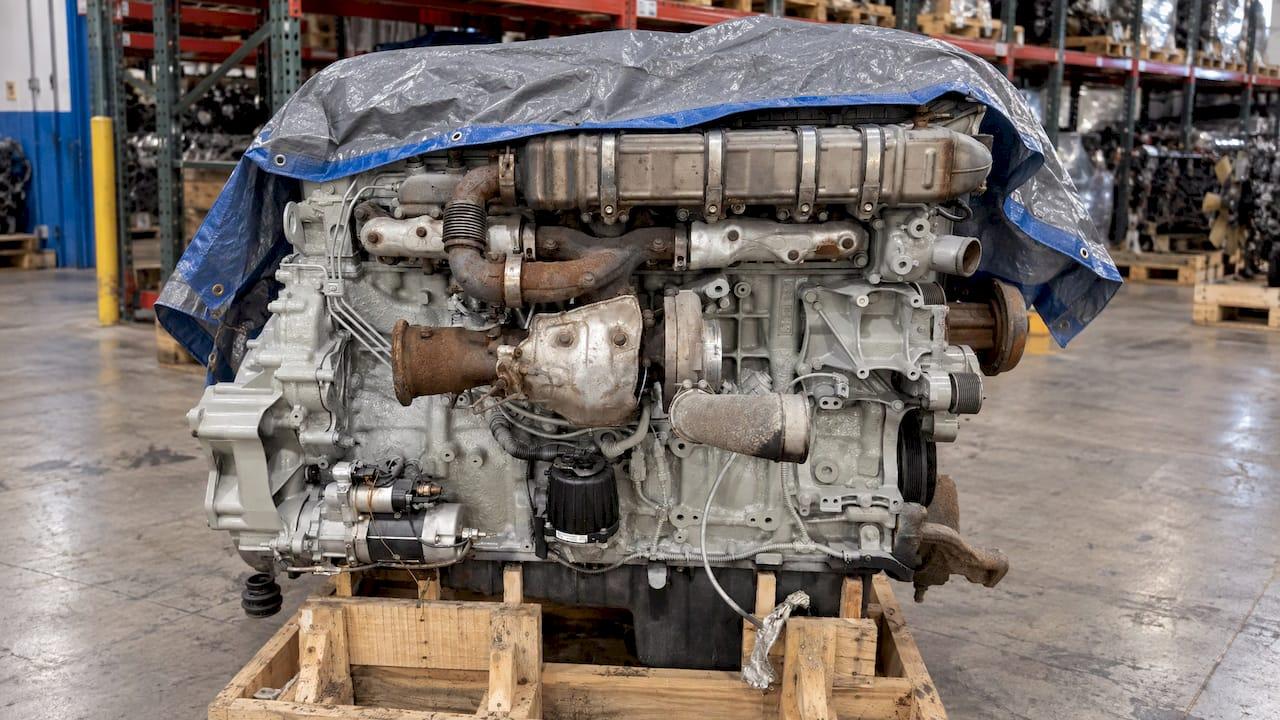
A diesel engine sitting on a pallet is not safe just because it is not running. Oil drains off internal surfaces, moisture condenses on bare metal, and seals dry out. The guidelines below follow the manufacturers' own storage bulletins: prepare the engine for the length of storage, keep it dry and covered, and check it again before it goes into a truck. We sell tested, warrantied used diesel engines, so we handle stored engines every day. This guide covers the routine and the checks that follow.
TL;DR
- For storage over 30 days, Detroit Diesel's bulletin calls for a preservative oil fill, a flushed cooling system, a fuel system sealed after a short run, and sealed openings.
- Store the engine indoors in a dry, ventilated space, on a flat hard surface, covered and sealed against pests and moisture.
- Turning or running the engine on a schedule is recommended by several makers, but the interval depends on the maker and the storage method.
- Before install, inspect for rust, leaks and damaged belts or hoses, and use oil analysis and a borescope for a deeper look.
- Treat one oil sample or one clean borescope image as a data point, not a verdict.
Table of Contents
- Why stored engines get damaged
- Match the procedure to the storage period
- Preparing a diesel engine for extended storage
- Where and how to store the engine
- Keeping a stored engine healthy
- Inspecting an engine when it arrives or comes out of storage
- Oil analysis on a used or stored diesel engine
- Borescope inspection
- Our view on storing and installing engines
- When you need an engine ready to install
- FAQ
- Sources
Why stored engines get damaged
If an engine is not used, oil can run off the interior parts that normally stay lubricated. The lack of lubricant lets condensation form on bare metal, and that causes corrosion, especially in humid areas. Sherman+Reilly gives this as the reason for running a stored engine periodically.
The damage is quiet. A cylinder wall with surface rust or a seized water pump seal looks fine on the shelf and shows up in the first hours of service. That is why every maker publishes a storage procedure, and why the right procedure depends on how long the engine will wait.
Match the procedure to the storage period
The makers draw their lines in different places, so decide your timeline first.
| Storage period | What the maker's documents call for |
|---|---|
| Over 30 days | Detroit Diesel's 2012 bulletin sets this as the threshold for its extended storage procedure |
| Up to 1 year | John Deere says to change the oil and filter and add rust preventive oil; Caterpillar's 3406 instructions say the treatment protects for a year or less |
| Over 1 year | Deere says to drain, flush and refill the cooling system; Kubota specifies a rust-preventive circulation about every 1.5 years |
Sources: Detroit Diesel bulletin 485-12, John Deere manual OMRG33324, Kubota KSI-275.
When in doubt, prepare for the longer period. Plans change, and an engine prepped for a year is not harmed by being installed in three months.
Preparing a diesel engine for extended storage
Detroit Diesel's Service Information Bulletin 485-12 is the most complete heavy-truck procedure in circulation. It runs 20 steps for engines stored more than 30 days. The core of it is below. Always confirm against the manual for your exact engine, because other makers differ in the details.
1. Cooling system
Drain and flush the system with clean soft water and a rust inhibitor. Coolant that sits in an idle engine keeps attacking metal, so the system should be clean and properly inhibited before the engine waits. Our guide to the coolant system's role in heavy truck engines explains what the inhibitors are doing.
2. Crankcase oil
Drain the crankcase, install new oil filters and fill with preservative oil. Detroit specifies Tectyl 930A or an equivalent 30-weight oil meeting Mil-L-21260C Grade 2. John Deere makes the same point for its engines: used oil does not give adequate protection, so change it first. Deere's alternative for storage up to one year is to add 30 mL of rust preventive oil per 1 L of engine oil.
3. Fuel system
Drain the fuel tank and add enough clean ultra-low-sulfur diesel for about ten minutes of operation. Run the engine for five minutes to circulate the clean fuel, then plug the fuel return and inlet lines.
On biodiesel, John Deere advises against it for long-term storage. If you must use it, the manual says to keep the blend to B7 or less, with a quality stabilizer, and to store no longer than one year.
4. Seal every opening
Seal the turbocharger air inlet and exhaust outlet with moisture-resistant tape. Cover the other engine openings too. This keeps out moisture, dust and anything that likes to nest in an exhaust port.

5. Protect exposed metal and belts
Apply a non-friction rust preventive compound to exposed parts. Put heavy paper strips between pulleys and belts so the belts do not stick or set. Clean the exterior and protect the surfaces. Caterpillar's 3406 instructions note that paint protects outside parts for up to two years.
6. The battery, if one is with the engine
Remove it, clean it and charge it fully. Store it in a cool, dry place and never let it fall below 0°C (32°F). Sherman+Reilly adds that discharged batteries are damaged by freezing temperatures. If you keep diesel exhaust fluid on hand, the same source says it commonly lasts two years at optimal temperatures, and heat above 86°F shortens that.
7. Cover it
Cover the engine with a weather-resistant tarpaulin and store it under cover, preferably in a dry building that can be heated in winter.
Where and how to store the engine
Kubota's 2025 storage bulletin is specific about the space:
- Store indoors, away from rain.
- Choose a dry, well-ventilated area without direct sunlight, extreme temperature swings or sea breezes.
- Prevent wildlife from getting in.
- Set the engine on a hard, flat surface with the oil fill cap and gauge tightened, all ports covered and a plastic cover over the engine.
If an engine has to sit outdoors, Caterpillar's 3406 instructions describe a waterproof cover that is tight but loose enough to allow air circulation. They say to remove it every two or three months to check for corrosion. Outdoor storage is the harder path, and Arrow Engine's brochure says outdoor or humid storage needs additional preservatives beyond what an indoor engine gets.
Keeping a stored engine healthy
The makers disagree on interval, so follow the one for your engine:
- Run it: Sherman+Reilly recommends running the engine every two to three months for 10 to 15 minutes under no load. It also says to apply engine oil to the valve guide and valve stem seal if the engine has not run for longer than five to six months.
- Turn it: Arrow Engine says to crank by hand one or two turns about once a month to help prevent seizure of the water pump seals. Its brochure also says engines treated per its instructions are normally protected for one year or longer.
- Re-treat: Caterpillar's 3406 instructions say that after a year the complete protection procedure must be repeated. For Caterpillar engines stored more than six months, the storage procedure calls for prelubing and rotating at six-month intervals. Our piece on how prelubing a diesel engine works covers when and why.
A preserved engine, one filled with preservative oil and sealed, should not be started casually. A run without proper preparation can undo the protection, so follow the maker's steps for returning the engine to service.
Keep a log taped to the crate or in the shop file: date prepped, oil type, what was sealed, and each turning or run. When the engine finally goes in, the person doing the install knows exactly what was done.
Inspecting an engine when it arrives or comes out of storage
Whether an engine just came off a freight truck or off your shelf, the first look should be methodical. Our used diesel engine buying checklist covers the paperwork side. Here is the physical side.
- Check the crate and the freight condition. Look for impact damage, shifted straps and moisture inside the wrap before anything is unpacked. Take photos. Our guide on how freight shipping of diesel engines works explains what to expect at delivery.
- Match the identification. Compare the engine's data plate and serial number against your order and your truck's requirements.
- Inspect the exterior. Kubota's pre-use check list is a good model: look for rust, fan or belt degradation, exterior breakage and leaks. Kubota also says to replace the fuel hose and any time-based parts that have deteriorated.
- Verify the openings. Intake, exhaust, fuel and coolant ports should be capped. If caps are missing, note it and look inside for debris.
- Look at the fluids. Check what is in the crankcase and cooling system. Milky oil, sludge, visible metal particles or a coolant film are all reasons to stop and investigate.
- Turn it over by hand. If the maker's procedure allows, rotate the crankshaft and feel for smooth movement.
- Confirm the run test. Our article on what an engine run test verifies explains which functions a run test covers, so you know which checks to do after installation.
Do this before the engine is in the frame. Problems are cheaper to find on a stand than under a cab.
Oil analysis on a used or stored diesel engine
Oil analysis is the least invasive look inside. According to a Champion Brands technical bulletin, the lab uses atomic emission spectroscopy to report wear in parts per million for each element, and rising tin and lead point to bearing wear. It can also reveal water, coolant, fuel dilution and airborne dirt or sand.
Taking the sample
The same bulletin says to sample within 10 to 15 minutes of shutdown, after about an hour of normal work. Sample from the fluid return or drain line upstream of the filter and avoid the drain plug. A vacuum pump can draw a sample through the dipstick or fill port. Consistent technique matters because results are only as good as the sample.
That shapes how you use it on a stored engine. An engine that has sat in preservative oil has not run for an hour under load, so a sample taken then is not comparable to one from a working truck. Take the first sample after the engine has been installed and run properly, and treat it as your baseline.
Reading the report
Caterpillar's sampling guide lists wear metals including iron, lead, copper, aluminum and chrome. It also lists viscosity change, oxidation, sulfation, nitration, and contaminants such as soot, fuel dilution, water and coolant. Blackstone Laboratories maps where metals come from:
| Element | Typical source |
|---|---|
| Iron | Cylinders, rotating shafts, valve train |
| Copper | Bushings, bearings, oil coolers |
| Aluminum | Pistons, bearings, case |
| Chromium | Rings |
| Lead and tin | Bearings |
| Silicon | Dirt, often from an air-filter problem |
Heavy Vehicle Inspection says to read results as a trend over two or three consecutive samples on the same asset. High iron, high silicon and rising viscosity suggest dirt ingestion. A coolant-leak signature is rising sodium and potassium, water above 0.2%, rising TAN and rising copper. That is critical and calls for stopping the engine.
Mobil's lubricant analysis guide uses three ratings: Normal, Caution and Alert. Caution means monitor or diagnose, and Alert means corrective action. Read the whole report, not one line of it.
Borescope inspection
A borescope shows what is happening inside the cylinders without tearing the engine down. WonderfulPLC's inspection guide recommends a flexible video borescope of 4 to 8 mm, passed through the glow plug or injector port on a diesel.
The sequence it describes:
- With the piston at bottom dead center, inspect the crown for an even carbon film, heavy deposits, discoloration or cracks.
- Crank the engine until the target valve is fully open, then inspect the valve face, seat and stem.
- Sweep the cylinder wall with a side-facing, wide-field tip and look for consistent cross-hatching.
Findings can include vertical scoring, heavy patchy carbon, hot spots, a washed appearance, corrosion or pitting, and cracks in a piston, seat or valve. For a stored engine, pitting and light rust on the cylinder wall are the specific things to look for.
Detroit Diesel's April 2023 bulletin 23TS-04 for Gen 5 DD13 engines shows how the shops use the tool. It tells technicians to remove all six injectors and borescope the top edges of the piston domes for excessive carbon. It also says a bad oil control ring will not typically show as low compression or high crankcase pressure, so a compression test alone can miss it.
The borescope shows surface condition only. It cannot measure pressure or find subsurface cracks, so combine it with the run test and oil analysis.
Our view on storing and installing engines
Most storage damage we hear about comes from engines that were set aside with no plan. The engine was fine when it went on the shelf and nobody wrote down what was done to it.
We sell used heavy truck engines, transmissions and differentials, and each part is tested and inspected before sale and carries a standard warranty. Our inventory changes daily and we ship the same day, so many of our customers need the engine in a truck within days, not months. If that is you, the best storage plan is a short one: have the install lined up before the engine ships.
For fleets that keep spares, follow the maker's bulletin, keep a log and put a date on the calendar for the next turning or re-treatment. Then do the arrival inspection above before the engine goes in the frame. It takes an hour and gives you a documented starting point.
John
When you need an engine ready to install
If you are storing an engine as a spare, or you need one now, start with our truck engines for sale. We carry Caterpillar, Cummins, Detroit, Volvo, International, Isuzu, Mack, Mercedes, Hino, Mitsubishi and Paccar engines, and each is tested and inspected and comes with a standard warranty. We ship same day. The same goes for transmissions and differentials.

For a sense of what is in stock, look at the 2015 Detroit Diesel DD15 or the 2015 International N13.
Once the engine is in, our guides on diesel engine break-in and extending engine life as an owner-operator cover the first hours and the years that follow.
FAQ
How long can a diesel engine sit before it needs storage prep?
Detroit Diesel's bulletin treats more than 30 days as extended storage. Mack's operator's manual uses the same 30-day mark for parked vehicles. Beyond that, follow the maker's full procedure for your engine.
How often should I run a stored diesel engine?
It depends on the maker and the method. Sherman+Reilly recommends every two to three months for 10 to 15 minutes under no load. Arrow Engine recommends turning the crankshaft by hand once or twice about monthly. A preserved engine should be handled per its own procedure.
Can I store an engine outdoors?
Indoor storage is the recommendation. If outdoor storage is unavoidable, use a waterproof cover that still lets air circulate. Check for corrosion every two or three months, as Caterpillar's 3406 instructions describe.
What should I check when a used engine arrives?
Check freight damage, the data plate against your order, the exterior for rust, leaks and worn belts, and that all ports are capped. Then look at the fluids and rotate the crankshaft if the maker allows. Use oil analysis and a borescope for a deeper look.
Sources
- Detroit Diesel Service Information Bulletin 485-12, Extended Storage
- John Deere manual OMRG33324
- Kubota KSI-275 storage conditions
- Sherman+Reilly, Extended Storage of Equipment
- Champion Brands, Used Oil Analysis bulletin
- Caterpillar, How to Take a Sample and Read Results
- Blackstone Laboratories, How to Read Your Oil Report
- Heavy Vehicle Inspection, Diesel Engine Oil Analysis
- WonderfulPLC, Engine Inspection with a Borescope
- Detroit Diesel bulletin 23TS-04