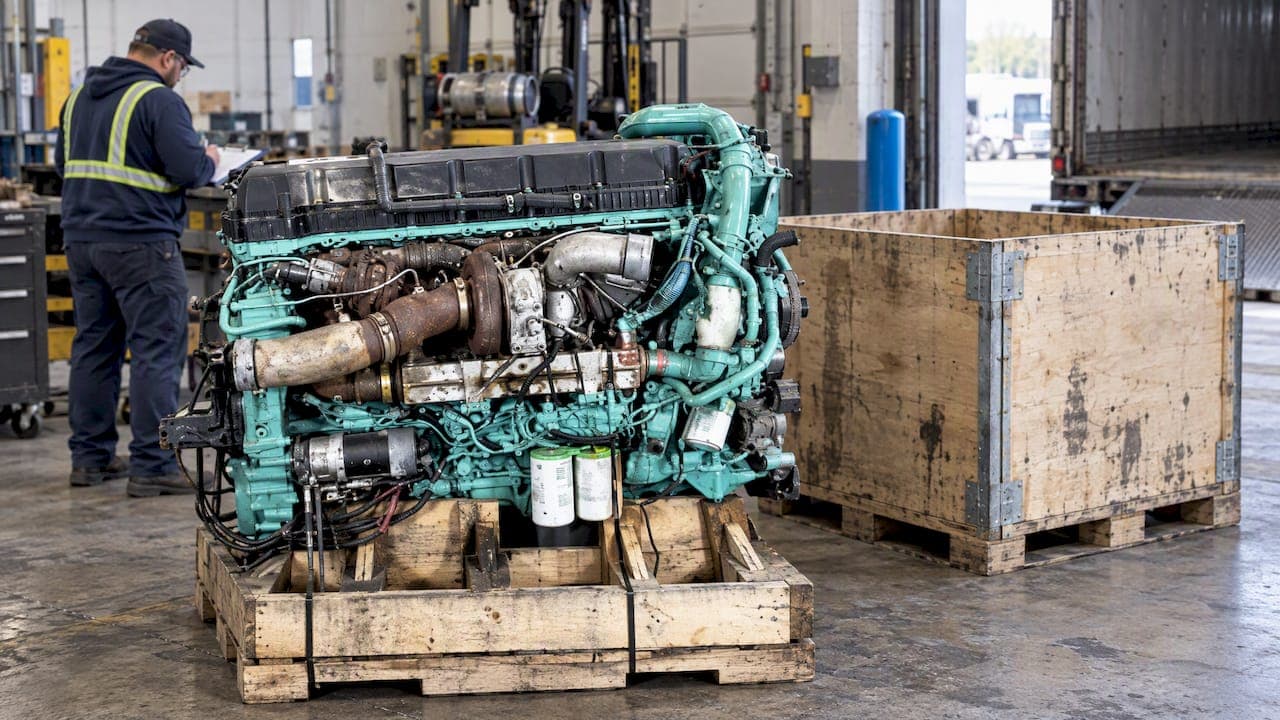
An engine core charge is a refundable deposit added to the price of a replacement engine. You pay it up front, ship your old engine (the "core") back, and get the money back once the seller inspects it and accepts it. If the core is missing, incomplete or too damaged to rebuild, you lose the deposit. That is the whole mechanism. The money is in the details: how long you have, how to pack it, and who pays freight.
This guide walks through each step the way a shop foreman would explain it to a new hire, with the places where drivers and fleets lose refunds called out.
TL;DR
- A core charge is a deposit, not a fee. It comes back when the old engine is returned in acceptable condition.
- Return windows differ by seller. Published policies we reviewed range from 30 days to six months, so read the terms before you order.
- Drain all fluids, keep the engine complete, and ship it in the replacement's packaging with a label. Missing parts are the most common reason for a short refund.
- Expect weeks, not days, for the refund after the core arrives. One published policy puts return and inspection at 30 to 45 days.
- Get the core amount, deadline, freight responsibility and condition rules in writing before you pay.
Table of Contents
- What an engine core charge actually is
- Core charge vs. other fees on your invoice
- How the core return process works, step by step
- Return windows: how long you really have
- What condition the core has to be in
- What happens if the core is rejected, late or missing
- Taxes and bookkeeping for fleets
- Our perspective: where core refunds go wrong
- Replacing an engine without a core headache
- A short checklist before you pay
- FAQ
- Sources
What an engine core charge actually is
A core is the old, rebuildable part you hand back when you buy a replacement. Ford's published policy describes a core as typically a rebuildable part used as a partial trade-in, with the extra purchase charge there to encourage its return and refunded when the core comes back. GMC gives the same logic: certain parts can be recycled and remanufactured, so the charge encourages customers to return the reusable portion of the old part.
For a heavy-duty diesel, the reusable portion is large. Block, heads, crankshaft and other castings and forgings are expensive to make and perfectly good raw material for a rebuild. The deposit keeps those cores moving back into the supply chain instead of into a scrapyard or a back lot.
Two points trip people up:
- The charge shows up on the invoice as a separate line. It is not part of the engine's price, and it is not profit for the seller.
- Not every engine purchase carries one. Remanufactured and rebuilt units almost always do. Whether a used engine does depends on the seller's terms, which is why you ask before you buy rather than after the invoice arrives.
Core charge vs. other fees on your invoice
A core charge sits next to other line items that look similar but behave differently.
| Line item | What it is | Do you get it back? |
|---|---|---|
| Core charge | Deposit tied to returning your old engine | Yes, when the core is accepted |
| Freight or shipping | Cost to move the replacement to you | No |
| Return freight | Cost to ship the core back, usually on you | No, unless the seller says otherwise |
| Warranty fee (if listed) | Extended coverage beyond the standard terms | No |
| Sales tax | Tax on the sale | Depends on state rules, see below |
One number matters more than the rest: the core amount. Sellers set it by engine family and model, and we will not guess at a figure here. It is printed on your quote or invoice, and you should confirm it before you commit. Budget for it as cash tied up for several weeks, because that is how long it can be.
How the core return process works, step by step
The sequence is similar everywhere, even though the details vary. Here is the usual order, using published policies as the guide.

1. Confirm the terms before you order
Ask for four things in writing: the core amount, the deadline, who pays return freight, and the condition standard. If a seller cannot answer all four, treat that as a warning sign about how they will handle your refund.
2. Keep the replacement's packaging
Many sellers want the core shipped back in the container the new engine arrived in. JEGS, for example, says that for engines in the lower 48 states the old unit should be drained, placed in the container the replacement arrived in, and labeled before it goes back. GMC's rule for its parts is similar: the original box, with liquids drained and the part placed in a plastic bag.
If your engine arrives on a crate or pallet, do not break it down and toss it. Photograph it as received, then store it where your shop can reach it when the old engine comes out.
3. Remove the old engine and prepare it
Drain oil, coolant and fuel completely. Cap or plug open ports so nothing leaks in transit. Bag or wrap what you can and strap the engine down so it cannot shift. A leaking core is a freight carrier's problem and a seller's inspection note, and neither helps your refund.
Keep the engine complete. That means everything that was on the block when the seller assumed it was a whole core: heads, oil pan, timing components and any other major assemblies the seller's terms list. Pull accessories only if the policy explicitly says they are not part of the core.
4. Label, document and ship
Put the seller's return authorization or core form on the package, as instructed. Take photos of the engine on the stand or pallet before it is sealed, with serial and model tags visible. Keep the tracking number and the carrier's delivery confirmation.
Moss Motors, which sells to U.S. buyers, states that the core return shipping is the customer's responsibility, and that is the common pattern. Heavy engines are freight shipments, so price the return leg before you decide to keep or return a core.
5. Wait for inspection and the credit
The seller inspects the core, accepts or rejects it, and issues the refund to your original payment method or as account credit. JEGS says the return and inspection can take 30 to 45 days before the refund is issued. Moss says core refunds can take up to 30 days. Plan your cash flow around the longer number.
Return windows: how long you really have
The clock usually starts at invoice, shipment or delivery. Which one matters, because freight on a 600-pound engine does not move in a day.
- GMC requires the core to be received within six months.
- Moss Motors states that cores must come back within 90 days, in the original box, clean, complete, assembled and rebuildable.
Sellers of heavy-duty diesel engines often set tighter windows than a dealer parts counter does, so do not assume six months. Ask whether the deadline is a ship-by date or a received-by date. If it is received-by, ship at least a week early, and longer if the carrier is slow in your region.
If you are mid-job and the old engine is still in the truck, say so to the seller. A short extension requested before the deadline is a very different conversation from one requested after it.
What condition the core has to be in
The inspector is asking one question: can this be rebuilt? GMC pays its full core rebate only if the core passes inspection, is complete with no missing parts, and arrives in the proper box with liquids drained and the part bagged. Moss uses the same language: clean, complete, assembled, rebuildable.
In practice, these are the things that cost drivers and shops money:
- Missing components. A core with a head or major assembly removed is no longer a core.
- Catastrophic damage. A hole through the block, a cracked casting or a failure that sprayed metal through the engine can make it unrebuildable. Our guide to types of commercial truck engine failures explains which failures leave a salvageable block and which do not.
- Wrong engine. Sending back a different model or part number than the one on your invoice gets the core rejected. Match the serial and model tags to your paperwork.
- Contamination and neglect. Fluids left inside, outdoor storage until the block rusts, or an engine left open to the weather all work against you.
Before you pull the engine, check it
Because a damaged core can forfeit your deposit, it pays to know what you have before you take it out. A basic look at the oil, the coolant and the condition of the crankcase tells you a lot. If you buy used and inspect carefully, you apply the same discipline to your own core. Our engine inspection checklist is written for buyers, but the same checks tell you whether the engine you are about to return is going to pass.
What happens if the core is rejected, late or missing
A rejected core gets no credit. Bates Corporation's policy says you can have the rejected core returned at your expense or authorize the seller to dispose of it. Either way, you do not get the deposit back.
A few consequences are worth knowing:
- No return after acceptance. Bates also notes that once a core is accepted and credited, it joins generic rebuilding inventory and cannot go back to the original owner. If you want to keep any parts off your old engine, pull them before you ship it, and only if the terms allow.
- Late cores. Past the deadline, most sellers keep the deposit. Some will take a late core at reduced credit, but that is a courtesy, not a right.
- No core at all. If the engine was scrapped, burned or sold, expect to forfeit the charge. Some sellers offer a no-core purchase at a higher price. Ask for that quote at the start if you know you will not have a core.
If you disagree with an inspection result, ask for the reason in writing and for photos. Your own pre-shipping photos are the evidence that counters a "missing parts" finding.
Taxes and bookkeeping for fleets
Because a core is treated like a trade-in, tax treatment can differ by state. The Washington Department of Revenue explains that returning a used part is treated as a trade-in, which can reduce the taxable value of the transaction. That is one state's rule. Other states may handle it differently, so check your state revenue department or ask your accountant before you assume.
For your books, track the core deposit as a receivable, not an expense, until the seller accepts the core. Then you do not overstate the cost of the repair, and you can see which deposits are still outstanding. A fleet with several engine swaps in a quarter can easily have thousands of dollars waiting on inspections.
Our perspective: where core refunds go wrong
We sell tested used diesel engines, transmissions and differentials, and we see the same pattern across the trade. Refunds rarely fail because of a bad seller or a bad inspector. They fail because of avoidable handling: the engine was stripped, the box was thrown away, or nobody wrote down the deadline.

Three habits fix most of it. First, before you order any engine, new, remanufactured or used, get the core terms in writing and ask about used units specifically, because policies for used and rebuilt engines are not the same. Second, assign one person in the shop to own the core: photograph it, pack it, and track it. Third, price the return freight when you price the engine, so you know whether the deposit is worth chasing on a damaged core.
A used engine can also simplify the equation, because you are buying a tested unit rather than a rebuild that depends on your old block being usable. If you want to see why that matters, our used diesel engine buyer's guide covers how tested used engines compare to rebuilds, and our piece on common diesel repair parts mistakes covers the errors that cost shops the most.
— John
Replacing an engine without a core headache
If you are replacing an engine and want a tested unit with clear terms, start with our used truck engines. Each part we sell is tested and inspected before sale and comes with a standard warranty, and inventory changes daily. We ship same day, so a down truck is not waiting on a slow handoff.

Popular late-model options include the 2015 Volvo D13, the 2015 Cummins ISX15 and the 2015 Detroit DD15. If the problem is further down the driveline, we also stock transmissions, differentials and exhausts. Ask about core terms on any unit before you check out, and we will tell you what applies to the part you are buying.
A short checklist before you pay
Use this before you place an engine order from any seller:
- What is the core amount, and is it on the quote?
- Is the deadline ship-by or received-by, and when does the clock start?
- Who pays freight to send the core back?
- What condition standard applies, and what counts as incomplete?
- How is the refund issued, and how long after the core arrives?
- Does the seller provide a return label or form, or do you arrange the carrier?
- Is the replacement engine compatible with your truck? Confirm that first, using our guide to finding compatible used diesel engines.
If you are still comparing sellers, our guide on how to find a reputable used truck parts supplier lists what to ask. Our used diesel engine buying checklist covers the engine itself, and owner-operators watching their budget may find why independent truckers choose used parts useful in deciding how much repair to buy.
FAQ
How much is an engine core charge?
It depends on the seller, the engine family and whether the unit is remanufactured or used. The amount is set by the seller and listed as a separate line on the quote or invoice, so confirm it before you pay. Do not budget from a forum number, because heavy-duty diesel cores can be a significant amount of money.
How long does the engine core refund take?
Plan on several weeks after the seller receives the core. One published policy says return and inspection can take 30 to 45 days, and another says core refunds can take up to 30 days. Your timeline also includes the freight time to get the core to the seller.
Can I get my core charge back if the old engine is damaged?
Only if it is still rebuildable under the seller's standard. Rejected cores receive no credit, and the seller may return the core at your cost or dispose of it. A cracked block or a catastrophic failure often falls outside the standard, so ask what counts before you ship.
Who pays to ship the core back?
Usually you do. Published U.S. policies commonly put return shipping on the customer, though some sellers provide a label. Get the answer in writing and price the freight, since an engine is a heavy shipment.
Do I have to return a core when I buy a used engine?
Not necessarily. Core requirements depend on the seller's terms for that unit. Ask whether a core deposit applies before you check out, and if it does, ask for the deadline and condition rules at the same time.
Sources
- About Core Charge, GMC Vehicle Support
- Core Return Policy, Ford Parts
- How to return an ATK Engine/Transmission/Differential Core, JEGS Help Center
- Core Return Policy, Bates Corporation
- Returns, Moss Motors
- Core charges, Washington Department of Revenue