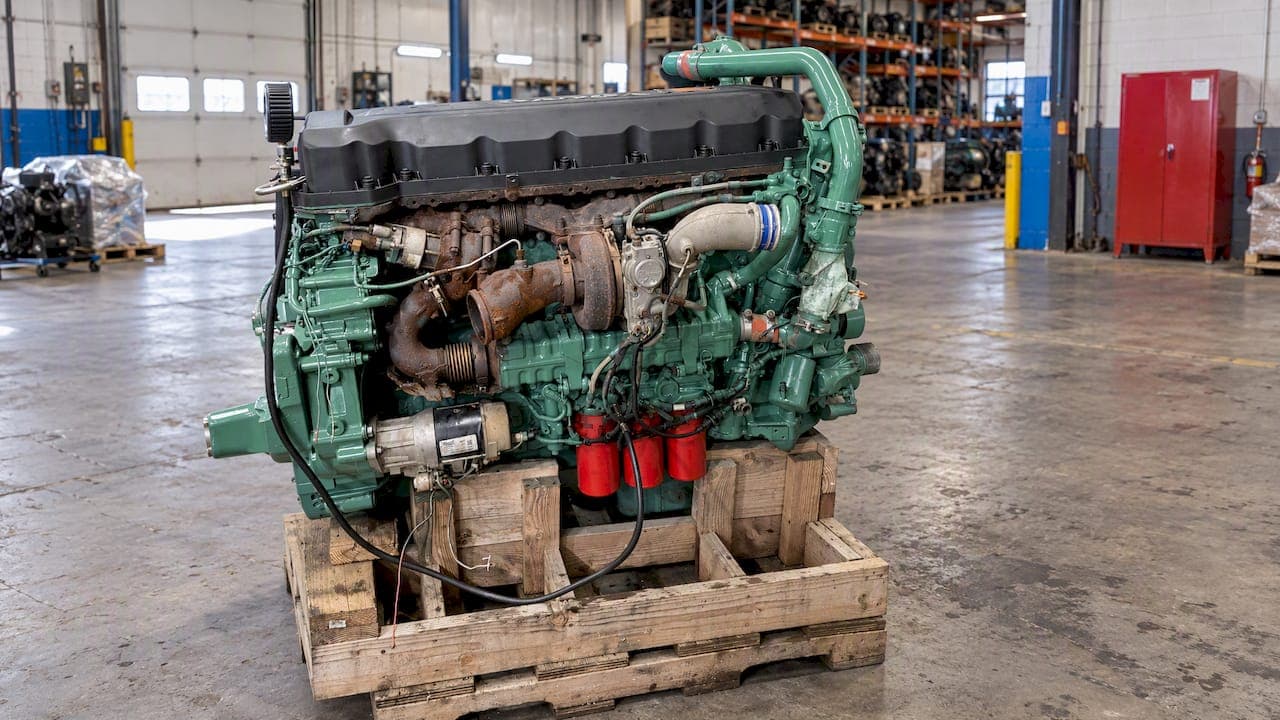
The Volvo D13 is a 12.8-liter inline-six turbo diesel built for heavy-duty on-highway and vocational trucks. If you run one, wrench on one or need to replace one, this guide covers what the engine is, the ratings that matter, the service intervals Volvo publishes, the systems worth watching, and what to verify before you buy a replacement.
TL;DR
- The D13 is a 12.8 L inline-six. Its current ratings run from 405 to 540 hp and 1,450 to 1,950 lb-ft of torque.
- It has been sold in North America since 2007, and the emissions hardware differs a lot between model years, so year matters more than displacement when you order parts.
- Oil change intervals depend on duty cycle and oil type, so follow the Volvo schedule for your engine's emissions generation.
- Most owner headaches start in the EGR, turbo and aftertreatment systems, and most of them announce themselves with codes or coolant and power symptoms first.
- Before buying a replacement, match the engine data plate, rating, emissions configuration and mounting hardware to your truck, not just the model name.
Table of Contents
- What the Volvo D13 is
- Volvo D13 specs at a glance
- Model years and emissions generations
- Service intervals that keep a D13 healthy
- Systems to watch and the symptoms that point to them
- How long does a D13 last?
- Buying a replacement D13: what to verify
- Perspective: why a tested used D13 makes sense
- Find a Volvo D13 for your truck
- FAQ
- Sources
What the Volvo D13 is
The D13 is a 12.8-liter inline-six turbo diesel that Volvo uses in heavy-duty semi-trailer and vocational trucks. It was introduced in North America in 2007 to meet emissions standards of that period, and it has been the core of Volvo's North American powertrain lineup since. Volvo continues to develop it: the next-generation D13 for EPA 2027 is still a 12.8-liter inline-six.
You will find it behind the cab of long-haul tractors such as the VNL, which Volvo describes as engineered for long haul, and in vocational and regional applications. If you want to see where the D13 sits next to other heavy-duty diesels, our overview of types of heavy truck diesel engines gives the wider picture, and our Mack MP8 guide includes a D13 comparison, since the MP8 is the engine most often cross-shopped against it.

Volvo D13 specs at a glance
Volvo's published figures for the EPA 2027 D13 give a good reference point for the platform:
| Spec | Value |
|---|---|
| Displacement | 12.8 L |
| Configuration | Inline six-cylinder, turbocharged diesel |
| Bore x stroke | 5.16 in x 6.22 in |
| Power ratings | 405 to 540 hp |
| Torque ratings | 1,450 to 1,950 lb-ft |
Those numbers come from Volvo's EPA 2027 powertrain page. The same 5.16 in x 6.22 in (131 x 158 mm) bore and stroke appears in Volvo base engine documentation, which also describes a four-valve-per-cylinder, single overhead camshaft design. That consistency in the bottom end is one reason many components carry across years, even while the emissions equipment around the engine changes.
The 2027 engine adds a DOC/DPF and dual SCR chambers to meet the 35 mg NOx standard. Older engines in the field use earlier aftertreatment layouts, which is why you should never assume a part from one year fits another.
Reading horsepower and torque ratings
A 405 hp D13 and a 540 hp D13 share displacement, so the rating, not the engine family, tells you what job the engine was set up for. Higher torque ratings suit heavy loads and grades, while lower ones can suit lighter regional work. If you want to understand how those two numbers relate, see our explainers on diesel engine torque and diesel engine horsepower ratings.
When you replace an engine, keep the same rating family as the original unless the transmission, rear axle ratio and cooling package were built for something different. A mismatch there can leave you with a truck that runs but is poorly matched to its drivetrain.
Model years and emissions generations
The D13 you are looking at depends heavily on when it was built. In broad terms, owners and shops talk about three groups, and Volvo's own maintenance documents split them the same way:
- 2010 to 2016 trucks. Volvo publishes a separate maintenance interval poster for these engines.
- 2017 to 2021 trucks. Greenhouse-gas era engines before the 2022 schedule.
- 2022 GHG and newer. Covered by their own Volvo service-at-a-glance poster.
The practical point: the intervals, the aftertreatment layout and the sensors differ by generation. Always identify your engine's generation first, then pull the matching schedule. Our guide to diesel engine mileage benchmarks can help you decide where your engine sits in its life.
Service intervals that keep a D13 healthy
Volvo ties maintenance to duty cycle. For 2022 GHG and newer engines, oil change intervals range from 35,000 to 75,000 miles, depending on duty cycle and oil type. For 2010 to 2016 trucks, the Volvo interval poster lists DPF cleaning at 400,000 and 250,000 miles, depending on the application.
Three habits matter more than any single number:
- Use the schedule for your year and duty cycle. A truck that idles, pulls heavy loads or runs short stop-and-go routes is not on the same clock as a steady highway tractor.
- Keep oil records. Oil level trends tell you a lot. Our piece on how diesel engine oil consumption works explains what normal looks like and what deserves a closer look.
- Watch the cooling system. Coolant condition and level protect the EGR cooler, head gasket and turbo. See our coolant system guide for what to inspect.
For a wider routine, our article on extending truck engine life as an owner-operator lays out habits that apply to any heavy-duty diesel.
Systems to watch and the symptoms that point to them
No heavy-duty diesel is free of wear items, and the D13 is no exception. Mechanics who work on these engines tend to look at the same three areas first when a truck loses power or throws codes.
EGR system
The EGR cooler routes hot exhaust through coolant. If an internal leak develops, the typical clues are unexplained coolant loss, white exhaust smoke and sometimes a sweet smell. Check coolant level history before blaming something else, and pressure test the cooler per Volvo procedure.
Turbocharger and actuator
The D13 uses a variable geometry turbocharger. Power loss under load, slow boost response or turbo-related fault codes call for checking the actuator and its wiring, along with the heat exposure around it, before condemning the whole turbo.
DPF, SCR and sensors
Aftertreatment faults often come from a sensor or the dosing system rather than the filter. A sensible order of work is to read the codes with Volvo's diagnostic tool, check sensor readings, inspect the dosing injector, and attempt a forced regeneration before replacing a DPF. Volvo's design also builds in protection: the engine shutdown system can derate or stop the engine for critical conditions such as low oil pressure, high coolant temperature or high DPF soot load. Treat a derate as the engine protecting itself and find the cause before resetting anything.

Injectors
Worn injector tips can show up as white or blue smoke, rough idle and misfire codes on a specific cylinder. A cylinder-specific code points you to that injector first.
False codes from airflow changes
The ambient air temperature sensor feeds OBD monitoring, and Volvo notes that blocking airflow with a winterfront can generate false diagnostic trouble codes. If a truck sets odd codes in cold weather after cover changes, check that first.
For a broader look at how failures develop across engines, our fleet guide to commercial truck engine failures is a useful companion.
Keep the engine bay readable
A grimy engine hides leaks. When you clean the engine bay safely, with the engine cool and electrical connectors protected, a fresh coolant or oil weep stands out against clean metal. That makes it much easier to catch an EGR, hose or gasket issue before it turns into a shutdown condition.
How long does a D13 last?
Service life depends on duty cycle, oil and coolant discipline, load, idle time and how early problems get addressed. Volvo does not give a single promise that fits every truck, so judge your own engine by its records: oil analysis, coolant history, fault code trends and compression or blow-by checks at overhaul time. A D13 with documented maintenance and a clean code history is a very different asset from one with gaps in its records, whatever the odometer says.
The same logic applies when you buy used. Records, a tested engine and a warranty matter more than mileage alone.
Buying a replacement D13: what to verify
Before ordering a used or remanufactured D13, confirm these items against your truck:
- Engine serial and data plate. Record the full engine serial number and model designation from the plate on the engine, and compare it with the replacement.
- Model year and emissions configuration. Aftertreatment, sensors and wiring differ by generation. Match the year range of your truck.
- Horsepower and torque rating. Keep the rating consistent with your transmission and axle setup.
- Accessories you are moving over. Decide whether you need the engine long block only, or with turbo, injectors, EGR parts and harness, and confirm what is included.
- ECM and software considerations. Ask a Volvo-capable shop how the replacement engine's control module data will be matched to your truck.
- Testing and warranty. Confirm the engine has been tested and what the warranty terms cover.
- Mounting and ancillaries. Check flywheel housing, bell housing, and cooling and exhaust connections against the original.
If you are replacing more than the engine, you may also be looking at drivetrain parts. We stock transmissions, differentials and exhausts as well. If your engine has failed at a high mileage, our guide to breaking in a fleet diesel under load covers how to treat the replacement during its first hours.
Perspective: why a tested used D13 makes sense
We talk with owner-operators and fleet managers every day who need a truck back on the road without a new-engine price tag. In our experience, the best answer is often a used D13 that has been tested and inspected before it ships, and that comes with a standard warranty.
What we focus on is matching. A D13 is only the right engine if its year, rating and configuration fit the truck it is going into. That is why we encourage buyers to send us the data plate details first, so the engine, and any related parts, line up before the order is placed.
Our inventory changes daily, and we offer same-day shipping, because downtime costs more than almost any part. For a logistics company with a truck sitting, speed and a tested engine beat a long wait for a new one. We design our process around that reality.
John
Find a Volvo D13 for your truck
We sell used heavy truck engines that are tested and inspected, with a standard warranty and same-day shipping. Browse our current D13 listings, such as this 2015 Volvo D13 500 HP engine, the 2012 Volvo D13 or the 2017 Volvo D13 S857.

To see everything we have in stock right now, go to our truck engines page. Inventory changes daily, so have your engine data plate ready when you check.
FAQ
What are the main Volvo D13 specs?
The D13 is a 12.8-liter inline-six turbo diesel with a 5.16 in x 6.22 in bore and stroke. Volvo lists EPA 2027 ratings from 405 to 540 hp and 1,450 to 1,950 lb-ft of torque. Earlier model years have different ratings and emissions equipment, so check your own engine plate.
How often should I change oil in a D13?
It depends on the engine's generation, duty cycle and oil type. For 2022 GHG and newer engines, Volvo's schedule lists intervals from 35,000 to 75,000 miles. Use the Volvo interval chart for your model year rather than a single number.
What does a D13 derate mean?
Volvo's engine shutdown system can reduce power or stop the engine for critical conditions such as low oil pressure, high coolant temperature or high DPF soot load. Read the active codes with the proper diagnostic tool and fix the cause before returning to service.
Is the D13 the same in every model year?
No. The block dimensions are consistent, but emissions hardware, sensors and ratings vary by generation. Always match year, rating and configuration when ordering a replacement engine or parts.
Sources
- Volvo D13 overview
- Volvo EPA 2027 powertrain and next-generation D13
- Volvo base engine specifications
- Volvo service at a glance, 2022 GHG and newer
- Volvo maintenance intervals, 2010 to 2016
- Volvo body builder instructions, engine section (2026)
- Volvo body builder instructions, engine section (2025)